
Date:2026-07-30
Who this is for: graduate students, early-career researchers and AI practitioners with an engineering background
Keyword: Ablation study, control variables, negative results, mechanism interpretation, reproducing experiments
Abstract
Ablation study is often translated as "Ablation study", but the Ablation in many papers is actually just "remove the module, and the score can't be dropped". This approach can make up a table, but it may not be able to answer scientific questions. Truly valuable Ablation, is to disintegrate the core proposition in the paper into a falsifying hypothesis: if a module, training target, data filtering rule or reasoning strategy is really important If, then, after controlling for other factors, remove, replace, weaken or disturb it, it should have an interpretive, repeatable, and consistent direction.
Ablation studies are a basic research skill. Start by listing the variables in a method diagram, then define the full model, a minimal baseline, and four kinds of ablation: remove, replace, perturb, or scale. Account for random seeds and statistical significance, consider what a negative result contributes, and ask whether a change in performance supports a mechanistic explanation. AbGen and AblationBench in 2025–2026, alongside NeurIPS 2026’s emphasis on negative results and reproduction studies, show why designing an ablation deserves attention in its own right.
Contents
- Why Ablation Study Is Important
- From the paper claim to the ablation hypothesis
- Four common ablations: remove, replace, perturb, scale
- Control variables: don't let the experimental table lie to you
- Why Negative Results Are Valuable
- From score down to mechanism interpretation
- Representative paper and data road map
- Method/Experimental Comparison Table
- Re-reality exercise list
- Common Misunderstandings and Postgraduate Selection
- References
Why is this topic important
The approach to AI papers is increasingly complex: a LLM method may contain both data filtering, Prompt templates, preference optimization, Retriever, Planner, Verifier, sampling strategy, reranker and dedicated BENCHMARK; a multimodal method may simultaneously modify the visual encoder, projection layer, training stage, instruction data and evaluation protocol. The main experimental table can only tell you "how the final system performs on some Benchmarks", but it is difficult to tell you "what is the part that makes it effective".
This is the core position of the Ablation Study: it is responsible for dismantling the "system effective" into "what factors are effective, under what conditions, and why it may be effective". For graduate students, the ablation ability directly corresponds to three things:
- When reading a paper, it is not led by the complex method map, but can identify the real cause and effect proposition.
- When reproducing the paper, the deviation of the results can be judged from the implementation of details, data processing, and randomness, or the original paper advocates that it is unstable.
- When doing follow-up, you can find new research questions from failures, boundary conditions and mechanism conflicts.
AbGen (2025) benchmarks how well LLMs design ablation studies. It contains 1,500 expert-annotated examples from 807 NLP papers and assesses designs for importance, faithfulness, and soundness. AblationBench, updated in 2025–2026, gives AI research agents two tasks. AuthorAblation asks them to propose an ablation plan from a methods section. ReviewerAblation asks them to read a full paper and identify missing ablations. Together, these benchmarks treat experimental design as an aspect of research judgment that can itself be evaluated.
From the paper claim to the ablation hypothesis
The first step in doing ablation is not to start the experiment, but to write the paper advocate into a sentence. The assumption of an ablation usually looks like this:
Under the condition of fixed model size, training data, training steps, evaluation set and decoding strategy, module X improves the indicator y on task T through mechanism M; if x is removed or replaced, the indicator y should decrease, and the related intermediate phenomenon z should be changed synchronously.
There are five parts in this sentence:
X: Ablation object, which can be a module, loss, data source, prompt, retrieval strategy, training stage or reasoning budget.T: Tasks, don't just write "improvement ability", you should be specific to mathematical reasoning, long-context question and answer, code generation, medical report generation, etc.Y: Main indicators, such as accuracy, pass@k, BLEU, ROUGE, f1, win rate, human preference or cost-normalized metric.M: The mechanism explains why X will help the model, and it is easy to become a pure experience stack without writing a mechanism.Z: Auxiliary evidence, such as error type, search hit rate, Verifier pass rate, token usage, gradient stability, calibration error, repeated running variance.
Many failures of Ablation Study, because it only checks Y, no pre-declaration M and Z. For example, a tool invokes a paper that the Planner module can improve the success rate of complex tasks. If only the overall score of "Without Planner" is reported, it is not enough. A better design should be checked at the same time: whether the task is really decomposed into more executable sub-steps, whether the tool call failure rate has declined, and whether the error has shifted from the "wrong tool" to the "tool result interpretation error". In this way, the ablation has changed from a "performance table" to a "mechanism audit".
Four common ablations
1. Remove: Remove Components
The most common ablation is full model Compared w/o X. The advantage is intuitive, and the disadvantage is that it is easy to confuse "components themselves are important" and "systems are degraded due to interface damage". If the Input length is also shortened, the number of training steps is reduced, and the inference cost changes after removing Retrieval, then the decline cannot be directly attributed to Retrieval.
Objects suitable for remove include independent modules, additional lost, training data subsets, post-processing rules, verifier, memory buffer, etc. The key is to have a reasonable alternative path after removal, and the model cannot enter an abnormal state that will not appear.
Replace: Replace with weak but reasonable version
Sometimes w/o X Too rude, the better question is whether X is better than a simple alternative. For example, Replace the learned retriever with BM25, the complex reranker with an embedding similarity, the agent planner to a fixed template, and the RLHF to be replaced with SFT-only. Replace Ablation is closer to the reviewer's real concern: whether your complex design is necessary or a simple baseline is enough.
3. Perturb: Disturbance component or input
Perturb Ablation is suitable for validation mechanisms. Such as disrupting the order of the Retrieved Documents, randomly replacing memory entries, disturbing the reasoning instruction in the Prompt, the masking image area, the scrambling tool returning content, giving the Verifier Enter incorrect evidence. If the paper claims that the model relies on some kind of structural information, then structural disturbances should be more damaging than semantic independent disturbances.
4. Scale: Change strength or budget
Many AI methods are not switching variables, but continuous variables: the number of top-k, CoT sample, test-time compute, LoRA rank, MoE expert, data filter threshold, temperature, training token budget. Scale Ablation can answer "whether the effect varies with dose". Mechanism interpretation is usually weak if only one supersuper is won; if there is a steady trend as the budget increases and it holds after cost normalization, the evidence is stronger.
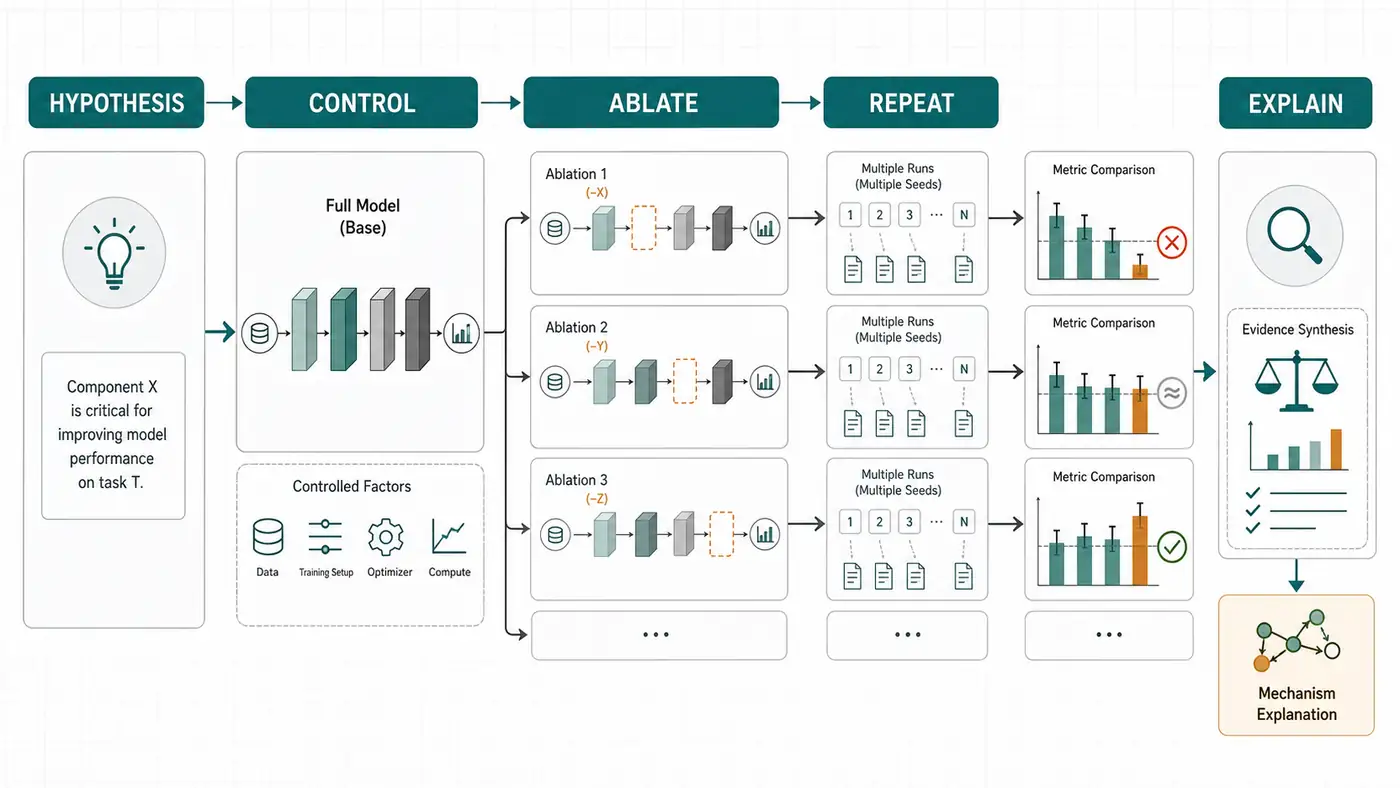
Control variables: don't let the experimental table lie to you
The most error-prone part of Ablation Study is not code, but experimental fairness. You think you have only changed one module, but you may actually change the training time, input length, parameter amount, randomness and early stopping selection criteria at the same time.
A reliable ablation table should at least fix these variables:
- Data: training/validating/testing division, filtering rules, deduplication strategies, feed-shot examples, retrieval library versions.
- Model: Base CheckPoint, parameter quantity, tokenizer, adapter configuration, freezing/thawing range.
- Training: batch size, learning rate, scheduler, warmup, training steps, gradient accumulation, optimizer, precision settings.
- Inference: Temperature, top-p, beam/search budget, max tokens, upper limit of tool calls, retrieval top-k.
- Selection: Checkpoint selection basis, whether to use validation best, whether to do multiple SEEDs, whether to report the mean and variance.
- Environment: CUDA/cuDNN, inference framework, hardware, parallel policy, quantization settings.
Reproducibility CheckList of ACL-IJCNLP 2021 has long requested to report training/evaluation runs, hyperparameter boundaries, selection criteria, mean variance, data division and preprocessing. ICLR 2026 also continues to encourage Reproducibility Statement, and requests to point reproducing materials such as code, certificate, and data to the main text, appendix or supplementary material. For those who do ablation, these are not the requirements of the submission format, but the minimum defense of experimental design.
A practical principle is: each ablation variant is written as a "diff". For example:
| mutant | Change | must remain the same | Mainly answered questions |
|---|---|---|---|
| Full | Complete configuration of the original method | All conditions | What is the upper limit of the system |
| w/o verifier | Remove Verifier, direct output | Data, Model, Decoding Budget | Has Verifier contributed quality control? |
| BM25 retriever | Replace Dense Retriever | TOP-K, context length, generator | Is Dense Retriever necessary? |
| shuffled evidence | Sorting the sequence of evidence | Evidence collection, token length | Whether the model depends on the structure of evidence |
| top-k sweep | k=1/3/5/10 | Other reasoning parameters | Whether the performance changes steadily with the search budget |
If this diff table is not clearly written, the experimental table is usually not explained clearly.
Why Negative Results Are Valuable
Many students are afraid of negative results: the module has not changed the score, the complicated method is not as simple as the baseline, the improvement disappears after the dataset is changed, and the cost of the test-time compute is increased faster than the performance after the increase of the test-time compute. In fact, these are the most important signals of scientific research.
NeurIPS 2026 explicitly lists Negative Results as Main Track Contribution Type, and MLRC in 2026 Relevant explanations emphasize that as long as the control is rigorous and recorded clearly, it is a valuable scientific contribution. For Ablation Study, Negative Results have at least four meanings:
- Redundancy: Module X may be replaced by other modules, and the system has overlapping functions.
- conditional dependency:x is only useful under certain data sizes, task difficulty or reasoning budgets.
- Implementation dependencies: The effect of X comes from unreported parameter, checkpoint selection, or data processing details.
- Mechanism error: The mechanism of the paper interpretation M does not hold, even if the total score sometimes rises.
Classic "Understanding Deep Learning requires Rethinking Generalization" It is a good example of negative results training: it does not propose a higher score Model, but challenges the common sense of "explicit regularization to explain generalization" through systematic experiments. 2025 "A Sober Look at Progress in Language Model Reasoning" The Progress of mathematical Reasoning has also been put back into the transparent, stable and statistical evaluation framework, and pointed out that many gains are sensitive to decoding parameters, SEED, prompt format, hardware and software configuration. Such a paper reminds us that the negative result is not "not done", but to turn the claim of instability into a checkable boundary.
From score down to mechanism interpretation
The most common way to write the ablation table is:
| Method | Score |
|---|---|
| Full | Highest |
| w/o X | Decline |
| w/o Y | slightly down |
This table only supports one weak conclusion: x may have contributed. It cannot automatically support "x functioning through a mechanism". To go to the interpretation of the mechanism, three types of evidence need to be supplemented.
The first category: evidence of intermediate variables. If you claim that Retriever is boosting Factuality, don't just look at the final QA Accuracy, but also look at the retrieval hit rate, reference coverage, answerable rate, and error attribution. If you claim that Process Supervision improves inference, look at step-level errors, verifier acceptance, search tree depth, and error propagation.
The second category: counterfactual evidence. Instead of just removing x, it is replaced with x of different properties. For example, random retrieval, oracle search, low-quality retrieval, and scrambling sequence search correspond to different mechanism assumptions. If the Oracle retrieval is greatly improved and the Learned Retriever does not improve, the problem may be in Retriever ; if high-quality evidence is still invalid, the problem may be in the way the generator uses evidence.
The third category: evidence of boundary conditions. Observe separately under simple samples, difficult samples, long contexts, cross-domain data, low resource settings, and different model scales. The real mechanism interpretation is usually not "X is always useful", but "X is useful when a certain type of bottleneck occurs, and it is not valid under another type of bottleneck".
2019 "Ablation Studies in Artificial Neural Networks" starts from the Ablation tradition of neuroscience, which links structural damage, redundancy and recovery training in Artificial Neural Networks. It reminds us that Ablation is not just a service for submission tables, but also as a tool to understand the internal representation and robustness of the model. 2019 Lottery Ticket Hypothesis It can also be used as a reading object for mechanism experiments: pruning is not just a compression technique, but a series of experiments around initialization, subnetwork and trainability convert "which connections are important" into testable assumptions.
Representative paper and data road map
classic base line
- 2016/2017: Zhang et al.'s "Understanding Deep Learning require needs". Learning focus: How to challenge mainstream interpretation through control experiments, rather than just pursuing higher indicators.
- 2018/2019: "Lottery Ticket Hypothesis" by Frankle and Carbin. Learning focus: From pruning experiments to the mechanism hypotheses about initialization and trainable subnetworks.
- 2019: "Ablation Studies in Artificial Neural Networks" by Meyes et al. Learning focus: Ablation as a tool for analytical structure, redundancy and robustness.
Reproduction and Evaluation Specification Line
- ACL-IJCNLP 2021 Reproducibility CheckList: The learning focus is on the number of runs, hyperparameter range, selection criteria, mean variance, and data processing.
- ICLR 2026 Author Guide: Learning focuses on how Reproducibility Statement references code, data processing, theoretical proofs, and supplementary materials.
- AAAI-26 Reproducibility Checklist: The learning focuses on basic verification of theoretical claims, experimental code, data motivation and data availability.
- NeurIPS 2026 Evaluations & Datasets Reviewer Guidelines: The learning focuses on reviewing standards for reviewing protocols, tools, data audits, and negative results.
2025-2026 New Trend Line
- AbGen: Make the Ablation Study Design into a LLM scientific research ability evaluation. Its importance is not to "let the model design experiments for you", but to dismantle the importance of human scientific research such as importance, Faithfulness, and Soundness into a dimensionable dimension.
- AblationBench: Evaluate the automatic ablation plan from the author and reviewer two perspectives. The latest version of arXiv V3 was updated on 2026-06-01, and the paper page links Hugging Face data and GitHub code. It is useful for graduate students: you can use it in reverse to train yourself to find missing experiments from the method section.
- A Sober Look at Progress in Language Model: Suitable for learning why SEED, prompt, decoding and environmental differences change conclusions.
- 100 Days After DeepSeek-R1: Suitable to see how Reasoning Model reproduction research can find reproducible experimental paths around SFT, RLVR, data construction and training recipes.
Method/Experimental Comparison Table
| ablation target | Recommended design | Strength of evidence | Common risks |
|---|---|---|---|
| Proof module is useful | Full vs w/o module, while maintaining input length and training budget |
In | Fake destruction caused by interface damage |
| Essential to prove complex modules | Compare with simple alternatives, such as BM25, Fixed Prompt, SFT-only | High | baseline lack of tuning |
| The certification mechanism was established | Add intermediate indicators and structural disturbances | High | Just look at the total score, not the error type |
| Prove that the trend is stable | Multiple SEED, multiple datasets, budget SWEEP | High | High calculation cost, easy to selectively report |
| Interpret negative results | Report failure conditions, logs, error analysis | High | Written as "experimental failure" rather than scientific conclusion |
Re-reality exercise list
When reproducing the ablation of a paper, you can advance in the following order.
Step 0: First reproduce the full model or the main experiment. Don't come up and do ablation at once. First confirm that the original configuration, data version, checkpoint, evaluation script and main indicator can run through. If the main experimental deviation is very large, the ablation results have no explanatory force.
Step 1: Draw the variable diagram. The method is divided into input, model, training objective, data processing, inference strategy, and evaluation protocol. Each node is marked with "removable, replaceable, disturbable, adjustable intensity".
Step 2: Write the Hypothesis log. Write the expected direction, expected mechanism, and possible reasons for failure before each ablation. Don't wait for the results to come out before explaining.
Step 3: Create a configuration matrix. Save each variant with YAML, JSON, or experimental management tools. Only one key field is changed in the configuration file, and other fields inherit the base config.
Step 4: Fixed randomness but don't be superstitious about single SEED. Record SEED, framework version and hardware; at least 3 SEEDs for higher-risk experiments. The LLM inference task also fixes the Sampling parameters, the prompt template, the batching and stop tokens.
Step 5: Save the original output at the same time. For generative tasks, only saving aggregate scores is not enough. To save Prompts, Model Outputs, Tool Traces, Retrieved Docs, Judge Inputs, Judge Outputs, and failed samples.
Step 6: Look at Sanity Check first. If w/o X Higher than the full model, don't rush to write a surprise conclusion. First check if full model overfitting, x introduce noise, evaluate script cache errors, or two variants use different checkpoints.
Step 7: Write Negative Result Note. Even if the experiment does not support the null hypothesis, it is necessary to record: which conditions are fixed, run several times, what is the direction of the results, what is the most likely explanation, and how the next step is to distinguish these explanations.
Step 8: Form a mechanism diagram. The final graph should not be just a histogram, but should show the chain of "Assumption-Intervention-Observation-Explanation". The text flow chart can help readers understand research contributions more than a simple score table.
Common misconceptions
Misunderstanding 1: W/O all modules is called complete ablation. The real problem is not "what will happen to each module to be deleted", but "what necessary conditions the paper advocates depend on". Some modules are suitable for remove, and some are better for replace or perturb.
Misunderstanding 2: Do not adjust the baseline, only adjust the full model. If the full model has a large number of parameters, and the ablation baseline uses the default parameters, the drop may just be unfair. Complex methods, especially give strong baselines enough budget.
Misunderstanding 3: Only report improvement, not variance. In small Benchmark, LLM Judge, and open build tasks, the difference in a single run may be enough to change the conclusion. There is no SEED and variance ablation table, and the strength of the evidence is very limited.
Misunderstanding 4: Hide the negative results in the appendix. If negative results change the understanding of the method, it should enter the main text narrative. A module is only effective at a specific data scale, more honest than "Module is generally effective" and more likely to inspire follow-up research.
Misunderstanding 5: Use the ablation as a review patch. Ablation should enter the experimental plan at the beginning of the method design. When the reviewer asks and then adds it, it is often found that the log is missing, the configuration cannot be tracked, and the calculation budget is not enough.
Research questions for graduate students
- Ablation quality rubric for LLM papers: Build a set of Ablation quality scoring tables for LLM papers to distinguish remove, Replace, Perturb, Scale and mechanism evidence.
- Seed sensitivity audit: Select a popular Reasoning or Agent Benchmark, and systematically evaluate the impact of SEED, prompt, decoding and framework versions on the conclusion of the ablation.
- Negative ablation report collection: Collect the recurrence report of "complex modules not bringing stable benefits" to analyze which negative results are most easily ignored by the paper narrative.
- Ablation planner assistant: Based on the task form of AblationBench or AbGen, make a tool to assist graduate students to generate the Ablation plan, but focus on evaluating Faithfulness and Soundness, rather than just looking at the number of generated generations.
- Mechanism-aware ablation for RAG or agents: Not only look at the final answer accuracy, but also include the search hit rate, tool call trajectory, error propagation path and judge deviation into the mechanism interpretation.
Summary
The essence of Ablation Study is not to "delete the module", but "check scientific research propositions with controlled intervention". A good Ablation table should answer three levels of questions: first, whether a component has a stable effect; second, whether this effect is better than a simple alternative; third, whether the observed change conforms to the mechanism claimed by the paper. Negative results, variances, failure examples and boundary conditions are not noise, but materials that form research and judgment.
For the intensive reading and reproduction training of AI papers, ablation is a threshold from the reader to the researcher. When reading the paper, ask "how should this claim be overturned by ablation"; recurrently ask "do I only change one variable"; when writing follow-up, ask "Which negative result exposes a deeper question". Being able to answer these questions stably is more important than memorizing a few more paper abstracts.
References
Search date: 2026-07-30.
- Yilun Zhao et al., “AbGen: Evaluating Large Language Models in Ablation Study Design and Evaluation for Scientific Research,” arXiv:2507.13300, submitted 2025-07-17, ACL 2025. https://arxiv.org/abs/2507.13300
- Talor Abramovich and Gal Chechik, “AblationBench: Evaluating Automated Planning of Ablations in Empirical AI Research,” arXiv:2507.08038, submitted 2025-07-09, latest version v3 on 2026-06-01; AI4Science Workshop, ICML 2026. https://arxiv.org/abs/2507.08038
- Hugging Face dataset page, “ai-coscientist/researcher-ablation-bench,” dataset for AblationBench with repository link and dataset structure. https://huggingface.co/datasets/ai-coscientist/researcher-ablation-bench
- Richard Meyes, Melanie Lu, Constantin Waubert de Puiseau, Tobias Meisen, “Ablation Studies in Artificial Neural Networks,” arXiv:1901.08644, 2019. https://arxiv.org/abs/1901.08644
- Chiyuan Zhang, Samy Bengio, Moritz Hardt, Benjamin Recht, Oriol Vinyals, “Understanding deep learning requires rethinking generalization,” arXiv:1611.03530, ICLR 2017. https://arxiv.org/abs/1611.03530
- Jonathan Frankle and Michael Carbin, “The Lottery Ticket Hypothesis: Finding Sparse, Trainable Neural Networks,” arXiv:1803.03635, ICLR 2019. https://arxiv.org/abs/1803.03635
- Andreas Hochlehnert et al., “A Sober Look at Progress in Language Model Reasoning: Pitfalls and Paths to Reproducibility,” arXiv:2504.07086, accepted to COLM 2025, latest arXiv version checked 2025-10-06. https://arxiv.org/abs/2504.07086
- Chong Zhang et al., “100 Days After DeepSeek-R1: A Survey on Replication Studies and More Directions for Reasoning Language Models,” arXiv:2505.00551, latest version v3 on 2025-05-15. https://arxiv.org/abs/2505.00551
- ICLR 2026 Author Guide, reproducibility statement and code/supplementary guidance. https://iclr.cc/Conferences/2026/AuthorGuide
- NeurIPS 2026 Evaluations & Datasets Reviewing Guidelines, sections on reproducibility, auditing, stress-testing, code artifacts and negative results. https://neurips.cc/Conferences/2026/EvaluationsDatasetsReviewerGuidelines
- NeurIPS Blog, “2026 Conference” category page, MLRC 2026 and contribution type notes mentioning negative results and reproducibility. https://blog.neurips.cc/category/2026-conference/
- AAAI-26 Reproducibility Checklist. https://aaai.org/conference/aaai/aaai-26/reproducibility-checklist/
- ACL-IJCNLP 2021 Reproducibility Checklist. https://2021.aclweb.org/calls/reproducibility-checklist/