
Date:2026-07-29
Who this is for: graduate students, early-career researchers and AI practitioners with an engineering background
Goals of this article: Organize the scattered experimental records into an auditable reproduction report, and then translate it into a Chinese technology blog that is helpful to readers.
Abstract
Many papers have failed to reproduce, not because the experiment itself has no value, but because the recording method is too similar to the "personal account": the environment is installed today, the bug is changed tomorrow, and the day after tomorrow, I will run a score, and finally write a sentence "no reproduction success". This kind of notes has short-term help for oneself, but it is difficult for tutors, classmates or later readers to judge: Which claim are you repeating the paper? Which author workpieces are used? Which configurations are consistent with the original paper? Where are your own alternatives? The difference in the results comes from resource limitations, implementation errors, randomness, evaluation scripts, or the paper advocates that it is unstable?
Reproduction reports gained prominence in 2025–2026. MLRC 2026 became an official NeurIPS track and explicitly recognized reproduction, replication, generalizability studies, meta-reproducibility, and AI-assisted reproducibility as publishable contributions. ReproEvalCard at ACL 2026 identifies evaluation artifacts needed to reproduce modern LLM pipelines, including prompts, judge configurations, retrieval snapshots, and intermediate traces. OpenAI’s PaperBench breaks the work of turning a paper into a runnable experiment into tasks that can be scored individually with a hierarchical rubric. Reproduction notes can thus serve as a record of the evidence behind a research result.
This article gives a set of writing methods for graduate students: first write the claim map, then write artifact audit, then maintain the run logbook, and finally reproduction report into a blog draft. The core principle is: blogs can have narratives, but the bottom layer must have reports; the conclusions can be concise, but the chain of evidence cannot be broken.
Contents
- Why can't I wait until the end of the experiment to write the reproduction notes?
- Three kinds of documents: experimental log, reproduction report, blog draft
- Define the reproduction scope before writing
- Seven core modules of Reproduction Report
- The five-step process of translating from report into a blog
- Representative data and writing roadmap
- Comparison table of method and experimental record
- Actionable checklist
- Common misconceptions
- Research questions for graduate students
- Summary
- References
Why can't I wait until the end of the experiment to write the reproduction notes?
Reproducing notes are most easily misunderstood as "summary after the experiment is completed". This causes three problems.
First, a lot of key information is only visible at the moment of the experiment. For example, the repository commit you used when you ran through the code for the first time, the revision when the data was downloaded, the version that depended on automatic parsing, the error in a failed operation, and the raw output when the indicator was abnormal. If it is not recorded on the spot, it will be difficult to restore after a few weeks.
Second, the reproduction conclusions often depend on negative results. Of course, whether the main table of the paper can be reproduced is of course important, but "which step can't run" It will also swallow abnormal samples" is also evidence. The official statement of MLRC 2026 emphasizes that negative results and partial reproduction failures also have scientific value.
Third, blog writing requires a stronger structure than a personal log. Readers will not care about all your installation details, but will care: Is the proposition of this paper worthy of trust? If I'm going to keep doing this, what pits should I avoid? If I reproduce with smaller resources, which experiments are the most worthy of running? This requires you to organize materials by pressing "What will readers ask in the future" during the experiment.
Therefore, the reproduction notes should be written from the first day. It is not the final packaging, but a part of the reproduction of the experiment.
Three kinds of documents: experimental log, Reproduction Report, blog draft
It is recommended to split the reproduction writing into three layers, not mixed in one file.
experiment log Face yourself and record the facts. It can be rough, but it must be timely: commands, configuration, commit, data version, error report, modification, GPU time, SEED, RAW output, metric file path. The experimental log does not pursue literary talent, but pursues traceability.
Reproduction report For reviewers, record the chain of evidence. It wants to answer: what is the reproduction range? How to dismantle? Which workpieces are available? How is the method implemented? How are the results compared? What conclusions are confirmed, partially confirmed, unable to confirm or cannot be judged? Its reader may be a tutor, course assistant, reviewer or future self.
Blog draft For a wider range of research readers, record transferable experiences. It should not be filled with all the logs, but should make the key path clearly: why choose this paper, how to dismantle claim, what evidence is encountered in the reproduction, how the result affects your understanding of the method, and what research can be done next.
These three layers of relationship are: the log provides raw evidence, the report forms an audit conclusion, and the blog is responsible for teaching expression. Don't jump directly from the log to the blog, otherwise the article will easily become "step on the pit diary"; also don't just write the blog and don't leave the report, otherwise the conclusion will lack a verifiable base.
Define the reproduction scope before writing
Before formally writing a report, first define the scope in one sentence:
This reproduction tests claim C in paper P. On dataset D, with split S, metric M, model or method A, baseline B, training or inference budget R, and environment E, does A produce the direction or magnitude of the result reported in the paper?
Spelling out the scope may seem cumbersome, but it removes much of the ambiguity from a reproduction report. “We reproduced a RAG paper” is too broad. A reader can audit a more precise statement: “We reproduced the EM/F1 gains reported in Table 2 for method X over BM25 + FiD on the HotpotQA distractor split. Because the original retrieval index was unavailable, we used the index snapshot released by the authors.”
The reproduction range can be divided into four categories:
| Types of | Target | What conclusion is suitable for writing |
|---|---|---|
| Exact reproduction | Rerun the main result with author code, data and configuration | "Under the same workpiece, the main result can be/non-repeatable" |
| Partial reproduction | The key workpiece is missing or the resources are insufficient, and only the subset is reproduced | "On the restricted setting, directional evidence supports/not supported claim" |
| Independent reimplementation | Without author code, independent implementation methods | "Whether the paper description is sufficient to support a third party implementation" |
| Replication / generalization | Change data, model, hardware or task test | "Claim can be generalized to new settings" |
Many graduate programs are actually partial reproduction or independent reimplementation, but write "reproduction of a certain paper" in the title. This will exaggerate the conclusion. A better way to write is to write the scope clearly: which table, which claim, and which group of ablations are reproduced; why the parts that are not reproduced are not done.
Seven core modules of Reproduction Report
1. Reproducibility Summary
The first page of the report recommends keeping a fixed summary. The ML Reproducibility Challenge 2022 of the Papers with Code organization has requested that the homepage of the report includes Scope, Methodology, results, What was easy, what was difficult. This template is very suitable for training, as it forces the author to compress the recreation contribution into a readable evidence summary.
The following Chinese version can be used:
| Field | What to write | Don't write anything |
|---|---|---|
| Scope of reproducibility | Reproduce which claim, table, graph or experimental settings | "Recover the whole paper" |
| Methodology | Use the author code or rewrite, where did you change it? | "Reference paper realization" |
| Results | The direction, numerical value, variance and difference of the results of the paper | Just write "basics" |
| What was easy | The part of the author workpiece to reduce the cost of reproducing | polite compliment |
| What was difficult | Lack, ambiguity, resource limitation, environmental issues | blame the author for all failures |
| Communication | Whether to contact author, issue, email or discussion area | hide the key source of clarification |
| Verdict | Confirmation, partial confirmation, not confirmed, inability to judge | Binary "success/failure" |
The abstract is not an introduction. It should let the reader know the scope and credibility of this reproduction in one minute.
2. Original Claims
The reproduction report must be split into a numbered list. Each CLAIM corresponds to the source of evidence, such as an abstract of the paper, an introduction to the contribution paragraph, a method chapter, a table, a figure, an appendix or a project page.
Recommended format:
Claim 1: 方法 A 在 benchmark D 上优于 baseline B。
Evidence in original paper: Table 2, Section 4.1.
Reproduction target: rerun official evaluation with released checkpoint.
Status: tested / partially tested / not tested.
Note that claim is not equal to the Chinese translation of the paper contribution point. It must be tested by experiments. If a claim is written as "the method is very effective", it means that it has not been dismantled in place; it should be changed to "under the X data set, y metric, and z baseline, the result direction of method A is better than b".
3. Artifact Inventory
Artifact Inventory is the skeleton of the report. It answers "Can the reader rebuild your experimental scene".
At least record:
- Papers PDF, OpenReview/arXiv/ACL Anthology/Proceedings links and versions;
- Author code repository, commit hash, release tag, license;
- Dataset name, version, split, download time, hash or number of samples;
- Model weights, tokenizer, adapter, Quantization, Revision;
- Environment: OS, Python, CUDA, GPU, key dependencies;
- Configuration: training, reasoning, evaluation, prompt, post-processing;
- Logs: original command, stdout/stderr, metric output, raw generations;
- Modification: Local patch, bug fix, alternative implementation, unusable original artifact.
2025 NeurIPS Datasets & Benchmarks Track requires data and benchmark code to be accessed at the time of submission, and the Croissant Metadata requirement is introduced; ICLR 2025 Author Guide also encourages authors to submit code and write reproducibility statement. These meeting requirements can in turn become the audit list of reproducers: Did the Author give enough material to reproduce? Where is the gap?
4. Environment and Execution
Environmental records don't just write "Python 3.10 + PyTorch". To write about the difference between others:
OS: Ubuntu 22.04
GPU: A100 80GB x 1
Driver / CUDA: ...
Python: ...
Key packages: torch, transformers, datasets, accelerate, vllm, peft
Repo commit: ...
Command: bash scripts/eval_x.sh --config configs/y.yaml
Seed policy: 3 seeds, seed = 13 / 21 / 42
If you have changed the code, you must put the diff into the appendix or repository, and the intent of the change must be explained in the body. Don't write "fix a few bugs" into one sentence. The reproduction report is concerned: have these changes changed the method of the paper? Is it only corrected for environmental compatibility? Is it possible to explain the difference in the result?
5. Results and Deviation Analysis
The results section should report both "Numbers" and "Explanation". It is recommended to add three paragraphs after each result table:
- Matched parts: Which results are consistent with the original paper;
- Divergent parts: Which results are different and how big are the differences;
- Likely causes: What is the possible reason and what other experiments are needed to distinguish.
Don't make up SOTA or ranking conclusions. For reproducing reports, it is more important to "evidence strength" than "beautiful numbers". Write a SEED if you only run a SEED; if you only run 10% of the data, indicate the Scale; if there is no original test set, it cannot be completely compared; if the reproduction fails but cannot locate the cause, write "Unruly cannot be judged", and do not write "the paper error".
6. Error Log and Decision Log
High-quality reports usually have two appendices: Error log and decision log.
Error log records failed to run: Error type, reproducing steps, solutions, whether the final result is affected. Decision log records human judgments: why change data split, why reduce batch size, why change FP32 to bf16, why skip a baseline.
The value of these two logs is to reduce "post-event rationalization". Many reproduction conclusions seem clear, because the author has deleted the inconvenient path. Research training should be the other way around: keep the key failure path and explain how it changes your understanding of the paper.
7. Verdict and Recommendations
Conclusions Avoiding the "successful reappearing/failing reproducing" binary expression, and using the fourth-level Verdict:
| Verdict | Meaning | example expression |
|---|---|---|
| Confirmed | Major Claims are supported within the convention | "The main table direction and magnitude are close to the original text" |
| Partially confirmed | Some settings support, some settings do not support | "Small model is established, large model or new data is not confirmed" |
| Not confirmed | Reproducing experiments conflict with the main CLAIM | "Paper report advantage is not observed under the same configuration" |
| Inconclusive | The workpiece is missing or the resources are insufficient to judge | "No test set tag, can't compare master metric" |
Finally, I will write a suggestion to the author, the repeater and the follow-up researcher. For example, the author should disclose the Evaluation Script and Raw Outputs; the reproducer should have fixed data revision; follow-up research can do long SEED ANOVA or cross-hardware testing.
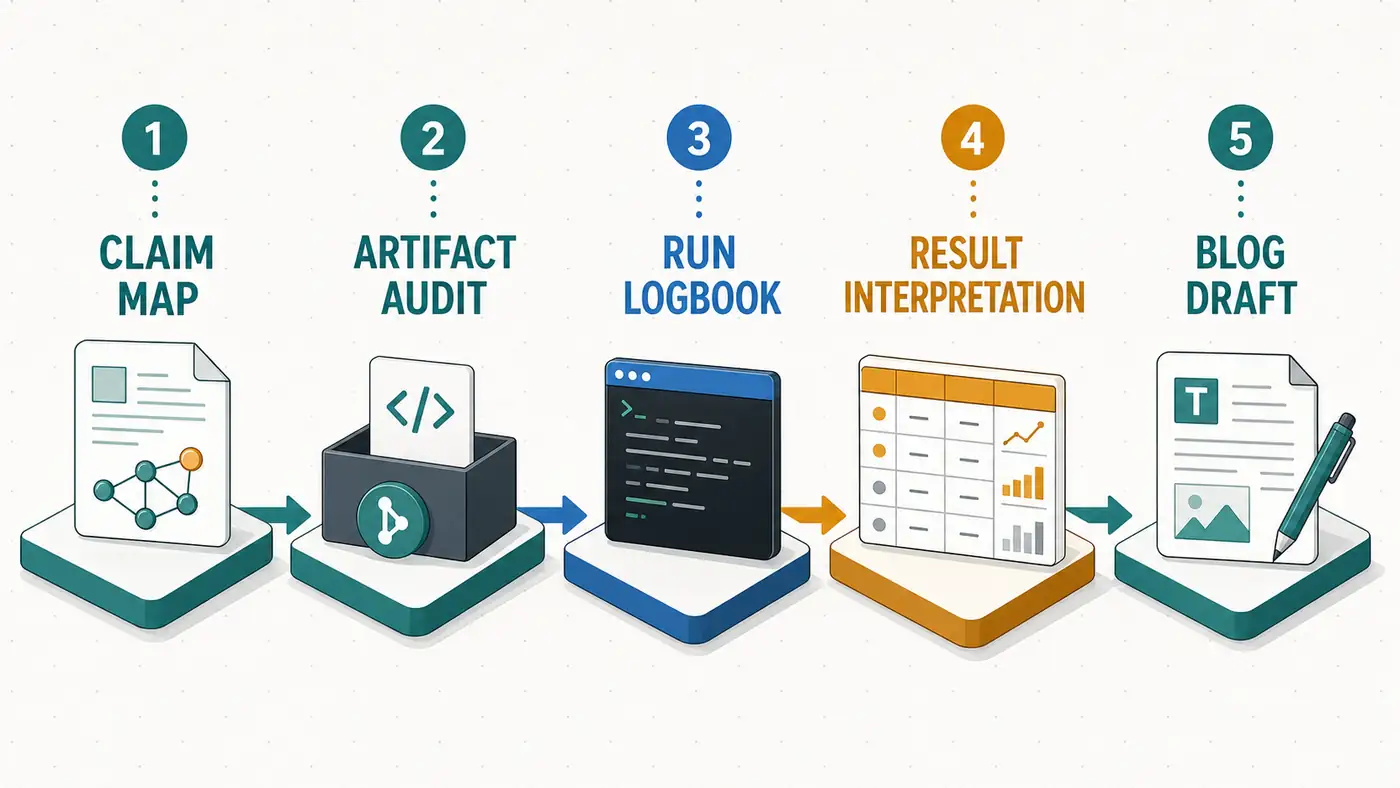
The five-step process of translating from Report into a blog
Step 1: Rewrite the claim map into a reader problem
Report to reviewers and blogs to learners. When transcribing, first change each claim to a question that the reader will ask:
- What does this paper really want to prove?
- Which table or which group of experiments does the evidence come from?
- What hidden conditions do this evidence depend on?
- What is the minimum verifiable experiment if reproducing resources are limited?
- How will the difference in the results affect the subsequent topic selection?
Do not repeat the abstract at the beginning of the blog. A better start is to make it clear that "why this paper is worth reproducing and which scientific research ability it can train".
Step 2: Rewrite Artifact Audit into a learnable checklist
The Artifact Inventory in the Report may be very thin, and the blog does not have to be fully expanded, but reserved mode. For example, you can write "environment, data, weight, SEED, log" as a checklist, and explain it with specific examples.
What blog readers need most is not your completeness conda list, but learn to ask:
- Does the paper provide immutable version of code?
- Is it possible that the dataset is revision drift on the Hub?
- Does checkpoint match tokenizer?
- Is the baseline the author's rerun, or is it citing the number of past papers?
- Is Metric Script consistent with the leaderboard?
- Can raw outputs be reviewed?
In this way, the article has changed from "My Reproduction Experience" to "The Reader's Transferable Method".
Step 3: Rewrite the run logbook into a key turning point
There is a lot of noise in the experimental log. The blog only reserves the nodes that change the judgment:
- What was the problem exposed for the first minimal run;
- Which configuration difference explains the main result deviation;
- Which failed sample reveals the vulnerability of Metric or Prompt;
- Which ablation makes you change your understanding of the methodology;
- Which one missing workpiece leads to conclusions only partial.
The paragraph structure of "Problem -> Troubleshooting -> Evidence -> Conclusion Boundary" can be used when writing. Don't write the timeline of "install the environment in the morning, run the script in the afternoon, and report an error at night".
Step 4: Rewrite the result table into evidence strength
The tables in the blog should not just copy the report number. Each result tells the reader what it supports and what it cannot support.
It is recommended to use the following table:
| observe | Conclusion of support | Conclusions that cannot be launched | Next experiment |
|---|---|---|---|
| Methods in the same direction on 3 SEEDs | CLAIM is more stable under this setting | Does not represent generalization across datasets | Change data or change model |
| There is a big difference in the number of baseline and the paper | Reviews may vary from pipeline | Does not mean that the author's result is wrong | Review Split and Parser |
| Ablation direction is unstable | Mechanism is weak | Does not mean that the main method is invalid | Increase SEED and sample size |
This way of writing is more suitable for scientific research training than "We ran out of X points".
Step 5: Rewrite Verdict as the Topic Entry
A good reproduction blog, the ending is not just "summarizing experience", but also should propose follow-up ideas. The problems found during the reproduction process are often the source of the research topic:
- If the result depends on prompt, you can do Prompt Sensitivity Study;
- If Raw Outputs is missing, you can do the Evaluation Trace Standard;
- If baseline is difficult to reproduce, you can do Benchmark Implementation Audit;
- If the variance of multiple SEEDs is large, you can do variance-aware evaluation;
- If the small model and the large model trend are the opposite, you can do scaling-dependent mechanism study;
- If the quality of the author's workpiece is uneven, you can do the Artifact Quality Checklist or automatic audit tool.
In this way, reproducing notes is not just an exercise, but a material library that leads to proposals.
Representative data and writing roadmap
1. NeurIPS 2019 Reproducibility Program: The starting point of institutional reproduction
Pineau et al., in JMLR 2021, summarized NeurIPS 2019 Reproducibility Program: Code Submission Policy, Community-Wide Reproducibility Challenge and ML Reproducibility CheckList work together to form an institutionalized attempt. For writing training, it reminds us that reproduction is not a matter of personal "running code ability", but a combination of paper writing, workpiece release, meeting review and community feedback.
When reading this report, the focus is not on historical details, but on three questions: How does the meeting request the author to report? How does the Reproduction Challenge organize students and communities? How does CheckList disassemble the "reproducible" into a checkable item?
2. MLRC 2026: Reproduction has become a formal research contribution
The MLRC 2026 official website shows that it will be held as the official Track of NeurIPS 2026; the NeurIPS blog stated in May 2026 that the reproduction of the paper needs to be first in TMLR Accept, and welcome types such as confirmation, partial recurrence, failure reproduction, generalization research, meta-reproducing research, AI-assisted reproducibility and other types. For graduate students, this has changed the positioning of the reproduction notes: it is no longer just a coursework, but may also be a research product that can continue to be polished.
When writing a report, you can learn from the spirit of MLRC: don't hide failures. As long as the scope is clear, the evidence is sufficient, and the reasons are carefully analyzed, some failures can also generate knowledge.
3. ReproEvalCard: LLM Pipeline's evaluation workpiece standard
ACL 2026's ReproEvalCard audited the 2022-2025 Pipeline-Based LLM paper, and pointed out that Prompt, Judge Configuration, Retrieval Snapshot, Intermediate Traces, etc. are the key artifacts required to reproduce the evaluation. It also reports that random control and missing intermediate traces limit review reproduction.
This is a direct inspiration for blog writing: if you are reproducing a RAG, Agent, Tool-USE, LLM-as-judge or Prompt-Chain paper, the body must write a "evaluation artifact" separately. Don't just write models and data. Without Prompt, Judge, retrieval library snapshots and execution trajectories, many LLM system results can only be partially audited.
4. PaperBench: Split the reproduction into a scoring task
OpenAI published PaperBench in 2025, requiring the Agent to recreate 20 ICML 2024 Spotlight / Oral papers and use layered rubric Break into a large number of evaluable molecular tasks. It is not the Agent score that is most valuable to ordinary graduate students, but Rubric idea: reproduction is not an action, but is composed of Paper Understanding, Implementation, Experiment Execution, Result Subtasks such as Matching and Analysis are composed of subtasks.
When writing reproduction notes, you can make a small Rubric for yourself: 20 points for understanding contribution, 20 points for workpiece audit, 15 points for minimum running, 25 points for main results, and 20 points for error analysis. This avoids only chasing the final number.
5. Papers with Code Research Code Checklist: the lowest line of the Code artifact
The Research Code CheckList of Papers with Code lists dependencies, training Code, evaluation Code, pre-training model, README and reproduction commands as core items. Although it was originally published for authors, the repeater can also use it in reverse: if a repository lacks training scripts, lack of evaluation scripts, lack of precise commands, lack of weight or lack of dependencies, the report should be clearly marked.
6. Replication studies after DeepSeek-R1: how to write when the open details are insufficient
2025 arXiv review "100 Days After DeepSeek-R1" summarizes a large number of restseek-r1 After the release of DeepSeek-R1 Studies, pointing out that some implementation details are not fully open source, so the community has replicated around SFT, RLVR, data construction and training processes. This case is very suitable for training the judgment that "open weight is not equal to complete reproducibility": when training data, filtering strategy, reward details or computing power configuration is missing, the report should be written as Replication / Approximation, not Exact reproduction.
Comparison table of method and experimental record
| record object | low-quality writing | High-quality writing | Blog Transfer Method |
|---|---|---|---|
| Reproduce the target | "Resulting paper results" | "Reproducing the Claim 2 of Table 3, using the official CheckPoint and dev split" | Start with a reader question |
| Environment | "Press README to install" | Record OS, GPU, CUDA, dependencies, commit, command | Refined into an environmental audit list |
| Data | "Using GSM8K" | Record source, version, split, preprocess, number of samples, hash | Explain data drift risk |
| Weights | "Using the Qwen model" | Record repo, revision, tokenizer, adapter, quantization | Interpret the weight pairing relationship |
| failed to run | "Words a lot of errors" | Record errors, reasons, patches, whether the conclusion is affected | Only write the failure of changing judgment |
| Result | "Basic Consistent" | Report values, variance, scale, differences and possible causes | written as the strength of evidence |
| Conclusion | "Recover Success" | Confirmed / Partially confirmed / Not confirmed / Inconclusive | Lead out follow-up idea |
Actionable checklist
Before writing reproduction report, check item by item:
- Did I list 1-3 test claims?
- Does each claim correspond to the tables, diagrams, paragraphs or appendices in the paper?
- Did I describe the reproduction type: Exact, Partial, Independent Reimplementation or Replication?
- Is the author code documenting commit, branch, license and local patch?
- Does the data record the source, version, split, preprocessing and number of samples?
- Does the weight record checkpoint revision, tokenizer, adapter, quantization and license?
- Does the evaluation record Prompt, Metric, Parser, Judge, Raw outputs?
- Does SEED write not just a number, but a random source and multi-seed policy?
- Do the results distinguish between numerical differences, directional differences and statistical uncertainties?
- Does the failure run keep enough information to let others know what you've tried?
- Does the conclusion avoid mistakenly writing resource restrictions as a paper error?
- Does blogging turn personal experiences into reusable methods for readers?
Before writing a blog draft, check again:
- Does the beginning say "why is it worth learning to reproduce this paper"?
- Do you use a picture or a table to display the reproduction route?
- Do you reduce the installation of running accounts and keep key evidence nodes?
- Is it clear what content is subject to manual verification?
- Are the references and search dates given at the end of the article?
Common misconceptions
Misunderstanding 1: Take the README running as a reproduction. Running demo can only indicate that Artifact is executable, not that the paper's claim is reproduced. The real report must be connected to the CLAIM and Evidence.
Misunderstanding 2: Only report the best RUN. If you run multiple SEEDs and write only the highest score, you will turn the reproduction report into a selective report. At least describe the number of RUNs, mean, variance, and the rules for selecting CheckPoint.
Misunderstanding 3: Hide the realization difference. Graduate students often worry that writing patches will appear "not pure enough". On the contrary, a transparent record patch is a prerequisite for the credible report.
Misunderstanding 4: Write the unreceivable workpiece as a small problem. Data, weights, prompts, judges, search indexes, and review scripts are missing any one, and the conclusion may be changed. Do not use one stroke of "skip due to resource limitations".
Myth 5: The blog is written as an abstract translation of the paper. The value of reproducing a blog is not what the reader is said, but tells the reader how you check these statements and what you have learned after checking.
Misunderstanding 6: Use "the paper is wrong" to create conflicts. Reproducing failures may come from environment, dependencies, hardware, SEED, metric, data version, baseline implementation or insufficient resources. The more rigorous expression is "not recognized within this reproduction scope" unless the evidence is sufficiently sufficient.
Research questions for graduate students
Reproduce Report Template Automation: Design a script that automatically generates a Report Skeleton from git commit, conda env, GPU information, running commands, and metric files.
LLM Review Trace Standards: Define the minimum save format for Prompt, Retrieval Snapshot, Tool Calls, Judge Config, and Raw Output for a RAG or Agent paper.
Dissertation Claim Extraction Tool: Let the model extract the CLAIM from the paper PDF, and ask each claim to bind the table, graph and experimental settings, and then manually verify it.
Benchmark parser audit: The system compares the analysis differences of the same RAW output by different open source evaluation scripts, and evaluates the score drift.
Reproduce Cost Estimation Model: Based on the integrity of the paper workpiece, model scale, data scale and dependence complexity, predict the reproduction cost of a paper.
Negative Results Writing Specification: Collect Reproduction/Negative Results papers in MLRC, ACL, ICLR, and NeurIPS to analyze how high-quality negative results are organized.
Summary
The goal of the paper reproduction notes is not to record "what I did", but to leave a chain of evidence that "how others can judge whether my reproduction conclusion is credible". The experimental log is responsible for retaining the facts, the reproduction report is responsible for organizing evidence, and the blog draft is responsible for teaching the method to the reader.
If you are a graduate student, it is recommended to use a fixed template from the next paper: first write the claim map, then do the artifact audit, then maintain the run logbook, and finally give verdict and follow-up ideas. After a month of training, you will not only get 30 reading notes, but a set of scientific research reading and resuming practice systems that can be reused for a long time.
References
Search date: 2026-07-29.
- Koustuv Sinha et al., the official website of MLRC 2026: https://reproml.org/
- NeurIPS Blog,MLRC 2026: Reproducibility as an Official Track at NeurIPS,2026-05-04: https://blog.neurips.cc/2026/05/04/mlrc-2026-reproducibility-as-an-official-track-at-neurips/
- Priyaranjan Pattnayak, Apoorv Bhatia,ReproEvalCard: A Reporting Standard for Reproducible Evaluation of LLM Pipelines,ACL 2026: https://aclanthology.org/2026.acl-short.22/
- Giulio Starace et al., PaperBench: Evaluating ai's Ability to Replicate AI Research, OpenAI, 2025-04-02: https://openai.com/index/paperbench/
- OpenAI frontier-evals GitHub repository: https://github.com/openai/frontier-evals
- ICLR 2025 Author Guide,Reproducibility section: https://iclr.cc/Conferences/2025/AuthorGuide
- NeurIPS 2025 Datasets & Benchmarks Track Call for Papers: https://neurips.cc/Conferences/2025/CallForDatasetsBenchmarks
- Papers with Code,Tips for Publishing Research Code: https://github.com/paperswithcode/releasing-research-code
- Joelle Pineau et al., improvement Reproducibility in Machine Learning Research: a Report from the NeurIPS 2019 Reproducibility Program, JMLR 2021: https://www.jmlr.org/papers/v22/20-303.html
- Chong Zhang et al., 100 Days After DeepSeek-R1: A survivey on Replication Studies and More Directions for reasonsing Language Models, arXiv: 2505.00551, 2025: https://arxiv.org/abs/2505.00551
- National Academies of Sciences, Engineering, and Medicine,Reproducibility and Replicability in Science,2019: https://www.ncbi.nlm.nih.gov/books/NBK547531/
- ACL 2026 Main Conference Call for Papers: https://2026.aclweb.org/calls/main_conference_papers/
source description: The conference policies, project pages, paper pages and code repositories cited in this article are all searched on 2026-07-29. Meeting time, track rule, OpenReview status, code repository commit, benchmark results and model artifacts may change over time; should be re-checked before official release. In case of access challenges or status changes on the OpenReview page, please refer to the official conference website, ACL Anthology, arXiv, TMLR/JMLR page and the author repository.