
Date:2026-07-31
Who this is for: graduate students, early-career researchers and AI practitioners with an engineering background
Keyword: follow-up idea, research proposal, the limitation of the paper, the falsification hypothesis, the minimum experiment
Abstract
After reading a good paper, many graduate students will stop at two extremes: either they feel that the author has finished the problem, and they can only repeat it. The former does not form a problem, and the latter is difficult to implement. FOLLOW-UP, which is truly suitable for research training Idea is not usually "a larger paper", but a small and reliable research problem: it comes from the unresolved limitations of the original paper, has clear assumptions, can use limited calculation and data validation, and can bring information whether positive or negative results can be brought.
A limitation, a failure case, a missing ablation, a biased benchmark, or an incomplete explanation can all become a research question you can test. From 2024 to 2026, work on AI research ideation, idea evaluation, scientific forecasting, and AI-assisted research grew rapidly. Large human studies of whether LLMs can generate novel ideas, along with Chain-of-Ideas, GraphEval, AAAR-1.0, PreScience, and Future-Aligned Proposal, suggest that developing an idea is a research skill whose component parts can be studied, evaluated, and practiced.
The core conclusion of this article is very simple: a good follow-up idea At least five inspections must be passed at the same time: the problem comes from the real gap, assuming that it can be falsified, the experiment can run through within two to four weeks, the evidence can distinguish multiple explanations, and the valuable analysis can still be written when it fails.
Contents
- Why follow-up idea is more suitable for training than "big direction"
- From the limitation of the paper to the research questions: five types of entrances
- What should a small and reliable idea look like
- Representative paper road map: how AI assists in scientific research concept
- Intensive reading of key papers: Think of Idea as a evaluable object
- Method/Experimental Comparison Table
- Minimum reproduction experiment and proposal template
- Common misconceptions
- Research questions for graduate students
- References
Why is this topic important
The ability that newcomers are most likely to underestimate is not reading papers, nor running code, but "compressing a vague inspiration into an executable problem". When reading the paper, you will see many possible directions: the author said that the future should be extended to multi-language, long context, more multimodal, larger model, more realistic environment, stronger benchmark; Ablation is not enough, the dataset is too narrow; when you reappear, you will find that the code is missing parameters, the results are sensitive to SEED, and a module does not actually contribute. These may all become follow-ups, but most are not research issues yet.
The reason is that research questions must be supported or overturned by evidence. For example, "making the agent more reliable" is too large; "In the WebArena class task, whether the introduction of additional verifiers can reduce the misreading of the status after the tool is called" is close to a problem. The former cannot determine the data, baseline and metric, the latter can design the smallest experiment: fixed the agent framework, compare no-verifier, rule-verifier, LLM-verifier, analyze the failure type and additional token cost.
For graduate students, the value of follow-up idea is not just publishing papers. It's more like a set of training devices:
- Train you to judge what the core of a paper is.
- Train you to write Limitation as a hypothesis, not a wish.
- Train you to design minimal experiments with limited resources.
- Train you to still refine mechanisms and boundary conditions when you face negative results.
- Train you to turn "reading ten papers" into "know what to test next".
The research environment in 2026 also makes this more important. ICLR 2026 Author's Guide requires that if LLM plays an important role in research ideas or writing, the author needs to explain its specific role and emphasize that the author is still responsible for the content, fact and scientific research integrity. In other words, AI can help you divert IDEA, retrieve literature, and check novely, but you can't afford to study and judge for you. A mature researcher must be able to answer: Why is this idea worth doing, what is the minimum evidence, where is the risk, and what is learned after failure.
From the limitation of the paper to the research questions: five types of entrances
1. Express Limitation: the boundary recognized by the author himself
The Limitation Section of the paper is the most direct entrance, but do not copy "future work". The author writes "only evaluate on English data", which does not mean that your follow-up is "extended to Chinese". You have to continue to ask: Which mechanism may fail after cross-language? Is it tokenizer, training data, cultural common sense, retrieval library coverage, or evaluation rubric? If the mechanism cannot be pointed out, the extended dataset is often just engineering supplements.
A better way to write is: the original method is instruction-following It relies on high-quality artificial preference data; assuming that when migrating to a low-resource language, the preference model is easier to reward fluency rather than fact-correct; the minimum experiment is to fix the model and task on two subsets of language, and compare the score with the artificial Factuality. Consistency of the annotation.
2. Failure case: the rules in the error sample
Many papers show failure cases, but readers often only regard it as an appendix. What is really useful is to re-encode the Failure case: errors occur in long input, rare entities, multi-hop reasoning, tool return conflicts, visual occlusion, external formats, or benchmark instruction ambiguous? If you can divide the errors into three to five categories, and find one of them to appear stably, it is close-up.
Note, Failure Case is not "picking a story to tell a story". At least you have to verify that it is not an accidental sample. You can extract 50-100 error samples, manually mark the wrong type, or manually review after using the model to assist. Small-scale but clear misclassification is often more valuable for research than blindly running a larger benchmark.
3. Ablation blank: variables that should be measured but not measured
The previous article talked about Ablation Study. For follow-up, the most common opportunity comes from "the paper claims that A is useful, but there is no explanation for excluding B". For example, the author has improved the performance after introducing the complex planner, but does not control the test-time token budget; after introducing the new data synthesis process, it is improved, but it is not compared with randomly sampled data of the same scale; proposed memory Modules get better after, but don't check if the model just benefits from a longer context.
The advantage of this type of follow-up is that it is small and hard: you don't need to come up with a new system, you just need to design a fairer control to verify the boundaries of the original claim. The disadvantage is that it must be very rigorous, otherwise it will easily become "reproducing the experiment and not running all". Your goal is not to dismantle the station, but to answer a repeatable question: After controlling the variable, which part of the original method still holds?
4. Benchmark Deviation: Missing Task Definition and Metrics Mismatch
Many controversies in AI papers come from Benchmark. A method may be improved on the Leaderboard, but the boost comes from data leaks, format adaptation, prompt tuning, judge bias, long answer preferences, or test set that is too narrow. Follow-up can start with the measurement object of Benchmark: Is the current indicator measured ability, style, cost, or adaptation to the distribution of data sets?
For example, LLM-as-a-judge may prefer output for longer, more confident or more like the reference answer in open reviews. A small follow-up can fix the content of the candidate answer, the system disturbs the length, tone and reference format, and tests whether the Judge ranking has changed. Such research does not necessarily require training models, but can directly affect the quality of evidence in subsequent papers.
5. Insufficient interpretation of the mechanism: the score rises but the cause is unknown
Many method papers will give intuition: search enhancement reduces illusion, process supervisor improves inference, self-consistency improves reliability, and tool use extends the ability boundary. But intuition is not a mechanism. Follow-Up can turn "why is valid" into a measurable signal: Does the search increase the evidence coverage? Does process supervisor reduce intermediate step errors? Does self-consistency just filter random noise in most votes? Does the tool call really solve the knowledge gap, or does it just provide a longer context?
Mechanical follow-up is generally more suitable for research training, because it does not depend on large-scale compute, but depends on experimental design. You can make a clear diagnosis with small models, small data, and small tasks, as long as the problem definition is sharp enough.
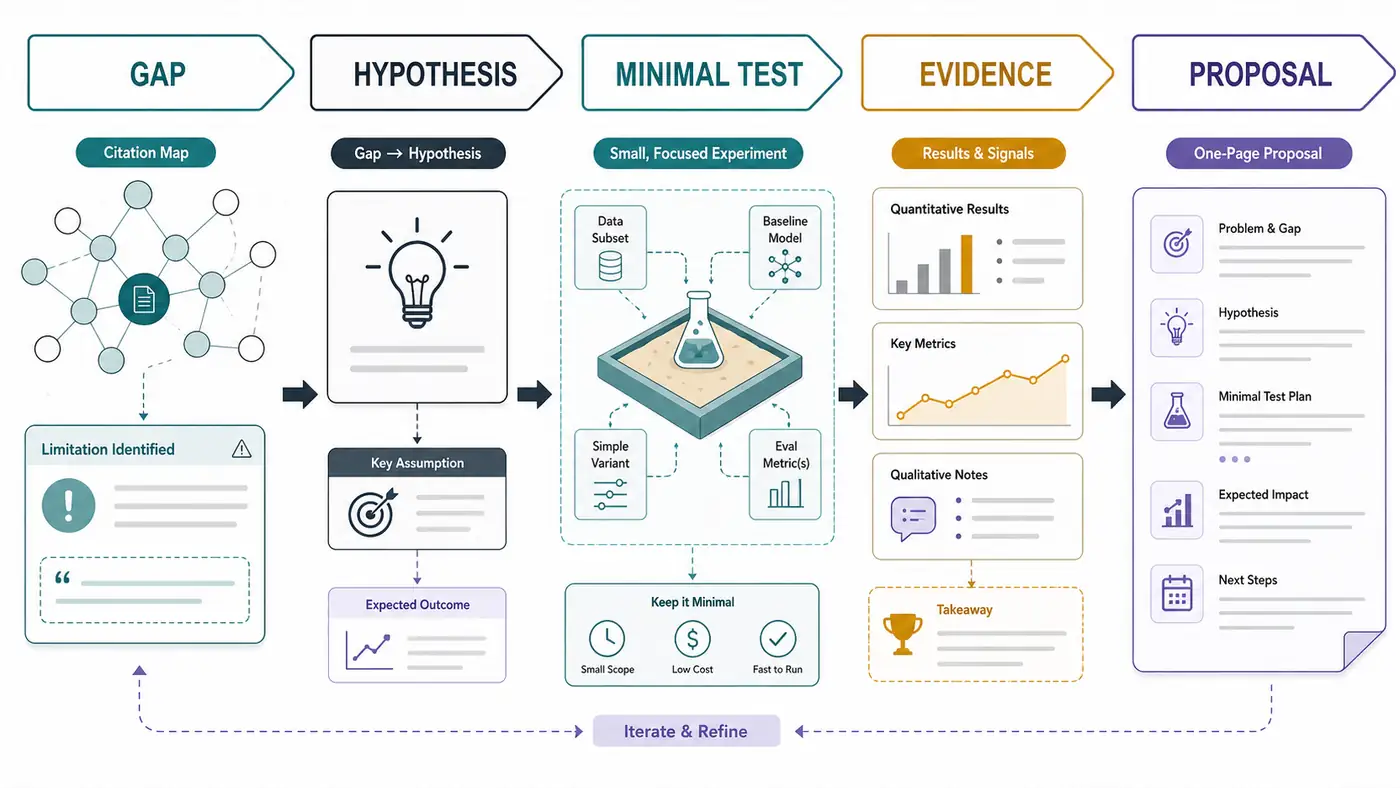
What should a small and reliable idea look like
An executable follow-up idea can be written in one sentence:
In response to the lack of evidence under condition S in the paper P, I assume that the mechanism M is the key bottleneck; after fixing the a, b, and c variables, the baseline and variant are compared through the minimum experiment e, and the indicator y is used. Determine if the assumption is true with the diagnostic signal z.
There are six elements in this sentence:
- Source: Idea comes from which paper, which sheet, which failure sample or which review opinion.
- Gap: What is missing from the evidence in the original paper, it is not a general saying that there is still room for improvement.
- Assume: What mechanism do you believe leads to the problem, and this mechanism may be overturned.
- minimum experiment: Experiments that can be completed within two to four weeks without relying on unknown resources.
- criteria: What is the difference between success and failure.
- exit condition: If you can't run out of expectations, how to judge whether it is a realization problem, a hypothetical problem or a data problem.
The "small" here does not mean no ambition, but refers to few variables. A reliable follow-up is best to change only one primary variable, with at most one auxiliary variable. For example:
| unreliable writing | more reliable writing |
|---|---|
| Be a stronger RAG Agent | Fixed generator and retrieval library, only compare whether reranker improves Factuality in conflict evidence scenarios |
| Extend the method to multimodal | The degradation curve of the three types of failures in visual occlusion, OCR noise, and cross-graph referring to the original method |
| Improve Reasoning with Reinforcement Learning | Verify that Process Reward is more able to locate intermediate step errors than Outcome Reward |
| Design New Benchmark | First construct 200 counterfactual examples to prove that existing Benchmark cannot distinguish two types of abilities |
| Automatically generate research ideas with AI | Evaluate whether the Novelty, Feature and Expected Effectiveness that generated the Idea can be stably distinguished by experts |
A practical criterion is the "Minimum Publishable Unit". It may not be able to independently become the top presidential text, but it should be the core of Workshop Paper, Reproduction Report, Short Blog, Appendix Experiment or Proposal. More importantly, it should allow you to learn a certain conclusion: the boundary of the original claim, the evidence of a mechanism, the defect of a certain Benchmark, or the interpretation of a certain type of negative result.
Representative paper road map: how AI assists in scientific research concept
In the past two years, there have been more and more papers on scientific research concepts, and they themselves also provide a frame of reference for follow-up training. Can be read by four lines:
| Direction | representative data | Focus on the issue | Inspiration for graduate students |
|---|---|---|---|
| Human vs LLM Idea Generation | Can LLMs Generate Novel Research Ideas?(arXiv 2024) | Is LLM Generation Idea novel, feasible and diverse | Don't confuse novely and feasibility |
| Literature Structured Generation | Chain of Ideas(arXiv 2024) | Helping LLM with Literature Development Chain | Idea should come from research context, not isolated Prompt |
| Research Tasks Benchmark | AAAR-1.0(arXiv 2024, 2025 revision; ICML 2025 notes see arXiv) | Equation judgment, experimental design, evaluation of paper weakness, review critical | Experimental design and finding weaknesses themselves can be evaluated |
| idea evaluation | GraphEval(arXiv 2025)、Literature-Grounded Novelty Assessment(arXiv 2025) | How to Evaluate Idea Quality and Novelty | Novelty needs documentary evidence, not just model self-evaluation |
| empirical outcome prediction | Predicting Empirical AI Research Outcomes with Language Models(NeurIPS 2025) | Predicting two studies idea which would be better on Benchmark | Idea feasibility can be converted into "predictable results" |
| scientific forecasting | PreScience(arXiv 2026)、Future-Aligned Research Proposals(arXiv 2026) | Predicting future paper contributions with time slices | A good proposal should be able to connect existing evidence and future development |
| Automation research pipeline | The AI Scientist / Towards end-to-end automation of AI research(Nature 2026) | End-to-end automation from Idea to experiments, papers, reviews | Automation can amplify efficiency and also amplify false assumptions |
The commonality of this route is that they no longer use the Research Idea as inspiration for inability to analyze, but dismantle it into novelty, feasibility, signification, and expected Dimensions are discussed in Effectiveness, Experimental Design, Weakness Detection, and Future Alignment. For newcomers, this is much more useful than "let LLM give me ten innovations".
Intensive reading of key papers: Think of Idea as a evaluable object
Can LLMs Generate Novel Research Ideas?
This 2024 arXiv paper recruited more than 100 NLP researchers for a blind comparison of ideas proposed by experts and those generated by an LLM ideation agent. The study goes beyond asking whether the LLM beat the humans. It evaluates ideas on separate dimensions, including novelty and feasibility, and identifies open questions about LLM self-evaluation, diversity, and whether eventual research outcomes bear out the ratings. Examine how the study controlled for author identity, organized the blind review, and handled subjective judgments.
The inspiration for the follow-up training is: don't just ask "my idea is new or not", but also ask "whether the expert thinks it works", "whether it just changed the term", "whether it is duplicated with existing papers". If the novelty is high but the feasibility is low, what you get is not a good topic, but an assumption that you need to continue to compress.
Chain of Ideas
The core idea of Chain-of-Ideas is to organize relevant literature into a development chain, and then let LLM generate ideas and experimental design based on the chain. It reminds us that the quality of many IDEAs depends on the literature structure: do you know which limits this direction has gone from, which methods have been proven invalid, and which task definitions have changed. For human readers, this is equivalent to the practical version of the Related Work map.
When doing follow-up, you can learn from this chain method: choose a target paper, follow three papers that are solved by it, read three citations or a new paper on the same topic, and then write "Old Restrictions -> Current Methods -> chain of new restrictions. If the chain can't be written, IDEA is still in inspiration.
AAAR-1.0
AAAR-1.0 makes researcher daily tasks into BenchMark, including ExperimentDesign and PaperWeakness. In the project page description data construction, senior AI researchers participated in the annotation and filtered through multiple rounds of inspection; it also shows that even the strong model still has obvious limitations in the task of researching weakness and experimental design. Don't just look at the model score, but look at the task definition: what kind of output is a good experimental design, and what kind of Weakness is not generalized.
This is very practical for graduate students. You can check your follow-up idea as an AAAR-style task: If another classmate is asked to only read the paper and your idea, can he write the same experimental plan? If not, it means that the definition of your problem is not clear enough.
GraphEval and Literature-Grounded Novelty Assessment
GraphEval dismantles the complex idea into viewpoint graph and uses a graph structure to assist the evaluation; Literature-Grounded novel asssessment proposes a search based on rerank and rerank. Novelty checker emphasizes that Novelty judgment must be grounded in literature. The two together point out a problem: The IDEA evaluation is not a "look new", but to decompose views, find relevant papers, compare differences, and give reasons based on literature.
In practice, you can write a novely card for each candidate IDEA: What are the three most similar papers in the last three articles? Is your difference a task, data, method, theoretical explanation, evaluation protocol, or application scenario? If the difference can only be written as "let's try x too", the novely is very weak; if the difference can be written as "there is already work without control variable v, so it is impossible to distinguish the mechanism m1/m2", it is more like a research problem.
Predicting Empirical AI Research Outcomes
This paper by NeurIPS 2025 translates the Idea evaluation into Pairwise Prediction: Given two Idea studies, predict which one will perform better on Benchmark. The paper reports the idea pair and experimental results extracted from the conference paper, and compares the model system and expert judgment. Its significance is not to make us blindly believe in model prediction, but to ask a good training question: before you actually run the experiment, can you tell which idea is more likely to succeed and what is the reason?
When doing Follow-Up, you can compare the candidate ideas: A is more novely, but the experimental risk is high; B novely is low, but can verify the key mechanism; C needs additional data, which is not suitable for the current cycle. Force yourself to choose with Pairwise Ranking, which is more effective than letting the model generate ten directions.
PreScience and Future-Aligned Research Proposals
PreScience in 2026 turns scientific forecasts into time slices Benchmark, focusing on the task of constructing AI papers and citation information in recent years; Future-Aligned Research Proposals The quality of proposal is aligned with the direction of the future paper, and the Proposal is generated with the data before the cutoff, and then it is to see if it predicts the Research contribution that appeared after the cutoff. These work give follow-up ideas a new perspective: good idea is not just different from the past, it should also explain "why the next step may have happened here".
For the readers of the training camp, there is no need to reproduce the complete Benchmark, but you can learn from the idea of time slicing: when reading the paper, only use the data before a certain point in time to write a reasonable Follow-up, and then use the paper for half a year or a year to check whether it has been done by others and where the judgment is wrong. This exercise can quickly improve research smell.
Method/Experimental Comparison Table
Below is a comparison table that can be directly used for topic selection and screening. Each candidate follow-up should be filled at least one line.
| dimension | low quality candidate | High-quality candidates | Check the problem |
|---|---|---|---|
| Source | "I think it can be improved" | From specific paper forms, Failure Case, Limitation or Reviewer Concern | Can you locate which page, which table, and which section claim? |
| Gap | The paper is not done x | The paper lacks evidence that can distinguish m1/m2 | Why can't the original paper answer this question? |
| Assume | x will be better | Under condition S, the mechanism M affects the indicator Y and the diagnostic signal Z | What results will overturn the hypothesis |
| Experiment | train a larger model | Fixed the main system, only change one variable | Can it be done in two to four weeks? |
| baseline | Only compared to the original paper | Contains simple alternative, strong baseline, random or budget control | Whether to exclude cheap explanations |
| Metric | Just look at the leaderboard score | Main Indicator + Cost + Error Type + Variance | Can you explain why |
| Risk | No risk | Clarify data, computing power, code, and evaluation of deviation risks | What is the downgrade plan after getting stuck? |
| Output | Must result | Both positive and negative results can write out boundaries or mechanisms | Is there any information after failure |
Minimum reproduction experiment and proposal template
For a follow-up idea suitable for training camp, it is best to write a proposal first, and then start running the experiment. The template is as follows:
1. Target paper
Write clearly the title, version, link, core claim, the table or paragraph you depend on. Don't just write "a certain RAG paper".
2. Gap Definition
In two to three sentences, it means that the original paper does not answer anything. It is recommended to use this format:
The original paper proves that A is improved on Benchmark B, but there is no control variable C, so it is impossible to judge whether the improvement comes from the mechanism M1 or M2.
3. Falsification hypothesis
Write an explanation of the two positive and negative results:
If M1 holds, after controlling the Token Budget, the Variant V should still increase the Factuality and reduce the error type Z; if the boost disappears, the original gain may come mainly from a longer context or decoding budget.
4. Minimum Experimental Design
List data, models, baseline, variables, metrics, SEED, log fields. Here to be specific to the extent that you can open the issue:
- Data: which public dataset, which Split, whether to sample, or SEED.
- Model: base checkpoint, inference framework, whether to quantify.
- Variable: Change only one main variable, such as Retriever, Verifier, Prompt step, reranker, Top-K.
- Baseline: original method, simple alternative, no-op or budget matched version.
- Metrics: Main metrics, cost metrics, misclassification, Confidence interval, or at least multi-seed mean.
- Logs: Save input, output, intermediate evidence, random seed, version hash, cause of failure.
5. Expected contribution
Don't write "improve performance". Write what type of knowledge you want to contribute:
- Prove that a module is still valid after controlling the budget.
- Finding the original method only works on a certain type of data.
- Give a Benchmark deviation diagnosis.
- It means that an intuition mechanism does not hold.
- Provides reproducible negative results and error analysis.
6. Stop condition
Set the exit line for yourself: the main result cannot be reproduced within two weeks, and it will be converted to reproduction report; three groups of seed If the variance is too large, the stability analysis is preferred; the cost of data construction exceeds expectations and is reduced to a subset of diagnostics; the core is assumed to fail, and the boundary conditions are written instead of the heap module.
Common misconceptions
Myth 1: Use Future Work as a topic
The paper says that Future work can be extended to multimodal, and you write "I want to do the multimodal version". This is just a task extension, not a research question. You need to point out what new contradictions are introduced by multimodal: the conflict of visual evidence and textual evidence? Is the image encoder freezing resulting in fine-grained grounding insufficient? Evaluation indicators cannot distinguish between visual understanding and language prior?
Myth 2: The idea is too big, so there is no first step
"Building an automatic research agent" is very attractive, but what is the first step? If the first step is not clear, the problem is too big. Compress it into a module question: Does the experimental design generated by the agent override the necessary baseline? Can LLM self-review find missing ablation? Is Idea Ranking affected by the thermal bias of the paper?
Misunderstanding 3: Only follow novely, not feasibility
Human research in 2024 has reminded us that LLM Idea may be considered more Novel, but weaker. You can't just look at the novelty for postgraduate topic selection, because you have to get out of the experiment. The feasibility is not conservative, but explicit risks: whether the data can be obtained, whether the code can run, whether the GPU is enough, and whether it is credible.
Myth 4: Use AI to generate results as evidence
LLM can help you list LIMITATION, find related papers, and generate experimental plans, but its output is not a novelty certificate, and it is not an experimental result. ICLR 2026 discloses the use of important LLM use requirements, which means that the research responsibility is still in the author. When using AI-assisted ideas, at least record Prompt, search sources, manual screening criteria, and final manual judgment.
Myth 5: Continue to add modules after failure
If the smallest experiment fails, the worst reaction is to continue adding complex modules until a certain Benchmark rises. A better approach is to go back to the hypothesis: is the mechanism wrong, the variables are not well controlled, the data is too small, or the metric is not sensitive? A clear negative result is often more capable of training research ability than an unexplained positive result.
Research questions for graduate students
1. Small-scale human consistency study of Follow-up idea Rubric
Collect 30-50 candidates from recent LLM papers, please follow-up IDEA, 3-5 graduate students, press Novelty, Feasibility, Significance, Evidence Strength scores to analyze consistency and disagreement causes. The goal is not to train the model, but to establish the evaluation criteria for this group.
2. Reliability Assessment of LLM Assist Limitation Mining
Given the full text of the paper, let LLM extract Limitation, Missing Ablation, Benchmark Risk, and then manually verify. Compare different prompt methods: directly extract, first build claim table, first do Related work map, first do reviewer-style critique. Indicators can be manual confirmation rate, specificity and executability.
3. Generate a minimum experimental plan from the ablation blank
Select 10 papers in one direction, manually mark the missing ablation, and then let the model generate the minimum experimental plan. The analysis model can control the variables, whether the baseline is missing, and whether the experiment is proposed. This topic can echo the ExperimentDesign idea of AAAR-1.0.
4. Adaptation of novely checker in Chinese AI paper reading
Based on the idea of Literature-Grounded Novelty Assessment, make a lightweight process: Chinese problem description -> English keyword extension -> arXiv / Semantic Scholar search -> Similar work facet comparison -> novely card. Focus on evaluating whether it can help Chinese readers avoid repeated questions.
5. Time Slice Review of Research Proposal
If you choose a paper in a certain direction in 2024, you only allow the use of the previous literature to write follow-up Proposal, and then use the 2025-2026 paper to check whether the Proposal hits the real trend. This exercise can draw on the idea of temporal slicing of PreScience and Future-Aligned Proposal, but the scale can be small.
Summary
The key to designing the Follow-Up Idea is not to think of a grand direction, but to compress the incompletely proven parts of the paper into a small problem that can be falsified, reproducible and interpretable. When reading a paper, you have to find an entry from LIMITATION, FAILURE CASE, ABLATION, BENCHMARK DEVICE, and insufficient interpretation of mechanisms; write proposals You need to clarify the source, gap, assumption, minimum experiment, criterion and stop conditions; when running the experiment, you have to ensure that even if the result is negative, you can answer "what we have learned".
This article can be used as a pre-training of "how to form a research proposal from 10 papers" as a follow-up article. This article focuses on the minimum follow-up after a single paper; the article on Research Proposal will further discuss how to string multiple follow-ups into complete proposals. The real scientific research reading system is to gradually establish your own problem map from a gap in a paper.
References
Search date: 2026-07-31.
- Chenglei Si, Diyi Yang, Tatsunori Hashimoto. Can LLMs Generate Novel Research Ideas? A Large-Scale Human Study with 100+ NLP Researchers. arXiv:2409.04109, submitted 2024-09-06. https://arxiv.org/abs/2409.04109
- Long Li et al. Chain of Ideas: Revolutionizing Research Via Novel Idea Development with LLM Agents. arXiv:2410.13185, submitted 2024-10-17, v5 2024-10-30. https://arxiv.org/abs/2410.13185
- Renze Lou et al. AAAR-1.0: Assessing AI's Potential to Assist Research. arXiv:2410.22394, submitted 2024-10-29, v4 2025-05-25; arXiv comments note ICML 2025. https://arxiv.org/abs/2410.22394
- AAAR-1.0 project page. https://renzelou.github.io/AAAR-1.0/
- Tao Feng, Yihang Sun, Jiaxuan You. GraphEval: A Lightweight Graph-Based LLM Framework for Idea Evaluation. arXiv:2503.12600, submitted 2025-03-16, v2 2025-05-28. https://arxiv.org/abs/2503.12600
- Simra Shahid et al. Literature-Grounded Novelty Assessment of Scientific Ideas. arXiv:2506.22026, submitted 2025-06-27. https://arxiv.org/abs/2506.22026
- Jiaxin Wen, Chenglei Si, Yueh-Han Chen, He He, Shi Feng. Predicting Empirical AI Research Outcomes with Language Models. NeurIPS 2025 Main Conference Track; arXiv:2506.00794 submitted 2025-06-01. https://proceedings.neurips.cc/paper_files/paper/2025/hash/03f99ca79b87c513d0b502e737a41a41-Abstract-Conference.html
- Anirudh Ajith et al. PreScience: A Dataset and Benchmark for Scientific Forecasting. arXiv:2602.20459, submitted 2026-02-24, v2 2026-07-02. https://arxiv.org/abs/2602.20459
- Heng Wang et al. Learning to Predict Future-Aligned Research Proposals with Language Models. arXiv:2603.27146, submitted 2026-03-28, v3 2026-05-26. https://arxiv.org/abs/2603.27146
- Chris Lu et al. Towards end-to-end automation of AI research. Nature 651, 914-919, 2026. https://ideas.repec.org/a/nat/nature/v651y2026i8107d10.1038_s41586-026-10265-5.html
- DARPA. The Heilmeier Catechism. https://www.darpa.mil/about/heilmeier-catechism
- ICLR 2026 Author Guide. https://iclr.cc/Conferences/2026/AuthorGuide
- NeurIPS 2026 Main Track Handbook. https://neurips.cc/Conferences/2026/MainTrackHandbook
- Papers with Code. Tips for Publishing Research Code. https://github.com/paperswithcode/releasing-research-code