Date:2026-07-23
Who this is for: Graduate students in AI, NLP, machine learning direction; new scientific research candidates who are ready to do intensive reading, recurrence reports, and topic selection; technical readers with engineering background but want to improve the efficiency of the paper screening
search date:2026-07-23
Abstract
The real difficulty of AI papers is not "understanding each essay", but judging which one is worth entering the stage of deep reading, reproduction and topic selection. If a one-month training camp only picks papers based on the novelty of popularity, forwarding volume or title, and quickly falls into two questions: read a lot of jobs with strong packaging but weak evidence, or miss those papers that are not lively enough but can change the definition of research questions.
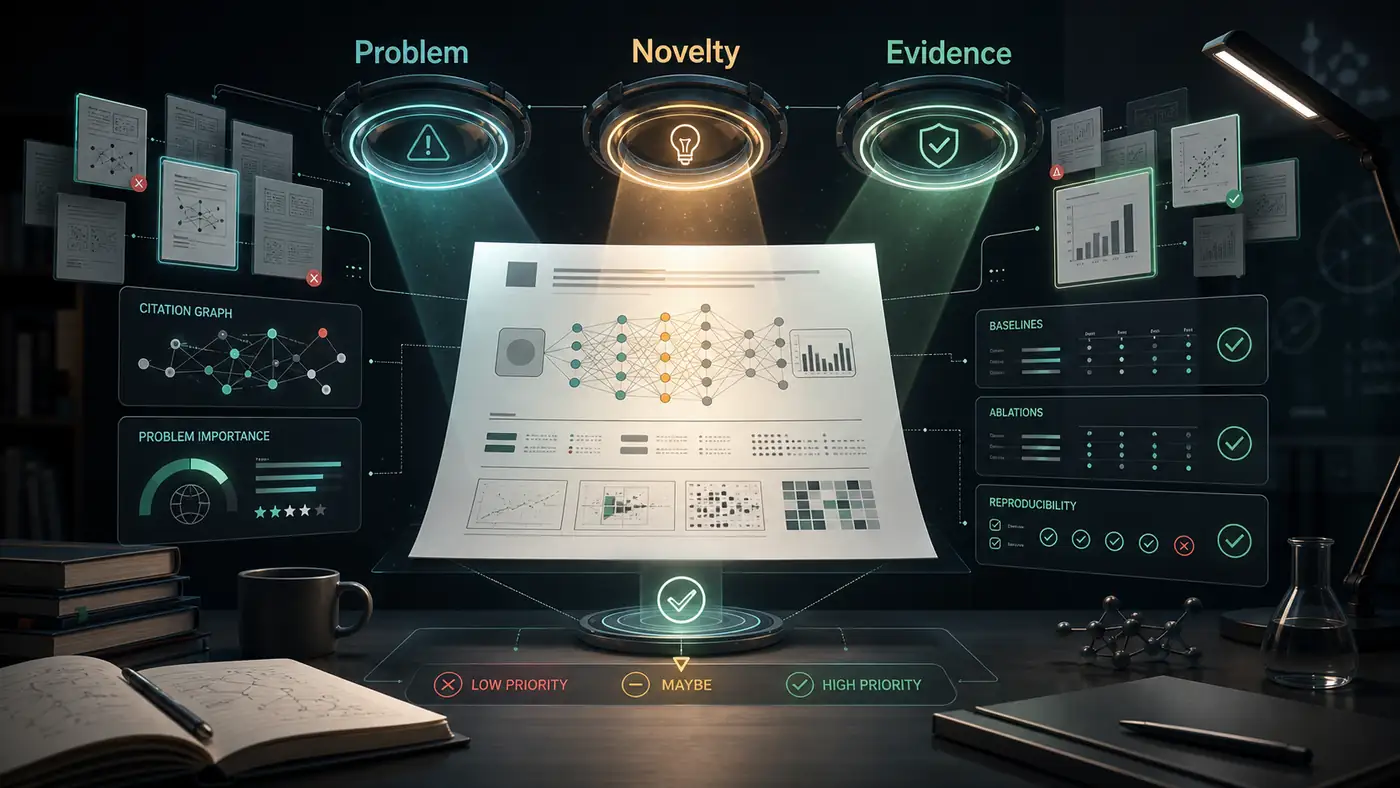
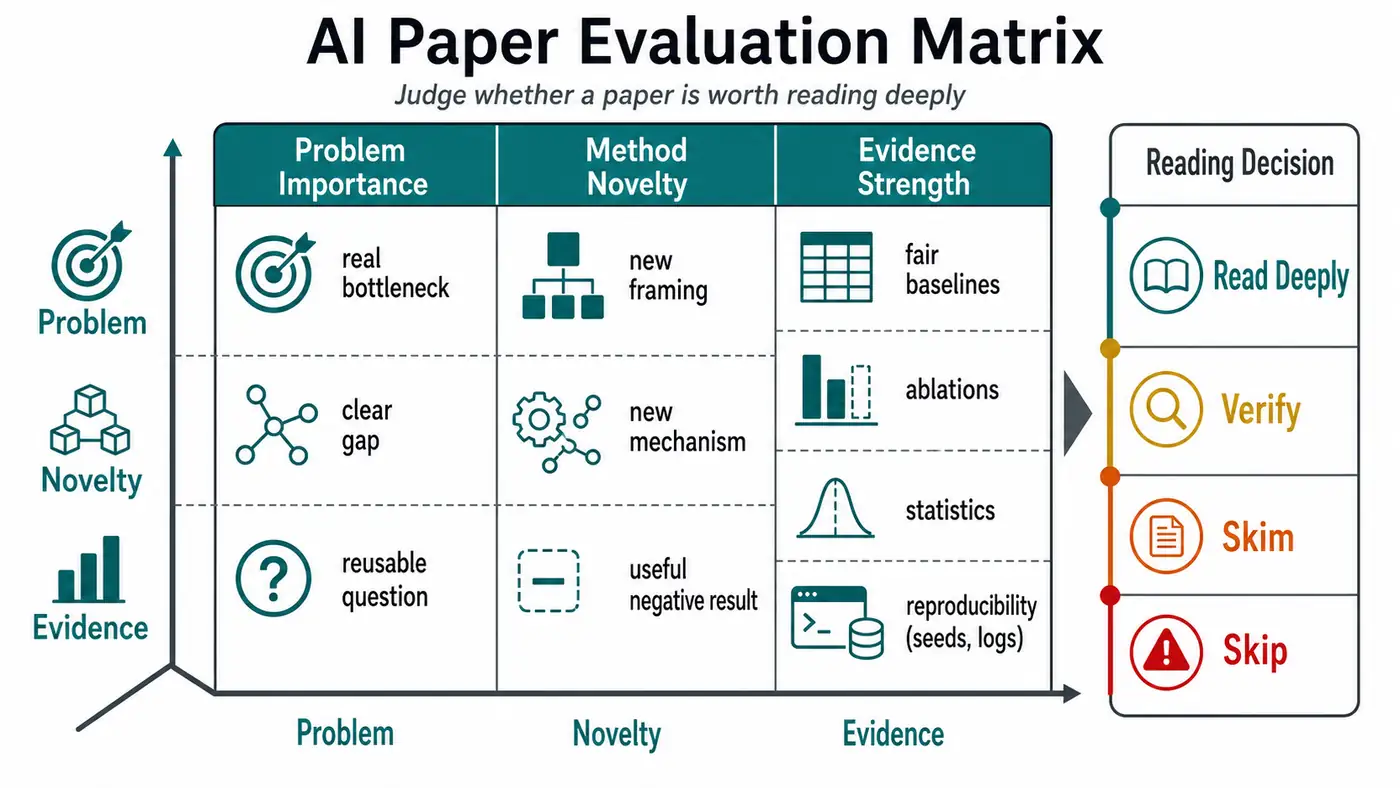
This article gives a set of paper screening methods suitable for graduate and engineering readers: The importance of the problem, the novelty of the method, the strength of the evidence Three axes determine whether an AI paper is worth reading. It draws on the evaluation dimensions in ICLR 2026, NeurIPS 2026, ACL Rolling Review and AAAI-26, etc. 2025-2026 The latest research clues such as LLM Benchmark, Data Contamination, Reproducibility Track and PaperBench. The goal is not to train oneself into a "quick scoring machine", but to form a reusable reading decision process: which papers are skipped, which are roughly read, which papers need to be verified, and which papers are worth investing in for half a day to a few days for intensive reading and reproduction.
Contents
- Why "Worth it is worth reading" itself is a scientific research ability
- 15 minutes Triage: Determine the reading depth first
- The first axis: the importance of the problem
- Second axis: new method
- The third axis: the strength of the evidence
- Four reading decisions: Skip, Skim, Verify, Read deepply
- Representative data roadmap: from review standards to benchmark papers
- Judgment matrix and scoring table
- Minimum verification before reproduction
- Common misconceptions
- Training questions for graduate students to continue
- Summary
- References
Why "Worth it is worth reading" itself is a scientific research ability
Scientific newcomers often understand the paper reading as a linear task: find the paper, download the PDF, read from the abstract to the conclusion, and take notes. But real research is not a library punch card, but a choice with limited attention. There may be dozens of arXiv preprints, several top posters, open source technical reports, benchmark updates and reproducing comments in one direction each month. You can't read every essay intensively, so you must first learn to judge.
To judge whether a paper is worth reading is essentially a small peer review. ICLR 2026 Reviewer Guide asks the reviewer to answer four core questions: what are the specific problems with the dissertation processing, whether the method has sufficient motivation and puts it in the relevant work, whether the evidence supports claim, and whether the work has contributed new knowledge or value to the community. NeurIPS 2026 Reviewer Guidelines also takes quality, clarrity, signature, originality as the core dimension, of which Significance Focusing on whether the results will be used by the community and whether to promote understanding, Originality is not the same as inventing a new module, but can also come from new insights, problem settings, indicators, or reveal the nature of existing methods.
This is very inspiring for readers: before reading the paper, don't just ask "is it SOTA", but "whether it is worth taking up my research time". Some papers do not have the highest score, but propose a task, data set, evaluation protocol or negative result that will be repeatedly used later. The former is worth reading, and the latter is at most rough.
In 2026, NeurIPS adjusted the Datasets & Benchmarks Track to Evaluations & Datasets Track and explicitly sets the Evaluation considered as a scientific object that can be studied, auditable, reproducible, and can be improved. This shows that the focus of AI research is changing: outside the model structure, the boundaries of evaluation hypotheses, data structures, reproducibility and claims are also determining the scientific value of a paper. To judge whether the paper is worth reading or not is to train yourself to identify these boundaries.
15 minutes Triage: Determine the reading depth first
It is recommended to give each candidate paper a maximum of 15 minutes. Don't get caught up in formulas, appendices, and code in the first place. Instead of pretending to have read it quickly, you have to quickly produce a reading decision.
The first step is to look at the concept list and conclusion at the end of the title, abstract, and introduction. Write down three short sentences: what problem it claims to solve; where it claims the new place is; what evidence it claims to prove. As long as these three sentences cannot be written, it means that the paper is unclear, or you still lack the background, this article is not suitable for intensive reading for the time being.
The second step is to look at the main image and the main result table. Don't just look at the highest numbers, look at the column names, datasets, baselines, model size, reasoning budgets, and indicators. If the paper claims "stronger reasoning ability", but the main table only reports a multiple-choice question that is easily contaminated. The paper is under test; if the paper claims to be "efficiency improvement", but does not report hardware, throughput, delay and quality loss, the intensity of the evidence will be degraded.
The third step is to look at the Related Work and references. Determine if the paper knows where you are standing. Strong papers can usually clearly distinguish between "what the existing Work has been solved" and "what the article has really changed"; weak papers often write Related Work as background piles, or only choose the most convenient baseline.
The fourth step is to see the reproducible entrance. Is there code, data, checkpoint, configuration, training log, evaluation script, license and model card? NeurIPS CheckList states that even if all the open source codes of the papers are not forced, a reasonable reproducible or verifiable path needs to be given; for new algorithms, models, data sets, and experimental papers, the shape of this path will be different. The reader's judgment should also change accordingly: the closed source is not automatically equivalent to not worth reading, but the closed source and the experimental details are not enough, usually not worth investing in the reproduction level intensive reading.
The first axis: the importance of the problem
The importance of the problem is not "big topic", but "whether this question really limits research progress". An important problem usually meets at least one of the following three categories of conditions.
First, it jams a high-frequency research process. For example, whether the long-context model can stably retrieve evidence in a large amount of irrelevant information, whether LLM-as-judge has positional bias and length offset, whether Agent Benchmark can be re-executed, and whether preference optimization really improves the target ability rather than optimize the evaluator. These problems are not the pain points of a certain paper themselves, but the public bottlenecks that many follow-up work must face.
A second kind of contribution changes the definition of the problem. Many strong papers redefine a task, metric, or experimental protocol. LiveBench (ICLR 2025) identifies test-set contamination as a major obstacle to fair LLM evaluation and seeks to reduce it with frequently updated questions, objective ground truth, and coverage across tasks. LiveBench need not be your only benchmark, but its design raises a question worth asking: how much evidence of real generalization does a paper provide if it reports results only on old, static benchmarks?
Third, it can generate subsequent research questions. NeurIPS 2026 Ed Track points out that reviewing hypotheses and reporting practices shaped scientific conclusions; this means a good Evaluation or DataSet The value is not just "give everyone a new list", but let the community re-discuss what can be measured and what conclusions can be supported. Similarly, MLRC 2026 became the official Track of NeurIPS, which also shows that rigorous reproduction, generalization testing, negative results and partial recurrence failures are gaining more formal research status.
There are four questions you can use when judging the importance of the problem:
| check | high value signal | low value signal |
|---|---|---|
| real bottleneck | Repeated encounters in multiple directions, affecting whether the claim holds | Just to make a module appear necessary |
| mission boundary | Clearly explain input, output, constraints and failure conditions | Very narrow experiments with big words |
| Community reuse | May affect subsequent benchmark, baseline, data or method | Can only be established in the author settings |
| Potential for topic selection | Can naturally launch follow-up, reproducible or negative results research | After reading it, I can only repeat the author's conclusion |
A practical rule: if you can't explain "why I will still care about this paper in three months", it's generally not worth reading. It can be collected, read or put into the Related Work, but do not use it as the main paper on the day of the training camp.
Second axis: new method
Methods are most easily misled by titles and naming. AI papers like to create new abbreviations, new agent frameworks, new training recipes, and new benchmark names, but new names do not equal new knowledge. NeurIPS 2026 Reviewer Guidelines clearly states that Originality does not have to come from new methods, it can also come from new insights, reveal, efficiency or fairness improvements, tasks/indicators / Framing's innovation. In turn, a new system that looks complex, if it is just a combination of existing modules, and does not explain why this combination will bring new results, the new ideas will be limited.
When reading the new method, first put the paper into four levels.
New idea of problem setting: Does the paper raise a question that was not clearly formalized before? For example, converting "the model can answer the question" into "whether the model can maintain the ability in the question of limited pollution, objective scoring, and continuous update". In 2025, PaperBench proposed to let AI Agents reconstruct code and experiments from the paper, and disassemble the 20 ICML 2024 Spotlight / Oral papers 8,316 scoring tasks. For the reader, its value is not only in one score, but in turning "reproduction research ability" into an operable evaluation object.
Mechanism: Has the paper changed the information flow, training objectives, optimization methods or reasoning process? For example, the new Verifier, Retriever, Planner, Preference Objective, Routing mechanism, Memory update rules. Be wary of "module stacking" here: if there are only common components left in series after removing the name, it depends on whether the author provides a sufficient mechanism explanation and ablation.
Evidence novelty: Does the paper reveal the properties of existing methods through new controls, negative results, error analysis, or stress tests? 2025 Review of the NAACL Findings paper on Data Contamination Detection 50 The pollution detection study, and pointed out that the multi-class detection hypothesis does not necessarily hold in different settings; such work may not propose a larger model, but it can significantly affect how we interpret the Benchmark score.
Resources: Did the paper publish reusable data, code, review scripts, Rubric, log or model weights? The resource itself is not an automatic contribution. NeurIPS ed track emphasizes the requirements of benchmark and dataset: the resource should indicate what evaluation claim it supports, what assumptions depend on, and what are the restrictions. If a dataset cannot indicate the measurement objectives and limitations, it is only a larger or more update, and it is not necessarily worth reading in depth.
The novelty of the method can be tested with a counterfactual problem: if all the new terms in the paper are deleted and only described in general terms, what new scientific claims are left? If the answer is "a new verifiable assumption" "a more rigorous question definition" "an experimental design that will change the conclusion", it is worth continuing to read; if the answer is only "put a, b, c The three existing tools are string together”, it is necessary to turn the focus to the intensity of evidence, and invest time with caution.
The third axis: the strength of the evidence
Evidence strength determines whether the paper can support its claims. For AI papers, evidence usually includes main experiments, baseline, ablation, error analysis, statistical significance, manual evaluation, automatic evaluation, code and reproducing materials. The reader does not need to review all the details in the Triage phase, but must identify the red flag.
First, see if the claim is aligned with the metric. The paper claims to be "more reliable", but only reports average accuracy; claims "more safer", but only tests a static jailbreak set; Case; these are all evidence and dislocation of evidence. The NeurIPS CheckList requires that the claims in Abstract and Introduction are consistent with the scope, assumptions and limitations of the contribution, which can be directly turned into a reader's check item.
Second, see if the baseline is fair. Fairness is not "a lot of baselines", but whether the comparison variables are clear. Model size, training data, prompt, context length, sampling times, tool access, retrieval corpus, verifier, reasoning budget and hardware can all affect the results. If the new method uses test-time compute, it attributes the benefits to the training target; if the baseline is not tuned, the method in this paper adjusts a lot of hyperparameters; Prompt, these will weaken the evidence.
Third, see if the ablation is an isolation mechanism. A good ablation answers "why does it work", and the weak ablation only answers "delete the module will make it worse". For example, a RAG paper should distinguish the roles of retriever, reranker, context packing, prompt and generator; an agent paper should distinguish between planner, memory, tool Validation and Retry Policy; a Post-Training paper should distinguish data, reward/preference targets, base model and sampling policies. If all changes occur at one time, the paper can only prove that recipes are useful and cannot prove that the mechanism is valid.
Fourth, look at statistics and repeatability. AAAI-26 Reproducibility CheckList focuses on SEED, number of runs, hardware and software environment, metric, statistical significance and hyperparameter selection; NeurIPS Checklist also requires experimental details, errors Bars or significant information. For a small increase, especially the differenceMark difference of 0.x points, if there is no multi-seed, variance or Confidence interval, don't take it as a strong conclusion.
Fifth, look at pollution, selective reports and Judge risk. In 2025, LiveBench, AntiLeakBench, and Contamination Detection Survey all state that the data pollution in the LLM evaluation is not a matter of corners. AntiLeakBench further emphasizes that collecting new data does not necessarily guarantee pollution-free, because new data may also contain the knowledge that has been seen in the pre-training of the model. When reading the paper, ask: Is the test set possible to enter the training corpus? Has Benchmark been discussed in abundance in large numbers? Is it only reporting favorable tasks? Are the prompts, model versions and deviations of LLM Judges artificially verified?
Four reading decisions: Skip, Skim, Verify, Read deepply
After the three-axis judgment, don't just give a "good/bad" impression. It is recommended to put the paper in four gears.
Skip: The problem is not important, the method is just packaging, and the evidence is obviously insufficient. Skipping does not mean denying the author, but protecting your own research time. Typical examples are: the title is very large, the experiment is very narrow; there is no clear task; the baseline is incomparable; the key data and evaluation settings are missing; it has nothing to do with its own direction.
Skim: Questions or materials have reference value, but are not worth reading for the time being. Suitable for supplementing related work, understanding trends, documenting terms and references. For example, you don't need a new Benchmark for the time being, but it sorts out the relevant tasks; a method paper evidence is general, but the introduction explains the direction and context clearly.
Verify: The paper may be important, but the key claim requires verification. For example, the result depends on data non-pollution, closed-source model API, LLM Judge, complex engineering settings or high computing power training. Do not directly refer to the conclusion at this time, you can first check OpenReview, code issue, reproducing reports, author supplements and community discussions.
Read Deeply: The problem is important, and the method or evidence has at least one dimension that is obviously strong and is related to your research goal. The papers entering this file should produce structured notes: problem definition, core assumptions, method decomposition, main claim, evidence table, reproduction entrance, limitation, can be done-up.
A simple experience is: read at most 1 articles a day, verify 2-3 essays, read 5-10 essays, and skip a large number of papers. The value of the training camp is not the number of collections, but in the fact that each in-depth reading paper can become a reproducing plan or topic selection material.
Representative data roadmap: from review standards to benchmark papers
In order to train judgment, you can read a set of "meta paper" and official materials according to the following route.
| Types of | representative data | the purpose of reading it |
|---|---|---|
| How to read paper | Keshav, How to Read a Paper, 2007 | Learn three times to read and five quick judgment questions |
| Review standard | ICLR 2026 Reviewer Guide;NeurIPS 2026 Reviewer Guidelines;ACL ARR Review Form | Convert Problem, Significance, Originality, Evidence, Reproducibility to Reader Checklist |
| reproducibility | NeurIPS Paper Checklist;AAAI-26 Reproducibility Checklist;Pineau et al. 2021 | Determine whether the experimental details are sufficient to verify the claim |
| Evaluation Trend | NeurIPS 2026 Evaluations & Datasets Track | Understand why BENCHMARK, METRIC, AUDIT, NEGATIVE RESULT have become research objects |
| Pollution Restricted Evaluation | LiveBench, ICLR 2025;AntiLeakBench, ACL 2025;Fu et al., NAACL Findings 2025 | Training Identify Benchmark Contamination and Evaluation Hypotheses |
| Reproduction Ability Evaluation | PaperBench, OpenAI 2025;MLRC 2026 NeurIPS track | Turn "whether the paper is reproducible" into specific tasks, rubric and logs |
The reading of this group of materials is not to recite chapters, but to extract the judgment dimension. The review standard tells you what is contributing; checklist tells you what is verifiable; the Benchmark paper tells you how the evaluation hypothesis will change the conclusion;
Judgment matrix and scoring table
The following is a scoring table that can be directly put into reading notes. Each item is 0-2 points, the total score is not an absolute ranking, only used to determine the reading depth.
| dimension | 0 points | 1 point | 2 points |
|---|---|---|---|
| the importance of the problem | Issue vague or only service packaging | There are specific tasks, but the scope of impact is limited | Pointing to a public bottleneck may change research problems |
| Literature Positioning | Relevant work stacking or omission is obvious | Basic coverage of the main line | Clearly explain the difference with key work |
| Methods of new methods | Mainly name change or stack module | There are local mechanisms or combination improvements | New Framing, Mechanism, Goal or Evidence Design |
| Claim sharpness | Advocacy is too large or untestable | There are claims but the boundaries are unclear | Advocate specific, measurable, and limited conditions |
| Baseline fairness | baseline is too weak or mixed variables | Basically comparable but lack of details | Size, data, budget and agreements are clear |
| Ablation / mechanism | No or only surface deletion | there is ablation but insufficient explanation | Can isolate critical variables and fail conditions |
| statistical evidence | Single result, no variance | There is partial variance or multitasking verification | Multiseed, Confidence interval, significance or robustness analysis |
| reproducible entrance | No code / data / configuration, missing details | Some materials | Code, data, configuration, SEED, log or checkpoint is more complete |
| Topic value | Difficult to launch follow-up questions | Can be used as background material | Can naturally form reappearance, negative results or follow-up |
Suggested threshold:
- 0-6 points: Skip, unless it is a must-read for your tutor's specification or direction.
- 7-10 points: Skim, record abstracts, method labels and related work.
- 11-14 points: Verify, check the appendix, code, OpenReview, reappearance report.
- 15 points or more: Read Deeply, enter the intensive reading and reproduction plan.
Don't mechanically believe in the total score. If the paper is 0 on the "problem importance" or "evidence strength", even if the other items look good, they should not be read directly and deeply. Conversely, some negative results, review papers, or theoretical papers may not have traditional Benchmark SOTA, but the problem is important and the evidence is rigorous, and it is still worth reading.
Minimum verification before reproduction
When a paper enters the Verify or Read Deeply file, do not immediately open the environment. Do the minimum verification first.
Verify claim: Rewrite the main claim in the abstract into 1-3 testable sentences. For example, "Method X is better than Baseline B under the dataset Y, indicator Z, and equivalent reasoning budget; or "Detect method D is unstable when the distribution changes". CLAIM, which cannot be rewritten as a testable sentence, is not suitable as a reproduction target.
verification data: Record the dataset name, version, split, license, download entry, preprocessing, deduplication and possible contamination. For LLM Benchmark, in particular, it is necessary to check whether there are dynamic updates, objective answers, manual annotation, LLM Judge or public question bank leakage risk.
Validation comparison variables: Lists the base model, the number of parameters, training data, context length, sampling times, tool permissions, retriever, judge, hardware and budget. If there are too many variables, first find the minimum controllable experiment, and do not try to reproduce the entire article.
Check code status: Check whether the repository corresponds to the version of the paper, whether the commit is marked, whether the dependencies are fixed, whether there are running commands, configuration files, checkpoints, logs and evaluation scripts. If the author only gives pseudocode, there is no code, and it can be reproduced, but the goal should be changed to "implement a minimum claim independently", rather than "reproducing all the results".
Verify external feedback: Check OpenReview discussions, issue, recursive report, subsequent references and errata. ICLR Author Guide Description ICLR 2026 reviews, discussions and revisions are conducted through OpenReview; OpenReview comments are often exposed for open meeting papers Dispute points for newy, baseline, clarity and reproducibility.
The lowest verification product should be a page reproduction pre-check, not a bunch of browser tags. Write clearly: which claim I am going to reproduce, what data and computing power are expected, and where is the most likely failure, and how to judge whether it is a paper problem, realization problem or insufficient resources after the failure.
Common misconceptions
First, take heat as the importance. The popularity of social media is often biased towards model release, cool demo and big headings, but the research value depends on whether the question, method and evidence can be used in subsequent work.
Second, use SOTA as sufficient evidence. SOTA is only established under specific BenchMark and settings. If the benchmark pollution, the baseline is unfair or the judge is unreliable, the highest score cannot automatically support the large claim of the paper.
Third, take complexity as new ideas. The more complex the method diagram, the more it needs to be restored to input, output, training objectives and inference flow. If there is no isolation variable in complex systems, it can only indicate that the recipe has an effect, and it cannot indicate that the mechanism is correct.
Fourth, read-only success stories, no read failures and restrictions. NeurIPS 2026 Reviewer Guidelines and MLRC 2026 both explicitly leave room for negative results and reproduction research. For graduate students, rigorous failure analysis is often more selective than a small positive result.
Fifth, ignore the calculation cost. The problem of some papers is important and interesting, but the cost of reproduction exceeds your training camp budget. At this point, the method and evidence can be deeply read, but the reproduction target should be reduced to a minimum claim or small-scale Sanity check.
Sixth, the judgment is replaced by the author institution or meeting label. Top-level institutions and tops will receive improved priors, but cannot check for you CLAIM, BASELINE, ABLATION, and reproducibility. Conversely, group, preprint or negative-results papers may also have high topical value.
Training questions for graduate students to continue
Pick 20 papers in your field posted on arXiv or OpenReview in the past month. Spend only 15 minutes on each. Record a decision (Skip, Skim, Verify, or Read Deeply) and give one sentence explaining why.
Select 3 high-popular papers, and use the nine score tables of this article to score. Then check their code, issue, OpenReview, or community after a week to check if your initial judgment is too optimistic.
Select a Benchmark paper and write the Construct, data source, pollution protection, indicators, baseline, update mechanism and restriction description for it to measure. Determine if it really changes your understanding of the field progress.
Select a method paper, and break its new ideas into four categories: problem setting, mechanism, evidence, and resources. If it can only be classified into "resources" or "system combination", further check whether the evidence is strong enough.
Pick a negative result or reproduce the paper you originally wanted to skip and analyze why it may have research value. Try to propose a small follow-up: swap data, model, change metric, change hypothesis or do boundary tests.
Establish a "must read threshold" for your research direction: which problems are worth reading as soon as they appear, which Benchmarks need to be cautious, which baselines must appear, and which reproducing materials are missing will be directly downgraded.
Summary
To judge whether an AI paper is worth reading, it is not to label the paper based on your feeling, but to allocate a limited reading time to the objects that can best train scientific research ability. A reliable judgment includes at least three questions: whether the question is important, whether the method really brings new knowledge, and whether the evidence is enough to support the claim.
For graduate students, the most worth reading papers are not necessarily the most popular or the highest scores, but can allow you to learn a clear problem, a testable hypothesis, a rigorous experimental design or a publicly executable follow-up paper. Write down each reading decision and continuously calibrate your own judgment, and you will gradually change from "paper consumer" to "research problem constructor".
References
The following information is 2026-07-23 retrieve. Meeting policies, review sheets, code repository status, benchmark versions and model results may change, and it is recommended to verify again before the official release.
- ICLR 2026 Reviewer Guide. https://iclr.cc/Conferences/2026/ReviewerGuide
- NeurIPS 2026 Reviewer Guidelines. https://neurips.cc/Conferences/2026/ReviewerGuidelines
- NeurIPS 2026 Evaluations & Datasets Reviewing Guidelines. https://neurips.cc/Conferences/2026/EvaluationsDatasetsReviewerGuidelines
- NeurIPS Paper Checklist Guidelines. https://neurips.cc/public/guides/PaperChecklist
- ACL Rolling Review Review Form. https://aclrollingreview.org/reviewform
- AAAI-26 Reproducibility Checklist. https://aaai.org/conference/aaai/aaai-26/reproducibility-checklist/
- NeurIPS Blog: Introducing the Evaluations & Datasets Track at NeurIPS 2026. https://blog.neurips.cc/2026/03/23/introducing-the-evaluations-datasets-track-at-neurips-2026/
- NeurIPS Blog: MLRC 2026: Reproducibility as an Official Track at NeurIPS. https://blog.neurips.cc/2026/05/04/mlrc-2026-reproducibility-as-an-official-track-at-neurips/
- Pineau et al. Improving Reproducibility in Machine Learning Research. JMLR 2021. https://www.jmlr.org/papers/v22/20-303.html
- Keshav, S. How to Read a Paper. ACM SIGCOMM Computer Communication Review, 2007. DOI: https://dl.acm.org/doi/10.1145/1273445.1273458
- White et al. LiveBench: A Challenging, Contamination-Limited LLM Benchmark. ICLR 2025. https://proceedings.iclr.cc/paper_files/paper/2025/hash/e4a46394ba5378b3f9a186a5b4c650d1-Abstract-Conference.html
- Wu et al. AntiLeakBench: Preventing Data Contamination by Automatically Constructing Benchmarks with Updated Real-World Knowledge. ACL 2025. https://aclanthology.org/2025.acl-long.901/
- Fu et al. Does Data Contamination Detection Work (Well) for LLMs? A Survey and Evaluation on Detection Assumptions. NAACL Findings 2025. https://aclanthology.org/2025.findings-naacl.291/
- OpenReview: The Emperor's New Clothes in Benchmarking? A Rigorous Examination of Mitigation Strategies for LLM Benchmark Data Contamination. ICML 2025. https://openreview.net/forum?id=TuvDxubEfE
- OpenAI: PaperBench: Evaluating AI's Ability to Replicate AI Research. 2025. https://openai.com/index/paperbench/