Date:2026-07-22
Who this is for: Graduate students in the direction of AI, NLP, machine learning; ready to reproduce the paper, write a reading report, and do a newcomer in scientific research;
search date:2026-07-22
Abstract
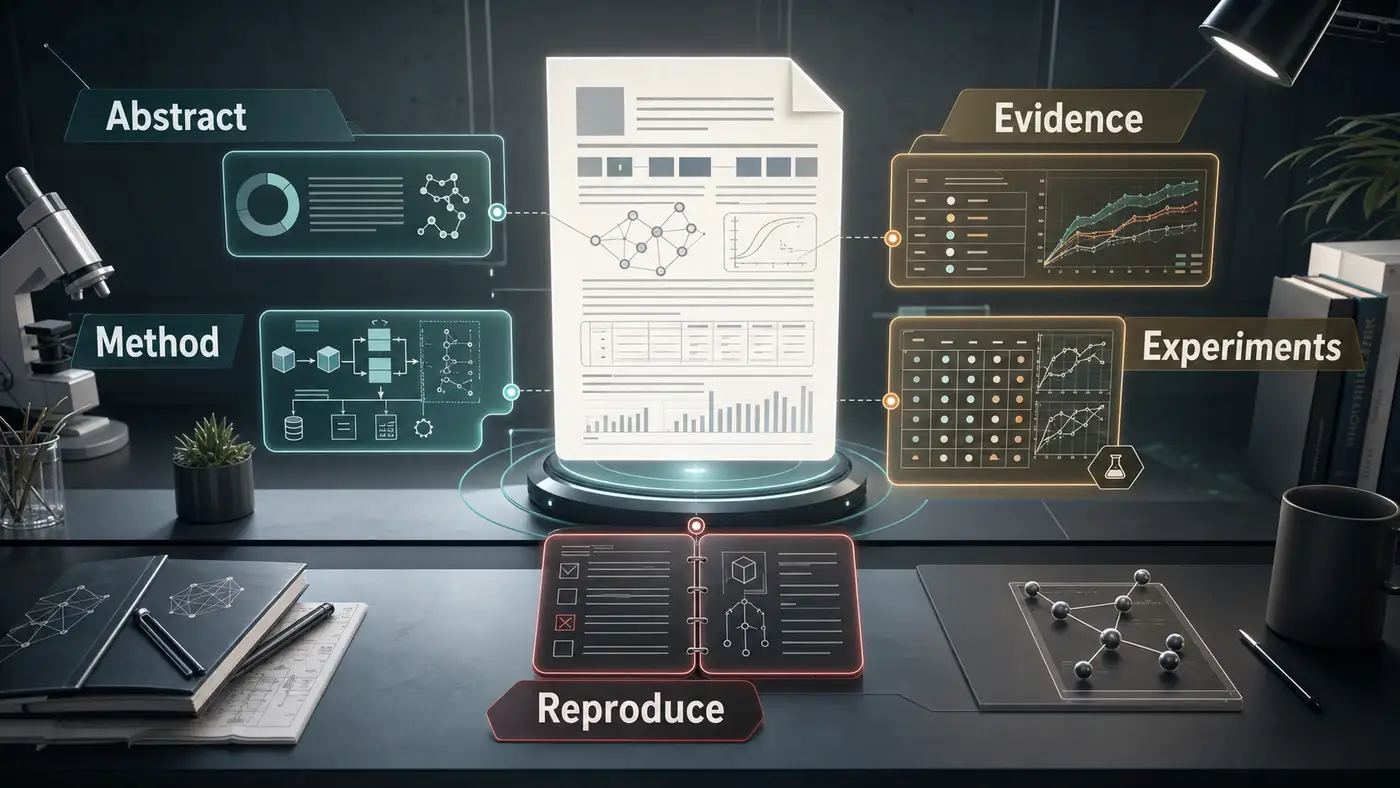
The AI paper is getting longer and more like a compressed package: the abstract is the conclusion, the method part is the algorithm assumption, the experimental table is the evidence, and there are many key details in the appendix, code, OpenReview discussion and project homepage. Just reading the paper from the beginning to the end will often get a false sense of familiarity: know what the author has said, but do not know what problem it solves, whether the evidence is enough, whether it can reproduce, and where else can we continue to do it.
This installment of the AI paper reading and reproduction course introduces a method that works for most AI methods papers. Use three reading passes to budget your time. Identify the problem, claims, method, supporting evidence, and a starting point for reproduction. Then use the experimental tables to assess the quality of the research. After reading, aim to write a one-page structured note answering four questions. What is the central hypothesis? Where is the fair baseline comparison? Under what conditions is the method most likely to fail? Which small claim would you test first in a reproduction?
Contents
- Why it is getting harder and harder to read AI papers
- Three-way reading method: from filtering to rebuilding
- Abstract and Introduction: Grasp the problem first, and do not rush to accept contributions
- Methods section: Restore the paper to tasks, assumptions, modules and objective functions
- Experimental tables: DataSet, Metric, Baseline, Ablation and statistical evidence
- Representative paper road map: how to choose training samples
- Intensive Reading Checklist
- Reproducing advice: start with the smallest claim
- Common misconceptions
- Training questions for graduate students to continue
- Summary
- References
Why it is getting harder and harder to read AI papers
Early machine learning papers usually revolve around a clear algorithm: problem definition, model, optimization, experiment. If the reader understands the model structure and loss function, he basically masters the main body of the paper. Today's AI papers are much more complicated. A LLM, Agent, multimodal or Reasoning Model paper, which may also contain pre-training data, post-training strategies, prompt templates, sampling parameters, BENCHMARK Selection, manual evaluation, LLM-as-judge, code repository, model card, failure cases in the appendix, and the project homepage that is constantly updated after release.
This brings three changes.
First, the body of the paper no longer contains all the reproducible information. ICLR 2026 Author's Guide still emphasizes Reproducibility Statement, which requires authors to explain which parts of the main, appendices and supplementary materials are supported for reproduction; AAAI-26 Reproducibility Checklist The details of pseudocode, data processing, code, SEED, computing power, software environment, metric, number of runs and statistical significance are clearly asked. If the reader reads the PDF main essay, it is easy to miss the material that really determines whether the experiment is trusted.
Second, the cost of interpretation of the experimental table rises. Large model papers often compare model scale, training data, reasoning budget, prompt, tool, retriever and evaluator at the same time. The high score in a table may come from the method itself, or it may also come from a stronger base model, a longer context, a larger sampling budget, a looser judge or data pollution. The 2025 review on AI Benchmark has listed issues such as data quality, contamination, construct validity, gaming, and selective reports as the core risk of evaluating trust. When reading the experimental table, the reader must first ask "Is this Benchmark really testing the abilities of the paper claim".
Third, AI-assisted reading papers have become common, but manual verification is also required. The RAG system of OpenScholar, PaperQA2 and other scientific literature RAG system description, search enhancement model can help researchers find and comprehensive papers; OpenScholar's Nature paper and official repository also emphasize Citation-Backed Synthesis, Open Datastore and ScholarQABench. They are suitable for clue discovery and cross-checking, but should not replace intensive reading. Especially when the system automatically generates roundups, citations and conclusions, the reader has to go back to the original text to check the claim, evidence and context.
Three-way reading method: from filtering to rebuilding
S. Keshav's short essay in 2007 How to Read a Paper Three reading methods are proposed. Its value is not "quick reading skills", but layering the reading goals: the first time to decide whether to continue, the second to understand the content, the third time to recreate the paper as if it were to be reproduced. AI intensive reading can follow this framework, but you need to extend the third pass to code, data, evaluation and reproducing experiments.
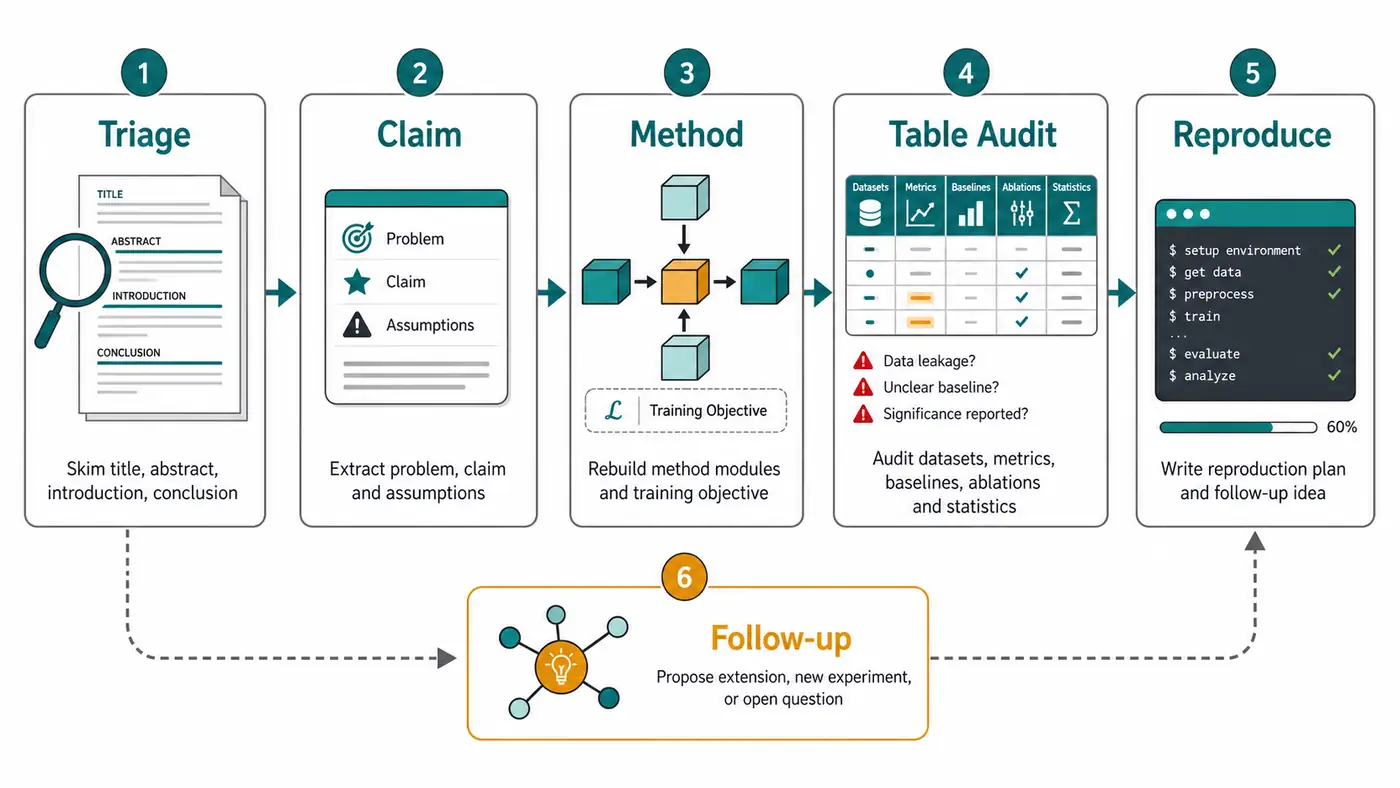
First pass: 10 minutes filter. Just look at the title, abstract, introduction, chart title, conclusion and list of references. The goal is to answer five questions: what tasks does it study? What is the core claim? What are the differences between existing jobs? What main evidence was used? Why do I need to read it? If these five questions cannot be answered, don't rush to enter the formula and realize.
The second time: 60-90 minutes to understand. Read the main text, key diagrams, method framework, experimental settings and main tables, but temporarily skip complex proofs, long appendices and implementation details. The goal is to be able to speak the paper in your own words: what is the input and output, where the model or algorithm is changed, what is the training goal, how the experiment supports claim, and the authors admit what limitations.
The third time: half a day to one day rebuild. Think of the paper as the object you want to reproduce, review, or continue to expand. Repaint the method diagram, list all the assumptions, check the formula dimension and training process, open the code repository, and find the data download method, configuration file, checkpoint, seed and log. At the end of the third pass, a reproduction note should be produced, rather than a bunch of scratched PDFs.
These three times are not necessarily done in a row. For a paper that "just understand", it is enough to add a second time; for a paper you want to reproduce, citation, submit a rebuttal or do follow-up, the third time is the core of intensive reading.
Abstract and Introduction: Grasp the problem first, and do not rush to accept contributions
The abstract usually compresses four types of information: problem background, method proposition, experimental conclusion and meaning packaging. Instead of translating the abstract, you should rewrite it into four fields.
The first is Problem: Which specific task or bottleneck does the paper try to solve? For example, is it to improve mathematical reasoning, reduce hallucinations, improve long context retrieval, or improve the performance of the model after compression? The more specific the problem, the easier it is to judge the later evidence.
The second is Advocate: What changes did the author claim to bring to his own approach? The claim can be performance improvement, data efficiency, interpretability, robustness, reproducibility, theoretical assurance or new Benchmark. Here we separate the "method name" and "Science Claim". A new module itself is not a contribution, unless it changes some observable.
The third is comparison object: Who does the author compare himself to? If the summary only says "outperforms strong baselines", but does not specify the baseline type, model size, data and evaluation settings, it should be marked as verified in the notes.
The fourth is form of evidence: The evidence comes from standard Benchmark, manual evaluation, ablation, theoretical proof, case analysis, or deployment log? Different evidence supports different conclusions. A Leaderboard score can only show that it performs better under the dataset and evaluation protocol, and cannot automatically launch "model can reason".
The introduction part should focus on whether the motivation chain is established. A good introduction usually starts from the real bottleneck, points out why the existing method is not enough, and then puts forward the key assumptions in this article. A common problem with weak introductions is: take "existing methods without using a certain module" as a gap, use "we can add a certain skill" as a research problem, or use an overly large vision to cover up a very narrow experimental setting. During the intensive reading, you can write a rhetorical question next to the introduction: If the method of this paper fails, which assumption is most likely to be wrong?
Methods section: Restore the paper to tasks, assumptions, modules and objective functions
The reading of AI method papers should not start with "the model looks complex", but should start with the task definition.
The first step is to write out the input, output and training signals. Is the input prompt, image, document, tool status, historical trajectory, or search result? Is the output token, action, embedding, reward, code patch or categorical label? Training signals come from manual labels, preference data, self-supervision, environmental feedback, verifier, synthetic data or distillation teachers? If the input and output are unclear, all the module diagrams below are just decorations.
The second step is to remove the module. Rewrite each module in the method diagram into a sentence "what does it receive, what is it, and why is it needed". For example, Retriever is responsible for candidate evidence, reranker is responsible for sorting, Generator is responsible for generation, Verifier is responsible for scoring, and Memory is responsible for cross-wheel status. Don't be fooled by the author's name: many new terms are just new combinations of existing modules. What really deserves attention is whether the flow of information and training goals between modules have changed.
The third step is to locate the objective function. For LLM papers, the key is not only the network structure, but also SFT, Preference Optimization, RLVR, Distillation, Contrastive Learning, Next-Token loss, Auxiliary loss, or Inference-Time Search. At least four things to check when reading the formula: what are the optimization variables, which modules the gradient flows through, and which items only exist at training, and whether the at inference time still needs additional models or tools.
The fourth step is the column hypothesis. Each method depends on the implicit premise: the search results are sufficiently relevant, the LLM Judge is reliable enough, the synthetic data distribution is close to the real task, the base model has the potential ability, and the verifier is not easy to be speculated. Can isolate variables. Intensive reading is not a complete negation of these assumptions, but knows where they are.
The fifth step is to redraw the minimum algorithm. Do not copy the paper diagram, but use your own symbols to write pseudocode: what to initialize, what to loop, which models to call, which intermediate variables to save, and what indicators are used to evaluate. If the paper does not provide enough details, this is the risk of reproducing, not the lack of reader's ability.
Experimental tables: DataSet, Metric, Baseline, Ablation and statistical evidence
The experimental part is the easiest part of AI papers to "understand but misread". It is recommended to check the five layers when reading the form.
The first layer is DataSet. Dataset version, division, filtering, deduplication, language, domain and leak risk are all recorded. Many papers refer to the same BenchMark name, but actually use different Splits, different Prompts, different FEW-Shot examples, or different post-processing. If the paper does not specify the data version, it should be marked for manual verification.
The second layer is Metric. Accuracy, F1, BLEU, ROUGE, Pass@K, Win Rate, Judge Score, Human Preference, and Success Rate do not measure the same ability. Especially in the generation task, metric often only overrides a part of the output properties. When reading the table, ask: Does this indicator directly correspond to the claim in the abstract? Is there a reported variance, Confidence interval, or multiple SEEDs?
The third layer is Baseline. Fair Baseline is comparable at least on model scale, training data, reasoning budgets, retrieval corpus, tool permissions, and evaluation protocols. If the new method uses a stronger base model or more test-time compute, but attributes the improvement to a small module, be cautious.
The fourth layer is ablation. Ablation is not as simple as deleting modules one by one, but to isolate variables. A good ablation should be able to answer "Where does the improvement come from"; a weak ablation only proves that "deleting things will get worse". If the paper does not report negative results, failure cases, or control experiments, the reader should reduce the trust in the interpretation of the mechanism.
The fifth layer is statistical evidence. AAAI reproducibility checklist clearly requires authors to explain the number of runs, randomness, significance test and result distribution. A small increase in AI papers is very common. Without multiple SEED, standard deviation or statistical tests, the difference of 0.2-0.5 points may be just noise. For LLM-as-judge results, also check Judge Prompt, model version, position offset, length offset, and artificial consistency.
You can rewrite each main result table into the following table reading template.
| check | Questions to record | risk signal |
|---|---|---|
| Dataset | Name, version, split, filtering, deduplication, whether public | Only write the benchmark name, not the version and processing |
| Metric | Indicator definition, calculation script, whether to align with claim | Replacing multidimensional capabilities with an overall score |
| Baseline | Model scale, data, reasoning budget, tool permissions | Baseline is too old or set is weaker |
| Ablation | Whether to isolate variables, whether to report negative results | Only delete the module, no explanation mechanism |
| Statistics | SEED, number of runs, variance, significance | Only report the best results |
| Reproducibility | code, configuration, checkpoint, log | Code is not published or does not match the paper |
Representative paper road map: how to choose training samples
To train the intensive reading ability, it is best not to randomly grab the paper, but to construct a "sample gradient".
Basic method samples. Select 3-5 articles from classic papers such as Transformer, BERT, GPT, InstructGPT, DPO, LoR, and RAG. They are suitable for practicing task definitions, structure diagrams, objective functions and historical locations. Don't pursue all the classics at once, but produce a page of structured notes for each article.
Sample of modern systems. Try the DeepSeek-R1 technical report, OpenScholar/ScholarQABench, PaperQA2, or a recent paper on agents or multimodal systems. They give you practice reading beyond the main text: technical reports, code repositories, model cards, data descriptions, evaluation scripts, and reproduction studies. Many replication studies followed DeepSeek-R1 in 2025. Surveys describe how researchers reconstruct key capabilities through SFT, RLVR, data construction, and training procedures when the original implementation is only partly public. These papers show how a reproduction can test the limits of a claim even when rerunning the original code is impossible.
Evaluation and reproducing samples. Select RewardBench, HarmBench, JailbreakBench, Scholarqabnch, SciFact, AI Benchmark Meta-Review, MLRC to reproduce papers, etc. They are suitable for training and reading experiments: what is the structural hypothesis of the Benchmark, who is the labeler, whether the task represents the real ability, and whether the leaderboard may be polluted.
Open review samples. Some of the papers in ICLR, TMLR, and NeurIPS are discussed in OpenReview. OpenReview officially stated that its platform supports open peer review, open discussion and API. The value of reading public reviews is to see how reviewers question Novelty, Evidence, Baseline, Clarity and Reproducibility. For graduate students, the OpenReview page of a paper is often more able to train judgment than a second-hand blog.
Intensive Reading Checklist
After reading an AI paper, at least you should be able to complete this list.
Summary in one sentence: What problem does this paper solve, what core method to use, and what CLAIM is supported on which evidence?
the importance of the problem: Is this problem real? Is it a capability bottleneck, efficiency bottleneck, safety bottleneck, evaluation bottleneck, or just a local optimization on the benchmark?
Methods of new methods: Does the new idea come from task settings, model structure, training goals, data structure, reasoning strategy, evaluation protocol, or system integration?
key assumption: What conditions does the author default to? Are these conditions still valid under real tasks, model scales, different languages or different data distributions?
Strength of evidence: Does the main experiment, ablation, error analysis, statistical test, manual evaluation and reproduction experiment jointly support the claim in the abstract?
Reproduction Entrance: Is the code public? Is the dependency fixed? Is the data available for download? Is there a checkpoint, configuration, SEED, training log and review scripts?
failure boundary: What are the examples, tasks, scales, languages, hardware or data conditions of the paper that may fail? Did the author report these failures?
scalable issues: If you want to do follow-up, should you change the method, data, benchmark, change the theoretical explanation, or do negative results reappear?
Reproducing advice: start with the smallest claim
The most common problem with novice reproducing papers is that the goal is too large: one wants to reproduce all the tables of the entire paper. A more reliable route is to choose a minimum claim.
The minimum claim should meet three conditions: it is part of the core conclusion of the paper; it has clear input, output and indicators; it can be completed within your computing power budget. For example, "a certain Reranker can improve the accuracy of literature search references", "a certain training target is better than SFT on an open mathematical dataset", "Ablation degradation after a memory" may be the smallest claim. Conversely, "reproducing the full power of a closed-source model" is generally not a suitable target.
Create environment matrices before reproduction: Python, CUDA, PyTorch, Transformers, vLLM, data download script, CheckPoint version, random seed, GPU model and video memory. Then run the minimum demo provided by the author to confirm that the code can be executed; run a small-scale sample to confirm that the data processing is consistent with the metric calculation; finally, it is extended to the paper table.
Failure to keep when logging logs. MLRC 2026 became the official Track of NeurIPS, and reproduction, replication, generalization tests, negative results and partial failures are more formally regarded as scientific contributions. The reproduction report not only says "I ran out", but also wrote "What is the place where I didn't run out, what is the possible reason, and under what conditions the paper claim is established".
Common misconceptions
First, take the abstract as the conclusion. Abstract is the author's strongest expression, not independent evidence. All CLAIMs go back to tables, diagrams, appendices, and code checks.
Second, just look at the method diagram. Method diagrams are usually beautified, hiding data filtering, prompt, hyperparameters and failed branches. The real algorithm is in pseudocode, training scripts and configuration files.
Third, take the Benchmark score as a proof of ability. Benchmark is a measurement tool, not the ability itself. Especially for 2025-2026 large-model papers, data pollution, selective reporting and Evaluator deviation must be checked.
Fourth, read-only accept papers, not reviews. An open review can expose the controversial points of the paper. Even if the paper is finally received, the weakness in the review may be the entrance to you doing follow-up.
Fifth, over-reliance on AI summary. The AI tool can help you find papers, extract citations, and generate a list of questions, but cannot judge whether the experiment is fair for you. For each CLAIM, it should go back to the original text and the first-hand link.
Sixth, there is no product after reading. Reading without notes, tables, pseudocode and reproduction plans will soon degenerate into "feeling to see". The goal of scientific research training is to convert reading into reusable assets.
Training questions for graduate students to continue
Choose a paper for the LLM method in the past year, and write 800-word structured intensive reading notes in three readings. Only the main text and appendices of the paper are allowed to be quoted, and second-hand blogs are not used.
Select a main result table and reconstruct the DataSet, Metric, Baseline, Ablation and statistical evidence list. Mark each unclear point as "Verified / To be Verified / Not Verified".
Select an ICLR paper with OpenReview discussions, and classify the main questions of Reviewer as novelty, evidence, clarity, baseline, reproducibility or Ethics.
Choose an open source paper, and only reproduce a minimum claim. Commands, environment, SEED, log, result table, and failure analysis are required.
Select an AI auxiliary literature review or Scientific RAG paper, check its Citation Accuracy evaluation method, and manually check whether 10 citations really support corresponding sentences.
Create a small field map with 10 papers: each article only writes about problems, methods, evidence, limitations and a possible follow-up. The training goal is not to "collect papers", but to form a problem space.
Summary
Intensive reading of AI papers is not linear reading, but evidence auditing. The first time the judgment value is not worth continuing, the second pass understands the claims and methods, and the third time rebuilds like the repeater. The summary tells you what the author wants you to believe; the method part tells you what hypotheses the belief depends on; the experimental table tells you whether the evidence is sufficient;
For graduate students, the intensive reading ability of the paper is essentially a pre-training of research ability. You are not to remember more model names, but to form judgments: what is important, what method is just packaging, what experiment is really convincing, what failure is worth continuing to chase. Subsequent articles will continue to expand this framework to the Related Work map, method dismantling, experimental reading, benchmark trap, LLM paper reproduction, ablation study and proposal formation.
References
Search date: 2026-07-22. The following priority lists papers, official guides, official project pages, arXiv/OpenReview/Conference page and open source repository. The paper version, code repository status, benchmark data, model name, meeting policy and evaluation conclusions may change, and it is recommended to manually verify before publication.
- S. Keshav, How to Read a Paper, ACM SIGCOMM Computer Communication Review, 2007. https://doi.org/10.1145/1273445.1273458
- ICLR, ICLR 2026 Author Guide, official conference guide, 2026. https://iclr.cc/Conferences/2026/AuthorGuide
- ICLR, ICLR 2026 Reviewer Guide, official conference guide, 2026. https://iclr.cc/Conferences/2026/ReviewerGuide
- AAAI, AAAI-26 Reproducibility Checklist, official author kit, 2025-2026. https://aaai.org/conference/aaai/aaai-26/reproducibility-checklist/
- NeurIPS Blog, MLRC 2026: Reproducibility as an Official Track at NeurIPS, official blog, 2026. https://blog.neurips.cc/2026/05/04/mlrc-2026-reproducibility-as-an-official-track-at-neurips/
- ML Reproducibility Challenge, MLRC 2026, official site, 2026. https://reproml.org/
- OpenReview, About OpenReview, official platform page. https://openreview.net/about
- Papers With Code, About Papers With Code, official page. https://cs.paperswithcode.com/about
- ACL Anthology, Anthology Identifiers, official documentation. https://aclanthology.org/info/ids/
- Asai et al., OpenScholar: Synthesizing Scientific Literature with Retrieval-Augmented Language Models, arXiv 2411.14199 / Nature 2026. https://arxiv.org/abs/2411.14199
- Asai et al., Synthesizing scientific literature with retrieval-augmented language models, Nature, 2026. https://www.nature.com/articles/s41586-025-10072-4
- AkariAsai / OpenScholar, official implementation repository, GitHub. https://github.com/akariasai/openscholar
- Future House, PaperQA2 repository, GitHub. https://github.com/Future-House/paper-qa
- Future House, Journey to superhuman performance on scientific tasks, official research blog, 2024. https://www.futurehouse.org/research/engineering-blog-journey-to-superhuman-performance-on-scientific-tasks
- Wadden et al., Fact or Fiction: Verifying Scientific Claims, EMNLP 2020 / arXiv 2004.14974. https://arxiv.org/abs/2004.14974
- allenai / scifact, SciFact data and models, GitHub. https://github.com/allenai/scifact
- Lo et al., S2ORC: The Semantic Scholar Open Research Corpus, ACL 2020 / official repository. https://github.com/allenai/s2orc
- Semantic Scholar, Open Data FAQ, official page. https://www.semanticscholar.org/faq/open-data
- Eriksson et al., Can We Trust AI Benchmarks? An Interdisciplinary Review of Current Issues in AI Evaluation, arXiv 2502.06559, 2025. https://arxiv.org/abs/2502.06559
- Zhang et al., 100 Days After DeepSeek-R1: A Survey on Replication Studies and More Directions for Reasoning Language Models, arXiv 2505.00551, 2025. https://arxiv.org/abs/2505.00551