Date:2026-07-24
Who this is for: Graduate students in AI, NLP, machine learning direction; ready to write a newcomer to scientific research who writes Related Work, opening report, recurrence report and Survey; engineering readers who want to upgrade their papers from "Favorite List" to "Research Problem Map"
search date:2026-07-24
Abstract
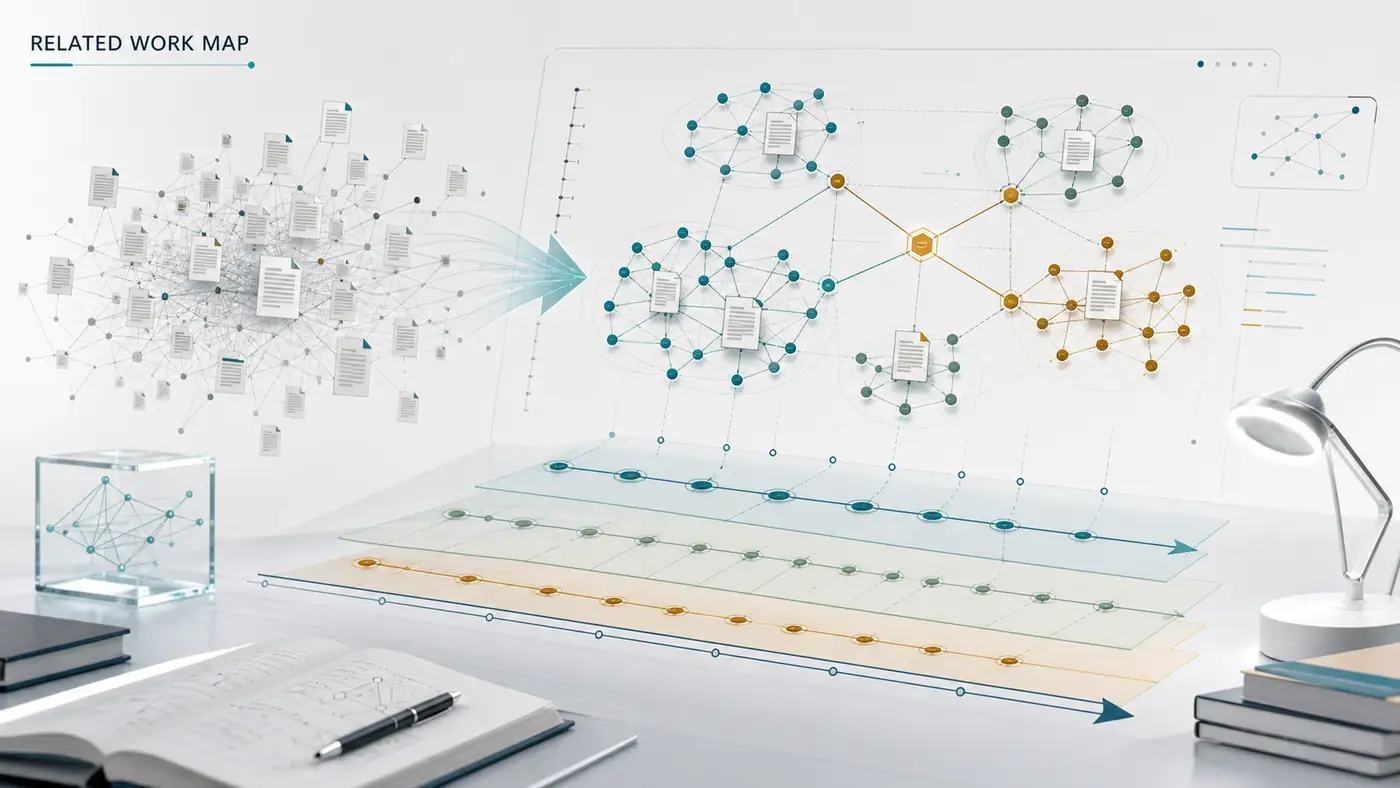
Related Work is not a polite background introduction in the paper, but a skeleton of research training. It answers three questions: where does this question come from, what has been solved by existing methods, and which link is the current paper or your proposal is going to change. The root cause of many graduate students to read papers is not enough to read, but not to show the relationship between the paper: which are direct competitors of the same task, which are the evaluation lines of shared datasets, which are the sources of method components, and which are just similar names but different questions.
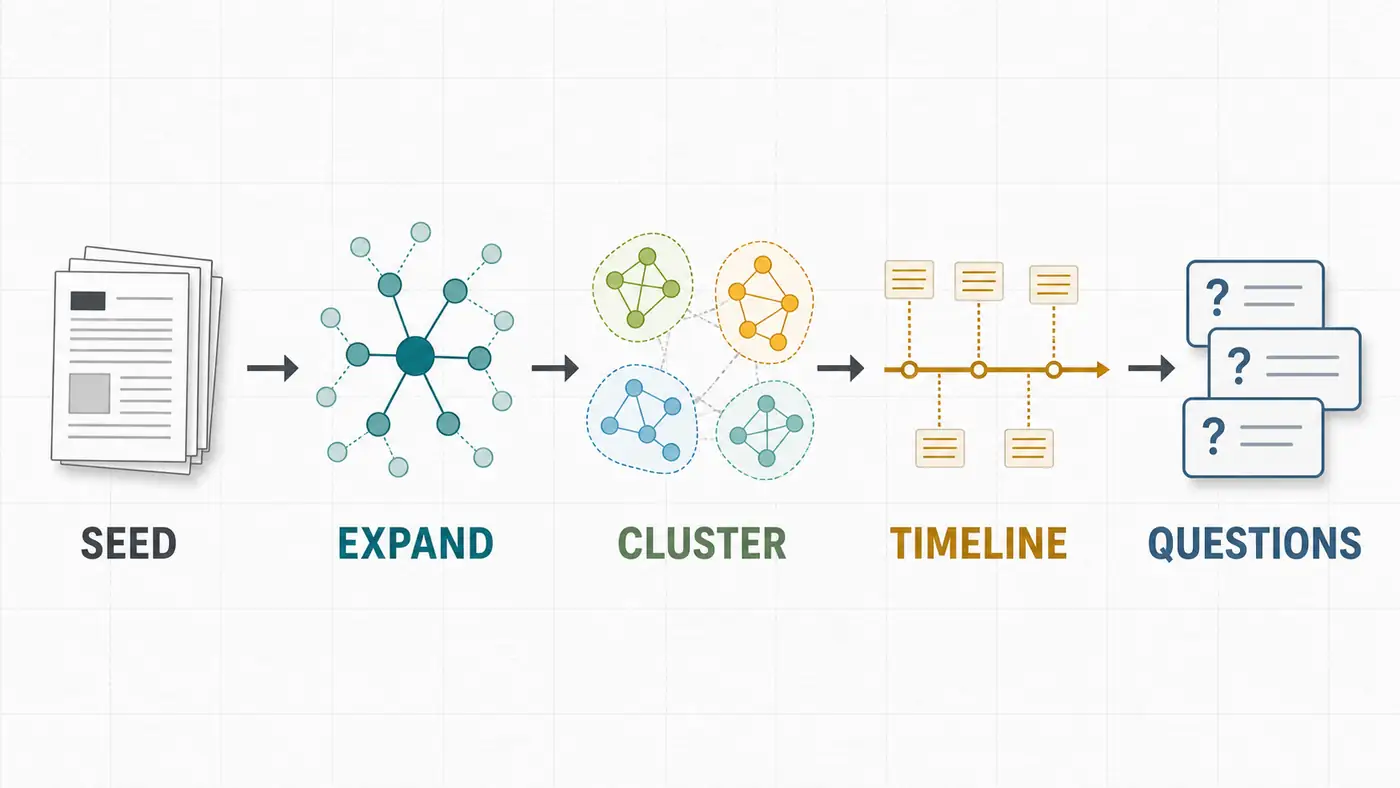
This article gives a set of "Related Work Maps" practice: from 3-5 Starting from the seed paper, the citation network is used to expand the candidate literature, the text and cited signal are clustered, the technical branches are sorted with the timeline, and each branch is compressed into a verifiable research problem. We will also discuss SPECTER, SciNCL, Semantic Scholar, OpenAlex, arXiv in combination with classical bibliographic methods, such as bibliography coupling, co-citation, science mapping New tools for AI research to read API, OpenScholar and 2025 Related Work Generation papers. The key point is not to teach you to use a certain software to draw a beautiful network map, but to train a scientific research ability: turn the literature list into a research context, and turn the research context into a reproducible, questionable, and progressive topic.
Contents
- Why Related Work Maps Are More Important than Document Lists
- What questions should a good map answer
- Five-step workflow: Seed, expansion, Cluster, Timeline, Questions
- Three types of reference networks: direct reference, co-citation, document coupling
- Representative papers and tools roadmap
- How to Name Clusters: From Keywords to Claim
- Method / Experimental Comparison Table How to Do
- Reality: Build your own literature diagram with the smallest script
- What can LLM help, what can't you do for you
- Common misconceptions
- Research questions for graduate students
- Summary
- References
Why Related Work Maps Are More Important than Document Lists
Many people's Related Work is written as "heap summary in the order they have read": what A does, what B does, what does C does, and finally this article is different. The problem with this way of writing is that it does not explain the relationship between the papers. After reading it, the reader only knows that you have read some papers, but do not know why this direction is formed, where the dispute is, and which variable determines the method fork.
There are at least three layers of really useful Related Work maps. The first floor is problem layer: How task definition, input and output, constraints and evaluation objectives change. The second floor is methodology: How to fork the model structure, training objectives, retrieval mechanism, reasoning strategy, data structure or security constraints. The third layer is evidence layer: Which DataSet, Metric, Baseline, Ablation and reproduction materials support these branches. Only write abstracts, covering a small part of the method layer; doing a map will force you to check both problems and evidence at the same time.
This matter is especially important in AI research 2025-2026. The number of papers has grown rapidly, and the entrances such as arXiv, OpenReview, ACL Anthology, NeurIPS, ICLR, ICMML, etc. are updated at the same time; the same concept is often discussed by different communities with different names; new model technology reports, Benchmark The paper and reproduction reports do not necessarily appear in the same channel. It is easy to get a bunch of "looks related" papers by searching only by keywords; only by relying on the number of citations, it is easy to miss new but key work; only relying on LLM to summarize, it is easy to write the correlation very smoothly, but confuses the task boundary and the source of reference.
Therefore, the Related Work map is not the last step of writing, but should be placed in the early stage of research. It helps you decide which one to intensively read next, which claim to reproduce, which branch to find GAP, and whether an existing paper has answered your thoughts. For graduate students, a map is closer to the ability to open a question than a hundred collections.
What questions should a good map answer
Before making a map, it is clear that the map is not "all-field encyclopedia". It is to serve a research action. Different actions require different granularity.
If you are going to intensively read a method paper, the map should answer: who is the direct precursor of this paper, whether the difference between it and the baseline is real, which work its modules come from, and which experimental settings can best verify its core assumptions.
If you are going to write a recurrence report, the map should answer: which papers share datasets and evaluation scripts, and which papers are comparable Baseline, which subsequent work questioned or reused the results of the original paper, which code repository, issue, model card and configuration files can be cross-checked.
If you are going to open the question, the map needs to be answered: what are the stability problems, which disputes, and which have not been fully tested in the direction; your follow-up idea is to make up for a gap Baseline, change a hypothesis, change a data distribution, or propose a better evaluation protocol.
A good map can usually output five specific products:
| Product | Effect | Minimum requirements |
|---|---|---|
| seed paper table | Define entry | 3-5 cover tasks, methods, evaluation or review |
| Candidate Literature Pool | Avoid read-only familiar papers | Annotation source: citation, citation, recommendation, keywords, conference proceedings |
| cluster diagram | View Tech Branches | Each cluster has a name, a representative paper and a boundary |
| time line | Look at the evolution of the problem | Dimension task definition, data set, model hypothesis and evaluation changes |
| List of research questions | Connection topic | Each problem corresponds to reproducible evidence or executable experiments |
Note the last one. The end of the Related Work is not "I know the direction", but "I can ask a well-founded question". If the map cannot export research questions, it is just a visual favorite.
Five-step workflow: Seed, expansion, Cluster, Timeline, Questions
Step 1: Seed, select the Seed paper
Don't search for 100 articles from the start. First choose 3-5 seed papers, each representing a different role.
Task Definition Papers: Ask or standardize questions, such as a BenchMark, DataSet, Evaluation Protocol, or Problem Formulation. It determines what "what is success" in the direction.
Method Representative Paper: Propose a structure, training goal or reasoning paradigm that is widely reused in the future. It decides "how to do it" in the direction.
Overview or Route Papers: Organize existing branches. It is not necessarily up to date, but can give you the initial classification.
Reproduction / Negative Results / Critique Papers: Point out the limitations of existing conclusions. It determines that you will not read only along the author's narrative.
Latest paper or technical report: Represents recent changes. It helps you check whether new data, new models, and new reviews for 2025-2026 have changed old conclusions.
Too few seed papers will be biased, too many will be messy. For a training camp topic, it is recommended to start with 5 articles: 1 classical foundation, 1 recent review, 1 strong method, 1 review or data paper, 1 Critique / Reproduction / Latest system.
Step 2: Expand, Extend Reference Network
Extensions are not just clicking "Related Papers". You need to record why each candidate paper entered the pool.
The first type is backward citation: Who is the seed essay cited? This can find theoretical foundation, task source, baseline and method components. The second category is forward citation: Who cited the seed paper. This can find subsequent improvements, reproductions, disputes and alternative paths. The third category is co-citation: Which papers are often cited together by subsequent papers. This often corresponds to a common problem or family of methods. The fourth category is bibliographic coupling: Which papers cited similar references. This can find adjacent work in the same period and under the same problem setting. The fifth category is text / embedding similarity: A paper with similar title abstract but not strongly cited, suitable for supplementing new papers and cross-community papers.
Here you can use Semantic Scholar, OpenAlex, arXiv, ACL Anthology, OpenReview and conference Proceedings. The Semantic Scholar API covers papers, authors, citations, Venue, SPECTER2 Embeddings and recommendation services; the OpenAlex Works API provides Works retrieval, filtering, sorting, referenced_works、related_works、cited_by_count etc. fields; arXiv API support search_query、id_list, paging and sorted by Submitted/Updated Date. Tools are only responsible for expanding the recall, and researchers are responsible for screening reasons.
Step 3: Cluster, clustering rather than classification
The classification is usually when you have a label first, and then put the paper in; clustering is to look at the relationship between the paper first, and then name the relationship. The Related Work map is recommended to be clustered first and then named, because your initial classification is likely to come from a review or author's words, which may not be suitable for your problem.
Clustering can be superimposed with three signals:
| Signal | suitable for discovery | Common risks |
|---|---|---|
| citation | Academic heritage, baseline, the same community | There are few citations in new papers, and cross-community papers may be missed |
| textual resemblance | subject, task, method terms | easily misled by buzzwords |
| Experimental settings | DataSet, Metric, Model Scale, Reasoning Budget | Need to manually extract, the cost is high |
Start with broad clusters of 5–15 papers. More than 20 usually means the label is too broad. A cluster of just 1 might be an isolated paper, a new branch of research, or a sign that your search missed relevant work. Give each cluster a name that identifies its research question. “Locating evidence in long contexts,” “using graph structure to guide reading order,” “citation-backed scientific synthesis,” and “detecting benchmark contamination” tell readers more than “method A” or “method B.”
Step 4: Timeline, draw the technical Timeline
The same cluster should be read by the timeline. The timeline is not a sort of published year, but a sequence of "how the question definition and evidence standards evolve".
You can record five columns for each branch: paper, year/Venue, main problem, key method, evidence material. Focus on the change points: when the new dataset will appear, when the baseline will be changed from the traditional model to LLM, when will the evaluation shift from the summary level similarity to the Citation-level correctness, and when the open source code or replicated material becomes the community concern.
Taking the automatic Related Work Generation as an example, early Work often approximates the task to multi-document summary or Citation Text Generation; 2024 EMNLP's Related Work and The Citation Text Generation Survey system organizes RWG's historical task definitions and challenges; SDP 2024 includes structured paragraphs and novelty statements; 2025 Select, Read, and Write of ACL Findings introduces full-text reading, shared working memory and graph-aware reading order into the framework. This timeline description: The core difficulty of the direction is not to "generate a smooth Text", but choose literature, understand the relationship, organize the structure and prove novelty.
Step 5: Questions, turn the map into a research problem
The last step is the easiest to overlook. Write at least one question for each cluster, and the format can be tested as much as possible:
- If the Citation Expansion is replaced with Embedding Retrieval, how will the coverage and noise of the candidate literature change?
- If you only use the abstract and not the full text, what will be missed in the method difference in the Related Work and the novelty statement?
- How to evaluate Citation CorrectNess, Coverage, Contrastiveness and Hallucination if you use LLM to generate a literature review table?
- If there are few citations in a new paper in one direction, how to avoid the importance of citing the network systematically underestimating it?
- If a BenchMark becomes mainstream, does the subsequent papers over-optimize the Benchmark and ignore the external distribution?
These problems can be directly turned into reproducing experiments, data labeling tasks, Survey subsections or opening proposals. The value of the map is here: it advances reading from "understanding the existing conclusion" to "design next step evidence".
Three types of reference networks: direct reference, co-citation, document coupling
When making a Related Work map, the three most common relationships are most likely to be confused.
References directly There is a directional edge: Paper A cited paper B. It often represents the source, background, contrast object or evidence supported by the method, but cannot be simply understood as "approval". Some references are criticism, and some are just datasets or tool references.
Guided together It is the subsequent literature citing two papers at the same time. In 1973, Henry Small proposed Co-Citation, using "the frequency of the two documents being cited together" to describe the relationship. It is suitable for finding paper groups that are shared by the community as the same problem or on the same basis. The disadvantage is that it lags behind: the new paper needs time to accumulate and be cited.
Literature Coupling It is two papers citing similar references. In 1963, M. M. Kessler proposed Bibliography Coupling to measure the similarity of the paper with shared references. It is suitable for finding the work of the same topic in the same period, because the references have been determined when a paper is published. The disadvantage is that the relationship is distorted if the author misses or is a strategic reference.
Derek de Solla Price's 1965 Networks of Scientific Papers regards Scientific Papers as a network structure, which has laid an important perspective for later Science Mapping. Subsequent systems such as VOSviewer, CiteSpace, PageRank, Semantic Scholar Literature Graph, OpenAlex, etc., all expand this idea at different granularities.
For AI readers, the most important thing is not to memorize these terms, but to know that they answer different questions separately:
| Relationship | Problem | Suitable for use |
|---|---|---|
| References directly | What did A borrow or respond to from B? | Find method sources, baseline, dataset |
| Guided together | Which papers will the community look at together? | Find Classic Foundations and Stability Subfields |
| Literature Coupling | Which papers stand on the basis of similarity | Find a contemporaneous competition job and a near neighbor branch |
| textual resemblance | Which papers talk about similar topics | Supplement new papers, cross-community papers |
| Experiments are similar | Which paper evidence is comparable | Reproduce and experimental control |
A reliable map cannot use only one edge. Only direct citations will miss papers that are similar but not cited to each other; only Embedding will mix the papers with similar terms but different tasks; only the number of citations will underestimate the new paper and small community work. In practice, it is recommended to use the reference edge as the skeleton, the text similarity as a recall, and the experimental similarity as the final screening.
Representative papers and tools roadmap
| Time | Data | Effect |
|---|---|---|
| 1963 | Kessler, Bibliographic coupling between scientific papers | Identify paper relationships with shared references |
| 1973 | Small, Co-citation in the scientific literature | Research thematic structures with co-cited identification |
| 1999 | PageRank technical report | Estimate the importance of the link structure, inspire the sorting of graphs |
| 2010 | VOSviewer, Scientometrics | Representation of bibliometric maps and visualization tools |
| 2018 | Construction of the Literature Graph in Semantic Scholar | Practice on the construction of large-scale academic literature maps |
| 2020 | SPECTER, ACL | citation-informed scientific paper embeddings |
| 2021 | PRISMA 2020 statement | System overview report specification and retrieval process transparency |
| 2022 | SciNCL, EMNLP | Comparison and learning of scientific documents with Citation Graph Embedding |
| 2024 | Related Work and Citation Text Generation survey, EMNLP | RWG Mission History and Challenge Overview |
| 2025 | Select, Read, and Write, ACL Findings | Full text RWG, multi-agent reading and graph perception strategies |
| 2026 | OpenScholar, Nature / GitHub | Retrieval-Augmented LM system for scientific literature synthesis |
This route shows that the Related Work map has two technical traditions. One from bibliometrics: citing network, clustering, visualization, scientific map. The other one comes from NLP/LLM: the paper represents learning, literature retrieval, Citation-Aware Generation, and long document synthesis. Research and training should combine the two lines: use bibliometrics to ensure the structure, use NLP tools to improve the recall and sorting efficiency, and use manual review to ensure that the boundary of the problem and the interpretation of evidence are not replaced by automation tools.
How to Name Clusters: From Keywords to Claim
After clustering, the most critical action is naming. The naming is not to paste keywords, but to compress the research context.
The poor names are "RAG class", "Agent class" and "LLM class". These labels are too large to explain the difference. Better naming to include object, mechanism, evidence or dispute. For example:
- "Citation-Backed Scientific Synthesis": The object is the synthesis of scientific literature, and the mechanism is the support of retrieval and reference;
- "Graph-Aware Reading Order for RWG": the object is the Related Work Generation, and the mechanism is the graph-perceived reading order;
- "Benchmark Contamination Detection": the object is to evaluate pollution, and the evidence is a detection agreement;
- "Full-Text vs Abstract-Only Literature Understanding": The dispute is whether the full text information is necessary.
Three steps can be used when naming. First, list 5 articles within the cluster representing the main claim of the paper. Second, look for these CLAIM shared variables: tasks, data, method components, evaluation metrics, or failure conditions. Third, write variables as a discussable question, not a noun. For example, do not write "Scientific RAG", but write "Whether search in Scientific document synthesis, whether RERAANKING and CITIATION VERIFICATION are enough to reduce illusion".
If a cluster is difficult to name, there are usually three possibilities: the candidate papers are too complicated and need to be split; your understanding of the paper is still at the abstract layer; Bridge essays are important, because good follow-up ideas often come from between two clusters: move the evaluation protocol of one branch to another, and turn the failure case of one branch into the data structure of another branch.
Method / Experimental Comparison Table How to Do
The Related Work map will eventually fall to the table. Tables are not to tuck into the paper, but force you to align variables. It is recommended to make at least two tables.
The first one is Comparing the methods:
| Paper | question definition | enter information | core mechanism | Export | key assumption |
|---|---|---|---|---|---|
| Essay A | Generate Citation Sentence | Summary + Reference Context | Multi-Document Summary | single sentence or paragraph | The abstract is sufficient to represent the paper |
| Essay B | Structured Related Work | Multiple reference papers | Theme Segment + Novelty Statement | Many paragraphs | good RWS should explicitly state novely |
| paper c | Full text RWG | Full text Sections + Graph | selector / reader / writer agents | RWS draft | Reading sequence and relationship modeling affect quality |
The second one is Evidence comparison table:
| Paper | data source | metric | baseline | Is the full text | Is it open source | Main risk |
|---|---|---|---|---|---|---|
| Essay A | ACL / Reference Sentence | ROUGE et al | abstract model | No | Part | Indicators are similar to words |
| Essay B | Self-built structured data | Structure and Novelty Metrics | SOTA LM | Part | Need to be checked | Novelty judgment subjective |
| paper c | full text data | Automatic + manual assessment | Multiple base models | Be | Code data disclosure | High cost, the graph structure depends on the quality of metadata |
Form to serve judgments, do not pursue the more columns the better. Each column should help you answer a question: Are these papers really comparing the same thing? Do their evidence support claims? If I want to reproduce, what is the minimum controllable variable?
Reality: Build your own literature diagram with the smallest script
For engineering background readers, it is recommended to do a minimum reproducible experiment: enter 5 arXiv / DOI / ACL Anthology ids, and output a 50-100 candidate paper map.
The steps are as follows:
- Prepare the seed table:
seed_id, title, year, venue, role, why_seed. Don't just save the title, save the DOI, arXiv ID, ACL ID, or Semantic Scholar paperId. - pull metadata: Use Semantic Scholar or OpenAlex to get Title, Abstract, Year, Venue, Authors, References, Citation Count, Open Access PDF. The API returns fields will change, and the original JSON will be preserved in the script.
- Extended Candidate Pool: Each SEED takes backward citations, forward citations, recommended papers and keyword search results. Each candidate record
source_reason, for examplecited_by_seed_1、shares_references_with_seed_2、s2_recommendation. - Deduplication and filtering: Press DOI, arXiv id, ACL id, title fuzzy match to deduplicate. Filter records that are clearly irrelevant, non-paper pages, missing abstracts and inaccessible.
- edge of computation: directly referenced from the metadata; the document is coupled with Jaccard or Overlap shared with references; the text edge is marked with a title + abstract embedding; DataSet/Metric.
- Clustering and Visualization: Choose one with NetworkX/Graph/Gephi/VOSviewer/Cytoscape. The size of the node can be referenced within the year or artificial importance, the color is clustered, and the edge type is line type.
- 20 Representative Papers for Manual Review: Read at least 2-3 articles for each cluster, do not directly trust the cluster label.
- Output map notes: Write a claim, a sentence of evidence, a limitation, and a follow-up for each cluster.
This minimum experiment does not require the pursuit of fully automatic. On the contrary, 20 manual labels represent the most valuable part of the training. Automation is responsible for recall and visualization, and the researchers are responsible for judging which relationships are explanatory.
What can LLM help, what can't you do for you
LLM is useful for the Related Work map, but in the right place.
It is suitable for four types of auxiliary: organize the paper title abstract into the initial label; extract dataset, metric, baseline and CLAIM; compress a clustered paper into an abstract to be verified; generate an omission check problem according to the existing map. OpenScholar and other retrieval-augmented scientific synthesis system descriptions, specifically for the search, RERAANKING, CItation-Backed Generation and Citation of scientific literature Verification can significantly improve the coverage and reference reliability of ordinary LLMs in document synthesis. Its GitHub repository also shows that the system includes retrieval, Reranker, Self-Feedback, Posthoc Attribution and other components, instead of simply letting the model answer from memory.
Three judgments remain yours. First, relevance depends on your research question, even when titles and abstracts look similar. Second, an LLM can extract a table, but you must check whether the experiments support the claim, including the fairness of comparisons, contamination, statistical significance, and differences in baseline settings. Third, verify the citations before weaving them into an account of prior work. Both the EMNLP 2024 survey on related work generation (RWG) and the ACL Findings 2025 study on full-text RWG highlight the difficulty of selecting and organizing papers, modeling their relationships, and articulating what is new. Those are precisely the skills that research training should develop.
The practical principle is: every Related Work statement generated by LLM must be traced back to the nodes, edges and original texts in your map. If there is no chain of evidence, it is only used as a draft.
Common misconceptions
Myth 1: The bigger the map, the better. Graphs of 1000 nodes are usually of no reading value. The training camp is recommended to control 50-100 candidates, 15-30 key points, and 5-8 intensive reading. The map should be explained, not just the pursuit of the whole.
Myth 2: The number of citations is equal to the importance. The number of references is affected by the year, domain size, tool attributes, and review references. New papers, negative results, and cross-domain papers may be less but critical. You can use the number of references to sort, but you can't use it instead of judgment.
Misunderstanding 3: Treat similar papers as the same paper. The title says "Agent Memory" or "Scientific Discovery", which does not mean that the task, input, metric and failure conditions are the same. The Related Work map must be marked with the problem definition.
Misunderstanding 4: Just look at the author's citation, not the subsequent citation. The author's citation tells you where the paper comes from, and the subsequent citation tells you how the community uses, rewrites or questiones it. Both are indispensable.
Myth 5: Write the Related Work as "who did what". The better way to write is "what variables this branch is solving, how to deal with the work, what are the limitations of the evidence, and why this article needs new questions or methods".
Myth 6: Over-reliance on automatic review. The 2026 OpenReview has already had work on the evaluation of LLM generation Literature Review Tables, focusing on the difficulty of evaluation of accuracy, completeness and overall quality. It reminds us that LLM can assist with tabulation, but the quality of the table itself needs to be evaluated too.
Research questions for graduate students
Topic 1: Related Work Map Recall Assessment. Select 3 AI sub-directions, take expert curated reading list as approximate Gold Set, compare keyword search, reference extension, Semantic Scholar recommendations, OpenAlex related works and Embedding Retrieval Recall, noise rate and new paper coverage.
Topic 2: The impact of full-text information on the Related Work clustering. Compare only Title + Abstract, join the introduction, and add the full text sections, whether the clustering label and the representative paper have changed. This topic is suitable for reproducing a small module in the full-text RWG work in 2025.
Topic 3: LLM generates a verification protocol for the Related Work table. Design a Rubric to evaluate the Citation Correctness, coverage, Contrastiveness, Novelty Statement, omission-critical jobs, and Hallucinated Citation. Don't just use ROUGE or Embedding Similarity.
Topic 4: Quoting new paper biases in the network. Analyze the papers in a certain AI direction from 2024 to 2026, compare the coverage differences of new papers by Co-Citation, Bibliography Coupling and Text Similarity, and propose a Hybrid ranking.
Topic 5: Inversely deduce the Related Work quality from the OpenReview discussion. Extract comments from ICLR/NeurIPS/ACL public review about Missing Related Work, novelty, baseline and positioning to build a "Related Work" defect classification table".
These topics do not need to train a large model, but they can train solid scientific research capabilities: retrieval protocol, data cleaning, manual annotation, evaluation indicators, reproducing experiments and argumentative writing.
Summary
The core of the Related Work map is not to draw pictures, but to turn the paper relationship into a research judgment. You need to start with a small number of torrent papers, use citation network and text retrieval to expand the candidate pool, organize branches with clustering and timeline, and then compress each branch into claim, evidence, limitation and follow-up. Classical bibliographical metrology provides structural tools such as direct citation, co-citation, and document coupling; SPECTER, SciNCL, Semantic Scholar, OpenAlex and OpenScholar Modern systems have improved the ability of scientific literature retrieval and presentation; but the final research problem must still be defined and verified by people.
For the readers of the training camp, it is recommended not to read only one paper today. Please select 5 seed papers in your current direction, make a Related Work map within 50, and write 5 testable questions. As long as you can complete this action, your paper reading has entered the stage of "organizing evidence and generating topics" from "absorbing information".
References
Search date: 2026-07-24. The following links give priority to using the paper homepage, official documentation, ACL Anthology, Nature, OpenReview, arXiv, project repository or tool official pages. Some preprints, API fields, code repository status and model/data versions will change, and manual review is recommended before the official release.
- M. M. Kessler. 1963. Bibliographic coupling between scientific papers. American Documentation. https://doi.org/10.1002/asi.5090140103
- Henry Small. 1973. Co-citation in the scientific literature: A new measure of the relationship between two documents. Journal of the American Society for Information Science. https://doi.org/10.1002/asi.4630240406
- Derek J. de Solla Price. 1965. Networks of Scientific Papers. Science. https://pubmed.ncbi.nlm.nih.gov/14325149/
- Lawrence Page, Sergey Brin, Rajeev Motwani, Terry Winograd. 1999. The PageRank Citation Ranking: Bringing Order to the Web. Stanford InfoLab. https://ilpubs.stanford.edu/422/
- Nees Jan van Eck, Ludo Waltman. 2010. Software survey: VOSviewer, a computer program for bibliometric mapping. Scientometrics. https://doi.org/10.1007/s11192-009-0146-3
- Waleed Ammar et al. 2018. Construction of the Literature Graph in Semantic Scholar. NAACL. https://aclanthology.org/N18-3011/
- Arman Cohan et al. 2020. SPECTER: Document-level Representation Learning using Citation-informed Transformers. ACL. https://aclanthology.org/2020.acl-main.207/
- Malte Ostendorff et al. 2022. Neighborhood Contrastive Learning for Scientific Document Representations with Citation Embeddings. EMNLP. https://aclanthology.org/2022.emnlp-main.802/
- Page et al. 2021. The PRISMA 2020 statement: an updated guideline for reporting systematic reviews. BMJ. https://www.bmj.com/content/372/bmj.n71
- PRISMA 2020 statement official site and checklist. https://www.prisma-statement.org/prisma-2020-statement
- Xiangci Li, Jessica Ouyang. 2024. Related Work and Citation Text Generation: A Survey. EMNLP. https://aclanthology.org/2024.emnlp-main.767/
- Kazuya Nishimura et al. 2024. Toward Structured Related Work Generation with Novelty Statements. SDP. https://aclanthology.org/2024.sdp-1.5/
- Xiaochuan Liu et al. 2025. Select, Read, and Write: A Multi-Agent Framework of Full-Text-based Related Work Generation. Findings of ACL. https://aclanthology.org/2025.findings-acl.366/
- Akari Asai et al. 2026. Synthesizing scientific literature with retrieval-augmented language models. Nature. https://www.nature.com/articles/s41586-025-10072-4
- OpenScholar official implementation. https://github.com/akariasai/openscholar
- Semantic Scholar Academic Graph API overview and documentation. https://www.semanticscholar.org/product/api
- Semantic Scholar Recommendations API documentation. https://api.semanticscholar.org/api-docs/recommendations
- OpenAlex Works API documentation. https://developers.openalex.org/api-reference/works/list-works
- arXiv API User Manual. https://info.arxiv.org/help/api/user-manual.html
- OpenReview documentation. https://docs.openreview.net/
- Evaluating LLM-Generated Literature Review Tables: A Survey and Preliminary Study. OpenReview, 2026 workshop submission. https://openreview.net/forum?id=3y7kBvvq32