
The large model research controversy: AI goes into everyday life
The class magazine received a manuscript to write the school sports meeting. The editor circled the last sentence "at that moment, I understood the meaning of persistence", and put a question mark next to it. She was so familiar with this ending, I asked the AI to write a sports meeting last night, and it ended like this. But the classmates who were sitting next to him said that the primary school teacher taught them to sublimate the theme, and half of the people in the class would write like this. If the author's name is folded, is this sentence alone, are you willing to return the manuscript?
This is an idea. Both students recognized a certain way of writing, and the dispute happened in the next step. The same cliché may come from the model essay learned by the model, or from the composition format that the students have practiced for several years. Readers can sometimes identify the source from the article, especially when there is a copy of the same inscription on the table for comparison. But if there is only this one in my hand, the most important question will be: How many of the manuscripts you think are "very similar" were originally written by people?
Take away the manuscript next to you
Imagine that there is another manuscript on the table. In the first article, I used three paragraphs to praise the spirit of sports, and the second article wrote that the baton fell on which runway, who didn't pick it up for the first time. If someone tells you in advance that exactly one of them is written by a model, you may choose the first one. Now take the second one away. The first article has not changed a word, but you have lost a very useful message: you can no longer answer by excluding another. This small action is also a comparison that is worth doing in the mind when reading and identifying research.
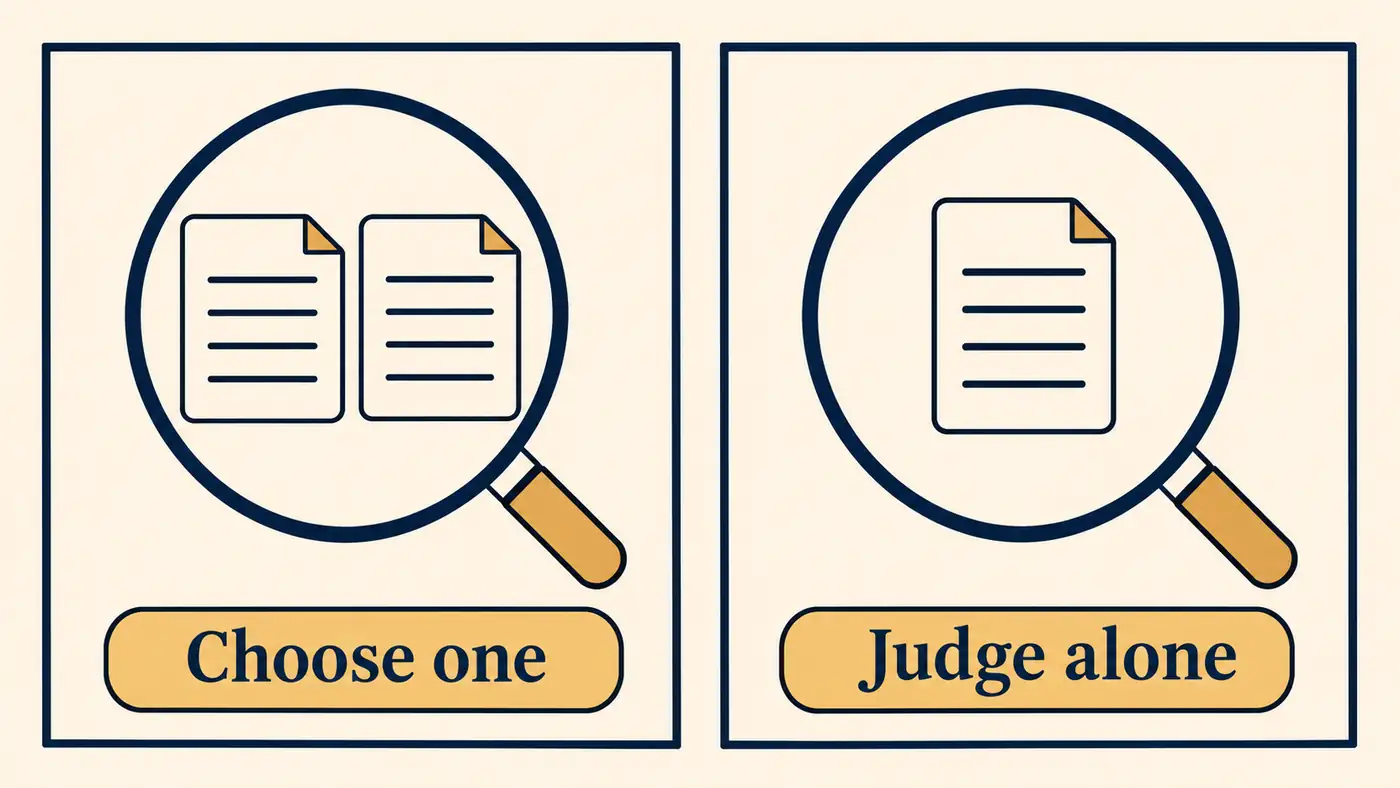
The two reading conditions are shown. The two articles on the left are known to come from one side, and the right side must be judged independently. The picture is juxtaposed, there are no sequential arrows, and it does not indicate the actual measurement score of the two conditions.
The research published by Wang et al. in ACL directly wrote this difference directly to the question for readers. Table 2 lists four tasks, one of which is to select the one to write from a pair of texts, and the other is to give two articles, but allow "both articles" or "n neither". In the latter question, even if the first one shows obvious clues, the reader has to look back at the second article. There is also a kind of simply for a single article. Most of the annotations in the study use a pairing problem with known one person and one machine. Table II and Section 3.4
This paper leaves a place for "I can see it". The research recruited nineteen annotators with experience in natural language processing and familiar with the text of the model, and asked them to read the materials of their native language. In nine languages and sixteen sets of data, the simple average accuracy reported by the authors is 87.6%. This is the average of the Accuracy settings for different dimensions. It cannot be used to stamp a new manuscript, saying that the author has such a high probability that it is a person, and it has not measured a score for each ordinary reader. Research methods and table three
Chinese students' compositions are especially worth reading. If everything depends on the prompt of "one person, one machine", then it should become very difficult to identify after allowing two articles of the same origin. However, in the third of the table, the row of the pairing of the pair is 98.0%, and the row that allows both articles to come from the same party is still 97.0%. This provides a counter-example for "it's all about guessing skills", and also draws a boundary for the conclusion. The number of examples used in the two lines is different, the labeler configuration is different, and there are different examples with answers in advance. If you can't subtract the two numbers, you can say that the cost of removing the prompt is exactly one percentage point. There are also two articles in front of the readers in the two lines. Table 3 Chinese composition two lines
There are two explanations that make sense and can be tested separately. The first is that the reader is familiar with a certain type of model draft, and does recognize its habit of dealing with specific details. The second is that there are differences between the two piles of manuscripts when they are collected. The latter example is the idea of the method. To distinguish the two, you can first ask the two parties to receive the same on-site notes, space requirements and reader's instructions, and then see how much the original clues are left. Just relying on the high score of a certain question bank, we don't know how much the word that was in the bet can help after changing the editor's request.
How many times have readers guessed people as machines?
Another study called TURING has built a reading page within the company. Employees read one article at a time, you can choose people, AI, or "I don't know", you can see the answer after submitting. The question bank covers ten genres such as poetry, recipes, and speeches. The paper was published in 2026, but the author indicated that the model draft was born in the middle of 2024. Taking the year of publication of the paper as the year of the tested model will delay this identification for nearly two years. Original Section 2 and Table 1
The study received more than 9,000 judgments of 214 people. When analyzing the answers that "do not know" and have no valid reading time, then process the records that are too fast to read, and finally leave 7943 judgments, and the accuracy is 59.3%. The time here is when someone answers a certain paragraph, the same person will contribute many answers, and the same article can also be read by different people. It was neither a vote of more than 7,000 readers, nor did it tell us what would happen if a person who never got feedback from an answer would take a look at it for the first time. Sections 3.1, 3.2
"I don't know" is worth leaving a separate line. Imagine that the two editors read the same ten articles, one guessed each one, and the other only expressed their position on the two most confident articles. Even if the latter two are all right, you have to ask what to do with the remaining eight. If the editorial department allows the author to return the difficult manuscript to the author's description, it will be useful to suspend the judgment itself. If each article is required to be finalized on the same day, the previous grades that are only calculated when making a statement will reduce part of the work. After reading an accuracy, first look for how many times you have judged that the denominator is not in the denominator at all, and then decide which practical question this number can answer.
More useful for class journal editors is Figure 2. Reading along the line known to be written by people, 37.3% of the judgments are judged as AI; reading along the line of the model draft, 43.6% of them are judged as human beings. The previous number answered "How many mistakes will be given to you", and the latter number will answer "How much will be missed for you to give you a model draft". There can be many errors at the same time. If I only remember that I accurately picked out a model draft, I remember those who also made them suspicious but did not have the opportunity to reveal them later. Original Figure 2 and Section 3.2
The genre will also change this question. In the same study, only looking at the model draft, people recognized the proportion of the novel fragments of about 44%, and the proportion of news articles was about 70%. What the reader wants to identify here is the samples under this batch of sources and models. Don't put a permanent label on the genre forever, the sampling space, topics and generation methods may change with a question bank. It is also not possible to subtract this single study with the previous multi-language research, and mark the benefits for expert training. To test the training, readers with a starting point with a comparable starting point must be faced with the same set of new drafts and control the feedback they get. Section 3.2 and Table 1
Seven detectors nod, do you count as seven evidence?
Give the composition to the software, and change the answerer. Liu et al. studied seven types of detectors available at the time. The author collected 91 English TOEFL essays on the Chinese forum, and compared the eighty-eight essays of the eighth grade students in the United States. Both groups are measured by human-written materials. Therefore, as long as a tool reports "AI" here, the researcher can write down a false positive, and there is no need to create a high imitation machine composition first. The author's full text and picture 1
Of 91 TOEFL essays, 89 were flagged by at least one tool and 18 by all seven. The first count corresponds to an editor saying, “I’ll hold a piece if any tool flags it.” The second corresponds to “I’ll wait until every tool flags it.” Moving the threshold from one to seven held up fewer human-written essays, but it didn’t change who wrote those eighteen. And since none of the 91 essays were machine-written, they cannot tell us how often all seven tools together would miss one that was. Figure 1 and text results
Why is TOEFL composition easy to lose? One may be that exam writing encourages safe and common expressions, and whether the words are good or not is just a clue to some detection methods. The author also asks the model to change the use of the original essay, and the detection result changes with the wording. Pay attention to reading this control, the rewrited version has been processed by the model, and you cannot continue to use it as an original written by pure people. The two original collections of essays also come from different channels, and the author's age and writing tasks are not matched one by one. The study reveals the false positives of specific tools in these English compositions, and the cause and effect of the mother tongue background cannot be measured alone, let alone a false positive rate for today's Chinese class journal. The author's full text Figure 1
How many machine drafts are there in the manuscript box?
The following are the assumptions of convenient mental arithmetic, and the numbers are not taken from the paper. Suppose an identification method can catch 90% of the machine draft, and it will also make an adult draft wrong. If there are 50 machine drafts in the 100 submissions, it will mark forty-five machine drafts and five manuscripts. The editor draws a marked manuscript, guess it comes from the machine, and the chance of guessing is 90%. Using the same method to another hundred, this time there are only ten machine drafts, it will catch nine articles, and it will also wrongly mark nine manuscripts. Of the eighteen alarms, only half of them were hitting the machine draft.
The detector performs exactly the same way both times, yet the editor should place different levels of trust in a red flag. All that changed was the inbox: the second batch contained 90 human-written pieces available to be falsely flagged. Ask “How likely is this flagged piece to be machine-written?” and the denominator is all flagged pieces. When the tool says it rarely flags human writing, its denominator is all pieces known to be human-written. Even if the tool can back up that claim, you still need the mix of actual submissions to answer the editor’s question. A class magazine often has no way of knowing that mix.
Some submissions never fit either basket. A student conducts the interview, gets an assistant to smooth out the spoken phrasing, then rewrites the last paragraph. Which label fits the whole piece? If the class magazine needs to verify that the relay race happened, the editor can check the notes and speak to the interviewee. If the teacher wants to know whether the student can write an ending independently, ask why they kept that last sentence, or have them write another ending for the same race. Each question has evidence you can check. Forcing a binary verdict onto the whole piece would turn an unsettled agreement about writing into a quiz that pretends to have an answer key.
The next time you circle a clutch
You can do a small exercise with friends, the following are suggestions that have not been implemented. Ask the other party to find a few short texts that can be verified and allowed to play, and a model draft of the same genre is prepared, and the font size is unified, and the signature is removed. I'll show you a single article first, and don't say a few in advance. Every time you read an article, write down the reasons, such as "the ending is very general, and no one will take over", and then write down what findings will make you change your sentence. Leave a column for "don't know" and keep it. When it is revealed, turn back the article you are most sure of but guessed wrong, and see if the reason can still be used verbatim on it.
If you still want to know what the reference draft has helped, you can prepare another batch of materials for the two readers to read separately; Don't let a person re-test the original question just after seeing the answer. It was recorded that the two sides made a few mistakes in the manuscript, missed the machine manuscript, and gave up the judgment several times. A few small exercises are only enough to find out the reason why you use the wrong one, not to mention the whole class Accuracy. Going back to the beginning, even if the phrase "the meaning of persistence" is written first, the editor can still write a useful annotation next to it: "Where you stand, what do you see when the baton falls down?"
References
- Yuxia Wang et al., 2026, ACL official long article. Is Human-Like Text Liked by Humans? Multilingual Human Detection and Preference Against AI
- Natalia Kalashnikova, Nicolas de Bufala, Sophie Fayad, Laurent Cervoni, 2026, LREC formal meeting papers. TURING: Evaluating Human Abilities to Identify AI-Generated Texts
- Weixin Liang, Mert Yuksekgonul, Yining Mao, Eric Wu, James Zou, 2023, published in Patterns. periodical · Full text from the authors
Apps by the author
I also build small tools for everyday life. Here are two of my apps:
- Daily Expense Journal: Track your income and spending, plan a budget and set savings goals. View on the App Store.
- One Small Action: Pick a small action that fits the time and energy you have today, then record how it felt and what you noticed. View on the App Store.
Find more articles and projects on my website: zffjzz.top. I’d love to hear how the apps work for you and what I could improve.