
The large model research controversy: AI goes into everyday life
Imagine a very common question: cycling to the library, the outbound journey is slow, the return journey is fast, and the back and forth is the same path. Can you add up two speeds by two? You send the question to the AI. It is very clear, you nod and write the answer into the book. The next day, the teacher only changed a few words: this time it was not going to go back Distance the same, but ride at two speeds Time same. Should I still use the solution copied yesterday?
This is not a set for students. It makes people see the differences that are usually not seen in the workbook: It is two kinds of skills to be able to understand and understand what to do in the first step if you can understand the answers of others, and to know what to do in the first step. AI can help one of them, and it may make you just skip the one you originally planned to practice. Determine whether it has helped you learn it, it is worth seeing the next blank sheet, not just the written paper in front of you.
In the same math classroom, after writing the practice and taking the exam are two different things
In a high school in Turkey, the researchers divided the classes of nearly 1,000 students into three conditions. The teacher first reviews the math content that everyone has learned. In the next exercises, some classes use textbooks and notes, some can use a GPT-4 that can answer questions like ordinary chat assistants, and some use the same model as a tutoring version. After the practice, everyone closed the information and computer, and did the questions on the paper independently. The exam is a concept that has just been practiced, and the questions are similar, but you can submit the papers if you don't copy the original answer. Bastani et al., PNAS, Experimental Design and Table 1
Collect the workbook, and the two AI groups have better grades. If the story ends here, it will end, and the ordinary chat assistant has already been like a successful tutor. You can look at the next paper, and the class using the general chat version is lower than the control group that did not use AI. 5.4 percentage points. You may have seen this study summarized as "17% drop in exam scores". The two numbers do not conflict: the average score rate for this test in the control group is 32.1%, and 17% in the paper It is the difference in this baseline. It is not that the paper with a full score of 100 points is 17 points less, and not every student is less than the last time they are stepping back.
The results of the tutorial version are different. It is asked to give hints instead of direct answers as much as possible, and the teacher also provides correct solutions, common mistakes and corresponding feedback for specific exercises. Students get help during practice, and then the difference between independent exams and control groups is not statistically significant. The accurate reading is: the loss of the general version, which is not clear in the tutoring version; it has not been proved to be superior to textbooks and notes in this exam. Because the reminder method and the teacher's material are changed together, the difference cannot be attributed to the sentence "Please don't tell me the answer directly".
If you are a parent, you usually only see the end of the homework. The child took the initiative to ask five questions today, maybe he is comparing the solution, maybe just posting each of the five questions. The same number of chats, the book is also full. Instead of complimenting or accusing these two things, it is better to ask the child to pick one of them, replace a condition in the question, and talk about whether the reason for yesterday can still be used. This is the purpose of the practice.
Conversely, don't see the low score on the paper and think that the students have forgotten all the knowledge they originally mastered. This is a question: spend the same period of practice time in two different ways, which group will do better after that? It did not give everyone a "life with an assistant" and a "life without an assistant". One possibility is that the assistant did not take away any original knowledge, but only took up the time that could have been used to practice that step. This is two different things from "tools make people's intelligence worse".
How many of those questions that were not answered correctly were actually not tried again?
There are two origins of a blank paper: after thinking about it for a long time, you can't, or you can skip it when you see the problem. The two have different meanings for the next teaching. The former may need someone to explain a concept, and the latter may not even have the opportunity to show what they already know. A set of experiments on the online score calculation and reading comprehension, which are specially left for the participants to "skip" the button. Liu et al., COLM 2026, experiments 1 to 3
The second fractional experiment made a detailed correction: first let everyone do simple questions without relying on assistants, and then screen according to the same pre-test rules. In this way, a person who can't count is not easy to be left in the AI group just because the assistant gives the answer during the practice stage. The control group also has a sidebar, which only shows the solutions that have been seen before; both groups put away the sidebars when they reached the test stage. In this way, "one group is suddenly reduced by half an interface" is no longer an obvious reason for the two groups to behave differently.
The result is also more interesting than "I don't want to think after using AI". Among the 585 people who were included in the analysis, look at the last three questions without auxiliary questions. The average response rate of a group with AI was 71%, and the control group was 77%. But speaking Leapfrog, the two groups were about 10% and 7%, respectively, this time the difference did not meet the usual significant standard. The skip difference of the reading experiment is clearer, but it also memorizes the answer in less than five seconds as a skip. This is whether there has been a put into the test in front of the test, not a lifelong status for a person's perseverance. Experiment 2 Figure 2. Experiment 3 Method and Figure 4
There is also an attractive detail: the person who claims to be mainly for the answer to the AI during practice is weaker in the subsequent tests. However, what the researchers randomly arrange is whether there is an assistant or not, not to ask who must ask for the answer, and who must ask the principle. A person who is already anxious to end the task may not only like to ask questions, but also easier to jump questions. This result is worth designing the next study, but it is not suitable for judging a child's learning attitude. The experiment was quickly tested after the assistant was removed, and I didn't know what would happen to these participants in a few days.
There are also the opposite results: learning new knowledge is not always like brushing math problems
If the AI just takes the practice opportunity, the person who allows it is not to have an advantage in the independent test. But some tasks have another side: reading a paragraph of unfamiliar material may be stuck on one word; a reasonable explanation can allow you to go back to the original text and continue reading. Spend less time guessing terms and spending less time and want to solve problems, both are called "time-saving", but what saves is not the same activity.
Contractor and Reyes allow undergraduates to learn unfamiliar topics, such as carbon capture, and write an analysis essay. During the practice stage, one group can use AI as usual, but the other group cannot; the subsequent knowledge test cannot check the data according to the regulations. After about a week, the students will come back and answer the questions without tools. This is not to review the solution that the teacher has just demonstrated on the blackboard, but to find a worthy relationship in the unfamiliar materials. Author Preprint, October 2026 Revision, Experimental Design
This time, a group of AI that was allowed to use AI in the instant knowledge test, the estimated average accuracy instead 7.2 percentage points higher. After a week, the gap is estimated to be positive, about 3.9 percentage points, but the latter does not meet the commonly used 5% significant standard. There is also a detail that affects the interpretation: although the first test is prohibited, the data is prohibited, and the researchers have recorded that there are violations, and the immediate advantage cannot be described as the knowledge that has been internalized. Instead of picking a sentence "the effect is maintained for a week", it is better to keep this more useful judgment: under the conditions, it is indeed possible to reach an independent test. Revised Table 4, Section 4.2 and Note 19
The two classroom studies are not answering exactly the same question. In the mathematics class, writing the operation process is often the practice itself; in the writing of unfamiliar themes, the explanation of a term may make you understand the materials that you cannot read in the first place. Student age, learning task, control conditions and test time are also different. Without pulling these conditions, we cannot assert that "it's good to use AI for liberal arts, and it's bad to use math". The useful question is: The step it does for me, is it an obstacle that needs to be cleared today, or is it the skill I want to practice here?
Use the graduation defense as an analogy. One student asked the assistant to explain the new words in the paper, and then went back to the original text to pick out the most critical comparison; the other asked the assistant to pick out the "most critical comparison", and he was only responsible for changing the sentence. Both people may hand over a decent page at the specified time. Now the judges are asked not to read the speech, but just ask: "Deleting this control group, can your conclusion still be established?" The first person has practiced such judgment, and the second person may not have practiced. Who will answer this idea without predicting a good answer, it just shows the ability to hide in the beautiful speech.
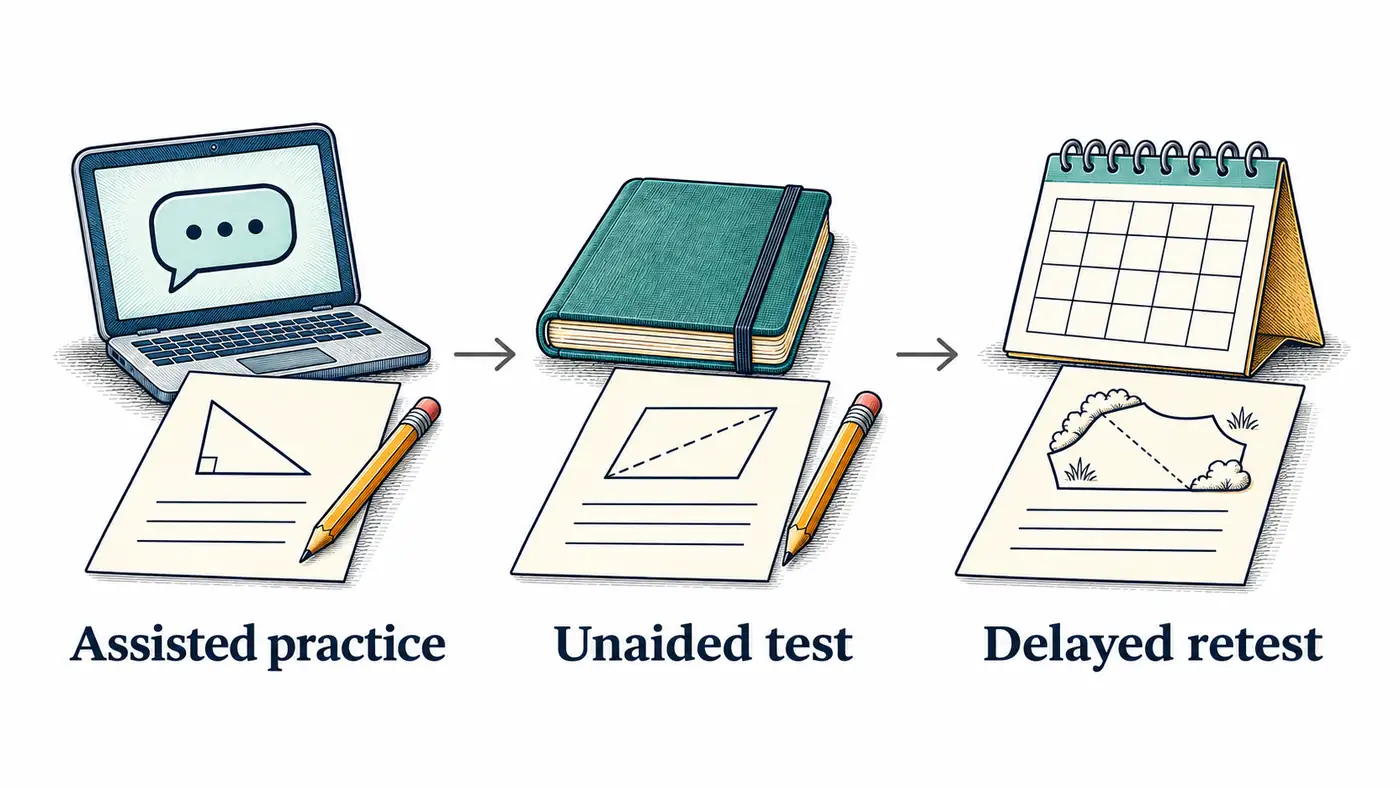
Reading pictures: From left to right are the three time points that can be observed separately, not the process jointly adopted by the three papers. Small papers represent different topics, and the arrows only indicate time, not that the grades have risen.
How to try tonight: keep a question, don't let the AI see
Back to cycling questions. When the two sections are equal, the slow one will take longer, so the average speed of the whole journey is closer to the slow speed; if the time spent on the two speeds is equal, the two speeds will each occupy half of the weight. You don't have to memorize two formulas. Next time, as long as you can ask "the equal time or the distance before writing", you will grasp the condition of the decision method. This example is to show how to self-examination, not the original question of any of the above experiments.
Before opening the chat, try dividing the exercises into two piles. You can ask for help with one. Fold the other away for now. For the first pile, write down how you would start, even if you’ve only spotted one relevant condition. If you get stuck, show the AI your reasoning: “I think the outward and return distances are equal, so the two speeds should get equal weight. Hold off on the answer. Which two quantities am I mixing up?” Once you can reply in your own words, ask it to challenge you once more. The wording needn’t be perfect. What matters is that you can still tell which judgments you made and which came from the assistant.
Close the chat window and open the second one. It is best to pick up questions in advance from the textbook or the teacher's question bank, and do not use the model just to rewrite the questions according to the example questions, and by the way to suggest that the method of understanding the law. It is enough to remember three things: whether you can write the first step independently; whether you can locate the wrong condition when you do something wrong. It is also useful if you can't answer it. It tells you which step you should go back to, and you don't have to copy the entire standard answer. Occasionally, the two questions are not strict personal experiments, don't use it to label yourself "syndrome" or "inseparable from AI".
Sometimes you can skip this self-check. If an event notice is due tomorrow and you just need the meeting place and signup instructions to be clear, it makes sense to let the assistant format it and verify the address yourself. There’s no need to turn off the computer and reproduce the notice from memory. But if you’re practicing how to draw out the main points yourself after chairing a meeting, delegating that step skips the very skill you wanted to learn. Before starting, try finishing this sentence: “Next time, without the assistant, I still want to be able to…” If you can’t finish it, decide whether today’s goal is to deliver something or to learn a skill.
For readers who want to design research: Compared to "AI" and "No AI”, I would like to see a comparison like this: use the same model, the same set of materials and the same exercise time, and randomly divide the learner into three groups: direct answers, step-by-step prompts and no helper. Use unseen independent questions to make the main measurement, and also remember to skip, do wrong, and answer correctly; every other week, replace the surface situation. If the prompt group is only dominant in the original question, it is necessary to consider that it teaches the problem-solving routine; if the performance of the independent new question is also improved, it is more supportive to learn what can be migrated. This is a design that has not yet been implemented, not a new experiment in this article.
So, next time you see a beautiful AI assignment, you don't have to ask "Is this a cheating" immediately, and you don't have to use it as a proof of teaching success. Change the question, close the window, and leave the first stroke to the person who studied. That one is more worth watching than the length of the chat record. The last time you asked AI to help, is there any step that you understood at the time, and then you realized that you couldn't understand it?
References
- Hamsa Bastani et al. (2025), Generative AI without guardrails can harm learning: Evidence from high school mathematics, PNAS. Experimental design, main results and table 1.
- Grace Liu et al. (2026), AI Assistance Reduces Persistence and Hurts Independent Performance,COLM 2026; Full text of the author v6, Sections 2–4 and limitations.
- Zara Contractor、Germán Reyes(2026), Experimental Evidence on the Learning Impact of Generative AI, arXiv preprint v2, revised on October 4th; Original Table 4 and Research Design. This article adopts a revised version, and does not mix the first draft numbers.
Apps by the author
I also build small tools for everyday life. Here are two of my apps:
- Daily Expense Journal: Track your income and spending, plan a budget and set savings goals. View on the App Store.
- One Small Action: Pick a small action that fits the time and energy you have today, then record how it felt and what you noticed. View on the App Store.
Find more articles and projects on my website: zffjzz.top. I’d love to hear how the apps work for you and what I could improve.