Readers: postgraduate, early-career researchers and research engineers; search and experiment date: 2026-09-18.

Abstract
If a probe predicts an attribute almost perfectly from a hidden layer, does the model actually use that attribute to perform its task? Drawing on the control-task paper and its official code, we trained linear probes on a small frozen network and tested probe accuracy and model behavior separately. The local synthetic experiment reproduces the measurement protocol and gives a checkable counterexample: a representation can encode information the current decision does not depend on. We did not reproduce the original paper’s language model or its natural-language benchmark results.
Contents
- Reproduce the value: split the problem into two layers
- Core ideas and formulas
- A guide to the official implementation
- A minimal experiment and its results
- Evaluation protocol and independent audit
- Failure Troubleshooting and Causality Boundary
- Questions for further research
- Summary and References
Reproduce the value: split the problem into two layers
Probes are predictors attached to the frozen representation. Frozen means that the main model parameters are not updated with the probe; otherwise the high score may come from retraining the main model, not the measurement is already present. Linear Probe only allows affine mapping, and is usually used to ask if a property is easily exploited by a simple reader.
There are two questions here: whether the external classifier can restore the attributes, and whether the original model depends on the attributes to answer. The former is decoded and the latter requires evidence of behavior or intervention. The probe itself will also be learned; the amount of data, parameters, regularization and division are all measurement conditions, and the result cannot be derived from the word "linearity" in the title.
Paper report: Hewitt and Liang proposed the control task of randomly assigning tags according to the word type in 2019 to check the memory ability of the probe for the word identity. Ravichander, Belinkov and Hovy in 2021 natural language inference and synthesis experiments further demonstrate the gap between decoded attributes and task dependence. This paper borrows these problem awareness, and does another experiment with very small scale, data and parameters that can be audited. Control Task Papers; Task Relevance Papers
Core ideas and formulas
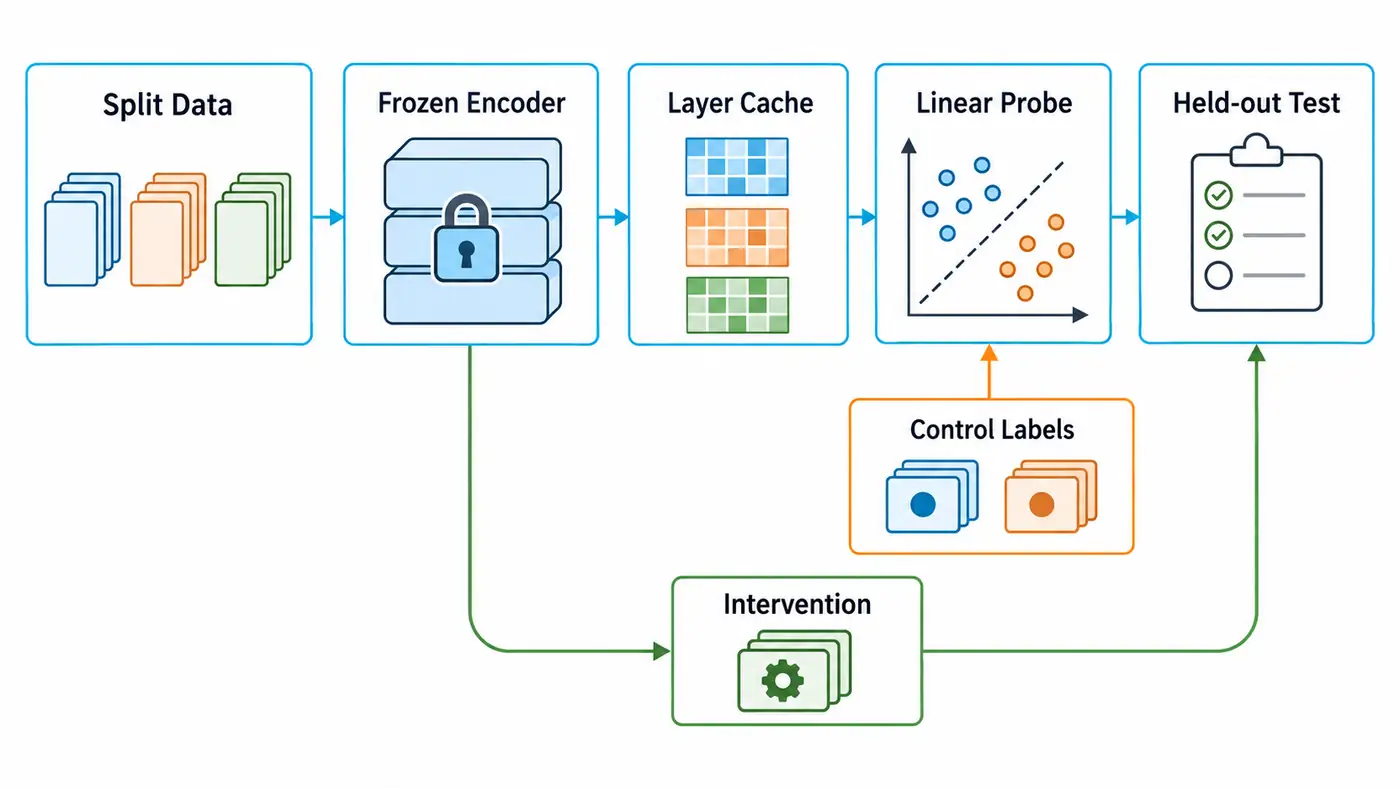
In the figure, the main path extracting and training the probe, and the green branch to check the original model behavior separately. The control label only changes the probe target, and does not return to modify the encoder. The method diagram shows the protocol relationship, not the result of this experiment.
is input, is the -th layer’s cache, and for the number of samples, to represent the width. is the length of weight, is a scalar offset, The sigmoid function to map the score to the probability. It is the binary attribute to be detected, which can be different from the answer to the main task; Control weight punishment, bias not punish. Multi-category situations can be used instead of softmax.
The selectivity in the paper is defined as the real task Accuracy minus the control task Accuracy . The control labels are fixed to the same word type, giving the probe the opportunity to remember the mapping of words to random output. The one-by-sample labels answer the other type of questions independently and cannot be mixed with this definition. The shuffle of this article is the latter, only checking for obvious leaks or accidental associations, not reporting the paper selective score. Definition and selectivity of control tasks
Linear failure also does not mean that the information disappears. For example, two binary variables can be kept in the input in full, but "whether different" requires a non-linear combination. High scores support readability under a given protocol, and low scores only indicate that the current probe, data and optimization budget are not read well.
A guide to the official implementation
Read the author's repository first README: It puts labeling corpus, disk representation, layer number, probe family and training settings into configuration. When migrating the real text, you should first check whether the sentence index and the word level representation correspond one by one, and then compare the layer; when the length is not correct after tokenization, even if the training can run, you may learn the wrong label.
Then enter task.py of CorruptedPartOfSpeechLabelTask. prepare Summarize the frequency of word types of three partitions, _register_type Generate fixed random tags for word types, labels Perform replacement. Here are also the forty-five categories of parts of speech distribution dead. It is the structure of a specific experiment, and it is not a general interface that can be used as a general interface to any label space; the use of test word type statistics must also be disclosed in the reproduction record.
Look again probe.py of OneWordLinearLabelProbe: There is no nonlinear activation between the two linear layers, so at inference time is still an affine function, and the bottleneck width constrains the rank of the valid matrix. The actual input is a batch × word number × a width, and the output retains the category axis; the output shape abbreviated in the comments should not replace the inspection of the return tensor. Adjacent neural network probes are added to ReLU, and the expression ability changes accordingly.
The above code has been actually opened and read statically, all are the main branch, and the submission is not locked; dynamic compatibility is for manual verification. Some original file addresses fail to read the official page that can be accessed after the failed retrieval, and the unread trainer is not written as a verification implementation. This NumPy script is an independent teaching implementation and does not run an official environment.
A minimal experiment and its results
The main task is the selector: input , when output positive or negative, otherwise output positive and negative. Two other standard deviations are The Gaussian noise coordinates form a five-dimensional input. Unselected variables are another item, such as selecting It is ; it is not a fixed input column.
Following "Activation Patching: After restoring the answer, can you say that the mechanism is found? 》The three small networks that have been trained are five-dimensional input, two-layer 16-dimensional tanh, and two-class output, with a total of 402 parameters. Tanh is a hyperbolic tangential nonlinear function. The checkpoint has been copied to this article as it is, and the file hash is recorded, and the operation does not depend on other directories. The seeds of the model are 76, 77, and 78, and only the probe is trained this time.
The new data seeds are 770, and the training, verification and testing are 512, 256, and 512 respectively. Each partition covers the same eight core rules, and the noise samples are different; it is not that there is no combination of generalization. The input, the first layer and the second layer produce the representation of the width five, sixteen, and sixteen respectively, and the test cache shape is [512,5] or [512,16].
Each layer predicts the main task, unselected variables, and random tags, respectively. Means and standard deviations are only estimated from training, and then applied to other partitions. The four penalty coefficients are zero, one percent, one percent, one tenth; the probe is initialized from zero, and the full batch gradient descent is fixed by two thousand steps, and the coefficient is selected with the validation set negative log-likelihood. Negative log-likelihood measures the probability that the model will allocate the correct label, the lower the better; the test set does not participate in the selection. The command is executed:
python3 code/probe_numpy.py
python3 code/audit_results.py
Dependencies, checkpoint sources and document descriptions are available code/README.md. This time, Python 3.12.14, NumPy 2.3.5, and CPU double-precision are actually used. The following table is the test Accuracy mean of the three main model seeds; the random label is a fixed scrambling, and there is no repeated random label distribution.
| Represent | Main task | unselected variable | random tags |
|---|---|---|---|
| original input | 0.7363 | 0.7363 | 0.4902 |
| first hidden layer | 1.0000 | 1.0000 | 0.4668 |
| second hidden layer | 1.0000 | 0.9987 | 0.4609 |
What we tested: the seed standard deviation of the unselected variable Accuracy in the second layer is . The original input three-line experiment actually uses the same representation, and its zero standard deviation does not represent the stability of independent repetition. The two properties of the first layer can be fully read out, and the main model cannot be declared accordingly to rely on both.
After flipping the unselected variables entered in each test, the answer rate of the three models is zero, and the main task Accuracy is still one. But the maximum logit change is about 、、. Logit is the score before probability normalization; the answer is not the same as the entire output function, let alone the variable is ignored by all internal paths.
Evaluation protocol and independent audit
In order to further separate the read out and behavior, a precisely defined projection is made in the second hidden layer. Let the last read matrix of the main model be , the orthogonal basis of its column space is , order , then:
here , for the sixteenth-order projection matrix, is the original model bias. The direction being removed belongs to the output zero space, that is, the change does not pass to this linear read. The base is calculated from the model weight, and the probe label is not used; the equation only depends on the last step linearity, and it is assumed that it is established after it cannot be transplanted into any intermediate layer.
What we tested: the maximum error of the two logits before and after the projection is lower than . The original trained unselected variable probe, after projection, the accuracy is 、、. The original model’s output stayed the same, yet the trained probes became less accurate. My interpretation is that the probes relied on directions in the representation that the projection changed. Because we did not train fresh probes after projection, the result leaves open whether information about the attribute can still be recovered.
All candidate weights, selected weights, normalized statistics, case-by-case scores and intervention output are saved in code/results/. Independent auditing does not import training scripts, recalculates 34,560 probes to predict the scalar cycle, and reviews the validation set parameters, mean and sample standard deviations, and the maximum numerical difference is about . The finite difference gradient check error of the six logistic regression parameters is about ; Freeze weight and projection identities are checked.
When reviewing the table, you must open the case-by-case record at the same time. For example, the unselected variables of the second hidden layer are not full marks for each seed, and the tiny drop in the mean is derived from the specific wrong case, which cannot be erased after being rounded. It is not a meaningful reverse law to have a random label below one-half: this time is only fixed once, and you can't see the test results before flipping the prediction or picking the seeds again. To determine whether the control score is abnormal, the number of independent shuffles should be increased in advance and the distribution should be reported.
In addition, there are only eight core modes of the five hundred and twelve test data. The noise variants in the same mode share the decision structure, and self-service sampling may make the uncertainty seem too small. Confirmation experiments should be left in units of rules or templates to clarify which changes come from the main model initialization and which come from data sampling.
Failure Troubleshooting and Causality Boundary
When the high score is abnormal, first check whether the label is mixed into the input, whether the near repetition is cross-partitioned, and whether the standardization is peeking at the test set. For low scores, first check the label and presentation order, category balance, training loss and optimization budget. This preservation of the final gradient norm, the fixed number of steps is not equal to all targets that have reached the strict optimality, especially without punishment and the linear can time can not claim to obtain a limited optimal weight.
When comparing the layer, it is also necessary to control the width and parameter quantity. In this example, the input probe has six parameters, and there are seventeen hidden layer probes; therefore, the gap between the original input and the hidden layer cannot be all attributed to the position of the layer. The random initialization encoder control is not added, and the amount of information contributed by this quantization main task training cannot be quantified.
The real text should be divided into groups according to documents, entities or templates, and the sub-word aggregation method should be recorded, and the baseline of most categories and word identities should be reported at the same time. This case only examines new noises within the eight rules and cannot replace natural language generalization assessments. The standard deviation of the three model seeds is also not the Confidence interval that covers the data changes. The language model, official corpus and group migration are not run, and are subject to manual verification.
Questions for further research
First, fixed representation, increase the training sample and change the penalty intensity, is the inter-layer ranking stable? The search budget should be fixed in advance, and the learning curve of the real label and the control label should be drawn at the same time, to avoid only reporting the best-looking single point.
Second, how many attributes can be restored after retraining the probe after projection? If the new probe is still successful, the failure of the original reader should be distinguished from the failure of the original reader, and the verification of different probe families should be introduced.
Third, can probe discovery predict the effect of the intervention on the non-rules or new text templates? First use the discovery set to propose the hypothesis of attributes and layers, then freeze the scheme to the independent confirmation set inspection, and keep the failure boundary of the answer that remains unchanged but the fraction moves.
Summary
Probes measure the decodeability of a given data, representation and training budget. This paper runs through linear read out, random label checking, counterfactual input and output to maintain projection, showing the lack of evidence that the high score is written as a cause and effect conclusion. The next step for the reader should be supplemented with generalization and retraining after projection, and then discuss whether the model really uses a certain information.
References
The following sources are 2026-09-18 It is actually opened; the paper is finalized by the conference, and the repository uses the main branch of the day to retrieve the main branch of the day.
- John Hewitt、Percy Liang. Designing and Interpreting Probes with Control Tasks. EMNLP-IJCNLP 2019; Full text.
- Abhilasha Ravichander、Yonatan Belinkov、Eduard Hovy. Probing the Probing Paradigm: Does Probing Accuracy Entail Task Relevance?. EACL 2021; Full text.
- Hewitt and Liang official implementation: Repository and Configuration Instructions、task structure、Probe implementation.