
Date: 2026-08-19
For graduate students, early-career researchers and AI practitioners with an engineering background
Search date: 2026-08-19
Abstract
Many people read OpenReview only look at the final decision, score and a meta-review, and then simplify the conclusion to "this article is received, so the quality is high" or "this is rejected, so it is not worth reading". This kind of reading wastes the most valuable training materials in the review system: what core questions did the reviewers point to? What questions did the author ReButtal answer and what questions did he avoid? Does the review change the judgment after the discussion? How does AC or meta-review weigh contributions, evidence and risks?
Read the reviews, rebuttal, discussion, and meta-review of a top-conference paper together as a diagnostic report on the research. The aim is to develop research judgment rather than learn how to please reviewers. What do the exchanges reveal about the paper’s contribution, the strength of its evidence, reproducibility, missing experiments, writing problems, and promising follow-up questions? The article draws on official guidance from ICLR 2026, ICML 2026, NeurIPS 2026, and ACL Rolling Review, as well as peer-review research including PeerRead, DISAPERE, NLPeer, PRISM, LimitGen, the ICLR 2025 review feedback agent, and the AAAI-26 AI review pilot. For current procedures, dates, policies, and uses of AI in review, consult each conference’s official pages.
Contents
- Why is this topic important
- Reading system first: Rebuttal of different meetings is not the same thing
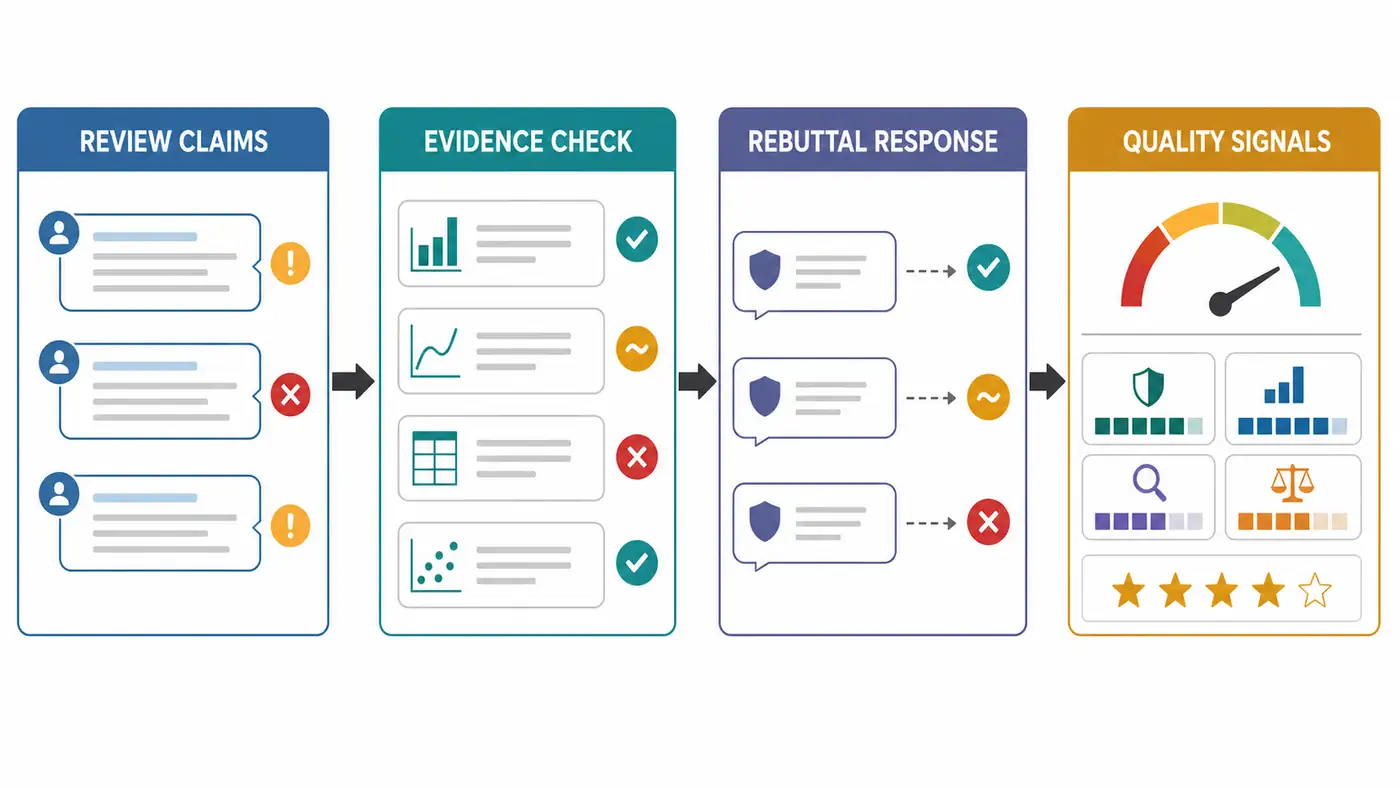
- Core reading method: four layers of evidence chain
- Representative data road map
- Critical Essays and Project Intensive Reading
- Review / Rebuttal quality signal table
- Reproduction training: how to do a review-reading report
- Common misconceptions
- Research questions for graduate students
- Summary and References
Why is this topic important
The body of the top paper is usually "the version the author wants you to believe in", and the review and rebuttal show "how the community tests this version". A method paper may claim a new paradigm in the abstract, but the Reviewer will ask: Has this question been done by predecessors? Is baseline reasonable? Does ablation isolate core variables? Does the result come only from larger models, longer prompts, or more expensive inferences? Is the conclusion beyond the scope of the experimental support? These questions are more able to train the researcher's eyes than the final accept/reject .
For graduate students, there are three additional value for public review. First, it exposes the "distortion point" in the writing of the paper: the author's motivation for the clear, the reviewer may not understand it; the author thinks that the author thinks that the reviewer may think that the statistical significance or the key baseline is lacking. Second, it lets you see how the same paper is interpreted from different experts from different angles: some people look at novely, some people look at soundness, some people look at reproducibility, and some people look at ethical Risk. Third, it can help you discover the follow-up idea: a core problem in a serious review that has not been solved by Rebuttal, and is often the entrance to follow-up research.
After 2025-2026, this topic is even more important, as the Review process itself is changing. ICLR 2026 explicitly requires reviewer to give timely and substantive reviews and require reviewer to disclose LLM use; ICML 2026's Peer-Review FAQ It is stipulated that each official Review can have a rebuttal, and the reviewer needs to confirm the author's reply and update the Review if necessary; ACL Rolling Review put the author response, Review issue REPORTING, RESubmission, and commit are split into continuous processes; NeurIPS 2026 Reviewer Guidelines Interprets by type Contribution Quality, Clarity, Significance and originality. Meanwhile, ICLR 2025 pilots LLM Feedback Agent, AAAI-26 reports large-scale AI-assisted Peer Review, PRISM and LimitGen Turn "AI can assist Review" into a reviewable question. Reading Review is not just reading a few anonymous opinions, but is reading a constantly institutionalized, data-based and automated scientific research evaluation system.
Reading system first: Rebuttal of different meetings is not the same thing
Read the meeting rules before reading a review. Otherwise, you will misunderstand the meaning of rebuttal.
ICLR is a typical OpenReview public discussion mode. ICLR 2026 Author Guide shows, November 11, 2025 Reviews, November 11 to December 3, 2025 Discussion period, the Author can reply to reviews on OpenReview, or modify the paper during the discussion period; the official page also states that if the revised version is submitted, pdfdiff will be used Comparing the original commit and the new version, the AC and Reviewer can ignore the modification that is too different from the original. For the reader, this means that ICLR Rebuttal is not a separate short essay, but a combination of "review, Author replies, essay version changes, reviewer discussions, and final recommendation".
The ICML 2026 Peer Review FAQ describes a structured exchange. Authors may post one response per official review, with a limit of 5000 characters per response. Reviewers must acknowledge the author’s reply and agree to update their review if necessary. Subsequent comments and final responses have limits of their own. When reading an ICML rebuttal, check whether the authors answer each reviewer’s questions individually, even if they also provide a general response.
ARR has different goals. The author's guide for ACL Rolling Review emphasizes that ARR is a Review platform, and the reviewer does not directly make a decision to receive or reject a document. The main role is more inclined to clarify misunderstandings, point out factual errors, and provide a basis for the next round of revisions. ARR also provides Review Issue Reporting to report specific Review quality issues to the AC. When reading ARR Review, you can't simply apply the "convince reviewer to change points" logic of the conference rebuttal, but think of it as an iterative round of research diagnosis.
NeurIPS 2026 Reviewer Guidelines reminds us that the evaluation criteria for different Contribution Types are different. General, Theory, Use-Inspired, Concept & Feasibility, Negative Results should not be evaluated by the same set of SOTA competition logic. Especially Negative Results, the official guide emphasizes that it requires Grounded Analysis, rather than simply reporting a failed experiment. When reading NeurIPS Review, the first step should check whether the Reviewer is evaluated by the type of paper's self-selected contribution type, instead of requiring all papers to provide the same experiment.
Core reading method: four layers of evidence chain
The first layer, dismantle the review claim. Divide each review comment into claim, not group by Reviewer. For example, "Novelty is insufficient", "Baseline is missing", "experimental unfairness", "theoretical hypothesis is too strong", "results cannot be reproduced", "Writing is unclear", "ethical risk is not dealt with". Each claim is marked with the type: fact, method, experimental, expressive, subjective preference, process. Factual claims can verify that subjective preferences need to see whether there are reasons, and process issues should be compared with meeting rules.
The second layer, do the Evidence check. Find evidence for each claim back to the paper body, appendix, code, data, and related work. A qualified review should not just say "missing novelty", but should point out which work is similar and where the difference is not clear; Metric, which ablation, or which statistical description. Readers should train their own judgments: whether the reviewer is providing evidence or using an unexplained mantra.
The third layer, read Rebuttal Response. A good rebuttal usually has three types of actions: clarifying misunderstandings, supplementing evidence, and making reasonable commitments to revise. Weak ReButtal is common to four common problems: only say "we will add" but not specific results; avoid the most core baseline or hypothesis problem; use more rhetoric instead of experiment; all criticism is attributed to reviewer that is not understood. Don't just see if rebuttal is polite, it's a matter of whether it reduces uncertainty.
The fourth layer, read Quality Signals. The final judgment does not come from a single Reviewer score, but from the signal after the whole discussion: Do multiple reviewers independently point out the same core problem? Does the author use evidence to solve the high priority problem? Does reviewer acknowledge that clarification is valid? Does AC explicitly state the main cause of acceptance or rejection? Is meta-review just an average score, or does it differentiate between contributions, evidence, risks and repairable problems? If a paper is received but there is still an unresolved reproduction gap in the review, you can read it, but do not unconditionally inherit its conclusion; if a paper is rejected but the review Acknowledging that the problem is important, the method has the potential, and the main defects can be repaired, but it may be a good follow-up training material.
Representative data road map
The first group is the official process information: ICLR 2026 Author Guide and Reviewer Guide, ICMML 2026 Peer Review FAQ, NeurIPS 2026 Reviewing Guidelines, NeurIPS 2026 Evaluations & Datasets Reviewing Guidelines, ACL Rolling Review Authors Guidelines and Reviewer Guidelines. These data define the "institutional context" when you read the Review: who can reply, when to reply, whether the Reviewer must be updated, how the AC sees the reported issue, whether the use of LLM is allowed, and how the different contribution types are evaluated.
The second group is the Peer-Review dataset: PeerRead is an earlier public Peer Review dataset, covering ACL, NIPS, ICLR and other VENUE papers, review and Accept/reject information; Discourse Structure in the review-rebuttal Pairs, help researchers analyze how Rebuttal responds to Review Argument; NLPeer further integrates multi-domain papers, reviews, versions and metadata, and emphasizes ethical authorization and unified representation. They are suitable for training "extracting structured problems from Review text".
The third group studies rebuttals. The 2023 Journal of Informetrics article “What makes a successful rebuttal in computer science conferences?” uses open reviews from ICLR 2022. It treats the rebuttal as a social interaction between authors and reviewers, examining score changes, social effects among reviewers and rebuttal strategies. Initial positions, reviewer interactions and discussion structure can all matter alongside the quality of the written response.
The fourth group is the AI-assisted Peer Review. The Review Feedback Agent of ICLR 2025 is an important case: the official blog reports that the system provides optional feedback to some reviews, the goal is to improve the Review The amount of information, clarity and mobility, rather than directly changing the results of the paper. AAAI-26 AI Review Pilot reports a large-scale AI Review deployment for AAAI-26 Main-Track Submissions. PRISM proposes multidimensional Benchmark to evaluate LLM Peer Reviewers, emphasizing Depth, Novelty, Flaw Identification and Constructiveness; LimitGen It specifically evaluates the ability of LLM to recognize Scientific Limitations. These work can be used as research materials, but due to the rapid changes of AI Review policies, system implementations and meeting practices, all conclusions should be marked with a search date and manual verification is reserved.
Critical Essays and Project Intensive Reading
The value of PeerRead is that it treats Review as a studyable object, rather than just the body of the paper as a text. When reading PeerRead, don't just focus on Acceptance Prediction, because that is easy to induce the narrow goal of "predicting fate with text". The more valuable question is: Which language signals of the review correspond to Novelty, Impact, Clarity and Soundness? How does the review form of different Venues affect Reviewer writing? If you want to do a review-reading report, you can learn from its data organization method, and put Paper, Review, Score, and Decision in the same sample.
DISAPERE is more suitable for training Rebuttal analysis. It focuses on the relationship between the review and the rebuttal sentence, including the argument proposed by the reviewer, the author's stance, and whether the response is directly related. When reading this article, you should pay special attention to a methodological point: the quality of rebuttal is not "written long" or "tough attitude", but whether it can locate the review argument and give a verifiable response. You can transfer this idea to a daily reading paper: each rebuttal asks, which claim is the reviewer?
The contribution of NLPeer lies in the collection of unified resources and ethical data. It does not just put more reviews, but introduces parsed paper representation, metadata, versioning and other structures. This is important for research reproduction: if you want to compare Submission version and camera-ready version, or analyze whether the author has modified the paper according to the review, it needs version information, not only the final PDF. NLPeer GitHub also suggests that the purpose of data is to help Junior Reviewers improve the quality of reviews and oppose reviewer profiling; this is also a boundary that needs to be observed when doing peer-review research.
ICLR 2025 Review Feedback Agent and AAAI-26 AI Review Pilot provides new questions: when AI starts to affect the review production process, how do we judge the review credibility? The official blog of ICLR 2025 emphasizes that the system only provides feedback to the reviewer, and the reviewer can ignore or modify it, and finally did not directly change the results of the paper. The AAAI-26 arXiv report claims that all Main-Track full-review papers have received clearly identified AI Reviews and report useful evaluations of AI reviews by authors and program committee members. When reading these materials, three things should be distinguished: whether the AI can point out the real problem, whether the AI feedback can improve the human review, and whether the AI should participate in formal decision-making. These three things cannot be replaced by each other.
PRISM and LimitGen are materials closer to "research training". PRISM thinks that a single LLM-as-judge score will mix fluency and rigor, so it is split into multiple dimensions, and uses Argument Mining, Retrieval-Augmented Verification and Consensus Scoring to evaluate reviews. LimitGen separates the Limitation Identification, emphasizing the Prior Literature Grounding to improve the specificity of feedback. For graduate students, their inspiration is that when you read a review, you should also score "reasonable", "evidence", "executable" and "high priority".
Review / Rebuttal quality signal table
| Observation object | high-quality signal | risk signal | Reader's Action |
|---|---|---|---|
| Review summary | Accurately retell the problem, method and contribution boundaries | Summary does not match the paper core | First determine whether the reviewer understands |
| Novelty criticism | Point out specific similar work and difference gaps | just say incremental / not novel | Check Related Work |
| Soundness criticism | Describe specific vulnerabilities in hypotheses, derivation, experiments or metrics | only general distrust | labeled pending Claim |
| Baseline criticism | Indicate the missing baseline and its necessity | Requires irrelevant or not feasible baseline | Determine whether the core conclusions are affected |
| Reproducibility criticism | Ask SEED, hyperparameter, data version, code, statistical significance | Only ask for more details but no priority | Convert to recursive checklist |
| Rebuttal | Respond one by one, give new evidence, and recognize the problem of recognition | Avoid core issues, build commitments, and request to change points | Whether the uncertainty is declining |
| Reviewer update | Clearly state which responses change or not to change judgment | I don't see rebuttal or maintain the score for no reason | Judgment with AC/META-REVIEW |
| Meta-review | Weighing contributions, evidence, and defects | Only average score or repeat review | Record the final decision logic |
A simple rule is that strong papers do not mean that there is no criticism, but critical critiicism can be positioned, responded, and will not overturn core contributions. Weak papers do not mean low scores, but the author and reviewer still cannot clarify whether the core claim holds after the discussion.
Reproduction training: how to do a review-reading report
Choose an ICLR, ICML, NeurIPS, or ACL/ARR paper with an open review, and it is best to choose a paper with obvious differences in your research direction. Don't choose the best paper at the beginning; different samples can be more trained and judged.
The first step is to create a material package: submission PDF, supplement, code or project page, reviews, rebuttal, discussion, meta-review, final decision, camera-ready version. Record the search date and OpenReview/Anthology/proceedings link. If the reviewer or author mentions new experiments, anonymous code, and external benchmark in the discussion, it should be marked whether it is still accessible.
The second step is to extract review claims. It is recommended to make a table: claim ID, reviewer, original opinion brief description, question type, evidence location, severity, whether it has been reproduced by other reviewers, whether it has been responded by Rebuttal, and whether the response is sufficient. Seriousness should not be judged according to the tone, but whether it affects the main conclusion.
The third step is to do the Evidence Audit. For each high serious claim, go back to the text to verify. For example, reviewer says that the baseline is missing, you need to check whether the baseline is really missing, and whether the baseline is standard in the task; reviewer said that the method is only a combination of methods, you need to check the relevant papers; reviewer When it comes to data leakage, you have to check the dataset split and deduplication instructions. When it is impossible to judge, write "waiting for manual verification", and do not use intuition instead of evidence.
The fourth step is to evaluate rebuttal. Divide ReButtal into three categories: resolved, partially resolved, and unresolved. Resolved means that the author's uncertainty in reasonable readers has dropped significantly after the author gives evidence; partially resolved means that the local problem is still lacking; unresolved Indicates that the author has no answer, insufficient evidence or needs to add experiments. Don't take "the author is very confident" as resolved.
The fifth step is to write a quality conclusion. The conclusion can be divided into four paragraphs: what is the true contribution of the paper; what is the strongest evidence; what is the maximum unresolved risk; if you want to follow-up based on it, what is the most reliable small problem. The Report written in this way is closer to research training than the "Intensive Reading Notes" because it contains external review and evidence reassessment.
Common misconceptions
Misunderstanding 1, take the score as the quality. Scores are signals, not evidence. Scores are influenced by Reviewer Calibration, Domain Preferences, Types of Contributions, Discussion Engagement, and Meeting Policy. Especially in Open Review, the score change itself also needs to be explained: is the author supplementing the key evidence, or is the reviewer being persuaded, or is the AC rebalanced?
Misunderstanding 2, take the reviewer as an authority. A good reviewer will give checkable evidence; poor review may use lazy heuristics, such as "not enough SOTA", "too simple" and "not amazing", but it does not explain why these issues overturn the paper contribution. Both the ACL 2023 Peer Review Report and the ARR issue-reporting mechanism indicate that the Review Quality itself needs to be evaluated.
Misunderstanding 3, use Rebuttal as a debate competition. The ARR author's guide clearly reminds that Author Response's goal is to clarify misunderstandings and deal with key issues, and repeated debates with strong subjective views are often useless. Scientific readers should do the same: you don't want to judge who wins, but to judge which claims are solved by evidence.
Misunderstanding 4, read-only accepted papers. The review of rejected papers tends to be more training value, as Reviewer points more clearly why the chain of evidence is broken. Many of the IDEAs that have been refused work are still important, but the experiment, expression or positioning has not yet reached the top standard.
Misunderstanding 5, unconditionally trust the AI-generated review. 2025-2026 The research on AI Peer Review is very active, but there is no direct analogy between different systems, different tasks and different policies. PRISM emphasizes that LLM reviewers may be strong in some dimensions and weak in others; ACL Reviewer Guidelines also emphasizes confidentiality, responsibility and disclosure for the use of generative AI. You can use AI Review as an auxiliary clue, but not the final judgment.
Research questions for graduate students
Build a Review Claim Taxonomy: collect 100 reviews of ICLR or ARR papers, and divide Criticism into Novelty, soundness, baseline, ablation, clarity, reproducibility, ethics and other categories, analyze which categories most often lead to final negative judgments.
Evidence of research on Rebuttal: Compare evidence used by Rebuttal in Accepted and Rejected Papers, including new experiments, supplementary references, clarification definitions, acknowledgment restrictions, commitments Camera-Ready Modify. Pay attention to control the initial score and field.
Do review-to-revision diff analysis: using Submission version and camera-ready version, analyze what the author actually changes, which review comments are implemented, and which are only in Rebuttal promised but did not enter the paper.
Evaluate LLM as a review-reading asset: instead of letting the LLM write the review, it is for it to extract review claims, match the paper evidence, and mark unresolved Issues, and then the human validation accuracy . The data can be found in NLPeer/DISAPERE ideas, but must comply with data licensing and meeting policies.
Compare the review criteria for different contribution types: use NeurIPS 2026 Contribution Types as the framework to study the reviews of Theory, Negative Results, and Use-Inspired Papers SOTA BENCHMARK is still inappropriately requested.
Summary
The core of reading ReButtal and Peer Review is not to learn "how to pass the review", but to learn "how the community tests research". A mature reader should be able to extract the claim from the review, judge whether the uncertainty is reduced from ReButtal, solve the policy balance from meta-review, and convert the unsolved problem into an executable reproducing experiment or follow-up idea.
The next time you read an OpenReview paper, don't start with Final Decision. First read the abstract and method of the paper, write down your own questions; then read reviews to see which questions are captured by the reviewer; then read the rebuttal to see how the author supplements the evidence; How to weigh. In this way, you will gradually form a much more reliable scientific judgment than "Looking at the List" and "Looking at the Title".
References
Search date: 2026-08-19. The following links are all first-hand materials or research materials that have been checked at the time of writing; meeting process, policy, review form, AI usage regulations and OpenReview pages will change, please re-verify before submitting or citing.
- ICLR 2026 Author Guide. https://iclr.cc/Conferences/2026/AuthorGuide
- ICLR 2026 Reviewer Guide. https://iclr.cc/Conferences/2026/ReviewerGuide
- ICML 2026 Peer Review FAQ. https://icml.cc/Conferences/2026/PeerReviewFAQ
- NeurIPS 2026 Reviewing Guidelines. https://neurips.cc/Conferences/2026/ReviewerGuidelines
- NeurIPS 2026 Evaluations & Datasets Reviewing Guidelines. https://neurips.cc/Conferences/2026/EvaluationsDatasetsReviewerGuidelines
- ACL Rolling Review Authors Guidelines. https://aclrollingreview.org/authors
- ACL Rolling Review Reviewer Guidelines. https://github.com/acl-org/aclrollingreview/blob/main/reviewerguidelines.md
- ACL 2023 Peer Review Report. https://2023.aclweb.org/blog/review-report/
- ACL 2023 Peer Review Policies. https://2023.aclweb.org/blog/review-acl23/
- Kang et al. A Dataset of Peer Reviews (PeerRead): Collection, Insights and NLP Applications. arXiv, 2018. https://arxiv.org/abs/1804.09635
- Kennard et al. DISAPERE: A Dataset for Discourse Structure in Peer Review Discussions. NAACL 2022. https://aclanthology.org/2022.naacl-main.89/
- Dycke, Kuznetsov, Gurevych. NLPeer: A Unified Resource for the Computational Study of Peer Review. ACL 2023. https://aclanthology.org/2023.acl-long.277/
- UKPLab NLPeer GitHub repository. https://github.com/UKPLab/nlpeer
- Huang et al. What makes a successful rebuttal in computer science conferences?: A perspective on social interaction. Journal of Informetrics, 2023. https://doi.org/10.1016/j.joi.2023.101427
- Liang et al. Can large language models provide useful feedback on research papers? A large-scale empirical analysis. arXiv, 2023. https://arxiv.org/abs/2310.01783
- ICLR Blog. Leveraging LLM feedback to enhance review quality. 2025. https://blog.iclr.cc/2025/04/15/leveraging-llm-feedback-to-enhance-review-quality/
- Biswas et al. AI-Assisted Peer Review at Scale: The AAAI-26 AI Review Pilot. arXiv, 2026. https://arxiv.org/abs/2604.13940
- Loc et al. PRISM: A Multi-Dimensional Benchmark for Evaluating LLM Peer Reviewers. arXiv, 2026. https://arxiv.org/abs/2605.26730
- PRISM Benchmark project page. https://prism-benchmark.github.io/
- Xu et al. Can LLMs Identify Critical Limitations within Scientific Research? A Systematic Evaluation on AI Research Papers. arXiv, 2025. https://arxiv.org/abs/2507.02694
- Rao et al. Detecting LLM-generated peer reviews. PLOS ONE, 2025. https://journals.plos.org/plosone/article?id=10.1371/journal.pone.0331871