Date: 2026-08-18
Suitable for readers: graduate students, open source model research newcomers, AI readers with engineering backgrounds
Search date: 2026-08-18
Abstract
The open source model technical report is not a general paper, nor is it a download note. It usually puts model cards, training recipes, data descriptions, evaluation tables, licenses, security instructions and deployment recommendations together. The key to reading such reports is not to look at "the model ranking", but judge: what is it open to? What evidence is enough to support the reappearance? Which conclusions only apply to the author's evaluation settings? What limitations will affect your experimental design?
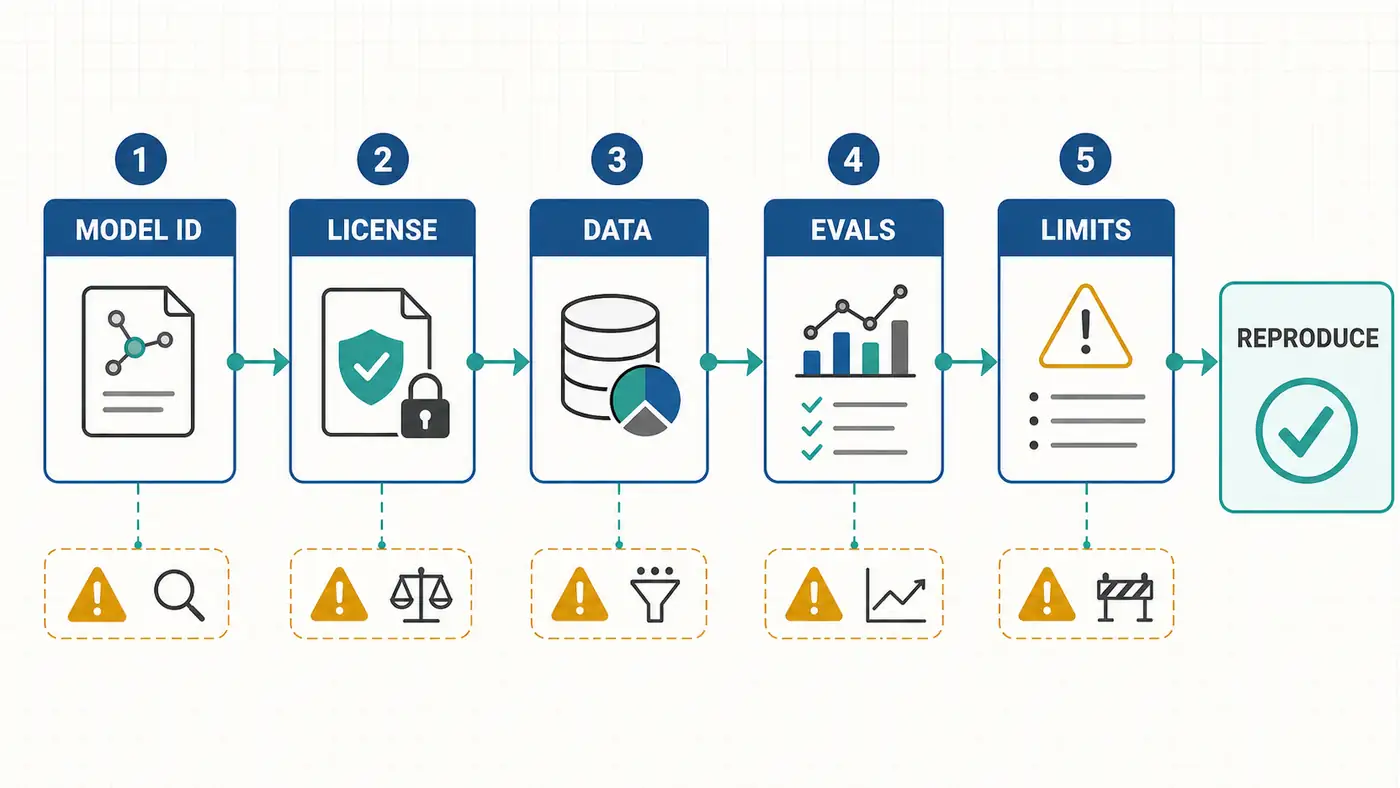
This article gives a set of seven-layer reading method: model identity, open scope, license, training data, training method, evaluation evidence, restriction and recurring assets. The case covers Llama 4, Qwen3, DeepSeek, Gemma, GPT-OSS, OLMo and Nemotron. The goal is not to endorse a model, but to train you to read the model report as a verifiable chain of evidence.
Contents
- Why is this topic important
- Core reading method
- Representative model report roadmap
- Technical report comparison table
- How to reproduce the results
- Common misconceptions
- Postgraduate Topics
- Summary and References
Why is this topic important
The open model release of 2025-2026 is more and more like a combination package: the official website is responsible for narrative, arXiv report talks about training and experiments, Hugging Face model card gives instructions to use, GitHub puts inference code, and also has safe pages, licenses and benchmark page. If a graduate student is read-only PDF, it is easy to miss the details that affect the reproduction: tokenizer, chat template, context length switch, quantitative version, recommended serving ENGINE, license limits, data filtering, and security review boundaries.
"Open" is also not a binary label. OSI's Open Source AI Definition 1.0 requires the machine learning system to provide sufficient data description, training and running code, parameters and other Preferred Form. Many models are more precisely open-weight: the weights can be downloaded, the inference can be run, but the training data, filter code, RL environment, complete hyperparameters, intermediate checkpoint and internal evaluation sets are not fully exposed. Scientific research must separate "can be used" and "reproducible".
Core reading method
First, look at the model identity. Record the model name, version, release time, developer, parameter scale, activation parameters, architecture, modal, context window, tokenizer, chat template, and base/instruct/thinking/quantized /distill relationship. Do not mix different suffixes of the same model.
Second, look at the open scope. Check whether the open is weights, reasoning code, training code, training data, data ratio, filter script, intermediate checkpoint, optimizer state, evaluation script, or only online interfaces. The Hugging Face model card document recommends the model, purpose and limitations, training parameters, training data and evaluation results; however, the recommendation does not mean that each model is fully disclosed. The notes should be marked "publicly / partially / unpublished / waiting for manual verification".
Third, look at the license. Scientific research reproduction is available, and does not mean that it can be commercially deployed, secondary distribution or distilled. Code licenses, weight licenses, data licenses, and Acceptable use policy may vary. Special note: GitHub repository MIT does not mean that the model weight is also MIT.
Fourth, look at the training data. At least ask: What is the number of tokens? What is the data cutoff time? Which languages and modalities are included? From public web pages, authorized data, synthetic data, user interaction or private data? Does it indicate deduplication, quality filtering, safe filtering and sensitive information filtering? Is the Benchmark Contamination reported?
Fifth, look at the training method. Draw pre-training, continued pre-training, SFT, RLHF, DPO/GRPO/RLVR, distillation, long-context The order of extension, quantization, tool-use tuning and safety tuning. A lot of abilities come from post-training, not the base model itself.
Sixth, look at the evaluation evidence. Check the benchmark version, number of shots, prompt format, whether to use tools, whether to use thinking mode, whether to compare the same size model, whether to report variance, and whether to publicly evaluate the script. The results of Arena, LiveCodeBench, AIME, MMLU-Pro, GPQA, MMU, SWE-bench, etc. change rapidly, and the search date must be written when citing.
Seventh, see the restriction statement. A truly valuable model card will indicate that the non-applicable scenarios: insufficient language coverage, limited image quantity, long-context quality decay, high-risk areas, bias and privacy risks, safety bypass risks, and training data cannot be reproduced. These restrictions are often the source of the follow-up idea.
Representative model report roadmap
Model Cards for Model Reporting are basic books. It emphasizes intended use, evaluation process, performance and limitations under different conditions. Datasheets for Datasets and Data Statements for NLP reminds us that the Data is not a token total, but has sources, collection processes, labeling people, language communities, deviations and maintenance responsibilities. When reading the Model report, you should look at the three together.
The Llama 4 model card is a typical sample of the open weight report. Meta discloses MoE architecture, activation parameters, total parameters, context length, training token amount, knowledge deadline, support language, license, energy consumption, benchmark of Scout and Maverick and security reviews; also states that the training data contains public, authorized, and information from Meta products and services. The focus of reading is to distinguish "more than complete disclosure" and "training can be fully reproduced".
Qwen3 is suitable for training version control awareness. Qwen GitHub README shows that the 2507 version will be released continuously from July to August 2025; Qwen3-235B-A22B-Instruct-2507 Model card labels 235b total parameters, 22b activation parameters, native 262,144 token context, and give the configuration instructions extended to about 1,010,000 tokens. Any experimental number must be bound to checkpoint, revision, inference framework, and chat template.
DeepSeek-V3/R1 is suitable for training reproducing boundary awareness. The R1 publication page and Nature papers provide multi-stage post-training, RL, distillation models, open source weights, and some data samples; however, the community replication review states that complete implementation details and training data are not all exposed. Therefore, the reproduction notes should be clear: which links are equivalent and which are just replacements.
Gemma, gpt-oss, OLMo, and Nemotron illustrate different approaches to transparency. The Gemma model card emphasizes inputs and outputs, training data, filtering, safety evaluations, and limitations. The gpt-oss model card discusses the risk that someone could fine-tune the open weights to bypass safety refusals. OLMo 2 takes a fully open approach covering training data, code, recipes, evaluations, and intermediate artifacts. Nemotron highlights open weights, training data, and the training recipe. Read together, they show the range of practices described as “open.”
Technical report comparison table
| dimension | What to look for | risk signal |
|---|---|---|
| model identity | Version, architecture, parameters, modality, context | Just write family names |
| License | Weights, Codes, Data, Output Licenses | Code License and Weight License Confusion |
| training data | token, source, cutoff, filter, deduplication | Write only High-Quality Mixture |
| Posttraining | SFT, RL, preference data, security Tuning | Ability Attribution Blur |
| Evaluation | Benchmark version, shot, prompt, tool | Only the general chart |
| Limit | Language, modality, security, domain boundaries | out-of-scope |
| Reproduce Assets | repo, environment, weights, data, logs | Only demo or API |
How to reproduce the results
Reproducing a 100B+ model from scratch is a poor starting point. Work at three levels. First, audit the documentation. Check the model’s identity, license, data, evaluations, limitations, and available reproduction materials, then report how much is ready to reproduce. Second, reproduce inference results. Pick a checkpoint you can run, fix the revision, environment, chat template, sampling settings, and hardware, and reproduce 1–2 small benchmarks or official examples from the model card. Third, use a 0.5B–7B model to reproduce one mechanism, such as deduplication, mixing SFT data, constructing refusal examples, checking for contamination, analyzing quantization error, or benchmarking tool use.
A minimum experiment can do this: choose three open model cards, build a unified audit table; choose one of the 7B-30B to run the model, run the MMLU-Pro subset, IFEval subset or self-built Chinese task in a fixed environment; compare base / The difference between the Instruct/Quantized ; finally writes "Which information is enough to reproduce, and which missing causes only approximate reproduction".
Common misconceptions
First, take the leaderboard as a paper. The list number is just the entrance, and must be checked for the evaluation date, version, prompt, tool, shot, thinking mode and contamination. Second, open the weight opening as training opening. The download weight can only reproduce the reasoning behavior, not the training process. Third, ignore the license. Classroom reproduction, open source repository, commercial service, secondary distillation and output retraining may correspond to different constraints. Fourth, the mixed version. Model card updates, quantized weights, post-training versions, and provider deployment versions change.
Postgraduate Topics
- Open Model Report Transparency Score: Build LLM Model-Card Audit Rubric, compare 20 open weight models.
- Training data descriptions with Benchmark Contamination: study whether different contamination statements can predict actual overlap risk.
- Empirical validation of the model card limitation description: Convert Reported Limitations to run Test Set .
- Evaluation drift under fast version iteration: Compare the review settings for different checkpoints of the same model family.
- Fully-open and Open-Weight recursive cost comparison: the missing information required for metric reproduction.
Summary
The reading of the open source model technical report does not start from the Benchmark table, nor does it start from the download command, but starts from the chain of evidence: who the model is, what is opened, where the data comes from, how the training is carried out, how the evaluation is set, whether the limit is clear, and whether the asset is reproduced is enough. Read each report as a "reproducible contract": if you make a clear commitment, you can try to reproduce it; if you have vaguely brought it, you must mark the risk; if it is not disclosed, do not complete it for it.
References
Search date: 2026-08-18. The terms of the model version, repository commit, evaluation list and license may change, and it is recommended to manually verify it again before publication.
- Model Cards for Model Reporting. https://arxiv.org/abs/1810.03993
- Hugging Face Model Cards. https://huggingface.co/docs/hub/model-cards
- Open Source AI Definition 1.0. https://opensource.org/ai/open-source-ai-definition
- Foundation Model Transparency Index. https://crfm.stanford.edu/fmti/
- Datasheets for Datasets. https://arxiv.org/abs/1803.09010
- Data Statements for NLP. https://aclanthology.org/Q18-1041/
- Llama 4 Model Card. https://github.com/meta-llama/llama-models/blob/main/models/llama4/MODEL_CARD.md
- Qwen3 GitHub. https://github.com/QwenLM/Qwen3
- Qwen3-235B-A22B-Instruct-2507. https://huggingface.co/Qwen/Qwen3-235B-A22B-Instruct-2507
- DeepSeek-V3. https://github.com/deepseek-ai/DeepSeek-V3
- DeepSeek-R1 Release. https://api-docs.deepseek.com/news/news250120/
- DeepSeek-R1 Nature paper. https://doi.org/10.1038/s41586-025-09422-z
- OpenAI gpt-oss Model Card. https://openai.com/index/gpt-oss-model-card/
- Gemma 3 model card. https://ai.google.dev/gemma/docs/core/model_card_3
- Gemma 4 model page. https://deepmind.google/models/gemma/gemma-4/
- OLMo 2. https://allenai.org/olmo2
- NVIDIA Nemotron. https://developer.nvidia.com/topics/ai/nemotron
- Open-weight AI risk management. https://www.aisi.gov.uk/research/open-technical-problems-in-open-weight-ai-model-risk-management