
Date:2026-07-27
Who this is for: graduate students, early-career researchers and AI practitioners with an engineering background
Goals of this article: Learn to split the Benchmark results in the paper from the "number of the leaderboards" into auditable evidence to determine whether it really supports the paper's claims.
Abstract
The Benchmark in AI papers can easily give people a sense of certainty: a table, several bold numbers, and an "outperforms previous method" seems to show that the method is effective. But for scientific research training, Benchmark is not the conclusion itself, but a preconditioned measurement system. Whether the data is leaked, whether the test set has entered the pre-training corpus, whether the baseline is fully tuned, whether the metric corresponds to the real ability, whether the negative result is hidden, and whether the code and log are enough to reproduce, will change our interpretation of the result.
This article does not focus on "which list is the most authoritative", but trains an action to read a paper: when you see the experimental table, first ask what it is measuring, what it is not measured, who may be favored by this measurement method, and if you reproduce, which step will fail first. The 2025-2026 evaluation research has pushed this issue to the front of the stage: LiveBench, LiveCodeBench, AntiLeakBench, Kernel Divergence Score, Benchmark Watermarking, Preference Leakage, PaperBench, REPRO-Bench and NeurIPS 2026 E&D / MLRC Emphasizes on transparency and reproduction, all of which indicate that benchmark itself has become the research object.
Contents
- Why Benchmark traps are worth training individually
- Three types of core traps: leaks, reports, reappearances
- Representative papers and evaluation roadmap
- Intensive Reading Process of Benchmark Papers
- Methods and experiments compared
- Reproduce Suggestions and Log Template
- Common misconceptions
- Postgraduate topics that can continue to be done
- Summary
- References
Why is this topic important
The original function of Benchmark is to make method comparison repeatable: the gap between method A and method B is meaningful only under the same data set, the same metric, the same split, and the same constraint. But the era of the large model changed this premise.
First, the training data boundary becomes blurred. The closed-source model usually does not disclose the complete pre-training corpus, and the open source model may only expose the high-level data mixing ratio. A long-open test set may have been repeated in web pages, code repositories, data images, teaching materials, and list submission records. Even if the author of the paper has no proactive abuse, the model may have seen test samples indirectly during the pre-training or instruction Fine-Tuning stage.
Second, the evaluation object becomes complicated. In the past, a classification model outputs a tag, and now LLM will generate free text, call tools, write code, search web pages, and run experiments. Metric may come from rules, labor, another LLM Judge, or a set of execution environments. For each additional link, there is one more source of deviation: prompt, sample parameter, parser, judge model, timeout setting, dependency version, hidden test, cache policy.
Third, the leaderboard incentive will enlarge the selective report. The paper does not necessarily show all the BenchMarks, all prompts, all SEEDs, all failed baselines. What the reader sees is the compressed evidence, not the complete experimental trajectory. If a newcomer in scientific research only looks at bold numbers, it is easy to misread "higher under a certain setting" as "a stronger method mechanism".
Therefore, the recognition of the Benchmark trap is not doubting everything, but restoring the results of the paper into a checkable scientific statement: what is the difference in a method in a method under what data, what protocol, what cost, what randomness, and what controls.
Three types of core traps: leaks, reports, reappearances
1. Data leakage: Test set is no longer "unseen data"
There are at least four levels of data leakage.
Sample-Segment Leaks: The original text of the test sample or the near-duplicated sample enters the Training Set. Typical risks come from public benchmark, web images, GitHub dataset repository, list discussion posts, paper appendices and teaching materials.
answer level leak: The model may not have seen the original text of the question, but has seen the problem solution, standard answer, analysis or related discussion. Mathematics, code, and Q&A all are prone to this situation.
Template-level leaks: The model does not remember specific topics, but learns the construction template of Benchmark. Multiple-choice questions, instruction compliance tasks, and synthetic reasoning questions need to be checked in particular.
Feedback Leaks: In the LLM-as-a-judge, Preference Optimization and Synthetic Data Cycle, the training model, data generator and review model are from the same model family or inheritance chain, and the evaluation may be biased towards some output styles. Preference Leakage defines this relationship as the correlation between Judge and generator/Student, not the train-test overlap in the traditional sense.
When reading the paper, first find three types of evidence: whether the data is released later than the model training deadline; whether the author has checked the near duplication and answer leaks; whether the Benchmark has a LIVE update, a private test, or the automatic scoring mechanism can be verified. If these evidences are missing, do not immediately deny the paper, but downgrade the conclusion from "enhancing ability" to "score improvement on that open test protocol".
2. Selective report: what the table shows and what is hidden
Selective reports are not necessarily fraudulent, but more often the screening deviations in the research process. The paper is limited in length, and the authors tend to show the settings that best support propositions. Readers should take the initiative to ask:
- Is only the average score reported, without the task subclass, difficulty hierarchy and variance?
- Is it only comparing the weak baseline, avoiding the latest or stronger baseline?
- Is it only showing the best prompt or the best SEED, without specifying the search space?
- Is it only highlighting favorable results in multiple Benchmarks, putting adverse results in the appendix or omitted completely?
- Are you using different inference budgets, tool permissions, context length, retrieval library or external resources, but compared horizontally in the same table?
A common pitfall is a "bold number narrative": a column in the table is 0.5 to 1 percentage point high, and the text explains it as a mechanism breakthrough. But if there is no Confidence Interval, repeat run, significance test, cost constraints and failure cases, this gap may just be insufficient for noise, prompt search, sampling randomness, or baseline tuning.
3. Non-reproducing: the results may be true, but the chain of evidence is incomplete
Non-reproducing does not mean a result error. Many LLM experiments do rely on expensive APIs, non-public weights, dynamic web pages, data sources that change over time, and non-fixable version of the server-side model. However, the paper must explain which parts can be reproduced, which can only be reviewed, and which need to be checked manually.
NeurIPS 2026 Evaluations & Datasets Reviewing Guidelines At the core of the E&D track; MLRC 2026 also incorporates reproduction, partial recurrence failure, generalization research and meta-reproducing research into the formal contribution type. This means that "I can't reproduce" is no longer just an engineering complaint, but a problem that can be systematically studied.
For the reader, the minimum reproduction evidence includes: data download and version, preprocessing script, model checkpoint or API Version, prompt, sampling parameters, SEED, hardware and dependency environment, raw output, scoring script, statistical summary script, failure sample, run log. If these materials are missing, you can still read the method, but don't think of the experimental table as a solid fact.
Representative papers and evaluation roadmap
Classic Fundamentals: First Understand Pollution and Evaluation protocol
Early NLP and machine learning have long discussed the Train-test Contamination, DataSet Bias, Leaderboard Overfitting, and Reproducibility Crisis. The new problem in the era of the large model is not "the first leak occurs", but the leakage is more difficult to observe, the impact is greater, and the spread is faster. Once the public benchmark is absorbed by the model training pipeline, it is almost impossible for the latecomers to know whether the model has seen the sample.
2024: Live Benchmark and verifiable scores become the mainline
LiveCodeBench proposes a Contamination-Free Evaluation for code-oriented capabilities, and reduces the old Benchmark by continuously collecting new questions such as LeetCode, AtCoder, and Codeforces. Risk of pretrained contamination, and extends the evaluation range from code generation to self-repair, code execution, test output prediction and other abilities.
LiveBench combines the Live update with the Objective Ground-Truth Scoring . Its official site displays the latest Release as 2026-06-25 on 2026-07-27, covering 23 Objective Tasks and 7 categories. The meaning of training here is: a good Benchmark is not only a difficult problem, but also explains how to update the topic, how to rate it, and how to reduce the Judge BAS.
2025: Refinement of pollution detection and anti-leak construction methods
AntiLeakBench, focusing on the issue of "newly collected data may also contain old knowledge", proposes that anti-leakage Benchmark is constructed with Explicitly new knowledge. Kernel Divergence Score detects DataSet Leakage from the angle of the model where the sample represents a change before and after the model. Benchmark Watermarking tries to implant statistically detectable "RadioActivity" before the release of Benchmark to determine whether the training process has absorbed the test set .
These studies show that rephrasing test questions, shuffling options, or asking the same thing a different way may leave contamination intact. The ICML 2025 paper “The Emperor’s New Clothes in Benchmarking?” systematically evaluated mitigation strategies. Many meaning-preserving rewrites did little to improve resistance to contamination, while changing the meaning reduced fidelity to the original benchmark. Treat claims such as “we paraphrased the test set, so it is contamination-free” with caution.
2025-2026: The reproduction ability itself becomes a benchmark
PaperBench asks AI agents to reproduce ICML 2024 Spotlight or Oral papers from scratch and uses rubrics to score the work in parts. REPRO-Bench focuses on social science papers and asks agents to check whether a reproduction package is consistent with its paper. Both turn the ability to reproduce research into an object of evaluation in its own right.
This is very inspiring for graduate students: reappearance is not to run through the repository, but to verify whether the paper statement and the chain of evidence are consistent. When you fail to reproduce, you should also distinguish whether it is environmental problems, data problems, realization problems, randomness problems, calculation of budget problems, or the paper advocates itself is unstable.
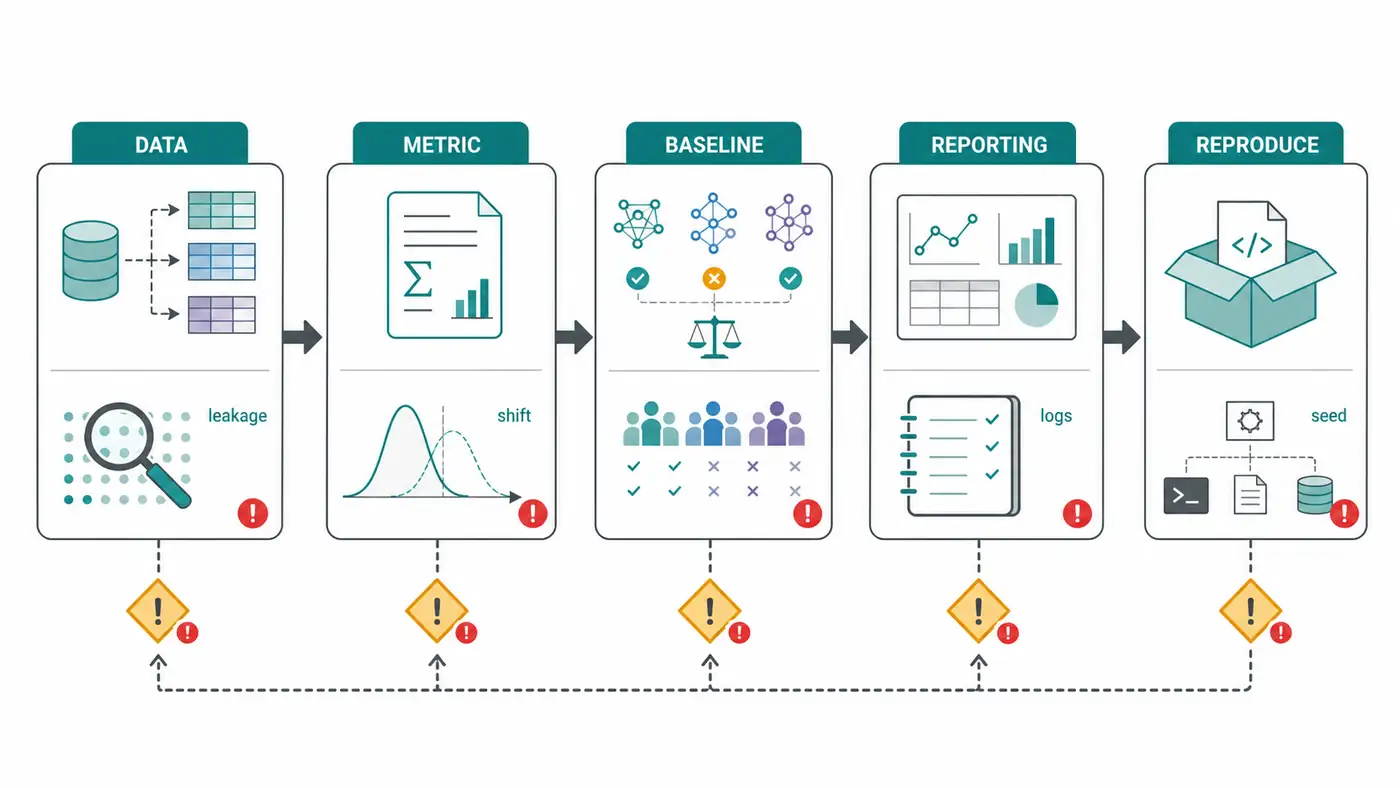
Intensive Reading Process of Benchmark Papers
Step 1: Rewrite the claim into a testable statement
Don't stop at "our method is better". Rewrite it to:
On the Split S of DataSet D, under Metric M, in the inference budget B, model scale P, training data T, Prompt scheme R, random seed collection Z, method A is improved relative to Baseline C x, and the boost support mechanism assumes H.
If the paper cannot fill this sentence, it means that the boundary of the explanation is unclear.
Step 2: Check the data boundaries
Data audits include at least:
- Dataset release time, version number, license, download address;
- whether train/validation/test split is fixed;
- Is there a Near-Duplicate, an answer leak or a template leak;
- Whether it may be pre-trained, SFT, RLHF, tool logs or benchmark tuning contact with the target model;
- Is there a private test, live update, canary, watermark or held-out audit set;
- Whether the deduplication or contamination detection script is exposed.
This is not sufficient if the author only writes "We follow the standard benchmark setting". Standard settings may have expired.
Step 3: Check if the metric has detected the claim
A benchmark may measure format obedience, not reasoning; it is a retrieval hit, not a synthesis of knowledge; it is a JUDGE preference, not a fact that is correct; the test is pass@1, not a debugging ability. Ask when reading metric:
- What is the output space: multiple choice questions, short answers, free text, code, tool track?
- Scorer is a rule, executor, human, LLM judge, or a mix?
- Is Scorer public, stable, and offline?
- Is metric biased for length, style, absention, format error, and some are correct?
- Are constraint indicators such as cost, delay, token, and tool calls reported?
Step 4: Check if Baseline is fair
Baseline is not a escort in the table. It determines the strength of the evidence of the paper. Prioritize these details:
- Whether baseline uses the same model size, data, training steps, context length and reasoning budget;
- Whether baseline uses official implementation or author reruns;
- Whether the baseline is re-adjusted;
- Whether the new method has obtained additional tools, retrieval library, external API or longer chain-of-thought;
- Is there a comparison of the "new method full setting to the old method Cheap setting".
If the baseline is an outdated version, or there is no description of the budget adjustment, the novelty of the paper may be exaggerated.
Step 5: Check the report integrity
Reliable papers allow readers to see structured evidence, not just the highest score. Suggested check:
- Is there any per-task, per-category, and difficulty buckets outside the main table;
- whether to report the average, standard deviation or Confidence interval;
- Whether to indicate Prompt search, hyperparameter search and checkpoint selection;
- whether to show failure cases and negative results;
- Whether to correspond to the mechanism assumption;
- Whether to expose raw predictions, scoring logs, error samples, and statistical scripts.
Step 6: Check the repeat path
You can use the "24-hour reproduction plan" to test the transparency of the paper: if it starts to reproduce today, can you complete the minimum subset in one day?
Minimum subsets do not require full training. It can be 100 samples, a model, a SEED, and a Benchmark subtask. But it must cover the full link: data loading, inference, scoring, summarizing, generating tables. If you can't even build this path, the reproduction material of the paper is not mature enough.
Methods and experiments compared
| Representative work / specification | Years | Mainly resolved problems | Inspiration for reading papers | Prioritize checking |
|---|---|---|---|---|
| LiveCodeBench | 2024 | Code Benchmark Pollution and Capacity Coverage | New questions, time window and task diversity are more important than a single pass@1 | Question time window, AutoGrader version, execution environment |
| LiveBench | 2025, site 2026-06-25 release | Pollution of generic LLM Benchmark and Judge Bias | Live update + Objective Scoring is a more stable evaluation direction | Release version, open topic scope, Scoring script |
| AntiLeakBench | 2025 ACL | Newly collected data may still contain old knowledge | "New data" does not mean "no leakage" | New knowledge definition, automatic construction process, knowledge cutoff hypothesis |
| Kernel Divergence Score | 2025 ICML | Measuring Benchmark Dataset Leakage | Contamination detection can be an independent experiment, not just a statement | Controlled control settings, code repository, ablation |
| Benchmark Watermarking | 2025 arXiv | Add detectable traces for Benchmark before release | In the future, Benchmark may need an audit mechanism | Whether Watermark affects task utility, statistical inspection conditions |
| Preference Leakage | 2025 arXiv,ICLR 2026 accepted | LLM JUDGE correlates with generator/student model causing bias | Judge is not a neutral measuring instrument | Judge model family, training data sources, Blind Judge |
| PaperBench | 2025 ICML / OpenAI | Evaluate the ability of AI agents to reproduce AI papers | The reproduction task can be split into Rubric, not just the final score | Rubric, original paper collection, Judge calibration |
| REPRO-Bench | 2025 ACL Findings | Evaluation Agent Review Paper Reproduction Package | The quality of reproduction includes "whether the result is consistent with the paper" | Reproduction package, task instance, manual label |
| NeurIPS 2026 E&D / MLRC | 2026 | Evaluation specification for evaluation, dataset and reproduction research | Benchmark itself is a scientific research contribution and requires transparency | Data documents, code availability, negative result records |
Reproduce Suggestions and Log Template
When reproducing a Benchmark paper, don't start pursuing a complete leaderboard. Do a small and reliable audit package first.
Minimum Reproduce Target
- Select 1 major BenchMark subset;
- Select 1 representative baseline and 1 paper method;
- Fixed 1 to 3 SEEDs;
- Fixed model version, dependency version, prompt, max tokens, temperature, top-p;
- Save raw output, not only the final score;
- Summarize the paper scripts and their own independent scripts once;
- Manually categorize 20 to 50 error samples.
Log field template
run_id:
paper:
benchmark_name:
benchmark_version_or_release:
dataset_url:
dataset_download_time:
model_name:
model_checkpoint_or_api_version:
prompt_template_hash:
decoding_params:
seed:
hardware:
dependency_lockfile:
scorer_commit:
num_examples:
num_failed_or_timeout:
main_metric:
confidence_interval_or_std:
raw_outputs_path:
score_script_path:
known_deviations_from_paper:
Reproduction judgment
- If the score is close to the paper, but the distribution of failures is different, priority check for prompt, post-processing and scorer.
- If the baseline is significantly lower than the paper report, it is preferred to check that the baseline is correctly tuned.
- If only certain tasks vary widely, prioritize the data version, split, topic filtering, and judge.
- If the API model results drift, log the call date and model version; do not interpret the drift directly as a method error.
- If data or code cannot be downloaded, label "non-reproduced independently" and limit the paper's conclusion to the scope of the author's report.
Common misconceptions
Myth 1: The high score of the public Benchmark indicates strong ability.
Public Benchmark can be contaminated, overfitting, or templated. The high score indicates that the model is suitable for the protocol, and does not automatically explain the strong generalization ability.
Myth 2: There must be no leaks in the new Benchmark.
If the new BenchMark is based on existing web knowledge, publicly available question bank rewriting, or LLM synthesis, it may still contain pre-training knowledge or template leaks.
Myth 3: LLM Judge is more objective than artificial.
LLM Judge is cheaper and more consistent, but is affected by positional deviation, length deviation, style preference, model family relevance, and Prompt design.
Misunderstanding 4: Failure to reproduce is a wrong paper.
Reproduction failures may come from dependencies, randomness, hardware, data downloads, API updates, hidden preprocessing, or missing documents. Scientific research training should classify the reasons for failure, rather than just write "failed".
Myth 5: The more ablation tables, the more reliable it is.
If the ablation has no control variables, or each module changes the training budget, the amount of parameters, the amount of data, and the inference cost, it is just multiple sets of experiments, not mechanism evidence.
Research questions for graduate students
- Near Repeat and Answer Leaked Audit for Chinese LLM Benchmark: Collect public question banks, list examples, GitHub images and web page cache, and build a Contamination audit pipeline.
- LLM JUDGE family correlation experiment: The system compares the scoring deviation of the same model output by Judge, the same family, inheritance relationship, and different institutions.
- FIDELITY-RESISTANCE TRADE-OFF: Reproduce ICML 2025 related ideas, compare paraphrase, variable replacement, semantic refactoring and new knowledge structure on Chinese Q&A, code or math tasks.
- Selective Report Detection of the Paper Rankings: Tracking the difference reported on multiple Benchmarks from the OpenReview/arXiv/GitHub Release to analyze which results are easier to be emphasized by the main text.
- Small Reproduction Package Score Rubric: Design Reproduction Report Rubric for a certain type of LLM paper, including environment, data, logs, failure samples and statistical tests.
- Drift Study of Dynamic Benchmark: Compare the change of model rankings under different Releases of LiveBench / LiveCodeBench, and distinguish between real ability changes, problem difficulty changes, and evaluation protocol changes.
Summary
When reading the Benchmark table, the most important action is not to find the highest score, but to restore the measurement conditions of the experiment. A trusted result should at least answer: whether the data is clean, whether the metric corresponds to the claim, whether the baseline is fair, whether the report is complete, whether the reproducing path exists, and whether the failure case explains the boundary.
Benchmark trap recognition is a very practical training for newcomers to research: it will force you to move from "believe the form" to "audit evidence". When you can point out the leak risk, report bias and recurrence gap of a paper, it is easier to come up with your own follow-up idea: improvement Benchmark, build audit tools, reproduce experiments, do negative results analysis, or redefine a more reliable task protocol.
References
Search date: 2026-07-27. The following priority lists the paper homepage, conference/journal page, official project page and official specification; the changeable leaderboard, release, and model version information are subject to the search day page.
- ICLR 2026 Reviewer Guide. https://iclr.cc/Conferences/2026/ReviewerGuide
- NeurIPS Evaluations & Datasets 2026 Reviewing Guidelines. https://nips.cc/Conferences/2026/EvaluationsDatasetsReviewerGuidelines
- MLRC 2026: Reproducibility as an Official Track at NeurIPS. https://blog.neurips.cc/2026/05/04/mlrc-2026-reproducibility-as-an-official-track-at-neurips/
- LiveBench official leaderboard, latest release shown as 2026-06-25 on 2026-07-27. https://livebench.ai/
- LiveBench GitHub repository. https://github.com/LiveBench/LiveBench
- Colin White et al. “LiveBench: A Challenging, Contamination-Limited LLM Benchmark.” ICLR 2025. https://mlanthology.org/iclr/2025/white2025iclr-livebench/
- Naman Jain et al. “LiveCodeBench: Holistic and Contamination Free Evaluation of Large Language Models for Code.” arXiv:2403.07974. https://arxiv.org/abs/2403.07974
- Xiaobao Wu et al. “AntiLeakBench: Preventing Data Contamination by Automatically Constructing Benchmarks with Updated Real-World Knowledge.” ACL 2025. https://aclanthology.org/2025.acl-long.901/
- Hyeong Kyu Choi et al. “How Contaminated Is Your Benchmark? Measuring Dataset Leakage in Large Language Models with Kernel Divergence.” ICML 2025 / PMLR 267. https://proceedings.mlr.press/v267/choi25b.html
- Yifan Sun et al. “The Emperor’s New Clothes in Benchmarking? A Rigorous Examination of Mitigation Strategies for LLM Benchmark Data Contamination.” ICML 2025 / PMLR 267. https://proceedings.mlr.press/v267/sun25t.html
- Tom Sander et al. “Detecting Benchmark Contamination Through Watermarking.” arXiv:2502.17259, v2 revised 2025-07-21. https://arxiv.org/abs/2502.17259
- Dawei Li et al. “Preference Leakage: A Contamination Problem in LLM-as-a-judge.” arXiv:2502.01534, ICLR 2026 accepted. https://arxiv.org/abs/2502.01534
- OpenAI. “PaperBench: Evaluating AI’s Ability to Replicate AI Research.” 2025. https://openai.com/index/paperbench/
- Giulio Starace et al. “PaperBench: Evaluating AI’s Ability to Replicate AI Research.” ICML 2025 / PMLR 267. https://proceedings.mlr.press/v267/starace25a.html
- Chuxuan Hu et al. “REPRO-Bench: Can Agentic AI Systems Assess the Reproducibility of Social Science Research?” arXiv:2507.18901, ACL 2025 Findings. https://arxiv.org/abs/2507.18901
- Stanford CRFM. “HELM Capabilities: Evaluating LMs Capability by Capability.” 2025. https://crfm.stanford.edu/2025/03/20/helm-capabilities.html