- Date: 2026-11-01
- For graduate students, early-career researchers and research engineers
- Scope: Deep reading of evidence for three diagnostic studies; this model experiment is not reported.
Abstract: The answer is correct, the evidence may not be used
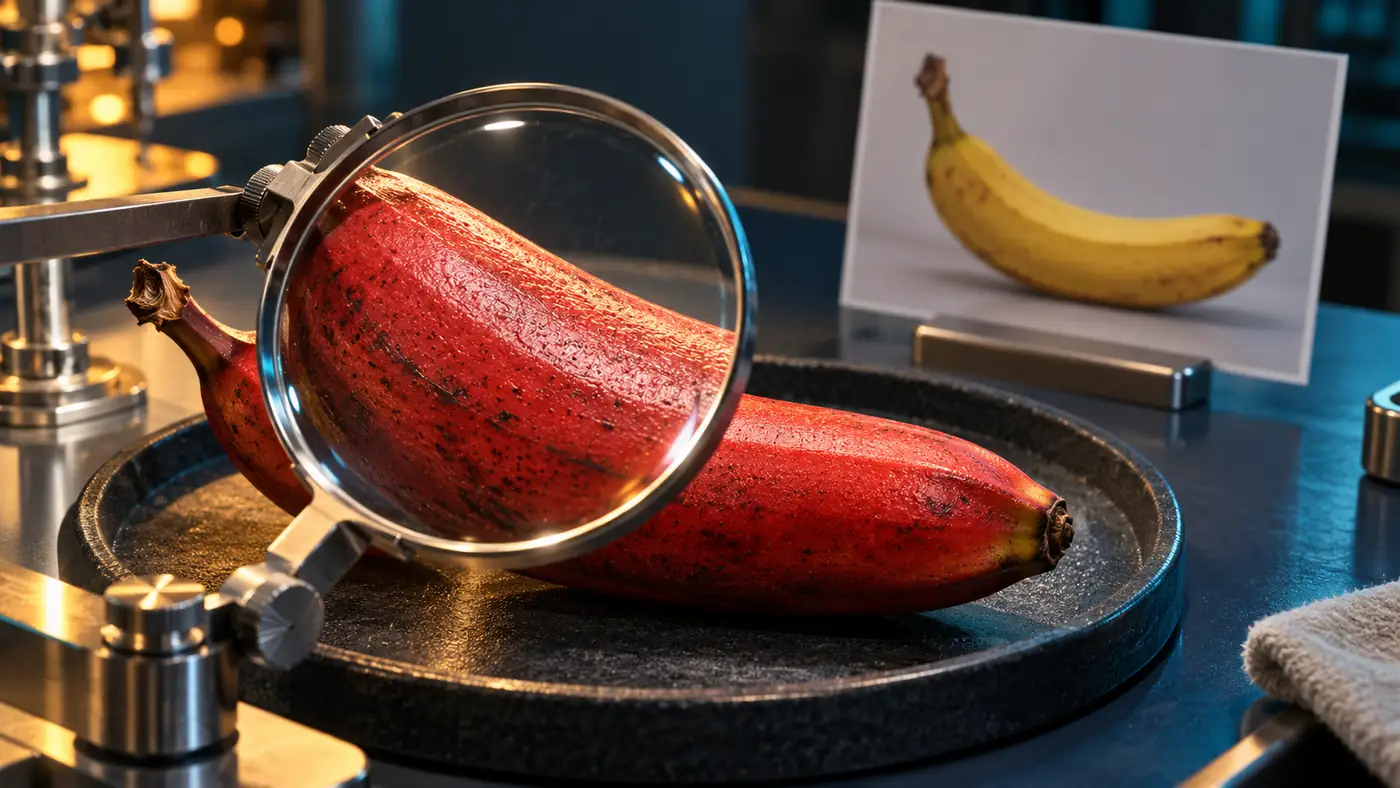
Ask a banana photo "what color is it", the answer may come from looking at the picture, or from common sense. Change the banana to red, and the error will be revealed; but the answer may still be that you have not seen the color, did not understand the problem, or did not use the attributes you see for answering. Total Accuracy cannot distinguish these explanations alone. The red bananas in the cover are just concept illustrations, not paper test samples.
This article focuses on three diagnostic entrances: VLind-Bench first checks the basic ability, and then evaluates the inverse common sense images; Winoground fixed vocabulary, changes the combination relationship; VisRes split the visual task into perception and rule inference. They are not "visually effective" and "language harmful" two camps. This article is concerned with: what observation is enough to support the model relying on visual evidence, and what observation cannot locate the cause of failure.
"Look at the picture" contains at least three different things
Vision-Language Model, referred to as VLM, is a model that processes both images and texts at the same time. Visual Q&A requires it to answer questions based on images. The language prior is the common collocation, fact or answer inclination learned from training; it can help understand the problem, and it may also replace the field evidence when the image conflicts with common sense.
Need to distinguish Identify objects, bind relationships and use evidence. Seeing "cup" and "bowl" does not mean that who is on the left; it does not mean that the default answer of "banana is usually yellow" is not returned when answering the follow-up question. The three links may have problems at the same time, and all failures cannot be counted as language bias.
The following are three competitive explanations for reading evidence in this article. First, the model mainly relies on questions and common answers, and the image contribution is very small. Second, the model does receive visual information, but compression, resolution or attribute recognition limits available evidence. Third, the information can be individually identified, but has not stabilized into the relationship judgment. Their predictions for interventions are different: changing the wording of the problem, improving the resolution, and the relationship between the objects of exchange should not only be regarded as three "pointing skills".
If the answer is wrong, first check whether it has the premise ability
VLind-Bench uses a conditional diagnostic. It first checks whether the model knows the relevant common sense, recognizes the objects in the image, and accepts a counterintuitive premise when it is stated explicitly in text. Only examples that pass these checks are used to assess the judgment based on the image. Each check requires the model to handle both true and false statements correctly. Table 3 shows that this filtered pipeline score differs from accuracy over all examples. Lee et al., §3, §5.1 and Table 3
This changes what we can say. If the model does not even recognize the goals in the figure, continue to criticize it for "seeing but not believing it clearly", and the evidence is insufficient. The author's approach has reduced confusion, but its limitations clearly admit that there may still be unconsidered factors and hint sensitivity. Original Limitations
This article inference: Passing the premise test does not mean that the perception problem is completely ruled out. Object presence check is easier than fine-grained properties, subject and object binding. If you can recognize a sword, you may not be able to stably judge who is holding it; if you can accept the text description, it may just be the text to explain the answer directly. The pipeline is more like a diagnostic filter than a complete proof of the internal mechanism.
Also pay attention to the denominator. The sample sets of each model by premise may be different, so higher condition scores do not automatically mean that it is stronger on the same set of puzzles. When comparing, the coverage amount entering the final stage, the task performance of the overall problem, and the results of the common passage on the subset should be given at the same time. Keeping only one beautiful final percentage will mix "the rest of the questions is easier" with "use vision better".
Know the words, but the relationship may not have been paired successfully
Winoground combines two figures and two sentences with the same vocabulary and different arrangements. In this way, it is difficult to complete the matching by "what words appeared". It checks the group scores for graph selection, sentence selection, and two directions, respectively. The test model in Table 3 in the original text is lower than its random baseline in group indicators; this describes the model and protocol at that time. Thrush et al., §3–5, Table 3
It is not another generic list, but a difficult negative example design. Negative examples share a large number of objects and vocabulary with positive cases, and errors focus on combination relationships. Ordinary retrieval may only require the selection of relevant pictures from obviously different candidates; relationship diagnosis requires a distinction between candidates with "all objects are paired".
This article is inferred: Two-way matching is more convincing than a single hit, but the fault cannot be positioned separately. Image encoding, text-word order processing, and cross-modal comparisons all participate in matching; failure may occur at any one. Photos may also contain ambiguity and background differences, and the two real photos cannot be directly regarded as a perfect causal intervention to change the relationship.
Therefore, the historical results of the paper cannot be rewritten to "All multimodal models today will not be viewed". Changing the generative model to answer multiple-choice questions has also changed the scoring interface. If you adjust the prompt, candidate position or answer extraction rule during re-testing, you should first ensure that each model accepts the same protocol, and then discuss where the progress comes from.
Visual puzzle failure, may also be a problem of input representation
VisRes has three levels: perceptual completion, rules involving one attribute, and combinations of multiple attributes. The distractors are visually similar to the correct options. The authors also test attribute recognition separately, vary input resolution, and restate the rule problems in words. The experimental account here draws on the December 2025 arXiv v1. I confirmed publication at CVPR 2026 in the official program but did not obtain the full conference paper. Törtei et al., §3–5
In this version of Table 7, the second level of GPT-5 is increased from 1024 to 2048, and the Accuracy is reduced from 49.61 to 48.99; so "higher resolution increases all levels by file" does not conform to the table. The literal rule questions also perform better, but this cannot only prove that the visual encoder is a bottleneck: the text has completed the attribute extraction and changed the representation. Original §5.2, Table 7
Inference in this article: See clearly and reason correctly, there is a bridge that needs to be interfered. If the resolution is improved to improve grades, it supports input details or processing methods to affect the results; but increasing the image information also usually changes the visual token and the calculation cost. If the performance is improved directly after providing an accurate attribute table, it means that the expression is helpful to the task, but it does not prove that the model has already perceived the same information.
In the same way, the negative example of the difficulty will make the test more differentiated, and it will also change the test distribution. When the options are similar, low scores may expose fine visual discrimination; it is not evidence that "all visual knowledge in training is ineffective". Researchers need to report how negative cases are selected and whether the conclusions are consistent between ordinary candidates and similar candidates.
What can three studies spell, what can't be spelled
| diagnostic entrance | Observation object | judgments that can be supported | cannot directly prove |
|---|---|---|---|
| Anti-common sense prerequisite screening | Image judgment after the basic test passes | Some simple failure explanations have been restricted | The remaining errors are all caused by the language prior |
| Two-way pairing with the same vocabulary | Composite relationship and matching consistency | Vocabulary is not enough to complete the task | The fault must occur on the visual side |
| Perception and Rule Hierarchy | Properties, Resolution and Representation Changes | Input and task structure impact performance | There is only one mechanism for all gaps |
The above table is a summary of the three agreements, not cross-paper rankings. Their model starting point, data source, training experience, reasoning budget and indicators are not uniform: there are graphic scoring, there are also true and false judgments and one of the four; there are conditional denominators and group requirements. The training information of the public model and the closed source interface is also different, and it is impossible to spell the conclusion that "what architecture will look at the map under the same training budget" from these papers.
The current evidence is more suitable to support a limited judgment: there is a distance that needs to be measured separately between the high score of visual tasks and the stable dependence of vision evidence. **Language knowledge can provide concepts and rules, and visual input provides current scenarios; the real problem is whether it can be adjusted according to the requirements of the task, rather than completely eliminated language knowledge. This is a comprehensive judgment of this article, not a universal theorem to prove a single paper.
Next step: Let different interpretations give different predictions
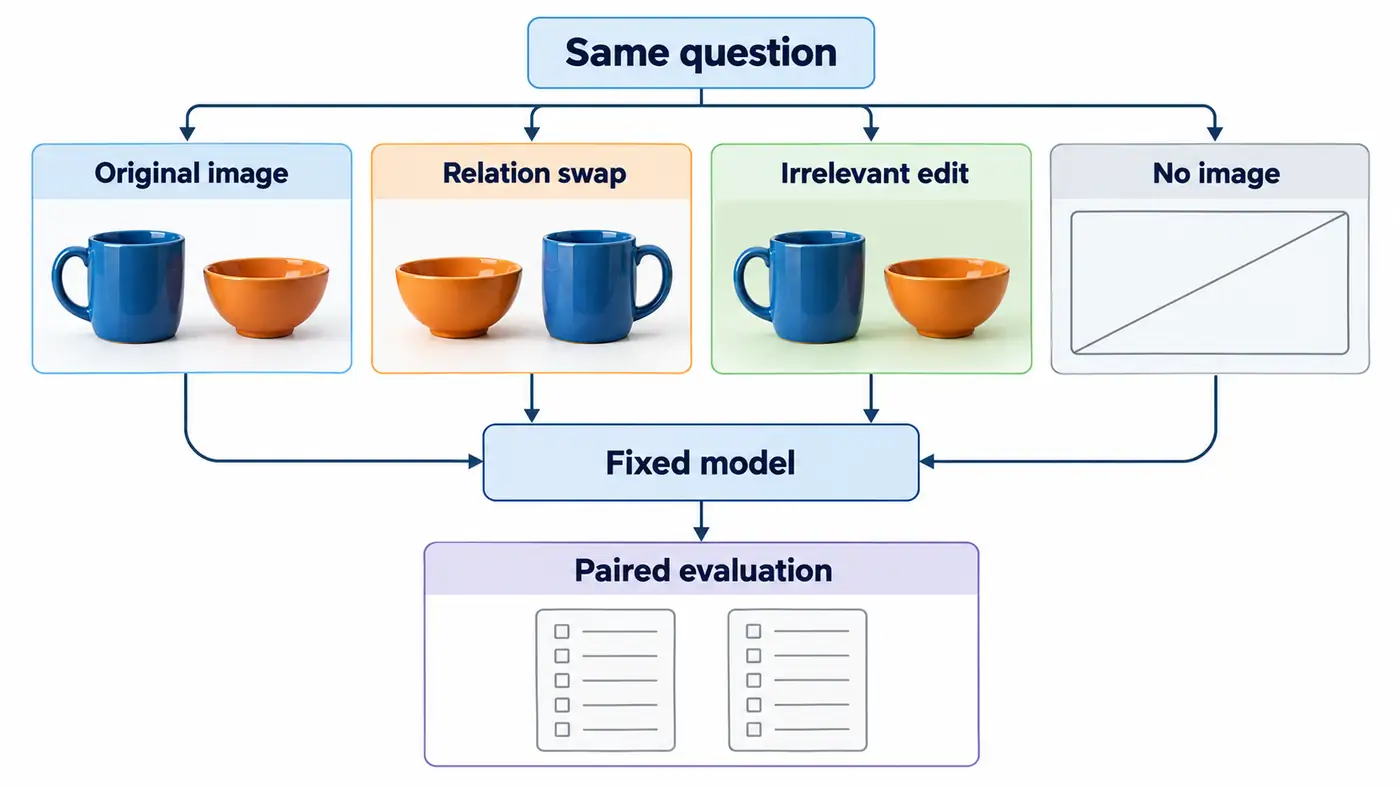
Figure: Unexecuted experiments proposed in this article. The four inputs are sent to the same model, and the arrows only indicate the evaluation process, not the internal causal mechanism of the model, and there is no observed result. The relationship exchange diagram is only a schematic, and the actual test must maintain the same non-target factors such as the direction of the cup handle.
It starts with a set of scenes where the relationship between the objects is clear and the answer is balanced. Fixed problems, provide the original image, the graph that changes the target relationship, the picture that only changes the unrelated background, and the no-pic input supported by the model natively. When the target relationship changes, the correct answer should be changed; when editing, the correct answer should be maintained. The focus of the test is whether these two types of responses can be established at the same time.
First, separate the object recognition from the relationship judgment, use an independent session, and avoid the previous answer from the previous answer. All samples are recorded, and then a subset of common pass-through inspections is attached. If you only look at the subset, you must report how much you have screened out and what questions are screened out; otherwise, it is easy to delete the most serious perception failure of the model from the conclusion.
Second, fixed checkpoints, prompts, candidate sequence rules, decoding parameters and budgets. The experiment to improve the resolution will report the image token and cost separately, and the text attribute table is listed as an external information condition. If no picture input is not supported by the interface, the control cannot be implemented truthfully.
Finally, observe the correctness of the pairing, not just whether the answer has changed. Switching back and forth between wrong answers is also very sensitive, but it is not used by evidence. If the relationship changes cause correct flipping and background editing is correct, it is more supportive to selectively use relevant information; if all editors disturb the answer, it is more like input vulnerability; if all editors do not change the answer, they still need to distinguish the task without looking at the picture and ignore the image.
Before the actual execution, it is also necessary to independently judge whether the edited semantics are accurate, and check the occlusion, viewing angle and artifacts. You cannot make the same model to be evaluated and give a unique gold standard. This article does not carry out this experiment, nor does it claim that it has been artificially marked; the value of the above design is to write the requirements of the next step clearly.
It should also be prescribed in advance what results will change the judgment. For example, if the text conditions are also frequently confusing, the confidence in "pure visual failure" should be reduced; if only a certain background editing leads to degradation, first investigate the editing traces and input processing. Retaining samples that do not meet the expectations are more constrained to interpret the interpretation than redefining "problems that require vision" after seeing the results.
Summary: Turn "seeing" into a testable problem
To judge visual reasoning, you don't have to choose the position of "true understanding" or "just guess". First ask whether the image is necessary, then ask whether the relevant changes can cause correct changes, and finally check whether the irrelevant changes remain stable. The prerequisite screening, group matching and expressing interventions add a piece of evidence, but none of them is enough to prove internal understanding alone. For newcomers to scientific research, the more valuable result is to narrow the scope of failure interpretation and clarify which intervention may overturn the current judgment.
References
- Lee, Kang-il; Kim, Minbeom; Yoon, Seunghyun; Kim, Minsung; Lee, Dongryeol; Koh, Hyukhun; Jung, Kyomin. VLind-Bench: Measuring Language Priors in Large Vision-Language Models. Findings of NAACL, 2025. Published paper.
- Thrush, Tristan; Jiang, Ryan; Bartolo, Max; Singh, Amanpreet; Williams, Adina; Kiela, Douwe; Ross, Candace. Winoground: Probing Vision and Language Models for Visio-Linguistic Compositionality. CVPR, 2022. Read the full text of arXiv v2; Official publication page.
- Törtei, Brigitta Malagurski; Dahou, Yasser; Huynh, Ngoc Dung; Para, Wamiq Reyaz; Lê Khac, Phúc H.; Singh, Ankit; Chaybouti, Sofian; Narayan, Sanath. VisRes Bench: On Evaluating the Visual Reasoning Capabilities of VLMs. 2025 preprints, published by CVPR 2026. Read the full text of arXiv v1; Official publication page.
Deadline for retrieval and data: 2026-11-01. Retrieval covers work related to nearly twelve months, and retains the classic diagnostic design; does not claim comprehensive coverage. The CVF page is limited directly, and the published information is checked using its official search records, and the experimental details are subject to the read version that is clearly listed.
Apps by the author
The following is the author's own product promotion. In addition to writing a technical blog, I have also independently developed some daily gadgets, welcome to learn:
- Daily Expense Journal: Record the daily income and expenditure, arrange the budget and savings goals, so that the whereabouts of each money is more clear. View on the App Store.
- One Small Action: Choose small actions according to the current time and energy, record the feelings after completion, and leave a clue to the daily review. View on the App Store.
More technical articles and personal works, welcome to visit Author personal website. These works are not technically linked or endorsed by the paper.