
- Date: 2026-10-24
- For graduate students, early-career researchers and research engineers
- Deadline: 2026-10-24; Retrieval covers related work for nearly 12 months, and reserves the starting point of the method. This article is a deep reading of the literature, no model experiment is run, and it does not claim to be fully covered.
Summary: First ask what "Jiatu" has added
Organize a batch of documents into pictures, and then answer cross-document questions, and the results have improved. We easily interpret the results as "relationship modeling works". However, building maps usually extracts facts, generates descriptions, merges entities, summarizes documents in advance, and changes the amount of calculations at the time of the query. The content that the model sees and the process of obtaining the content may change together.
Current evidence supports the value of certain graph augmented systems on a specific task, but is not enough to give all the benefits to the connected structure of the graph. This article uses the original GraphRAG, HippoRAG 2 and a systematic evaluation updated to 2026 to examine the global generalization, graph guided search and budget control respectively. original study、HippoRAG 2、systematic evaluation The tasks and evaluations are different, and they cannot be put into a list of championships.
An edge, not just a line drawn between two points
Retrieval-Augmented Generation, referred to as RAG, is to first find evidence from external data, and then let the language model answer accordingly. The graph enhancement method represents entities, paragraphs, etc. as nodes, and represents the relationship or attribution as an edge. Triples are fact units such as "subject-relationship-object". The topology of the graph is how the node is connected; it is not the same thing as the text and edge semantic tags on the node.
Think of a Pure illustrative example: Material A said that a researcher participated in the project, and the material B said that the project was funded by a fund, and asked the researcher which sponsors were associated. Sort by question and paragraph similarity, you may only find A; expand along the project node, there is a chance to find B. However, if a pre-generated summary has already written the connection between the two, even if the graph is not traversed, it may be correct. This example has no measurement results and only explains two distinguishable explanations.
Therefore, at least three hypothetical paths must be separated. first, Connection Help Navigation: The correct relationship makes Retriever cross the word distance and find the missing evidence. second, Processing improves readability or coverage: Extraction, entity merge and abstract make answers easier to retrieve. third, Resources Change Search Opportunities: More candidates, longer contexts, or additional model calls to increase success rates. They can be established at the same time and do not have to be mutually exclusive.
"More information" also needs to be made clear: the abstract of the same corpus does not necessarily add new external facts, but it may increase the relevant content that is actually seen in a certain answer; the extraction model may also be mixed into its own knowledge. If the original text source is not reserved for the generated content, it is impossible to distinguish between effective compression and unsupported supplements. This is the attribution issue raised in this article, not a factual allegation against all map-building systems.
Three studies that answer three levels of questions
The original GraphRAG study is summarized globally. It extracts the entity relationship from the text, divides the closely connected community, and then generates a community summary; answer and summarize in batches during query. The experiment has both vector retrieval and TS baseline that directly summarizes the original text in batches. The community program is dominant in the partial comprehensive and diversity comparison, but the statement count and clustering indicators of V2 do not show that it is significantly different from TS. The "declaration" here is the extraction unit that can verify the statement, and does not mean that each item has been verified to be true. §3–5, especially §5.2
The value of this design is to remind us that weak baselines may not have the opportunity to see the overall situation. The graph scheme is better than the local search, and cannot directly prove that the connection itself is irreplaceable; it is closer to this problem with the comparison of the full text summary. The author also limits the scope of the research to the global problem of the two sets of corpus, and ensures further evaluation of the fictional content. Richer answers and more reliable facts are still two measurements. §4.1、§6.1
HippoRAG 2 uses the picture to select the original paragraph. It includes both phrases and paragraph nodes, so that the query matches the triplet. After filtering through the language model, it uses personalized PageRank to spread the correlation, and then answer the paragraph. This algorithm can be intuitively understood as: starting from the position related to the query, assigning access weights according to the connection, instead of just seeing how similar each paragraph of text is alone. §3
In the multihop retrieval ablations, removing paragraph nodes or changing how queries connect to the graph affected recall. But the alternative query-to-node method used different triple filtering, and the filtering ablation did not yield improvements on every dataset. Several components interact, so the gap between the full system and dense retrieval cannot be attributed solely to graph topology. Recall here measures how much of the supporting passage material is retrieved. Final-answer accuracy is a separate outcome. Table 2–4, §6.1
The system evaluation of Han et al. provides a more direct budget test. In its Llama-3.1-8B, MultiHop-RAG settings, regular RAG, RAG and community local graph RAG, the overall accuracy 67.02, 69.33, 69.01, respectively. After completing the budget, the overall score of the text plan is close to the graph scheme; there are still differences in different question types. The token here is the unit of measurement for the model to process the text, and the quantity is not equal to the evidence. Appendix M, Table 31–32
This group of results cannot prove that the graph is useless, nor can it prove that the remaining difference is the causal effect of the graph relationship. It only changes an important interpretation condition: the original first ten paragraphs and the first ten entities and their associated content, the actual input amount is not the same. There are still differences in preprocessing information, indexing and retrieval processes. The paper also tests a stronger text retrieval strategy, which cannot be summed up as "only the simplest baseline". §3.4, §4.3, Appendix M
| What the evidence can tell us | critical condition | what can be observed | what can't be proven |
|---|---|---|---|
| global overview | Community summary comparison original text summary | Differences between organizational style and indicators | All advantages come from connections |
| Graph guided retrieval | paragraphs, query connections and filtering | Recall changes after parts change | Isolated topological causal contribution |
| Input budget control | Same task, same generation model, make up the token | Some system gaps shrink | Equivalent information, etc. still dominate |
Why can't you directly compare the scores in the paper
Let's see what the problem is asking for. Cross-corporeal generalization needs to cover multiple topics; multi-hop Q&A requires a support chain. An answer contains more perspectives, which does not mean that it has found all the nodes on the funding relationship problem. Evaluation of comprehensive referee preferences cannot directly replace the question and answer Accuracy. Calling these tasks "complex reasoning" will mask the real test objects.
Look at the starting point of the model. The HippoRAG 2 main experiment uses Llama-3.3-70B and NV-Embed-v2; the above system evaluation uses another set of drawing, embedded and generated configurations. Therefore, even if you use a dataset of the same name, you should continue to check the sampling, corpus scope and prompts. This article only explains and contrasts in each article, and does not need to cross-section numbers to judge a method and then "regress". Two experimental settings、Unified setting instructions
It is also necessary to distinguish the time and location of resources. The invocation of the drawing call is paid in the index stage, and the summary may be reused by subsequent queries; the query extension and filtering will occur at every question. Only the last build length is reported, and the previous work will be missed. Conversely, if all the cost of a single drawing is put on the first question, it may also misjudge the efficiency of a large number of reuse. More interpretable comparisons should list the index cost, cost per question, number of queries and update frequency respectively.
These distinctions lead to a limited conclusion: The graph is a candidate tool for organizing and selecting evidence, and systematic results are the starting point evidence for its effectiveness; to explain why it works, more careful intervention is needed. Between "relationships help" and "summary helps", existing research has not formed a camp that must be chosen.
Next Experiment: Let the Competition Explanation Give Different Predictions
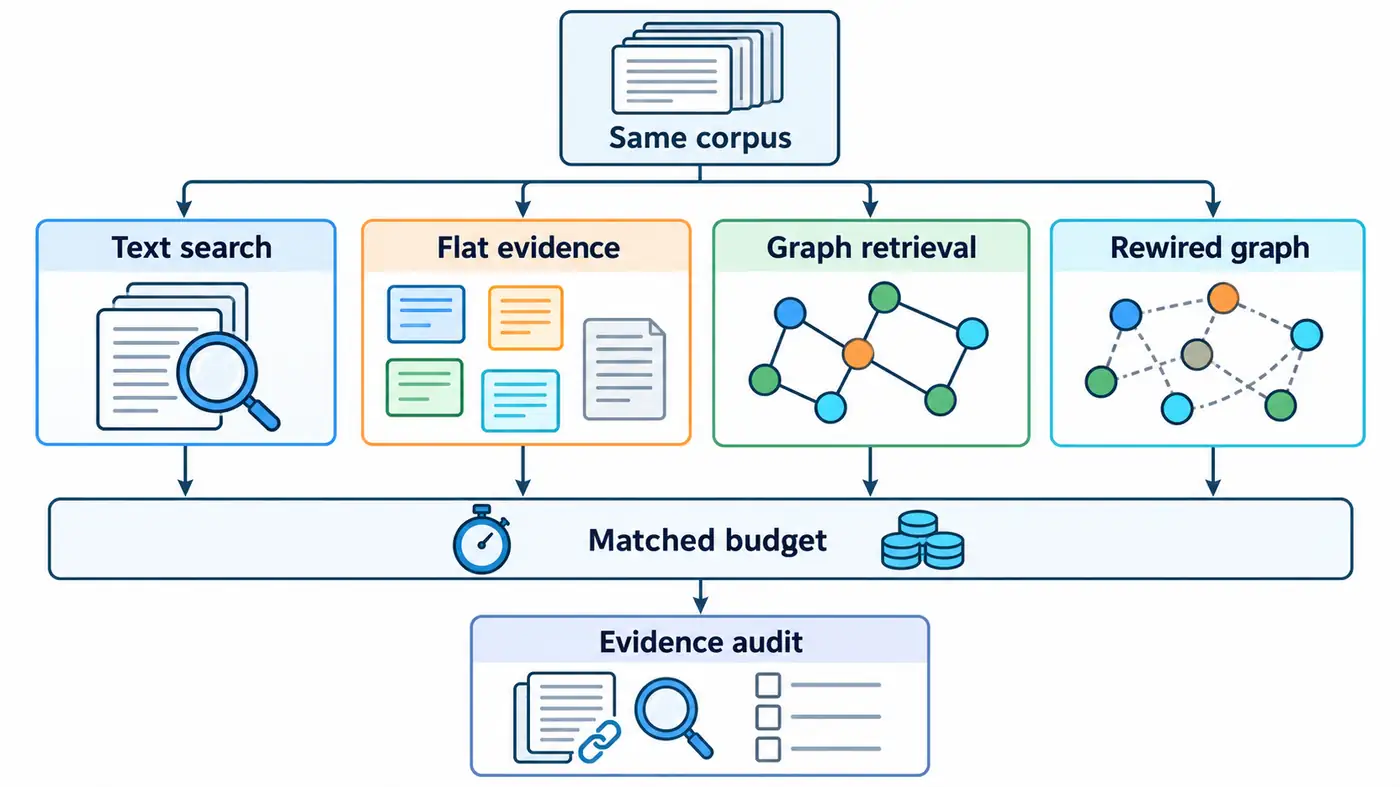
The figure shows a proposed four-way comparison that has yet to be run. Solid arrows trace the procedure. Dashed edges on the right depict the proposed rewiring intervention. Node colors illustrate groups only, without encoding probabilities or correspondences. The saved data determine which controls actually match. Although the budget appears at the bottom for ease of reference, its limits must be set before the experiment starts.
You can first fix a corpus snapshot and a generative model, and set four channels: the original text search; you can access the tile search for the same batch to extract the facts and abstracts, but do not use the adjacent traversal; complete the search; keep the node text and change the map retrieval of the navigation connection. The second road answers "whether the information processing is enough", and the fourth road answers "whether the current connection has been effectively used". They are more diagnostic than the original baseline, which is more diagnostic than the entire image.
There is an easily overlooked trap: the relational text itself is also information. If you reconnect and rewrite the content of the triple at the same time, the loss of points may come from the fact that the wrong fact is read, rather than losing the navigation structure. Therefore, we can only interfere with the adjacency relationship used by Retriever, so that the final answer can still be checked back to the original text; it is clear that false connections are not fed to the generator as a fact. Relational semantic interventions are then carried out separately, and the two experiments should not be mixed.
Reconnection cannot be done at will. The number of nodes, the appropriate degree distribution and candidate access limits should be retained, and changes such as disconnection and reachable distance should be recorded. Otherwise, the system deterioration may just become unreachable just a lot of evidence. Such control is still not perfect, but it makes the interpretation of "providing navigation signals correctly connected" more specific than "destroying the index, of course".
The budget is best to deal with it in two rounds. In the first round, the final input token and the generation settings are examined, and the selection of evidence is examined; the second round is matched with the upper limit of the general model call or calculation, and the saved budget is given to the text scheme for reranking and multi-round retrieval. Indexes build separate accounts and report amortization under different queries. If a control cannot satisfy all budgets at the same time, the difference should be displayed, rather than "fair" as a label with no content.
The evaluation should also be disassembled along the process: first see whether the supported paragraphs are candidates, and then see whether the cross-document chain is collected, and finally see whether the answers and references are supported by the original text. Group by direct facts, relationship combination, global generalization and no-answer questions, avoid the increase of a question type and change the meaning of the total score. If the artificial gold label is required, the independent labeling is clearly arranged; the model referee can only be used as another measurement, and cannot pretend to be artificial judgment.
The development data of the test questions and the filtering prompts should be separated. You can use the questions that already support paragraphs in the public data, but check whether the answer is written directly in advance by a certain summary, and report this situation separately. It may still be a legitimate pre-processing benefit, but it cannot be used as evidence of reasoning along the edge when querying.
Finally, how to explain the results in advance: the tiling scheme is tied to the complete map and supports the interpretation of information processing; Any result only constrains the corpus, task and realization, and cannot pronounce the value of all graph methods.
Summary: Dismantle the system gain into a questionable contribution
After reading "Improvement after joining the map", you can continue to ask: Which text has been added, which connections have been changed, which calculations have been done, and the final measurement is covered, recalled or correct? These four questions determine how far they can go. It is not worth continuing to verify whether the map is natural and superior, but which relationship can make the evidence easier to find, combine and check under the same information opportunity.
References
- Darren Edge et al., From Local to Global: A Graph RAG Approach to Query-Focused Summarization, 2024 first draft, 2025 V2. Original V2. This time, according to the preprint, the official publication record has not been confirmed.
- Bernal Jiménez Gutiérrez et al. From RAG to Memory: Non-Parametric Continual Learning for Large Language Models,ICML 2025. Official publication page、The full text of this verification V2. The official PDF access failed, the method and value are subject to the read V2.
- Haoyu Han et al., RAG vs. GraphRAG: A Systematic Evaluation and Key Insights, 2025 first draft, March 2026 v3. Original V3. Author publication list It is listed as KDD 2026; this time that the meeting included entries that can be independently checked has not been obtained, the ACM page access is limited, and it does not claim that the official final version has been read.
Apps by the author
The following is the author's own product promotion. In addition to writing a technical blog, I have also independently developed some daily gadgets, welcome to learn:
- Daily Expense Journal: Record the daily income and expenditure, arrange the budget and savings goals, so that the whereabouts of each money is more clear. View on the App Store.
- One Small Action: Select small actions according to the current time and energy, record the feelings after completion, and leave a little space for daily actions and reviews. View on the App Store.
Find more articles and projects on my website: zffjzz.top. Your feedback helps me improve these tools.