
- Date: 2026-10-22
- For graduate students, early-career researchers and research engineers
- Data deadline: 2026-10-22; search for relevant work in the past 12 months, and retain the necessary classic research. This article is a deep reading of the evidence of four papers, no model editing experiment, and does not claim to be fully covered.
Abstract: To change the right sentence is not the same as repairing a knowledge
Suppose a research institute has moved from A to City to City B. The model can finally answer "Where is the research institute now", but it is changed to abbreviation and answered to Jiacheng; ask the province where it belongs, and also use the old address. The other system has updated the documentation, but gives the same error as it retrieves the old copy. This is a hypothetical scenario that illustrates the problem, not the experiment in this paper.
Both systems can claim "update success", but have not completed the same kind of error correction. The judgment of this article is: External records are usually more convenient to locate and replace the modified object, but whether the answer is reliably changed depends on the search, application Scope and reasoning; parameter editing can change the answer when the document is not attached, but it cannot infer that the relevant knowledge has been consistently updated based on the success of the target question. This judgment comes from a comprehensive analysis of the following paper settings, not the championship conclusion of a certain list.
Delimit the boundaries for "correction" first
Parameter memory is the knowledge that affects the model weight through training, and there is no need to explicitly retrieve the original record when answering. The parameter knowledge editing tries to locally change these weights, so that the output corresponding to the specified fact changes. The external memory writes the update outside the model, and then calls the record when answering. Retrieval-Augmented Generation usually sends documents into the model; retrieval editing may also train a dedicated router and answer module, and the two cannot directly draw equal signs.
Corrections include at least three things. effectiveness Whether the original question is answered correctly; generalization Ask if rewriting, aliases and association issues have been changed together; locality Ask if the behavior that should not be affected is reserved. This division has a clear basis in the editing research, but the measurement methods of each paper are different. SERAC,§2、§4
The boundary must also be determined by the task. The relocation of the Institute does not mean that its establishment location has also changed. "Where is now" and "Where was that year" should have different answers; if it is just a new cooperative organization, the original partner cannot be easily erased. Before the start of the experiment, it is necessary to write down the time, whether the relationship allows multiple values, and which consequences are inevitable. Otherwise, the wider the spread, the more correct it is, and the more it is to maintain, the more reliable it may not be.
Change the weight and change the read path, each explains what
ROME(NeurIPS 2022) The specific feed-forward module is regarded as an editable association map, and the weights are modified through the update of rank one. In the CounterFact experiment of GPT-2 XL and GPT-J, it also examines the target rewriting, questioning method and neighboring subjects, and demonstrates the feasibility of partial editing. The "Ran 1" here means that the update matrix has a restricted structure, not "only one neuron is changed". The main indicator of the paper compares the probability of the old and new goals, so it is not the generation of arbitrary open problems (§3.1, §3.3, Table 4).
This supports an explanation: new answers can be made easier to output through changes within the model. This article further points out that editors can work and do not automatically prove that all relevant knowledge is located in the same "fact grid" that can be replaced independently; local tests cannot cover all possible consequences. The modification operator is called knowledge editing, and it forms a new world with the proof model, which is a different intensity proposition.
SERAC(ICML 2022) offers another approach. It stores a record of each edit and trains a scope classifier to decide whether the current question is affected. Questions within scope go to a counterfactual answering model conditioned on the record. The base model handles the rest. Both auxiliary modules need training, so keeping the base weights fixed still entails a learning cost. In the paper’s QA-hard experiment, the authors applied ten edits simultaneously to T5-large. The results and component-level error analysis identify scope classification for complex questions as a major bottleneck (§§3–5, Tables 3–4).
This supports another explanation: the improvement comes from more accurately identifying "when this correction is applied", and it is not necessary that the base model itself has re-remembered the facts. For the researchers, the checkable records make debugging more direct, but routing errors may still give the correct correction to the error problem. If you only demonstrate a successful search once, there is no test for confusing neighbors.
Both interpretations can be established at the same time. The parameter editing solves a part of the internal association modification, and the external record changes the channel to obtain the update; the two face the problem of "what input should be affected by the update". You can't attribute all the differences to the storage location of knowledge compared to a weight updater that only receives a single edit.
What really opens the boundary of evidence is the issue of association
RippleEdits(TACL 2024) Extend the evaluation to relational inferences, combination problems, aliases and facts that should be preserved. The measured editing method failed to deal with these consequences consistently; the ICE baseline that directly puts new facts into the context is generally strong. However, ICE directly obtains the corresponding editing, not to find it by itself from the mixed documents; the evaluation also filters the situation that the target editing is successful and the old knowledge required can be answered correctly, and the target alias for the generated text is scored (§5.1-5.2).
Therefore, it provides a conditional associated update diagnosis, which cannot prove that the complete retrieval system is more reliable in the real database. The evaluable samples left by different models and methods may also be different, and the average score after screening cannot be regarded as the success rate of the same population.
Another kind of misreading needs to be prevented here: the association problem fails, and it is not necessarily equivalent to "the update is not written at all". It may be that the new facts are not generalized to the reverse question, or the model does not know the other jump knowledge, or the two facts are not combined. Conversely, answering the associated answer may also be to read the current prompt. Only by changing these conditions separately can the interpretation be distinguished.
The new benchmark expands the problem and also changes the meaning of the score
Included in the last 12 months UniEdit (NeurIPS 2025, dataset and benchmark track) Construct a broader combination of domains and relationships with knowledge graphs. In Table 2, the generalization of IKE and SERAC is strong, but the locality is low; GRACE has strong retention, and the generalization is close to the starting point of the unedited. The most critical reading details are in Appendix D.1: Generalization and locality to check whether the target tokens has entered the first five candidates, and the first candidate is used to judge the question; multi-hop tasks will temporarily add non-edited jumps that the model does not know. IKE also uses training examples as contexts, and SERAC uses trained auxiliary modules.
Therefore, this group of results can explain the trade-offs under the protocol, which cannot be translated into natural language question-and-answer success rate, let alone splicing with RippleEdits ranking. Its data mainly revolves around the relationship between English, knowledge graph and generation of questions, and this article does not extrapolate the conclusions to open documents in Chinese. The paper can reveal what the old indicators are missing, but the new evaluation scaffold must be included in the explanation.
| Evidence | core condition | Observe what is supported | what can't be proven |
|---|---|---|---|
| ROME | Specific models, local weight modification, probability indicators | Associations can be modified in orientation | Any inferences have been updated |
| SERAC | Training auxiliary modules, explicit editing cache | Separate processing range and answers | External records are naturally not misused |
| RippleEdits | Directly provide editing and filtering the samples that can be reviewed | Correlation consistency is worth a single test | The pros and cons of a complete retrieval link |
| UniEdit | Candidate Sorting and Intermediate Knowledge Supplement | Generalization and Preservation Existential Choice | Achievement of free generation without stents |
The conclusions in the table correspond to the original text cited above. They do not form a neat front and back camp: together, the single-target question is not enough to accept and correct errors; the differences come from the scope of tasks, auxiliary information and scoring methods.
Turn "Easier Error Correction" into a distinguishable experiment
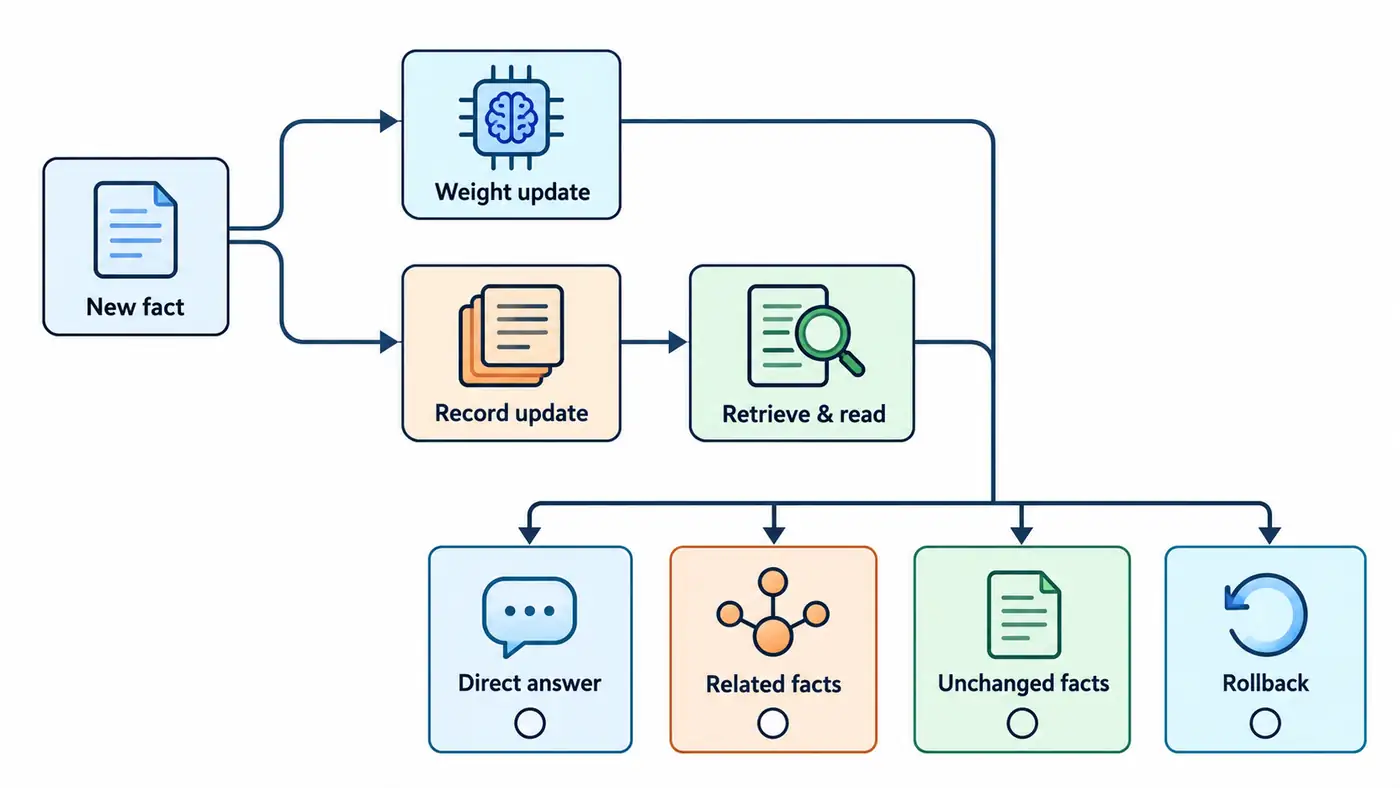
The figure shows the proposed intervention and evaluation procedure. Both approaches receive the same correction. Each is then tested on the direct answer, related facts, unrelated facts, and recovery after the edit is undone. Arrows show the sequence, and open circles mark tests still to be run. The figure describes an experiment, without claiming success or specifying how knowledge is stored.
Below is a research design that has not yet been performed. Fix an open model, the same set of corrections and the same batch of problems; divide the facts into real timeliness updates and clearly marked counterfactual updates, and report them separately, to avoid miscalculate the following assumptions into mastering reality.
Set four conditions: original closed volume model, parameter editing, direct provision of correct records, and provide records after real retrieval. The latter three use the same correctional copy; directly providing a record is a diagnostic reference, not counting the actual results of the search method. If the real retrieval fails and directly provides success, it is preferred to check the recall and sorting first; if both fail, you should continue to check for reading, range judgment or combined reasoning, and you cannot put all responsibilities to the storage form.
Each correction is assigned the original question, no rewriting, alias, reverse relationship, multi-hop problem, and a negative example of the wording that should not be changed. Test questions and relationship combinations cannot be involved in tuning. Items that require a semantic ruling should be confirmed by the real annotator according to the freezing rule; the same model cannot be allowed to generate answers, judge answers, and then claim independent evidence.
All methods first report the end-to-end results on the complete sample, and then list the conditional results of "Target editing is successful and the rest is known". When encountering intermediate facts that were not known, the two evaluations of "no supplement" and "supplement" were retained respectively, and the latter was not quietly merged into the main results. If the gap is only widened after filling, the more reasonable conclusion is that the utilization ability under specific information conditions is different.
Resources cannot be hidden either. Parameter editing report optimization and storage cost, external path report index update, auxiliary module training, search times and context length; at the same time, record inference time is time-consuming. Fixed input and generation budget is the first layer of control, and when there is a trained editor, the training data and cost are also listed. When it is not fully aligned, it should be clear that this is a system comparison, and cannot claim to isolate the causal effect of the storage location.
Finally, do the undo test: restore the pre-editing weight, or remove the correction and restore the old record and index status, and check whether the output has returned to the expected. The full recovery checkpoint is not the same operation as individual withdrawal from multiple consecutive parameter editings; the external system should also include duplicate documents, caches and derived abstracts. The record is successfully deleted only after the storage action is verified, and the answer is no longer affected by the old correction. This is the inspection requirement proposed in this article, not the conclusion that the four papers have completed.
If a method only improves the original question, it should be called a local correction; if the correlation problem is improved but the neighbors are negative, it should be reported that the scope of influence is too wide. The truly convincing result is to explain at the same time within the pre-agreed scope at the same time to explain what has been corrected, what is saved, and what is restored when revoked, rather than looking for an average score that can cover up the trade-offs.
Summary: Easy to modify and reliable to take effect, there are two evidences
If knowledge is placed on the outside, it is often more convenient to point out "Which record has been changed this time"; knowledge is written to parameters, and the updated answer may not depend on the attached data every time. However, the traceable records still need to be used correctly, and the partially successful parameter editing still needs to pass the association and retention check.
What is more worthy of questioning for newcomers to scientific research is: Whether this paper verifies the modification object, update scope, or final behavior? Separate the three before discussing which path is more likely to correct errors under what conditions, and can also propose experiments that can really overturn a certain explanation in the next step.
References
- Kevin Meng、David Bau、Alex Andonian、Yonatan Belinkov. Locating and Editing Factual Associations in GPT. NeurIPS 2022. Published paper
- Eric Mitchell、Charles Lin、Antoine Bosselut、Christopher D. Manning、Chelsea Finn. Memory-Based Model Editing at Scale. ICML 2022. Conference page · Published paper
- Roi Cohen、Eden Biran、Ori Yoran、Amir Globerson、Mor Geva. Evaluating the Ripple Effects of Knowledge Editing in Language Models. TACL 2024 (preprints began in 2023). Journal Page · Published paper
- Qizhou Chen、Dakan Wang、Taolin Zhang、Zaoming Yan、Chengsong You、Chengyu Wang、Xiaofeng He. UNIEDIT: A Unified Knowledge Editing Benchmark for Large Language Models. NeurIPS 2025,Datasets and Benchmarks Track. Published paper