
- Date: 2026-10-20
- For graduate students, early-career researchers and research engineers
- Data deadline: 2026-10-20; search for nearly 12 months of research, and retain classic papers that explain the dispute. This article is deeply read as evidence, not running the model experiment, and does not claim to be fully covered.
Summary: Determine what "correct" means first
The model originally answered A, and changed the answer B after seeing the retrieval materials. Is this a successful update, or is it biased by an error message? Only observe the change of the answer, and cannot make a judgment. We also need to know: the task requires the retelling of the material, or the answer to the real facts; whether the material is reliable; the question is when.
The judgment of this article is: there is no fixed priority of the quality of the task and the evidence. Context compliance, facts are correct and uncertainty under conflict should be measured separately. Four studies provide different cuts: read material reads for physical replacement tests, offset test answers for coherent testimonials, test error coverage of mixed materials, and explicit conflict analysis attempts to improve rulings. They do not constitute the two camps that can directly compare the total score of "believe in search" and "believe in memory". Longpre et al.、Xie et al、Yigit-Sert、Peng et al
The same change may correspond to three explanations
Parameter memory refers to the information stored in the weight of the model after training; the experiment usually detects it indirectly by not providing the material "closed volume answer". Context knowledge comes from the text entered this time. Retrieval-Augmented Generation, referred to as RAG, is to find relevant content first, and then hand over the content to the generative model. The search score mainly helps to select relevant texts, and cannot automatically endorse the authenticity of the text.
There are at least three distinguishable explanations here. First, the model identifies new evidence that is trusted and corrects outdated answers. Second, the model follows the task requirements of "answer based on the material", even if the material describes the world of counterfactuals. Third, the model is affected by wording, space or repeated statements, and accepts misinformation. The first two may be reasonable behaviors, and the third is the risk we want to identify; and all three may be changed from A to B.
Consider an example of a hypothesis: the former site of a certain institution is in A, and the new announcement says that it has moved to City B. If the question is asked "Where is the announcement, the second in the material is the target answer; if you ask "Where is last year", the old site may be correct; if the announcement comes from the reprint that cannot be verified, the latest date itself is not enough to determine the credibility. Mix these three questions in the same Accuracy, and the evaluation will lose its direction before the model.
Therefore, a closed-book answer can only prove that the output is correct at one time; writing a "memory basis" is only observable text. They cannot directly prove that there is a stable, fully readable fact record inside the model. Subsequent studies need to retain this measurement boundary, rather than treating "internal knowledge" as a database that has already been obtained.
For researchers, conflict detection and conflict resolution should also be separated: point out that the two paragraphs are inconsistent, and only complete the first step; determine whether they talk about the same object, the same time and the same caliber, it is possible to judge which sentence is suitable for the problem. If the two materials actually describe the past and present respectively, and simply delete one of them, they may lose valid information.
What are the four studies used as evidence?
Solid Replacement: Can Obey a Given Material
Longpre et al. replaced the answer entities in the question and answer material in EMNLP 2021, and changed the target answer accordingly. Study the use of the T5 generator and the RoBERTa removable reader; the AT Inference Time directly provides the correct support paragraph after the original or replaced, bypassing the Retriever . This keeps the question on how the reader handles conflicts, and the search system has not found a document. Original §2, §3.2
The paper observes that some models still output the original answer; replacement data training can improve material compliance. But the success here is first and foremost to follow the revised text, which cannot be automatically interpreted as the real-world fact-testing ability. The authors also acknowledge that automatic replacements have gaps in fluency and answer quality in §2.3. Original §2.3, §4.4
Its "memory ratio" also has an important denominator: only the relative ratio is calculated between the original answer and the replacement answer, and the other answers are not included in the denominator; Therefore, the low memory ratio is not equal to the high overall accuracy, let alone read it directly as "model learns to distinguish between true and false". Original §3.3, §4
Coherent Proof: Adhere to the old answer is not a stable character
Xie et al. ICCLR 2024 study on PopQA and StrategyQA, first obtain closed-book answers and explanations, and then construct materials that support another answer, and check and screen for consistency between text and answers. The text contains the question of whether the material supports this sentence, and does not verify whether the material is true in reality; the study also retains the sample of the closed-book wrong answer. Original §3.1–3.5
Research report: Compared with direct words, the complete coherent evidence is easier to change the answer; at the same time, when presenting the materials and counter-evidence that support the original answer, there are often behaviors that bias the original answer. The more secure conclusion is that the material structure and combination will affect the choice. The author uses coherence to explain the difference, but the entire rewriting of the whole paragraph changes many text attributes at the same time, which is not enough to attribute the effect to a certain psychological mechanism. Original §4.1–4.2
This is not the later model "overturning" the earlier model. The data, model generation, and material generation methods and answering forms are different; the latter uses three options: the original answer, the reverse answer and the uncertainty, and the set of questions for each model after screening is not exactly the same. The so-called stubbornness or vulnerability is a description of the behavior under a specific agreement.
Error coverage: Can indicators undertake the author's explanation
Yiigit-Sert's ROMCIR 2026 workshop paper extracted 100 TruthfulQA questions, and compared correct, wrong and mixed materials with GPT-4o and LLaMA-3.1-8B. Its parameter coverage only counts the ratio of the original closed volume and wrong answer after adding the material. The clean material search uses "question plus correct answer" to construct a query, so this is a controlled diagnosis with answers, not an end-to-end search evaluation under ordinary user queries. Original §3–4.1
Table 1 documents cases where erroneous context overrides an answer. It offers a counterexample to the claim that the error rate must rise at every step as contamination increases. For LLaMA the value is 0.583 under Mixed-67 and 0.563 under full contamination. The reported “confidence” comes from human ratings of how certain the answers sound. More assertive wording need not correspond to a higher probability of being right. The questions answered incorrectly can also differ by condition, so mean tone ratings reflect changes in the mix of examples as well. Original §4.2, Table 1; workshop PDF page 7
The paper acknowledges that there are only a small number of questions, two models and synthetic error materials. This article uses it to explain the diagnostic design of "the original answer may also be biased by the material", and does not upgrade the local result to the generally harmful conclusion of RAG.
Explicit ruling: what additional resources are in the gains
In 2026, the pre-printed version of the MACR first estimates the answer uncertainty, and then explicitly writes the knowledge or external information generated by the model, and answers with the help of rule induction, conflict analysis and adjudication module. Table I has been improved on LLLAMA3.1-8b, Qwen 2.5-7b and three benchmarks; the component replacement experiments of Table III also support continuing to study this process. Original §III–IV
However, the external knowledge in § IV-A is actually generated by GPT-4o-mini, and should not be read as verified web page evidence. The authors also provide the same information to the baseline, which controls a part of the difference in the source of the information, but does not prove that the total number of calls and the budget are equal. The Validation Set also participates in threshold selection, the rules come from example induction, and the benefits cannot be all attributed to "the model finally knows who to trust".
This version leaves a counting convention unclear. Section IV-C gives a range of 2 to 4 contexts, while Table II lists 3 to 5. The text does not clarify whether the base context accounts for the discrepancy. I therefore omit the noise-proportion curve and leave the authors’ convention unresolved. The work proposes a candidate method. Its validation falls short of establishing an independent arbiter of the truth of every source.
Comparable units are not the total score of the paper
| Research | Main operation and observation | cannot directly prove |
|---|---|---|
| Longpre et al. | Replace the entity, observe the material to follow | Following the material is true |
| Xie et al | Rewrite or combine counter-evidence, observe answer choices | Individually caused by coherence |
| Yigit-Sert | Fixed questions, compare mixed materials | General search gains or general monotony relationships |
| MACR | Add explicit analysis and rule flow | and other budgetary gains or sources have been independently verified |
These four lines must first align the task objectives, and the second is the starting point of the model, the source of information, the division of the problem, and the call budget and indicators. The first two are mainly diagnosing the selection behavior, the third item is checked with a realistic reference answer, and the fourth item also introduces examples, validation sets and multiple calls. Compare their percentages directly and mistake the measurement object and additional resources into the algorithm gap.
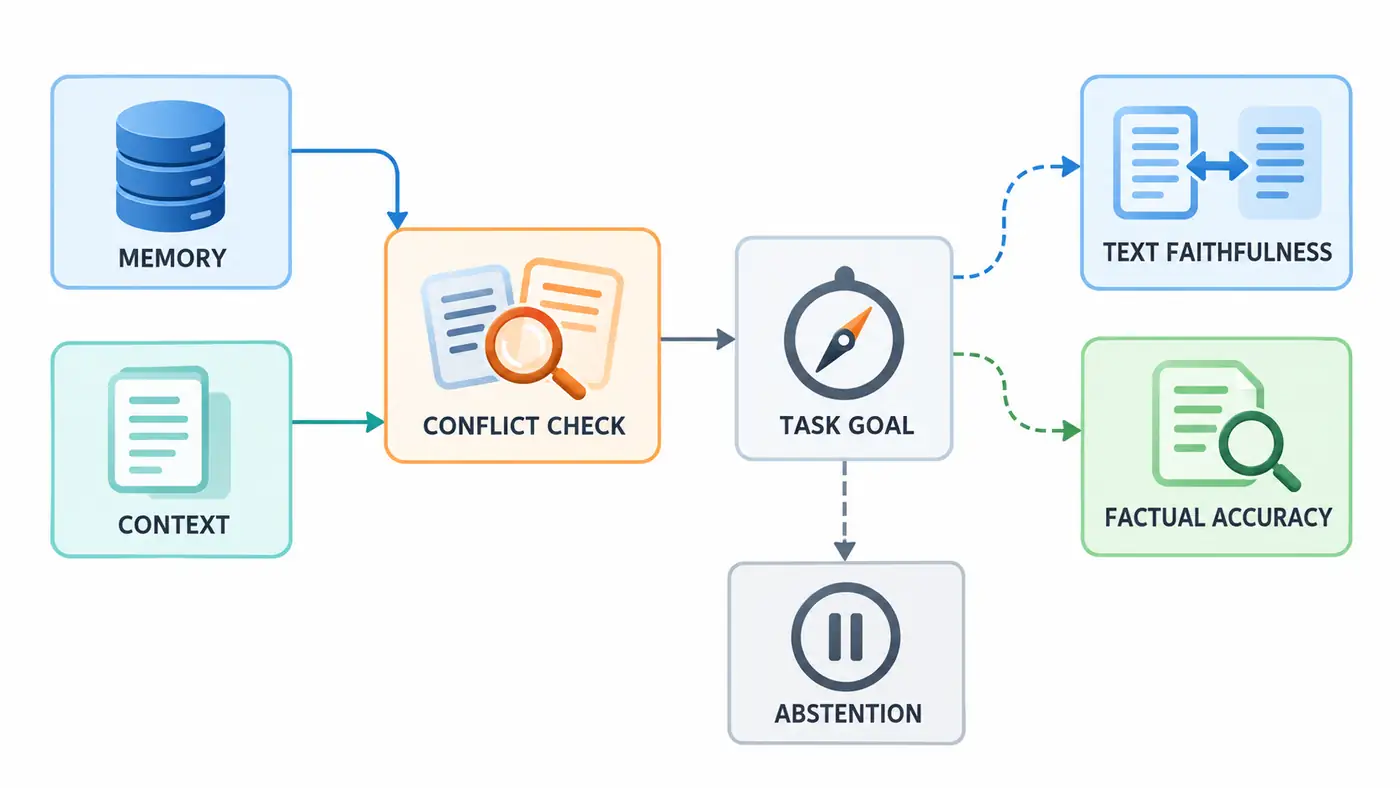
Figure: The evaluation framework proposed in this article. The solid line only indicates that the candidate information enters the inspection process; the dotted line indicates the evaluation path selected according to the task objective, not the verified improvement relationship. The paper observes the answer behavior under specific conditions, and there is no claim that the "conflict check" will inevitably improve the fact Accuracy. Suspension of answers should also be recorded separately, and cannot quietly disappear from the denominator.
How to design experiments that can really distinguish interpretation
The following are suggestions for subsequent experiments that have not yet been performed. First, prepare materials with verifiable sources and time for the same problem, and mark at which time the facts are established. Keep two sets of goals: answers within the material, and realistic answers for a given time. Correct materials, outdated materials, wrong materials and insufficient evidence are grouped into groups; for the forged content, the experimental use must be clearly marked, and the real knowledge base cannot be mixed.
Then separate the fact content from the surface cues separately. Fixed factual propositions, only exchange material sequence, source display method, date position and expression length; then fix these formal attributes to change whether the material is real. If the model only follows the authoritative name, the exchange tag will change the judgment; if the verifiable facts are used, the behavior should be more able to follow the content change. This is verifiable and predictive, not a mechanism that has been demonstrated in this article.
The two directions of "new material is correct, old memory error" and "new material error, old memory is correct" should also be set. If only the second category is tested, the system will be rewarded for rejecting the material; only the first category will be tested, and the system will be rewarded with the blind slave material. Repeat the measurement of the closed volume performance, and separate the screening from the formal evaluation, to avoid the damage caused by the material caused by the accident after the accidental answer.
When comparing the adjudication method, give a single prompt, additional thinking and the same material pool with the multi-module process, and report the number of calls, input and output length and search cost respectively. The comparison of fixed resources answers the efficiency questions; allows the comparison of more resources to answer the questions that can achieve the effect. Both have value, but cannot share a "fair budget" label.
In the end, the correctness of the facts, material compliance, conflict identification, abstent ratio and change-to-problem should be preserved at the same time. The Abstention policy needs to report coverage, that is, how many questions the system actually answers, and then look at the error situation in these answers. The source authenticity and time tags require real evidence and a clear annotation process, so that the tested model cannot generate answers by itself, confirm the authenticity by itself, and finally announce the success of error correction by itself.
Summary: Trust should fall on verifiable propositions
In the face of conflicts, it is worth asking whether the model has insistence on his own opinions, but why it changes and which goal it meets after the change. Reliable new evidence can correct outdated answers, and wrong materials can also induce the same correction; a smooth explanation cannot replace the source verification.
Existing evidence supports putting material structures, task conventions and evaluating denominators back to their conclusions. The next step in the real distinction is whether the system can be updated correctly in both directions when the fact content and the appearance of the source are intervened separately, and the answer is appropriately suspended when the evidence is insufficient. This result is closer to the answer "who should be trusted".
References
- Shayne Longpre, Kartik Perisetla, Anthony Chen, Nikhil Ramesh, Chris DuBois, Sameer Singh. Entity-Based Knowledge Conflicts in Question Answering(2021, EMNLP official paper). Conference page · Full text
- Jian Xie, Kai Zhang, Jiangjie Chen, Renze Lou, Yu Su. Adaptive Chameleon or Stubborn Sloth: Revealing the Behavior of Large Language Models in Knowledge Conflicts(2023 first preprint, 2024 ICLR official paper). Published paper · Read arXiv v4
- Sevgi Yigit-Sert. Evaluating RAG Reliability under Clean, Misleading, and Mixed Retrieval(2026, ROMCIR workshop, with ECIR; non-ECIR main meeting paper). Full text of the workshop · arXiv v1
- Huang Peng, Jiuyang Tang, Weixin Zeng, Hao Xu, Xiang Zhao. Navigating Unreliable Parametric and Contextual Knowledge: Explicit Knowledge Conflict Resolution for LLM Inference(2026, arXiv V1 preprint, no official employment is confirmed). Version page · Full text