
- Date: 2026-10-10
- For graduate students, early-career researchers and research engineers
- Deadline: 2026-10-10; Retrieve work for nearly 12 months, while retaining the starting point of the dispute. This article is a deep reading of evidence from four first-hand studies, without running a model experiment, and does not claim to be fully covered.
Summary: The value of too much thinking should be judged on the same topic
The model gives the correct answer for the first time, then checks and replaces the solution, and finally changes it to the wrong answer. This and "it took a long time to finally get right" may appear in long reasoning. Just looking at the length of the generation, it is impossible to know which situation the extra calculation belongs to.
**Longer reasoning can help particular models solve particular problems. The evidence does not show that reliability rises steadily with length, or that shortening an answer means we have found the right time to stop.** Budget interventions, analysis of completed reasoning traces, and studies of when to stop generation address different questions. A single average curve cannot settle all three. s1、Track Diagnostics Study、REFRAIN Evidence of these different levels is provided.
The new question here is not the inference methods, but the inference methods, but: how to distinguish useful append calculations, useless repetitions, and continue to generate correct answers? **Go further, the researcher knows when to stop after the fact, does it mean that the model can also know at the time?
"Longer" and "Too", first distinguish the measurement object
The thought chain is the intermediate inference text generated by the model before the final answer; token is the basic unit of the model to process the text. This article discusses the length of the reasoning, and does not regard the number of words as all internal calculations, nor does it directly judge the length as overthinking.
At least three lengths should be distinguished. budget cap how much is allowed to be generated, actual length how much the model ends up using, First time correct prefix length It is the earliest position that can induce the correct answer in several truncated positions of the existing trajectory. The prefix is the text that is reserved from the beginning to a certain step. The last quantity requires additional questions, answer extraction and correctness checking, which is usually a post-event diagnosis. For the prefix agreement, see Caldarella et al. §3.1, Appendix C.1
There are at least three explanations for "long answers are easier to make mistakes." First, the problem requires more attempts and more difficult to answer correctly, and the difficulty affects both length and accuracy. Second, the model repeatedly checks the solved problem, adding cost without changing the result. Third, continue to generate new errors introduced. The three can coexist; group the length and short answers of different questions, and it is impossible to identify the third explanation.
A hypothetical example helps to understand: the short answer of the model is a simple question, and the long answer is wrong. On the contrary, if the same prefix is answered correctly immediately and the answer is wrong, the evidence is closer to "continue to generate unfavorable time". It still involves only a given prefix, a continuation method and an answer judgment, and cannot directly explain the internal mechanism. This example is a conceptual description, not this measurement.
Four evidences, put back their respective experimental conditions
Extending the budget can make a profit, but the extension method is also at play
S1 starts with the instruction-trained Qwen2.5-32B, and then uses the screened inference trajectory to supervise fine-tuning. It uses budget forcing to control the budget: when the upper limit is reached, the thinking ends, and the time to be extended is blocked, and the "Wait" can be inserted. The paper reports on the benefits of budget expansion on the measured mathematics and science Q&A, and also reports that it tends to be platform, repeat cycle and contextual limitations after continuing to expand. Official version §2–4, §6.2 and Limitations
**My interpretation:** A particular model paired with a particular decoding intervention can benefit from extra compute. Inserting a prompt also changes what the model writes next. Attributing the gain to length alone would require controlling both the prompt and the continuation strategy. A higher average score can still conceal questions on which extra reasoning did not help.
Redundancy can be compressed, but the short-solution training method is not an early stop on the scene
Chen et al. split an answer into a multi-round solution with a clear answer, and examine the first correct solution and the subsequent strategy repetition. Its analysis involves QwQ-32B-Preview and DeepSeek-R1, and the compression training is based on QwQ. The study constructs a shorter example from the correct candidates of self-generated, and then does post-training; retaining the first correct solution and appropriate reflection is one of the options. arXiv v2 §2–3
The "first time correct" here uses the correctness screening and cannot be ported into a freely available stop signal during the test. Table 4 also shows that there are Accuracy trade-offs for different compression schemes. This article distinguishes two things according to this: after training, it is better to answer concisely, and it is not the same ability to know when to stop on a new question with the frozen model. In addition, the solution segmentation and strategy clustering rely on the model, and the redundancy judgment is affected by the labeling protocol, and cannot be regarded as an internal calculation that is gradually proved to be useless.
The answer has been restored, which does not mean that it has been stabilized at that time
The 2026 preprint of Caldarella et al. prefixes the complete trajectory one by one to prefix the complete trajectory one by one, so that the model can answer, and then use the extractor to check. In the setting of visual language tasks, and supplementing pure language tasks, they distinguish between "previously and eventually correct" and "previous but ultimately wrong", and the latter category does exist. §2, §3 and Appendix C
The Optimal Length of the paper chooses the correct position for the first time with the help of standard answers, which is an Oracle diagnosis, that is, an ideal selector with unattainable information at runtime. It measures the recoverable space under a specific protocol, not an already realized early stop gain. A strong production answer is not enough to prove that the model has formed a stable solution; multiple prefix detections may also increase the chance of encountering the correct answer. Appendix D of the paper clearly acknowledges the dependence and detection cost of standard answers, and this paper further recommends checking the stability of repeated writing.
Online signals have real value, but still cannot replace the proof of correctness
REFRAIN is a method of stopping the model that requires no retraining: there are tentative answers, reflection signals appear, and the new steps are sufficiently similar to history, the trigger stops; the controller adjusts the similarity threshold according to the answer likeness and length penalty. The likelihood is the probability signal assigned to the output by the model, which does not mean that the answer is true and correct. Official Version §3
In Table 1, the Accuracy of Qwen3-8B on MATH-500 has been reduced from 91.40% to 91.20%, and the total generation of the entire set of questions has been reduced from 2.64M to 1.61M token; other settings also have benefits and regression. The paper proves the efficiency in the protocol tested - Accuracy compromise cannot be rewritten as zero loss for all tasks. Its limitations also include the need to read and intervene intermediate trajectories. Table 1, §4.3 and Limitations
Seemingly opposite results, why don't you have to deny each other
| Evidence | What changed | main observation object | can't directly prove what |
|---|---|---|---|
| s1 | Budget and Continuation Intervention of Model Post-training | Final Accuracy under different budgets | The longer each question, the better |
| Chen et al | Correct candidate screening, compression and post-training | Generate volume, final performance, solution redundancy | The frozen model can recognize the correct stop point online |
| Caldarella et al. | Prefix strong production answer and post-event correct choice | Correctness changes along the trajectory | No standard answer can also get Oracle benefits |
| REFRAIN | On-line stop control on freeze model | Final Accuracy vs total generation | High likelihood or semantic repetition is correct |
This table compares the problem definition, and does not arrange cross-paper scores. The starting point of the model is different, the teacher's trajectory is different from the post-training budget, and the test questions and answer extraction agreements are different; Even if both studies are written MATH, versions, subsets, and generation limits still need to be checked. The above conditions are derived from the methods and evaluation chapters of the four original texts.
In particular, it is impossible to mix "reduce redundancy" and "reduce the final error" into an indicator. The early-stop baseline in Table 2 in Caldarella stops with the constant answers for several consecutive steps, shortening the trajectory, but not improving its harmful over-thinking indicators. This does not constitute a direct conflict with the positive compromise of REFRAIN: the stop signal, model and evaluation of the two are different, and the former does not test the latter under the same protocol. §3.2 and Table 2
The comprehensive conclusion of this article is that the marginal value of the extra calculation may change with the title and the current state, but the actual stopper must bear the price of the judgment error. Stop too late will waste or correct mistakes, stop too early may cut off error correction. Accuracy has the same two strategies, and may also have gains and losses on different topics.
More Distinguishing Next Experiment
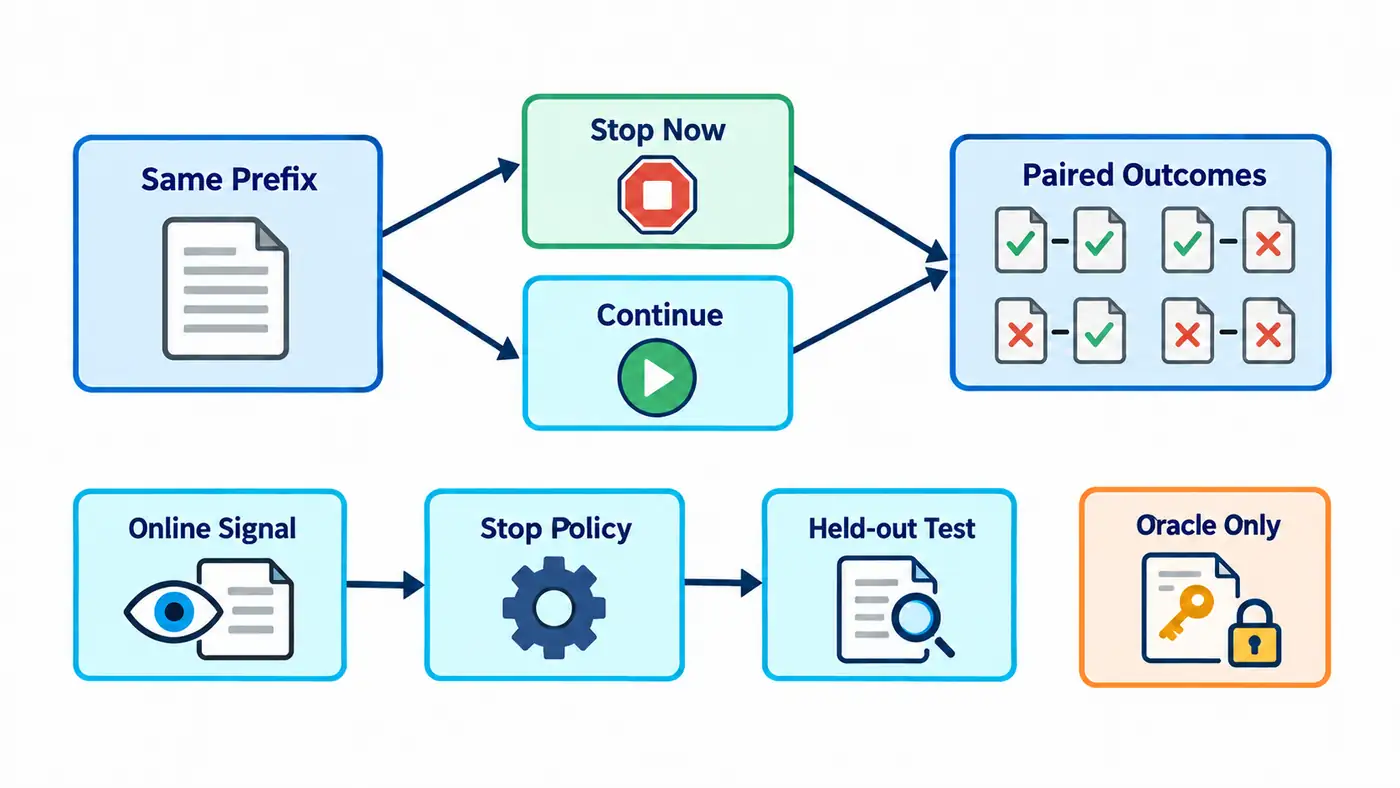
The picture shows the experimental framework proposed in this paper, which is not a paper data or a proven causal mechanism. The upper row compares "answeet answer" and "continue generation" from the same prefix; the left side of each pair of symbols represents the former, and the right represents the latter. The four combinations represent only possible results and have no frequency meaning. The lower row checks whether the online signal can form a transferable strategy; oracle on the right is only used for post-hoc reference, and does not provide test answers to the stopper. The arrows indicate the experimental flow, and the role of the strategy on the results to be tested is to be tested.
None of the following designs have been implemented, and there is no need to carry out large-scale training first. First, the model, questions and public prefixes are fixed, and two continuation paths are divided at the prescribed position. One ends the thinking and answers, and the other adds the same budget and then answers. Repeat samples for each prefix, and record the wrong pair, the wrong pair, and the constant, instead of just showing the total accuracy . If a single early answer is correct and repetitive, the statement that "has already been resolved" should be narrowed.
Second, the stopper can only look at the actual available prefix, output probability or repeat signal; the standard answer is left to the evaluator. Candidate signals, thresholds, and allowable losses should be determined on the development question, and then the rules are frozen to another set of questions that are not used for selection. If an online controller that is continuously updated, the update rules, unlabeled feedback and question sequence are fixed in advance, and the order is repeated in different orders. You cannot see the best trajectory after the test score. This can distinguish "signals can be migrated" from "well tuned on the selection set".
Compare the overall budget strategy. It is not only reported to generate tokens, but also includes prefix detection, encoder, validator and duplicate response costs; if the saved budget is used for additional sampling, it should be re-evaluated as another complete strategy. Group according to the predefined task category or independent difficulty, avoid directly using the length of this answer to name the difficulty, and form a circular interpretation.
The answer should also be fixed: when you change an ending prompt or extractor, is the so-called correct position changed significantly for the first time? If the change is large, the possible part is the induction and extraction effect. If the repeating signal is frequently stopped by mistake after another task, the interpretation of "signal dependence distribution" is supported. The shorter model generation is only process observation; on the topic of not participating in the selection rules, the common improvement of Accuracy, the wrong direction and the complete cost is the stronger strategic evidence.
Summary: It is worth learning to stop decisions, not short answer preferences
Existing evidence allows at the same time to accept two points at the same time: additional reasoning can bring benefits, and additional reasoning may also be redundant or harmful. What is really pending is which of the online visible signals can reliably distinguish these situations, and how many models and tasks they can migrate.
When reading the next paper "Reduced Reasoning But Performance Retention", you should ask how it chooses the stop point, who knows the answer, where the cost is calculated, and which questions are rescued and which are given up prematurely. This is to evaluate the ability to stop, rather than to use the length itself as an ability.
References
- Niklas Muennighoff et al., 2025, s1: Simple test-time scaling. EMNLP 2025 official paper; this article reads the official version method, results and limitations. Conference page|Full text
- Xingyu Chen et al., 2025, Do NOT Think That Much for 2+3=? On the Overthinking of Long Reasoning Models. ICML 2025 is officially included; the experimental details of this article are verified according to the accessible arXiv V2 (2025-02-01), and its title is "o1-Like LLMs", and the first draft is 2024. The official PDF access failed, and the two versions were not considered verbatim. Conference page|Full text of V2 read
- Simone Caldarella et al., 2026, Thinking Past the Answer: Evaluating Harmful Overthinking in Large Reasoning Models. arXiv V1, 2026-06-01; This time, the official employment is not confirmed, and it is quoted according to the preprint. Version page|Full text
- Renliang Sun et al., 2026, Stop When Enough: Adaptive Early-Stopping for Chain-of-Thought Reasoning. ACL 2026 official paper, the method name REFRAIN. Conference page|Full text