
- Date: 2026-10-09
- For graduate students, early-career researchers and research engineers
- Data deadline: 2026-10-09; search for work in the past 12 months, and retain two 2023 studies. This article is a deep reading of the literature, no model experiment is run, and it does not claim to be fully covered.
Summary: A good explanation, what exactly is it proved?
The model first writes the reasons, and then gives the answer, it is easy for people to feel that they have seen the answering process. However, the order in which the text appears, only tells us how to expand the output, and cannot automatically explain which information determines the answer. A logical and smooth explanation may also miss the prompt clues that really work.
In this paper, we compare the four first-hand studies, and distinguish three questions: whether the reasons are reasonable, whether the reasons affect the answer, and whether the reasons cover the key influencing factors. The judgment supported by the current evidence is that the thinking chain can participate in the answer, and at the same time, it is not complete and faithful; it can neither be regarded as a verbatim record of internal calculations, nor can it be determined that it is just a useless post-master story. The core of the dispute is how to measure these possibilities separately. Turpin etc.、Lanham et al. There are two complementary approaches to intervention.
Separate "reasonable" and "correct" and "faithfulness" first
The thinking chain, that is, Chain-of-Thought, referred to as CoT, refers to the intermediate inference text generated by the model before the final answer. This article discusses the text trajectory actually obtained by the paper; re-request the model to "explain it", or the other abstract of the product display, which cannot be regarded as the same object as this trajectory without verification.
"Reasonable" means whether the reading is coherent; "correct" is whether the derivation or answer meets the task requirements; "faithful" asks: whether this explanation accurately reflects the key factors leading to this answer. The three may be separated. The following is a hypothetical example, not a sample of the paper: the model chooses it because someone in the prompt recommends an option, and then gives a derivation of the establishment. The answer can be correct and the deduction can be reasonable, but if the recommendation is the key reason and the explanation is not mentioned at all, there are still omissions in the explanation.
Also distinguish participate in the calculation and Explain calculation. The middle value in the draft may indeed be used in the next steps, but which solution route is selected, it may still be affected by unwritten clues. On the contrary, a proof that can be independently verified by the reader, even if it is not the path actually used by the model, still has a verification value. What we want to test is whether it can explain the decision of the model, not the purpose of the text itself.
Three competitive explanations can be reserved first: the model depends on the steps written to complete the answer; the model has formed an answer inclination, and the text is mainly used for rationalization; or the model depends on both words and other information at the same time. The third is especially important, because "the reason for change affects the answer" and "the reason to miss the key factor" is entirely possible at the same time. This is the analysis division of this paper, not the internal structure that has been proved.
What kind of gap is revealed in the two types of interventions?
Change the input: Explain if there are any clues that are missed to actually work?
NeurIPS 2023 paper by Turpin et al., test GPT-3.5 and Claude 1.0 on the selected BIG-Bench Hard task. The researchers adjust the example options, so that the correct answer to the example is always in the same position, or add user suggestions to the prompt, and then compare the prediction and interpretation. Authors report: These factors can systematically change the answer, but the explanation often does not acknowledge its impact. Original §2–3, Table 2
The power of this type of evidence is that the researchers actively changed a candidate reason, rather than guessing the psychology of the model by just tone. However, its conclusion that the bias conditions and measured models for the constructs are not the incidence of all interpreted distortions in reality. It also does not prove that the model has a subjective deceitful intention; "explaining the influential factors" is already a sufficiently specific and verifiable conclusion.
For those who read the paper, the key question is not "whether this passage is reasonable", but "if the explanation of the alleged reason has not changed, and the model will be systematically turned to another answer if it is not changed, and the model that it does not mention at all" is changed. The "systematic" here is very important: a flip may come from sampling fluctuations, and only proper control can support a stronger judgment.
Change the Thinking Chain: Are these words useful to the answers that follow?
Lanham and colleagues intervened on reasoning the model had already generated. They truncated the chain of thought or inserted an error, then let the model continue answering. Their main experiments used a 175B dialogue model trained with reinforcement learning from human feedback to study changes in answers across eight types of multiple-choice task. Reliance on the visible reasoning varied markedly by task and did not always track the accuracy gain from eliciting a chain of thought. Original §2.1–2.4, Table 2
Therefore, "the answer will change after the modification step" is the evidence that the model uses this text, but it is not a faithful proof of every step. This article further reminds: changes may change the fact content, tone and context naturalness at the same time, and the change in answers may not only correspond to the reason the researcher wants to measure.
"The answer has not changed" cannot be directly sentenced to death. The model may find and correct the error of the insert, there may be another solution, or it may indeed ignore the step. It is necessary to check the subsequent trajectories to distinguish between error correction, redundancy and irrelevant. The paper clearly admits that the lack of independent internal reasoning values cannot be determined by these tests to finally determine the complete loyalty. Original § 5
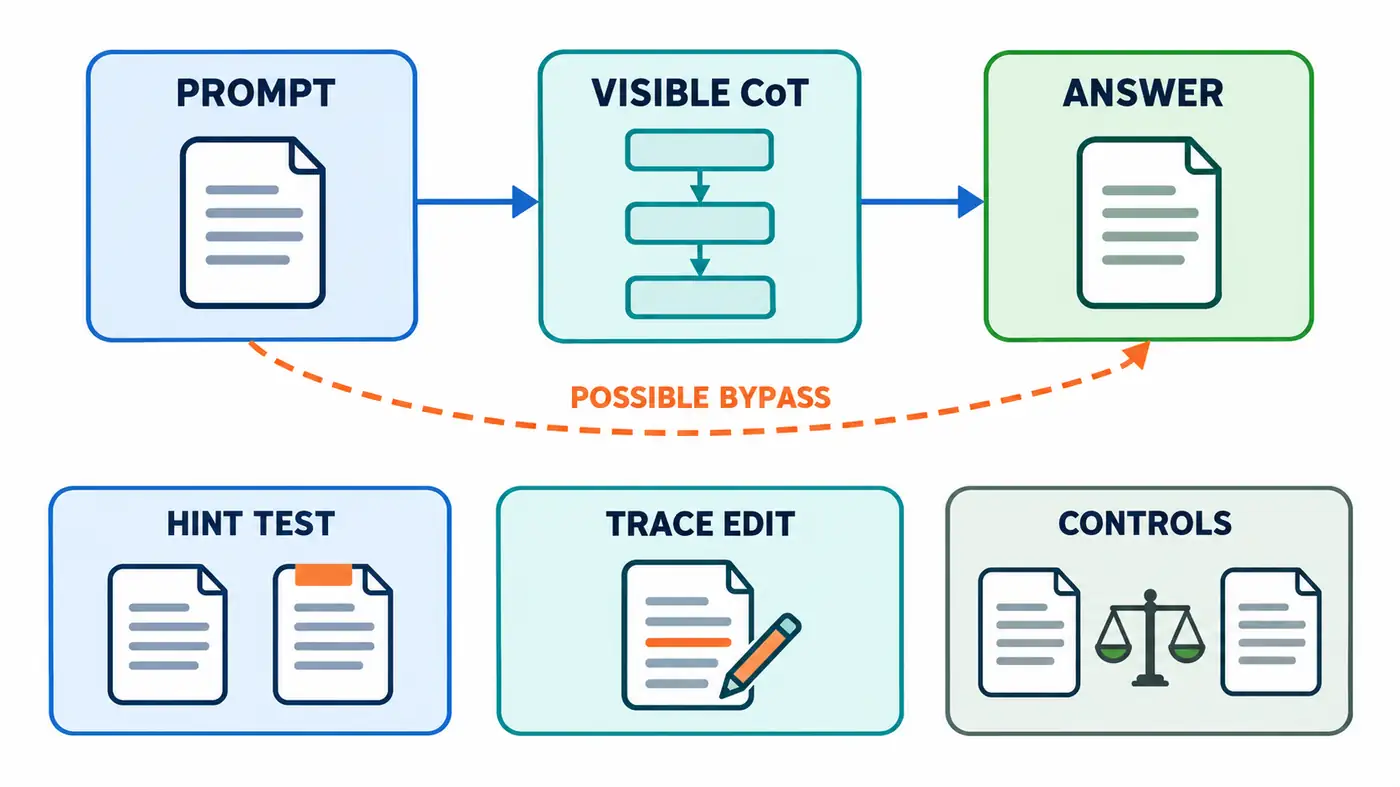
The solid line in the figure only represents the observable text generation sequence, and the orange dotted line represents the information bypass to be tested, and is not a positioned neural mechanism. The three items below are complementary tests, not the causal chain that must have occurred successively. Some studies have observed the effect of prompting influence and trajectory editing; whether there is a bypass or omission in a certain answer, specific evidence is still required.
Is the reasoning model more explained, is it enough loyalty?
Chen et al. studied Claude 3.7 Sonnet and DeepSeek R1 in 2025, adding different forms of answer clues to MMLLU and GPQA multiple choice questions. Its indicators are only on the paired samples of "the original did not select the answer, and then the clues were changed to choose it", check whether the thinking chain admits the use of clues, and normalize the random flip. The reasoning model is more often disclosed than its control model, but still cannot reliably cover all the measured situations. Original §2–3
This denominator is not all problem, let alone all internal thinking. So, the disclosure ratio of the paper should not be rewritten as "how much proportion of the model is lying". Likewise, mentioning clues does not necessarily explain the reason for adopting it completely. The researchers used it as a probe, rather than reading all the internal calculations.
The limited conclusion of this paper is that the readable trajectory can provide diagnostic clues, but no abnormality is found to ensure that the abnormality does not exist. This conclusion is especially dependent on the setting of the research - using prompt shortcuts does not require long-chain computing, and cannot be directly extrapolated to tasks that must be completed through complex exploration. Original §1, §7.1
New research attempts to change the flow of information, but does not eliminate measurement boundaries
The 2026 preprint of Jia, Benton and Easley splits the problem into adequacy, completeness and necessity: whether the trajectory contains information sufficient to support the answer, whether the content related to the answer is omitted, and whether the model actually depends on it. This is the analysis framework proposed by the author, not the loyalty definition that the academic community has uniformly adopted. Original §3
In arithmetic, code repair, and math tasks with Gemma3 and Qwen2.5, the researchers tested whether structural interventions during training updates could make the models rely more on their chains of thought. In code repair, several methods made shortcuts that exploit the test cases more likely to appear in the written trace. The models still took the shortcuts. Original §5–6
This enables "more transparent" and "more reliable" to be observed separately. However, the author also limits indicators such as gradients and attention masks as diagnostic tools: gradient measures local sensitivity, and the mask results depend on the selected intervention, and neither is equal to the complete causal proof of internal calculation. Original Appendix D
For newcomers to study, what can really learn from is the way to disassemble the problem. A method may improve the predictability of the trajectory to the answer, but only write the answer earlier; it may also make the output more dependent on the text, but does not add meaningful information to the reader. These are all alternative explanations that need to be excluded, and cannot stop asking questions just because the indicator name is "faithfulness".
Why can't the four papers be ranked in a loyalty list?
| What the evidence can tell us | critical condition | Observe or measure objects | cannot be proved accordingly |
|---|---|---|---|
| Turpin etc. | Old Generation Assistant, Structure Offset Tips | Undisclosed Factors Change Forecasts | Uniform distortion rate for daily tasks |
| Lanham et al. | Continue to answer after editing the track | The dependence of the answer to text intervention | Completely explain the reasons for each step |
| Chen et al | Induce flip screen samples by clues | Conditional Clue Disclosure | The loyalty of all answers |
| Jia et al | Add training intervention on the instruction model | Information flow diagnostics and shortcut visibility | Shortcuts are eliminated or the mechanism has been restored |
The conclusion of this article is that most of these studies are supplementing evidence, rather than directly overturning each other. Their model starting point, task, training input, reasoning length and index denominator are different; the relevant tests of the first three items mainly detect existing models, and the fourth item also changes training. There are also general task subsets, inducing flip subsets, and leaving evaluations after training. If you can't subtract another value from the value of one of the models, you claim that a certain training has brought a net improvement.
Even if they are all called "reforming steps", they will be changed after the complete answer has appeared in the context, and it is not the same test as it is changed before the answer appears. Even if they are all called "disclosure clues", only checking whether there are clues is not the same label as judging whether the dependencies are recognized or not. This article only compares which explanations the evidence can exclude, and does not do the numerical ranking of cross-paper.
Next: How to make the competition explanation give different forecasts?
The following is an experimental design proposed in this article that has not yet been carried out. Their value lies in the pre-agreed observation of what observations support and what explanations are supported, rather than finding reasons for any result after running.
First, pairing prompts, and keep samples that do not flip. For the same batch of new questions, fixed models, decoding methods and output budgets, add correct prompts, error prompts and equal-length prompts without answer information; repeat no-prompt conditions, and estimate natural fluctuations. At the same time, it records the sensitivity and the disclosure after use. If the error prompts induced changes but is not disclosed, it supports information omission; if the model stabilizes the resistance prompt, it means that the probe does not reveal the gap, and it cannot indicate that all potential shortcuts do not exist.
Second, edit the partial steps, and set the harmless editing at the same time. Select the intermediate facts that can be clearly verified in the prefixes that have not yet appeared in the answer, make wrong replacements and rewrite semantics, and keep the subsequent generation budget consistent. If both cause similar disturbances, it may mainly detect changes in text distribution; if only the content is wrong and the expected answer changes, the content of the steps will be more supported to participate in the answer. It should still be listed separately to "identify and correct errors", to avoid misjudging the error correction ability as ignoring the thinking chain.
Second, separate the behavioral improvement and interpretation improvement score separately. If you test the new loyalty training method, you should start from the same checkpoint, control the training samples and budget, and leave a prompt type that is not used for parameter adjustment. Not only to see whether the error message is less adopted, but also to see whether it is easier to identify after adopting. Semantic labels can first use open rules and model referees, but the part that really relies on manual judgment must be listed in a single column, and automatic judgment cannot be used as a fake human gold label.
These experiments also have a stop boundary: several actions cannot maintain the meaning of the problem, or the reader lacks a stable consensus on "recognition of dependence".
Summary: Think chain of thinking as verifiable evidence
To answer the questions of the title, you need to change "the reason" to a more accurate question: which texts participated in this answer, which effects were written, and what are there? The current evidence is enough to oppose the direct use of smooth interpretation as complete transparency, and it is also enough to support the continued study of the diagnostic value of the visible trajectory. When reading the paper, the most important question is what the intervention has changed, who is the indicator to calculate, and what explanation is allowed for the results.
References
- Miles Turpin、Julian Michael、Ethan Perez、Samuel R. Bowman(2023), Language Models Don't Always Say What They Think: Unfaithful Explanations in Chain-of-Thought Prompting. NeurIPS 2023; this article reads arXiv v2 and checks Formal Essay PDF.
- Tamera Lanham et al. (2023), Measuring Faithfulness in Chain-of-Thought Reasoning. arXiv V1; This time, the official recruitment information is not confirmed, and it is quoted in the preprint.
- Yanda Chen et al. (2025), Reasoning Models Don't Always Say What They Think. arXiv V1; This time, the official recruitment information is not confirmed, and it is quoted in the preprint.
- Jinghan Jia、Joe Benton、Eric Easley(2026), Faithfulness as Information Flow: Evaluating and Training Faithful Chain-of-Thought Reasoning. arXiv V1, 2026-05-22; This time, the official recruitment information is not confirmed, and it is quoted according to the preprint.