
Date: 2026-08-21
For graduate students, early-career researchers and AI practitioners with an engineering background
Search date: 2026-08-21
Abstract
One month of intensive reading training cannot leave only 30 blogs. The real valuable result is to establish a continuous operation of scientific research reading system: know how to discover the paper, judge whether it is worth reading, dismantle methods and experiments, make reproducible records, refine negative results and follow-up ideas, and precipitate these materials into Proposal, reproduction report and long-term question bank.
This article is a summary of the "AI Paper Intensive Reading and Reproducing Training Camp". The first 30 covers from a single paper intensive reading, related work map, experimental interpretation, benchmark trap, recurring report, to Transformer, Scaling Laws, RLHF, Reasoning, Tool-Using LLM, Multimodal LLM, AI for Science, Interpretability, Safety, Evaluation, Data-Centric AI, Efficient Training / Inference, Open Source Model Technical Report, ReButtal, Proposal writing and other routes. The last one no longer adds new topics, but organizes these Training movements into a long-term system: how to read every week, how to review every month, how to maintain paper map, claim ledger, experiment log and idea backlog, how to use LLM/agent assists but does not allow it to replace judgment.
This article combines 2025-2026 on AI-assisted research, PaperBench, AAAR-1.0, AI Scientist, Science of Science Agent, and ICLR 2026, NeurIPS 2026 Latest policies for reproducibility, code, data and LLM. The core conclusion is very simple: the long-term scientific research ability is not to "read many papers", but to turn papers into testable, reproducible experiments and sustainable topic selection.
Contents
- Why the Summary is still important
- What did the training camp really train in a month?
- Four repositories of long-term reading system
- Weekly research reading cycle
- From inventory to research judgment
- What can AI tools help, what can't you do for you
- Representative data road map
- Reproducible Reading and Experimental Record Template
- Monthly Review: Turn Reading into Topic Assets
- Common misconceptions
- System construction problems suitable for graduate students to continue to do
- Summary and References
Why the Summary is still important
Many paper training programs have failed, not because the reader does not work hard, but because the training goal is wrong. The most common goal is "how many papers you have read". This goal is easy to implement and easy to generate satisfaction, but its contribution to scientific research ability is limited. What really determines your research ability is not how many PDFs you have seen, but whether you can continue to answer five questions in one direction: Which questions are important? Which methods are really new? What evidence is credible? Which results can be reproduced? Which GAPs are worthy of their own experiments?
The 30 themes in the past month actually correspond to the five layers of scientific research training. The first layer is the reading entrance: how to read intensively, how to judge whether the paper is worth reading, and how to make a Related Work map. The second layer is structural dismantling: task definition, assumption, module, training target, dataset, metric, baseline, ablation. The third layer is the credibility judgment: Benchmark trap, data leakage, selective report, statistical significance, and non-reproducible results. The fourth layer is experimental training: environment, data, weights, seed, log, reproduction report, negative results. The fifth layer is the formation of topics: follow-up ideas, proposal, rebuttal and long-term research route.
If these abilities only exist in 30 independent notes, they will dissipate very quickly. What you need is a system that can run repeatedly. This system does not pursue to read all the papers, but ensures that each seriously processed paper enters a certain position: become a node on the map, a verifiable assertion in the claim ledger, a reproduction record in the experimental log, an idea Candidate questions in backlog, or evidence in proposals.
What did the training camp really train in a month?
The content of this training camp is not a list of themes, but a chain of scientific research action.
Methodology section: Starting from the abstract, method and experimental table of a single paper, train the reader to split the paper into problems, assumptions, variables, evidence and limitations; further learn related work map, benchmark risk, LLM Paper reproduction, reproducing notes, ablation study and follow-up ideas. They solve "how to turn reading into judgment".
Technical Routes: Transformer, Scaling Laws, Instruction Tuning, RLHF / Preference Optimization, Retrieval-Augmented Learning, Reasoning Models, Tool-Using LLM, Multimodal LLM, Vision-Language-Action, AI for Science, Interpretability, Safety/ Alignment, Evaluation, Data-Centric AI, Efficient Training, Efficient Inference. They solve "how to turn a domain into a roadmap". These articles should not be regarded as encyclopedias, but should be regarded as examples of building paper maps.
Scientific research system and output part: how to read the open source model technical report, how to read rebuttal and peer review, how to form proposal from 10 papers. They solve "how to turn the paper into research product". If a graduate student can only read Accepted Paper, but not technical reports, model cards, reviews, rebuttals, code repositories, failure reports and replicated materials, it is difficult to judge the true state of a direction.
The task of this article is to make these actions long-term. The goal of the long-term system is not to allow you to read papers at high intensity every day, but to allow you to return to the same set of scientific research workflows after you are busy, changing directions, failing experiments, and rejecting submissions.
Four repositories of long-term reading system
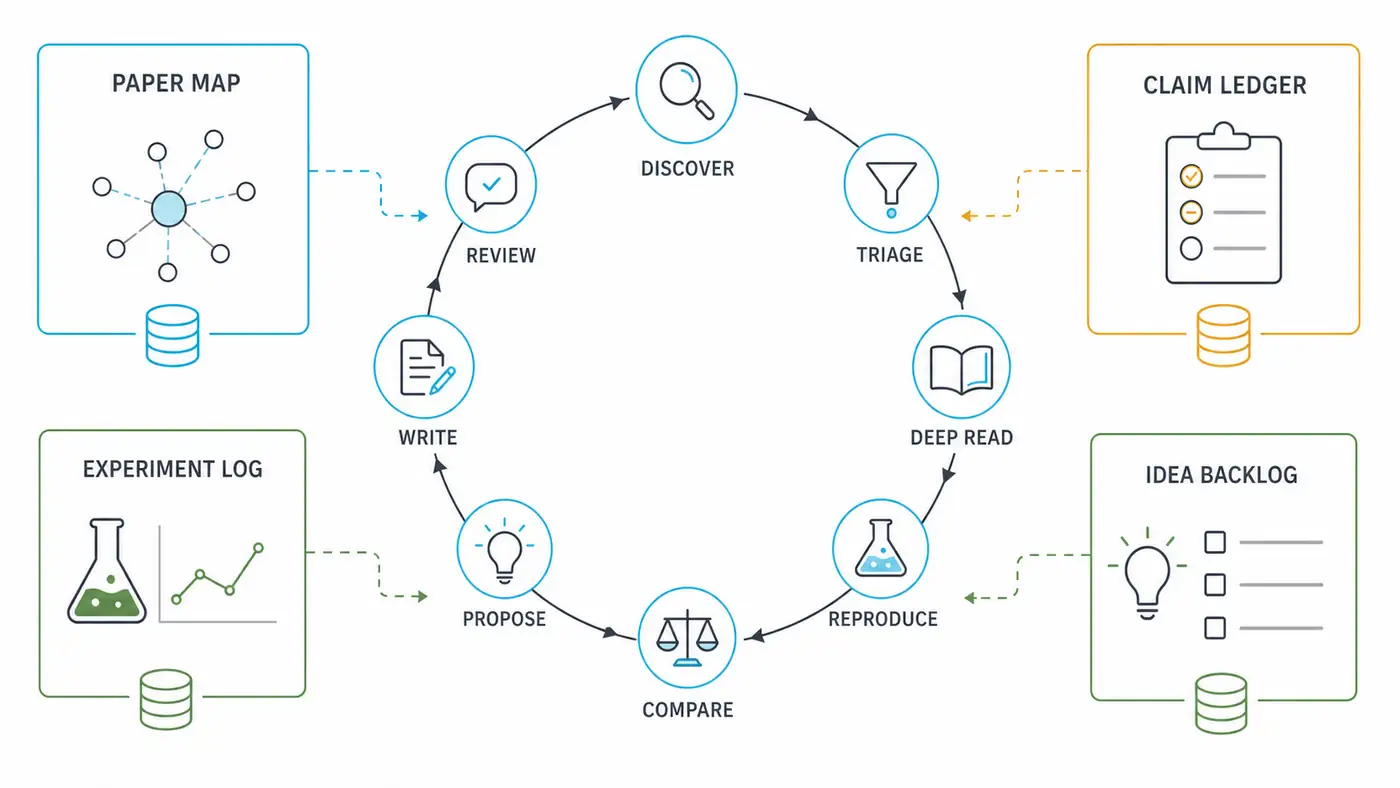
The long-term research reading system requires at least four repositories.
The first one is Paper Map. It is not a folder in the literature manager, but your understanding of the domain structure. Each node is not a paper title, but a problem, method family, dataset, benchmark, failure mode or technical assumption. For example, in the Efficient Inference direction, the nodes can be KV cache, speculative decoding, quantization, continuous batching, serving benchmark; in Safety The direction, the node can be Red Teaming, Refusal, Preference Optimization, Jailbreak Robustness, Policy Compliance. The paper is just evidence hanging on the node.
The second one is Claim Ledger. It records the verifiable assertions in the paper, not the abstract. Each claim includes at least: who proposes, under which settings, what variables are changed, what evidence is supported, what is the applicable boundary, and whether you have reproduced. A good Claim Ledger will quickly discover which conclusions are supported independently by multiple papers, which are only local phenomena on a Benchmark, and which depend on strong engineering details.
The third is Experiment Log. If there is no log in the reproduction experiment, only the impression will be left in a few weeks. Logs should log COMMIT, environment, dependency version, model weight, data version, run command, SEED, hardware, time-consuming, anomaly, metrics, screenshots and analysis. ICLR 2026 Author Guide emphasizes that reproducibility statements should point to the parts that can help reproduce in papers, appendices and supplements; NeurIPS 2026 Handbook Also considers Artifact, such as code, data, weights, environment versions, and hyperparameters, as important information for external review. For personal training, these requirements are not the burden of submission, but daily scientific research Hygiene.
The fourth is Idea Backlog. Don't write all ideas as proposals. The minimum entries of the backlog can only have four lines: problems, evidence, minimum experiments, failure criteria. An Idea is not a study hypothesis if there is no failure standard. An Idea may just be inspiration if you can't find evidence of the relevant papers. If there is no minimum experiment, an idea should not occupy the main line time for the time being.
Weekly research reading cycle
Long-term systems require a lightweight but stable cycle. It is recommended to use eight steps, rather than making a temporary decision on what to read every day.
The first step, Discover. Fixed scans on arXiv, OpenReview, ACL Anthology, PMLR, NeurIPS/ICLR/ICML/ACL/EMNLP/CVPR pages, official technical reports, code repository RELEASE, BENCHMARK LEADERBOARD to share with tutors/students. When scanning, only the title, source, date, task, why it is worth reading, and not deep reading are recorded.
The second step, triage. Divide the paper into four categories: must-read, intensive reading, skimming, and temporary storage. Must read is directly related to your current experiment; intensive reading is possible to change the paper map; skimming is to supplement the background; the temporary storage is interesting but does not affect the judgment in the short term. The criteria for judging are not heat, but the importance of the problem, the novelty of the method, the strength of the evidence, and the degree of coupling with your current research.
The third step, deep read. Read up to 1-2 intensive readings per week. When intensive reading, read the abstract and conclusion first, and write what the author wants you to believe; then read the method, dismantle the task definition, assumption, module and training target; finally read the experiment and check the dataset, metric, baseline, ablation, statistics and failure cases. Don't come up and translate sentence by sentence.
Step four is reproduction. You need not reproduce every paper in full, but do at least one concrete task each week: run the authors’ demo, reproduce a small configuration from a table, recalculate a metric, inspect a data split, run an ablation, or trace the core code path. PaperBench shows how reproduction can be broken into a hierarchy of tasks. Even a small task can sharpen research judgment.
The fifth step, compare. Put the new paper back to the Paper Map and compare the difference between it and the existing work. Does it change the model structure, data, training objectives, reasoning budget, evaluation protocol, or narrative style? If it's just a model or a Benchmark, it's not necessarily worth getting into the main line.
The sixth step, Propose. Generate 1-3 small follow-up ideas from this week's reading, each with a minimum experiment. Don't pursue quantity. A small problem with evidence constraints is more valuable than ten general "can combine x and y".
The seventh step, write. Output a short document per week: can be a paper card, reproducing notes, failure records, comparison table or proposal draft. Writing is not propaganda, but forcing yourself to make your judgment clear.
The eighth step, review. Check the four repositories in 30 minutes on weekends: Paper map adds nodes, whether the claim ledger has suspicious claims, whether the experiment log can be reproduced, Idea backlog Is there an item worth advancing.
From inventory to research judgment
Inventory of papers can easily become "there are many papers in this direction". Research judgments must answer "so what I believe, what I don't believe, what should be verified in the next step".
The most practical method is to press each paper into five sentences. The first sentence: it solves what specific failure modes. Second sentence: what is its core assumption. The third sentence: what variable does it really change. The fourth sentence: Which experiments the evidence comes from. The fifth sentence: I think it is the most vulnerable part of it. This format seems simple, but will force you to distinguish between "what the paper has done" and "what the paper has proved".
For the steering point, you can use three tables. The first one is Timeline Table, which lists the technical route changes by time. The second is Evidence Table, which lists the supporting evidence and counter-evidence by claim. The third one is a reproducibility table, which records code, data, weights, environment, operating costs and reproducing risks. When the three tables are combined together, it is close to the research and judgment.
In the 2025-2026 AI research environment, we should especially be alert to "model name-driven reading". Many technical reports change the model size, data, post-training, inference strategy and evaluation settings at the same time. If readers only look at the leaderboard, they will misread system engineering as a single method contribution. The long-term system needs to restore each claim to the variable level: whether the data is better, the training is longer, the model is larger, the prompt is stronger, the Benchmark is more suitable, or the method itself is more effective?
What can AI tools help, what can't you do for you
The AI tool has entered the scientific research reading workflow, but its correct position is "accelerated processing" and "exposed blind spot", not an alternative judgment.
AAAR-1.0 illustrates the distinction. It breaks researchers’ everyday work into EquationInference, ExperimentDesign, and PaperWeakness, all of which require expertise beyond ordinary question answering. PaperBench approaches the problem from another angle. Reproducing an AI paper entails understanding its contribution, writing code, and running experiments. OpenAI’s 2025 release page reports that even the best agent tested at the time did not surpass the human baseline. An LLM can assist with research, but researchers remain responsible for understanding, reproducing, and judging the work.
ICLR 2026's policy for LLMs also embodies the same principle: LLM It can be used as a general auxiliary tool, but if it makes a significant contribution in research ideas or writing, it needs to disclose its role; the author is still responsible for content, facts, citations and potential academic misconduct. NeurIPS 2026 has stricter rules for reviewers to use LLM, emphasizing the risk of submission confidentiality, controlled tools and Prompt Injection. For the personal reading system, this means: do not throw unpublished manuscripts, confidential codes, and review materials into the external model at will; do not trust the references generated by the model; do not let the model directly give the final review judgment.
Desirable usages include: let LLM help you convert the paper into the first draft of the Claim Ledger; let it list the dataset, metric, and baseline that need to be verified. The exception is sorted; let it propose a candidate Gap according to the Paper map; let it rewrite the reproduction notes into a blog draft. Undesirable usages include: letting the model decide whether the paper is credible for you; let the model compile the reference; let the model generate proposal based on unverified abstract; let the model execute unfamiliar code in a Sandbox-free environment; Comments are simplified to "receive/reject".
Representative data road map
| Category | representative data | Inspiration for the long-term system |
|---|---|---|
| Reproducible Specification | ICLR 2026 Author Guide;NeurIPS 2026 Main Track Handbook;Papers with Code research-code checklist | Include code, data, environment, weights, hyperparameters and running commands into daily records |
| AI Reproducing Ability Evaluation | OpenAI PaperBench;frontier-evals PaperBench README | Split the "reproduction paper" into an evaluable molecular task, instead of running the code in general |
| AI Assisted Research Tasks | AAAR-1.0;Can LLMs Generate Novel Research Ideas? | Differentiate Idea, experimental design, weak point identification, feasibility and novelty |
| Scientific Discovery Agent | Towards end-to-end automation of AI research;Automated Scientific Discovery survey;AI Agents for the Science of Science | Automated research requires external evidence, experimental substrate, feedback loop and deviation review |
| Research Writing and Reviewing | ICLR/NeurIPS LLM usage policy; top meeting review form; rebuttal experience | Treat writing, review and response as evidence quality training |
| long-term knowledge system | paper map、claim ledger、experiment log、idea backlog | Precipitate reading results into maintainable assets |
Reproducible Reading and Experimental Record Template
The following is a minimum template that can be copied directly to the note system.
Paper:
Venue / version / date:
Link:
Code / data / model:

Problem:
Claim:
Assumption:
Intervention:
Evidence:
Boundary:
Failure cases:

Datasets:
Metrics:
Baselines:
Ablations:
Statistical checks:

Reproduction target:
Environment:
Command:
Seed:
Hardware / budget:
Result:
Difference from paper:
Debug notes:

What I believe now:
What I do not believe yet:
Follow-up idea:
Minimum experiment:
Failure criterion:
The focus of this template is not complete, but consistency. After a long period of persistence, you will get a very valuable personal database: which papers really change your judgment, which experiments have you run by yourself, which Claims can't stand the recurrence, and which IDEAs have appeared many times but no one has solved them.
Monthly Review: Turn Reading into Topic Assets
Do a review at least once a month. It doesn't take a long time to review, but it has to produce three things.
First, update the paper map. Delete an already unimportant node, merge duplicate branches, and mark the newly emerging technology fork. For example, a month ago, you may use "LLM valuation" as a single direction; after reading it, it may be split into open-ended eval, human eval, LLM-as-judge, contamination, live Benchmark, Agent Eval and Domain-Specific Eval.
Second, clean up the claim ledger. CLAIM is divided into three categories: relatively stable, still pending verification, and inclination is not valid. This classification must be based on evidence, not based on the volume of the paper. For the CLAIM to be verified, write the minimum verification action; for the CLAIM that is "incl.", keep the counter-example and failure log.
Third, screen Idea Backlog. Progress only 1-2 ideas per month. The promotion standard is: the problem is specific enough, the relevant paper evidence is clear enough, the minimum experiment can be completed in 2-4 weeks, and something can be learned after failure. Other IDEAs are temporarily stored, don't let them interfere with the current mainline.
If you are a graduate student, you can turn the monthly review into a material to communicate with your tutor. Compared to "I read a lot of papers", it is more useful: "I think there are three unsolved claims in this direction; one of them can be verified in two weeks; if the result is positive, it can be expanded into a workshop paper; if it is negative, it can be written as benchmark audit or reproducibility note."
Common misconceptions
Myth 1: Collection is equal to reading. The 500 PDFs in the Document Manager will not automatically become understood. Failure to enter Paper Map or Claim Ledger papers has little help for long-term research.
Misunderstanding 2: Abstracts are equal to evidence. The abstract tells you what the author wants you to believe, and the experiment and reappearance determine how much you should believe.
Misunderstanding 3: Read the latest paper only. The AI direction is updated quickly, but the classic paper provides a task definition, induction bias and evaluation paradigm. Read only 2026 papers, it is easy to see the results but can't see where the problem comes from.
Misunderstanding 4: Read only classic papers. On the contrary, only the basic papers such as Attention, BERT, and InstructGPT will also miss the changes of current Benchmark, data policies, model reports and reproduction systems.
Misunderstanding 5: Treat LLM as a mentor. LLM can ask you questions, organize tables, and propose candidate GAPs, but it will not be responsible for your experiments, and will not bear the consequences of wrong references, errors, or non-reproducing results.
Myth 6: There is no maintenance cost awareness. Long-term systems must be lightweight. Each paper has a 5000-character note, which usually cannot be persisted. A better practice is a few intensive reading, batch skimming, and key CLAIM structured records.
Myth 7: Every idea starts an experiment immediately. The role of Idea Backlog is delayed impulse. Idea, which is truly worth advancing, should withstand the constraints of a week later and a minimum experimental plan.
System construction problems suitable for graduate students to continue to do
- Personal Claim Ledger tool: Structure the Claim, DataSet, Metric, BaseLine and reproduction states in AI papers, and support searching in direction.
- Reproducibility-first paper reading protocol: compare the influence of ordinary reading notes and reproduction priority notes on the success rate of subsequent experiments.
- LLM-assisted Literature Triage Audit: Evaluate the help and deviation of LLM for the initial screening of the paper, and focus on the problem of missing important negative results and excessive preference for popular models.
- Paper Map Drift Analysis: Track an AI sub-field for six months to analyze how Paper Map is refactored with changes to the Benchmark, model, and meeting policy.
- Proposal-from-ledger Workflow: Study which fields are the most feasible and reference accuracy when the first draft of Proposal is automatically generated from the Claim Ledger.
- Failed reproduction memory bank: Create a library of reproduction failure cases, and study the distribution of the reasons for failure in different paper types.
These topics do not necessarily have to be written into large papers, but they are all suitable as scientific research training programs. What they have in common is that they turn "reading papers" into a process that can be studied, measurable, and can be improved.
Summary
The end of a month's AI paper training camp should not be the end of reading habits. The real goal is that you already have a system that can continue to operate: discover and screen papers every week, intensively read a few key tasks, do the minimum reproduction, write claim as a verifiable record, write the experiment as a reproducible log, and put the idea in Backlog, and then use the monthly review to compress them into proposals or new research questions.
Long-term scientific reading is not a hot spot, nor is it a knowledge point. It is a process of continuous calibration judgment: keep asking yourself, what do I believe now? Is the evidence enough? If not enough, what is the minimum experiment? If I fail, what will I learn? When you can answer these questions stably, the paper will no longer be information flow, but will become your research asset.
References
Search date: 2026-08-21. The following links are first-hand or near-one-hand materials that can be accessed at the time of writing; meeting policies, code repository, benchmark results, model version, dataset version and arXiv/OpenReview status may change, please verify again before official release.
- ICLR 2026 Author Guide. https://iclr.cc/Conferences/2026/AuthorGuide
- NeurIPS 2026 Main Track Handbook. https://neurips.cc/Conferences/2026/MainTrackHandbook
- Papers with Code, Tips for Publishing Research Code. https://github.com/paperswithcode/releasing-research-code
- OpenAI, PaperBench: Evaluating AI's Ability to Replicate AI Research, 2025. https://openai.com/index/paperbench/
- OpenAI frontier-evals, PaperBench README. https://github.com/openai/frontier-evals/blob/main/project/paperbench/README.md
- Renze Lou et al., "AAAR-1.0: Assessing AI's Potential to Assist Research", ICML 2025 / PMLR. https://proceedings.mlr.press/v267/lou25c.html
- Chenglei Si, Diyi Yang, Tatsunori Hashimoto, "Can LLMs Generate Novel Research Ideas? A Large-Scale Human Study with 100+ NLP Researchers", ICLR 2025. https://mlanthology.org/iclr/2025/si2025iclr-llms/
- Yixuan Liu, Yicheng Zhang, "AI Agents for the Science of Science: A Survey of Tasks, Architectures, Evaluations, and Challenges", Findings of ACL 2026. https://aclanthology.org/2026.findings-acl.1804/
- Stefan Kramer et al., "Automated Scientific Discovery: From Equation Discovery to Autonomous Discovery Systems", Machine Learning, 2026. https://link.springer.com/article/10.1007/s10994-025-06955-2
- "Towards end-to-end automation of AI research", Nature, 2026. https://doi.org/10.1038/s41586-026-10265-5
- NeurIPS Ethics Guidelines. https://neurips.cc/public/EthicsGuidelines
- ICLR 2026 Policies on Large Language Model Usage. https://iclr.cc/FAQ/LLM
- REFORMS: Consensus-based Recommendations for Machine-learning-based Science. https://pmc.ncbi.nlm.nih.gov/articles/PMC11092361/
- Reproducibility in machine-learning-based research: Overview, barriers, and drivers, AI Magazine, 2025. https://onlinelibrary.wiley.com/doi/10.1002/aaai.70002
- An international consensus on core reproducibility items in research, 2026. https://pmc.ncbi.nlm.nih.gov/articles/PMC13086321/