
Date: 2026-08-14
Suitable for readers: graduate students, introductory researcher in LLM Evaluation, AI readers with engineering background
Search date: 2026-08-14
Abstract
LLM Evaluation papers are most easily read as "who is on the list higher". But what really needs to be learned in scientific research training is: why a Benchmark can represent ability, how to be scored in open answer, how human preferences and expert annotations enter the chain of evidence, LLM-as-a-judge How the errors are calibrated, and how data pollution, prompt formats, and version drifts will change their conclusions.
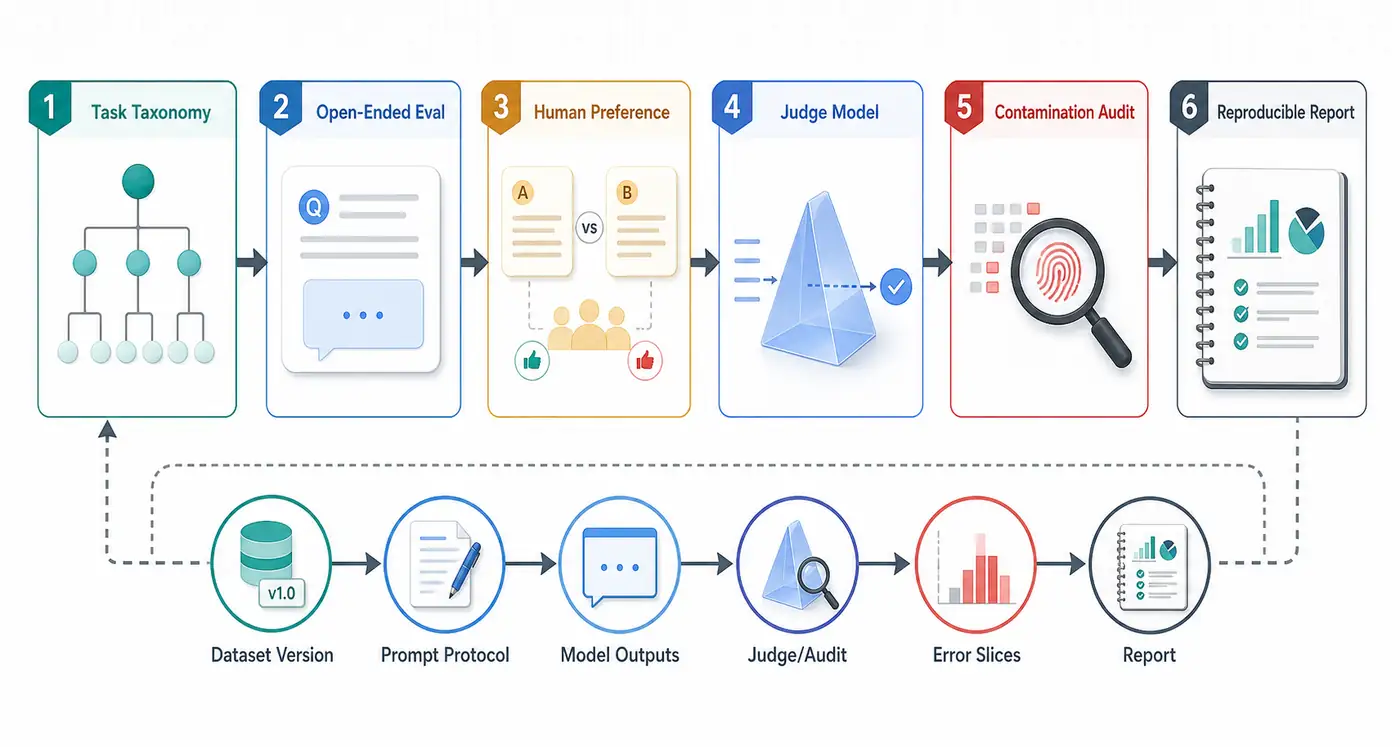
This article gives an intensive reading route from the classic Benchmark to the 2025-2026 dynamic evaluation. Read HELM, BIG-bench, MMLU-Pro, GPQA and other materials first, understand the task Taxonomy, standardization protocol and multi-index report; then read Chatbot Arena, MT-Bench, AlpacaEval, Arena-Hard, WildBench, understand why open answers and human preferences need to be compared in pairs, configure interval and error slices; then read LLM-as-a-judge SURVEY, Judge-Bench, PPE, OpenAI Evals, EleutherAI LM-Evaluation-Harness, understand the reproducible boundary of automatic referees; last read LiveBench, LiveCodeBench, YourBench, and Contamination Detection papers, understanding that modern evaluation is shifting from static to a dynamic, versioned, auditable evaluation system.
Contents
- Why is this topic important
- Core reading method
- A reading guide to the key papers
- Methods and experiments compared
- How to reproduce the results
- Common misconceptions
- Research questions for graduate students
- Summary and References
Why is this topic important
For graduate students, Evaluation is the most basic skill worthy of systematic training in AI research. The "method of methods" of many papers is actually only established under one vulnerable Evaluation protocol: DataSet is polluted, the baseline is too weak, the prompt is not aligned, answer is biased, LLM judge Preference for longer answers, Human eval samples are too few, or only reported the total score without error distribution. If you don't read the Evaluation section, it's hard to tell if a paper really advances its ability.
The trend of 2025-2026 is particularly evident. Static multiple-choice questions Benchmark is still important, but more and more research is starting to emphasize open-ended tasks, human preference, model-graded eval, real-time updates, private or delayed public tests SET, reproducible logs and pollution detection. The LiveBench page still has the core selling point of "contamination-free" and regular refreshes in 2026; the OpenAI Evals page is continuously published GDPval, SWE-Lancer, MLE-bench, etc. are closer to the evaluation of real workflows; Hugging Face YourBench has turned "generating dynamic Benchmark from self-owned documents" into an open source tool. These changes indicate that the evaluation is no longer just the last table of the paper, but the study of the problem itself.
The training goal of this article is not to let you remember which list is the most authoritative, but to establish a frame of judgment: what is this evaluation? What did you not test? Where does the label or referee come from? Can the score be reproduced? Is it possible to be contaminated with training data, prompt, answer format, or judge bias? Can you put forward the topic of the next paper from the wrong case?
Core reading method
When reading the Evaluation paper, it is recommended to write down six questions first.
First, what is the mission boundary? What is the review of closed-book knowledge, mathematical reasoning, code, long context, tool use, open Q&A, preference alignment, or real work tasks? Different tasks cannot be simply added with an average score. MMLU-Pro's multiple-choice questions, GPQA expert questions, Chatbot Arena's human preferences, and SWE-bench end-to-end testing, representing different types of evidence.
Second, where does the sample come from? Questions come from exams, expert writing, real users, code issues, Kaggle competitions, the latest arXiv summary, or LLM synthesis? The source of the sample determines the risk of pollution, difficulty distribution and extrapolation boundaries. When reading a paper, you need to record the data version, public time, training data, and whether the cutoff is known, and whether there is a private split or delayed release.
Third, how to score the output? Multiple-choice questions can be used in Accuracy, but open answers require Exact Match, Rubric, Pairwise Preference, LLM Judge, manual scoring, or test execution. The more complex the scoring rules, the more it is necessary to check the judgment stability, labor consistency, output resolution rules and invalid answer processing.
Fourth, is the comparison fair? System Prompt, Chat Template, Temperature, Max Tokens, Thinking Traces, tool permissions and answer extraction methods for different models will affect the score. Modern Reasoning Models will also introduce "hidden reasoning" and long-output budget issues; if the protocol is not fixed, the so-called increase may only be a larger reasoning budget.
Fifth, is the statistical evidence enough? Open reviews and human preference reviews must look at Confidence Interval, Sample Size, Bootstrap, Pairwise Matrix, Win Rate Uncertainty, and Error Slices. Only giving the leaderboard score of three decimal places is usually not enough to support strong conclusions.
Sixth, is there any pollution and drift audit? Pollution not only means that the original text of the test set has entered pre-training, but also includes the repeated spread of the benchmark topic in the network, leaderboard, forum and tutorial. The model API, JUDGE Model, Benchmark Release and data licenses change, and the reproduction report must specify the search date and version.
A reading guide to the key papers
1. From HELM to MMLU-Pro: learn to read the "Evaluation Protocol" first
HELM is a good first stop, as it expands Evaluation from a single Accuracy to a system project of "scenario, adaptation, metrics and transparent logs". The core training value of HELM lies not in the ranking of a model, but in three points: the coverage should be clear, and the gap should be clear; the indicators should be diverse, including accuracy, robustness, fairness, calibration, efficiency, etc.; the same batch of models should be compared under the same protocol. When reading HELM, it is recommended to split each Benchmark into five columns of Scenario, Adaptation, Metric, Model Access, and Raw Outputs.
BIG-bench and BIG-bench Hard are suitable for understanding the idea of "capacity probes". They are not to re-engrave a single application, but expose the model's ability boundaries with a large number of difficult tasks. The disadvantages are also obvious: after the question bank is disclosed, the subsequent model may indirectly contact the problem through training data or adjustment parameters, and the static question bank will gradually lose its discrimination.
MMLLU-Pro and GPQA represent the "make static benchmark harder and more stable". MMLLU-PRO starts from MMLU, increases the number of options, screens more biased inference, and emphasizes CoT evaluation and prompt stability in the official repository; GPQA Postgraduate science questions are written by experts in the field and emphasize that non-experts are difficult to answer even with search. When intensively reading these papers, don't just look at "the title is more difficult", but look at how they define the difficulty, how to verify the quality of the problem, how to deal with random guesses and expert errors.
2. Open-ended Eval: open answer is not without standard
Open-ended evaluation is difficult because many answers may be reasonable. MT-Bench uses a fixed set of multi-turn questions and a GPT-4 judge for automatic scoring. Chatbot Arena pits anonymous models against each other and estimates preferences from human votes. Both acknowledge how difficult it is to specify a single correct answer. This motivates pairwise comparisons, Elo or Bradley–Terry estimates, human preference judgments, and calibration of automated judges.
AlpacaEval and Arena-Hard are important nodes for automatic preference evaluation. AlpacaEval pursues low cost, fast and highly correlated with human preferences; the subsequent length-controlled win rate clearly handles long answer deviations. Arena-Hard constructs a more discriminatory challenge set from the real data of Chatbot Arena, and emphasizes Separability and Human Preference Agreement. When reading these papers, the key question is: Does prompt represent real users? Does Judge prefer long, polite, structured, or confident answers? Is the score difference large enough to exceed Confidence interval ?
WildBench further introduces real user tasks into open reviews. It reminds us that real Query is often not a clean exam question, but vague, long, lack of context, cross-field, and complex format requirements. For graduate students, the most valuable thing when reproducing open-end evaluation is not chasing the list, but the case of failed sampling reading: the model is in the wrong fact, the format, the reasoning is wrong, the constraints are not followed, or the answer seems beautiful but does not solve the task?
3. Human Eval: Human labels are evidence, not decoration
The common misunderstanding of Human Eval is to use "to vote with a few people" as sufficient evidence. Strict Human evaluations should at least explain the background, task description, scoring Rubric, sample sampling, blind evaluation method, consistency indicator, payment or incentive method, and how TIE/UNSURE will be handled. The advantages of Chatbot Arena are large-scale, many real users, and anonymous battles to reduce brand bias; the limitation is that user distribution, task distribution and voting motivation are not completely controlled.
Expert labeling of MT-Bench, CrowdSourced Preference of Chatbot Arena, Factuality design of OpenAI SimpleQA, GDPval The task of industry experts reflects different human evidence. SimpleQA tries to compress facts into short answer questions, reducing the difficulty of long text fact checking; GDPval pushes the evaluation object to the real knowledge work Deliverables. When reading these materials, it is necessary to distinguish: Are human beings providing Gold Answer, preference ranking, quality score, fact check, or task acceptance? Different labels cannot be mixed.
If you're going to do your own Human Eval, it's recommended to start with a small but high quality. Write Rubric first, and then do 20 Pilot annotation; statistical labeling is divergent, revision instructions; Blind pairwise samples, random sequence, duplicate samples and conflict arbitration are retained during the formal evaluation. Don't just report "average human preferences," report Confidence interval and typical differences.
4. LLM-as-a-judge: The automatic referee must be judged first
LLM-as-a-judge is a tool that cannot be avoided by modern evaluation. Because of the high cost of manual evaluation, it is difficult to score regularly for open output. However, the risks of automatic referees are also very concentrated: position deviation, length deviation, self-preference, format deviation, lack of domain knowledge, prompt sensitive, vulnerable to Adversarial Wording, and Proprietary judge The version cannot be reproduced.
2025 LLM-as-a-judge Survey and "LLMs INSTEAD OF Human Judges?" are worth intensive reading of ACL/EMNLP 2025. Their common conclusion is that LLM JUDGE can provide useful signals on certain tasks, but must be verified with Human labeling first, and cannot replace humans by default. Judge-Bench The work of the first class emphasizes the difference in Judge performance on different tasks, languages, and data types; PPE puts the Reward Model / LLM Judge in real Human preferences and verifiable Do meta-evaluation on correctness.
When reading a LLM Judge paper, it is recommended to fix a table: Judge Model, Judge Prompt, input format, output format, whether pairwise, whether the shuffle order, whether it is sampled multiple times, whether it is used Ensemble, correlation to humans, deviation test, manual random check ratio, failure example. A JUDGE experiment without this information, even if the score is high, is difficult to become reliable evidence.
5. Contamination: High scores may come from ability or memory
Data contamination is a major risk in LLM evaluation. The NAACL 2024 paper “Investigating Data Contamination in Modern Benchmarks for Large Language Models” proposes retrieval-based overlap detection and Testset Slot Guessing. It shows how behavioral probes can reveal possible prior exposure even in closed-source models. A contamination report in Findings of EMNLP 2024 presents an analysis workflow for open-source models and multiple-choice benchmarks. A survey of contamination research organizes the detection methods and explains where each applies.
Pollution is not a simple "you must have a high score if you see a question". Some pollution will significantly increase the score, some only affect some subsets; some models may remember the question stem but not solve the problem correctly; Easier to enter the training corpus. When reading the paper, you need to check whether Exact Overlap, Near-Duplicate, Semantic Overlap, Slot Guessing, or the performance exception after time-division.
LiveBench and LiveCodeBench represent dynamic anti-pollution routes. LiveBench uses regular refresh, objectively verifiable answers, and delayed public some questions to reduce pollution and LLM Judge deviations; LiveCodeBench continuously collects code questions from recent competition platforms, emphasizing time segmentation and code generation. abilities such as self-repair, execution and test prediction. YourBench provides another path: the domain evaluation is generated from the new document provided by the user, and the space for "resulting the model to answer questions with old knowledge" is reduced with Grounding / Citation Checks.
6. Reproduction Tool: Review code is also part of the paper
EleutherAI LM-Evaluation-Harness, HELM, OpenAI Evals, Evalchemy, LiveBench repository and MMLU-Pro The official code all illustrates the fact that the evaluation is not a few lines of inference scripts, but an engineering system that requires task definitions, data loading, prompt templates, output parsing, logging, versioning, and results summary.
When reproducing a paper, do not just copy the leaderboard command. You want to save the full config: model checkpoint or API name, date, temperature, top_p, max tokens, chat template, system prompt, feed-shot Examples, Stop Tokens, Answer Extractor, Judge Prompt, Judge Model, Concurrency Settings, Failed Retry, and Invalid Sample Handling. For Reasoning Models, it is also necessary to record whether to strip Thinking traces, whether to allow long reasoning, and whether the final answer extraction rule is consistent with the original paper.
Methods and experiments compared
| Read Branch | representative data | Main problem | Intensive reading must be checked |
|---|---|---|---|
| Holistic evaluation | HELM, VHELM, MedHELM | How to cover scenarios and metrics system | scenario taxonomy、adaptation、metric、raw outputs |
| Static Difficulty Benchmark | MMLU-Pro, GPQA, BBH | How to improve the difficulty and discrimination | Question source, expert verification, prompt stability, pollution risk |
| open review | MT-Bench, AlpacaEval, Arena-Hard, WildBench | How to evaluate open answer quality | Pairwise Protocol, Judge BAS, Length Control, Error Samples |
| human preference | Chatbot Arena, SimpleQA, GDPval | How Human Tags Go to the Chain of Evidence | Indicators, Rubric, Blind Reviews, Confidence Interval, Different Handling |
| LLM-as-judge | Survey, Judge-Bench, PPE | Is the automatic referee credible? | Relevance to humans, position/length deviation, version drift |
| Pollution detection | TS-Guessing, contamination reports | Whether the high score is amplified by data leakage | OverLap type, time segmentation, private set, delayed release |
| dynamic evaluation | LiveBench, LiveCodeBench, YourBench | How to keep the question bank fresh | Release version, public policy, verifiable answer, log |
How to reproduce the results
In the first stage, a closed benchmark is reproduced. Select the 1-2 subjects of the MMLU-Pro or the public Split of GPQA, use the official script or lm-evaluation-harness to fix the model and inference parameters. In the report, don't just write Accuracy, write Prompt, FEW-Shot, Answer Extraction, number of invalid outputs and error categories.
In the second stage, an open-ended judge is reproduced. Select a small sample of AlpacaEval, MT-Bench or WildBench, run the answers of the two models, and then use the fixed Judge Prompt to do the pairwise evaluation. Location exchanges must be done, at least 30 manual reviews are sampled, the statistics are divided between JUDGE and manual, and 5 different cases are listed.
In the third stage, do contamination audit. Check the public time of the dataset you want to use, the exposure of Hugging Face / GitHub / Leaderboard, and whether there is a training set leak discussion. If the model is training cutoff is opaque, don't write "no pollution", you can only write "no public evidence is found, wait for manual verification". Supplements can be supplemented with near-repeat search, slot guessing, or time segmentation.
In the fourth stage, build a small dynamic Benchmark. Select a group of course lectures, technical documents or the latest papers after 2026, generate 50-100 questions according to YourBench idea, and then manually review the answers to verify the verified. This exercise is suitable for training the ability to "review is research": you will quickly find that problem generation, answer uniqueness, and documentation Grounding and difficulty distribution are not resolved automatically.
In the fifth stage, write the evaluation reproduction report. Suggested fixed structure: task definition, data version, model version, evaluation protocol, operating environment, cost, failure sample, overall score, subset score, manual review, pollution risk, difference from the original paper, and next revision. Don't write the recurrence report as a screenshot of the leaderboard.
Common misconceptions
First, take the rankings as the conclusion of the paper. The leaderboard is the entrance, not the chain of evidence. Without protocols, Confidence interval and error analysis, the ranking is difficult to describe the mechanism.
Second, treat LLM JUDGE as an objective truth value. Judge is a partial model that must be calibrated by human or verifiable tasks.
Third, ignore prompt and output parsing. A few points of improvement in the Benchmark may come from Answer Extractor, not model capabilities.
Fourth, use static public question bank to evaluate the new model without discussing pollution. The longer the disclosure, the wider the spread, the more pollution audits are needed.
Fifth, just look at the average score. The findings of true research value are often in sub-tasks, error slices, low confidence samples and model differences.
Research questions for graduate students
- Chinese Open Evaluation Judge Calibration: Build 200 Chinese complex instructions to compare the consistency of human, LLM Judge and rule scoring.
- Benchmark Contamination Audit Tool: Do public exposure timeline and near duplicate retrieval for Hugging Face dataset and GitHub question bank.
- Length BIAS visualization research: The system controls the answer Length in the AlpacaEval style evaluation, and quantifies the deviation of different Judges.
- Dynamic Eval for Papers: Generate verifiable questions and answers from the last 3 months of arXiv paper to evaluate whether the model can utilize new knowledge.
- Evaluation Report Card: Design a reproducibility checklist for the Evaluation part of the paper, and use 10 LLM papers as a case study.
Summary
The focus of the intensive reading of the Evaluation paper is to restore the score to the production process of evidence. HELM teaches you to look at scenes and indicators, MMLU-Pro / GPQA teaches you how to verify the quality and difficulty of the problem, Chatbot Arena / AlpacaEval / Arena-Hard Teach you to read open answers and human preferences, LLM-as-a-judge paper teaches you to audit referees, LiveBench / LiveCodeBench / YourBench And pollution detection papers teach you to deal with dynamic question banks and data leakage.
The most practical training method for graduate students is to start with a small evaluation reproduction experiment: fixed model version, save the complete prompt and output, run the automatic score, and then do manual sampling review, and finally write the error slice into a new research problem. The truly mature Evaluation ability is not to know which Benchmark is popular, but can explain why a score is credible, where it is not, and how to change the next round of experiments.
References
Search date: 2026-08-14. The following priority lists papers, official project pages, conference pages, official GitHub / Hugging Face / leaderboard documents and first-hand data; model version, API behavior, leaderboard ranking, benchmark Release, code repository status and data license may change, please check again before reappearing.
- Liang et al., “Holistic Evaluation of Language Models”, TMLR / OpenReview, 2023. https://openreview.net/forum?id=iO4LZibEqW
- Stanford CRFM, HELM official leaderboard and documentation. https://crfm.stanford.edu/helm/index.html
- BIG-bench repository, Google. https://github.com/google/BIG-bench
- Suzgun et al., “Challenging BIG-Bench Tasks and Whether Chain-of-Thought Can Solve Them”, arXiv, 2022. https://arxiv.org/abs/2210.09261
- Wang et al., “MMLU-Pro: A More Robust and Challenging Multi-Task Language Understanding Benchmark”, arXiv / NeurIPS 2024, official repository. https://github.com/TIGER-AI-Lab/MMLU-Pro
- TIGER-Lab MMLU-Pro dataset card. https://huggingface.co/datasets/TIGER-Lab/MMLU-Pro
- Rein et al., “GPQA: A Graduate-Level Google-Proof Q&A Benchmark”, arXiv, 2023. https://arxiv.org/abs/2311.12022
- Zheng et al., “Judging LLM-as-a-judge with MT-Bench and Chatbot Arena”, arXiv, 2023. https://arxiv.org/abs/2306.05685
- Chatbot Arena official blog / LM Arena. https://arena.ai/blog/arena
- Chiang et al., “Chatbot Arena: An Open Platform for Evaluating LLMs by Human Preference”, arXiv, 2024. https://arxiv.org/abs/2403.04132
- AlpacaEval official repository. https://github.com/tatsu-lab/alpaca_eval
- Li et al., “From Crowdsourced Data to High-Quality Benchmarks: Arena-Hard and BenchBuilder Pipeline”, arXiv / official repository, 2024. https://github.com/lmarena/arena-hard-auto
- Lin et al., “WildBench: Benchmarking LLMs with Challenging Tasks from Real Users in the Wild”, arXiv / official repository, 2024. https://github.com/allenai/WildBench
- Li et al., “From Generation to Judgment: Opportunities and Challenges of LLM-as-a-judge”, ACL Anthology / EMNLP 2025. https://aclanthology.org/2025.emnlp-main.138/
- Bavaresco et al., “LLMs instead of Human Judges? A Large Scale Empirical Study across 20 NLP Evaluation Tasks”, ACL Anthology, 2025. https://aclanthology.org/2025.acl-short.20/
- Thakur et al., “Judging the Judges: Evaluating Alignment and Vulnerabilities in LLMs-as-Judges”, ACL Anthology GEM 2025. https://aclanthology.org/2025.gem-1.33/
- Frick et al., “Preference Proxy Evaluations”, LM Arena blog / arXiv / repository, 2024. https://arena.ai/blog/preference-proxy-evaluations/
- OpenAI Evals official page. https://evals.openai.com/
- OpenAI Evals repository. https://github.com/openai/evals
- OpenAI, “Introducing SimpleQA”, 2024. https://openai.com/index/introducing-simpleqa/
- EleutherAI lm-evaluation-harness official repository. https://github.com/EleutherAI/lm-evaluation-harness
- LiveBench official site. https://livebench.ai/
- LiveBench official repository. https://github.com/LiveBench/LiveBench
- White et al., “LiveBench: A Challenging, Contamination-Free LLM Benchmark”, ICLR 2025 / project links. https://crwhite.ml/
- Jain et al., “LiveCodeBench: Holistic and Contamination Free Evaluation of Large Language Models for Code”, ICLR 2025. https://proceedings.iclr.cc/paper_files/paper/2025/hash/94074dd5a072d28ff75a76dabed43767-Abstract-Conference.html
- Deng et al., “Investigating Data Contamination in Modern Benchmarks for Large Language Models”, ACL Anthology / NAACL 2024. https://aclanthology.org/2024.naacl-long.482/
- Li et al., “An Open-Source Data Contamination Report for Large Language Models”, ACL Anthology / Findings EMNLP 2024. https://aclanthology.org/2024.findings-emnlp.30/
- “A Comprehensive Survey of Contamination Detection Methods in Large Language Models”, OpenReview. https://openreview.net/forum?id=SxNMjbtdFm
- Xu et al., “Benchmark Data Contamination of Large Language Models: A Survey”, arXiv, 2024. https://arxiv.org/abs/2406.04244
- Shashidhar et al., “YourBench: Easy Custom Evaluation Sets for Everyone”, OpenReview / COLM 2025. https://openreview.net/forum?id=bkWERVKzuP
- Hugging Face YourBench repository. https://github.com/huggingface/yourbench
- Hugging Face Open LLM Leaderboard documentation. https://huggingface.co/docs/leaderboards/main/open_llm_leaderboard/about