Date: 2026-08-11
Suitable for readers: graduate students, introductory researcher of AI4Science, technical readers with engineering background
Search date: 2026-08-11
Abstract
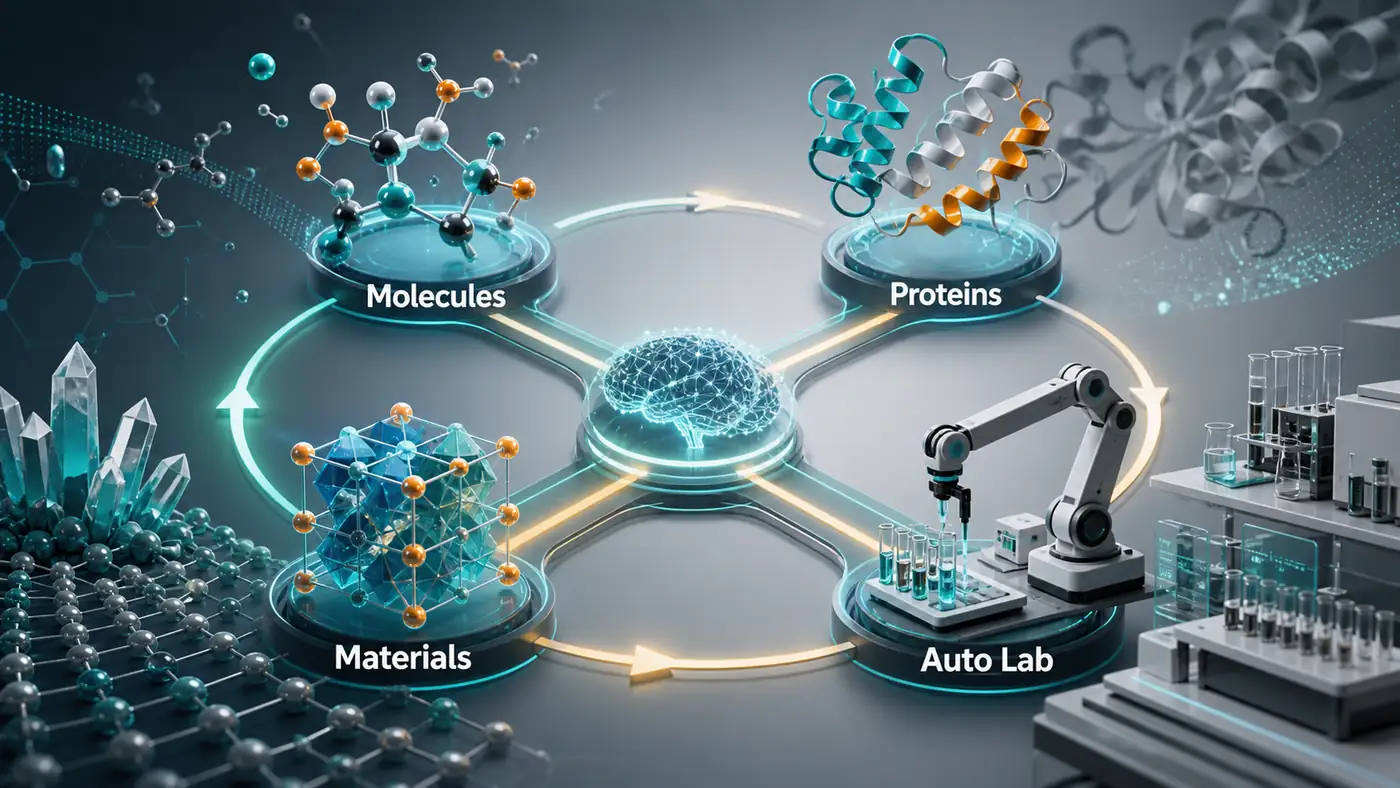
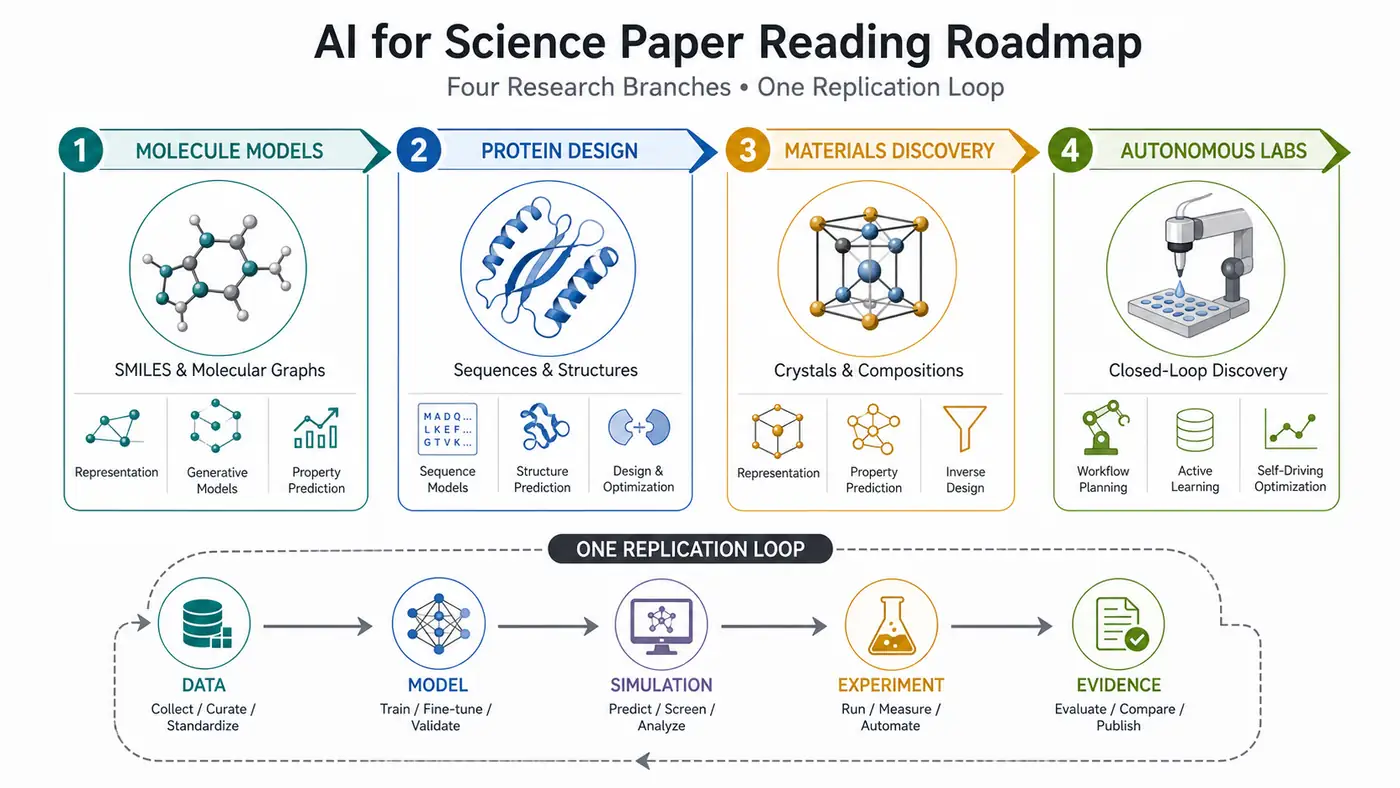
AI for Science is not a single-point model direction, but a set of methods organized around scientific objects, physical constraints, and experimental verification. Molecular direction care SMILES, molecular diagram, 3D Conformation and protein pockets; protein direction cares for sequence, structure, function and wet experiment screening; material direction is concerned with crystal structure, composition, stability, property constraints and synthesis feasibility; APIs, active learning and real measurements are connected into closed loops.
Start with representation and prediction, move on to generation and inverse design, then turn to experimental validation and autonomous discovery. To judge whether an AI4Science paper answers a scientific question, ask how well the data represent the real distribution and whether the benchmark suffers from leakage. Have the generated results been validated physically or experimentally? Are the data, weights, code, and evaluation protocol available for a reproduction?
Why is this topic important
The difficulty of AI4Science is that it requires both "machine learning is correct" and "scientific problems are correct". In ordinary NLP tasks, the improvement on the public test set shows that at least the model is suitable for the distribution of data; but in molecules, proteins and materials, offline indicators are only the first layer of evidence. The really important question is whether the molecules proposed by the model can be synthesized, whether the protein can be expressed and maintained, whether the crystals are stable and ready, and whether the experimental agent can complete a closed loop under the instrument and safety constraints.
Trends in 2025 to 2026 make this more pronounced. Co-Scientist pushes multi-agents, literature retrieval and hypothesis generation to scientific discovery processes; Boltz-2 pushes structural prediction to binding affinity prediction; MatterGen Turning material discovery from "screening candidates" to "direct generation by constraints"; InstructBioMol and other work try to make natural language a biomolecular design interface. These tasks are very exciting, but it also requires rigorous reading: the failure of the scientific intelligent system is often not the failure of the code to run, but the chain of evidence is broken in a certain link.
Core reading method
When reading the AI4Science paper, it is recommended to split each article into five layers.
- Scientific subjects: Are small molecules, proteins, protein-ligand complexes, crystal materials, reaction conditions, or complete experimental procedures? The object determines the representation. SMILES facilitates language modeling but weakens 3D geometry; the molecular graph retains the connection relationship but needs to deal with the conformation; the protein sequence is suitable for large-scale pre-training but not equal to function; the crystal material also represents periodic lattice and space groups.
- Task definition: The paper is doing Property Prediction, Structure Prediction, Inverse Design, Docking, Binding Affinity, Reaction Planning, or Hypothesis GENERATION? It is also called "generation", some only generate legal structures, some require satisfactory nature constraints, and some also require synthesis and experimental measurements.
- Constraints: Molecules should satisfy valence, drug similarity, synthesis and pocket compatibility; Non-specific effects; materials must meet charge balance, thermodynamic stability and process conditions; automatic experiments must also comply with instrument capabilities, reagent safety and budget.
- Evidence Strength: Offline Benchmark, Physical Simulation, Database Validation, Expert Review, Automated Experimental and Wet Experimental Verification is not the same level of evidence. The higher the evidence, the higher the cost and the more convincing, but the negative control, the failure sample and the statistical significance are still checked.
- Reproduction Boundary: Determine which layer you can reproduce as early as possible. The most reasonable reproduction goals of many AI4Science papers are not complete wet experiments, but the screening, evaluation split, ablation or failure case analysis before the experiment.
A reading guide to the key papers
1. Molecular Model: Learning from Representation to Verifiable Generation
The fundamental problem of the molecular direction is "what the model has seen". SMILES/SELFIES is suitable for language modeling, graph neural networks are suitable for atom-bond structures, and the 3D Equivariant model is further incorporated into the spatial geometry. When reading such papers, first look at whether it solves the representation, prediction or generation, and then sees whether the training and test split really isolate scaffold, target or assay.
A 2025 study highlights the risk of data leakage in binding affinity prediction. Graber et al. examined similarities between PDBbind and the CASF benchmark. With their proposed CleanSplit, several models performed worse. Such a drop can be informative. The evaluation may finally be measuring something closer to real generalization.
2. Protein Design: From Structural Prediction to Functional Generation
The classical starting point of the protein direction is still AlphaFold2. When reading it, don't just remember CASP14, but remove input, MSA, structural module, Confidence estimation and restriction. Then read ProteinMPNN and RFdiffusion: the former represents the inverse problem of "designed skeleton design sequence", and the latter represents a protein skeleton that satisfies the structure or functional constraints with a diffusion model.
After 2024 to 2025, the focus has shifted to more versatile biomolecular interactions. AlphaFold3 puts proteins, nucleic acids, small molecules, ions and modified residues into a unified structure prediction framework; Chai, Boltz and other systems promote reproducible complex modeling; ESM3 represents sequence, structure and function as Generic protein language model of multimodal space. When reading, it is necessary to distinguish between "accurate structure", "accurate affinity" and "effective function".
3. Material discovery: from large-scale screening to reverse generation
The material direction can be read first GNoME. Its core is not a language model, but expands the stable crystal candidate space through graph networks and high-throughput computing. When reading such papers, pay attention to stability criterion, DFT settings, data release version, and whether to link with databases such as Materials Project.
Read MatterGen again. It changes the goal from "sieve from massive candidates" to "directly generated directly from a given chemical, symmetry, or property constraints". This is important for methodology: the screening type discovery tests the candidate coverage and scoring functions, and the generative discovery tests the constraint control, structural validity, energy relaxation, stability and real synthesis verification. In particular, it should be remembered that thermodynamic stability does not mean that it is easy to synthesize in the experiment.
4. Automatic experiments: from tool agents to scientific closed loops
A-Lab puts the target material, literature mining, synthesis heuristics, robot operation, XRD characterization and active learning in the same closed loop; Coscientist uses LLM, document retrieval, code execution and experiment API To plan and execute chemical experiments; Co-Scientist uses multi-agent debate, sorting, evolution and expert feedback for hypothesis generation, and conducts experimental verification on biomedical issues.
This line is most suitable for training the ability of "system reading paper". You have to ask: which part is LLM and which part is a database, tool or human expert? Is the experiment fully automatic, or is it only automatic at the decision-making level? Is there a record of the failure experiment? How is security constraints implemented? Without these problems, automatic experimental papers can easily be read as a "robot doing experiment" press release.
Methods and experiments compared
| Papers/System | what to read first | method keywords | Reproduce entry point |
|---|---|---|---|
| AlphaFold2 | Input, Confidence, CASP14 settings | MSA, structural modules, geometric constraints | Run the public code or ColabFold, compare Confidence vs. failure cases |
| RFdiffusion | Design Tasks and Experimental Screening | diffusion、motif scaffolding | Small Scale Backbone Generation and Filtering Flow |
| ESM3 | How to align the sequence/structure/function three modals | protein language model、prompting | Use open models for restricted designs, document licensing and security boundaries |
| AlphaFold3 / Chai / Boltz | Input Entity and Output Task Boundary | biomolecular complex、affinity | Compare input formats, speeds and confidence with small complex collections |
| GNoME / MatterGen | Stability, Constraints, and Data Versions | graph network、crystal diffusion | Reproduce Candidate Screening, Relaxation and SUN Metric Definitions |
| A-Lab / Coscientist / Co-Scientist | Who makes decisions in a closed loop | robotics、tools、multi-agent | Reproducing Experimental Log Structure, Active Learning or Hypothesis Rubric |
How to reproduce the results
The reproduction of AI4Science must first choose the level, and do not promise to "completely reproduce the paper".
Reading reproduction: reproducing the column definition, data source, evaluation protocol and model input and output of the paper table, the goal is to clarify the task.
Calculated reproduction: download code and weights, run inference on small samples, record environment, GPU, random seed, version, failure example and time-consuming.
Evaluation type recurrence: redo benchmark split, deduesting, scaffold split, time segmentation, similarity filtering and Confidence calibration. It is especially important for molecular and protein affinity tasks.
Closed loop reproduction: Replace real experiments with simulators, public databases or cheap experiments. Only when there are experimental conditions and safety approvals, they enter the wet experiment reappearance.
It is recommended to keep four logs for each reproduction: environment log, data log, run log and judgment log. Determine which results are credible, which are just reproducing experimental settings, and which require manual verification.
Common misconceptions
First, treat the Benchmark score as a scientific discovery. Most of AI4Science's Benchmark is a proxy task and cannot automatically launch real-world valid.
Second, structure prediction is regarded as a functional prediction. Protein structural similarity does not mean that activity, stability, expression and immunogenicity are all available.
Third, "generate legal molecules" as "discover candidate drugs". Legal, synthesis, binding, optimized, low toxicity and drug-expertile are different thresholds.
Fourth, "stable material" is regarded as "energy synthetic material". The material paper must examine the relationship between thermodynamic stability, dynamic pathway, precursor and experimental characterization.
Fifth, read-only success examples. Failed examples tend to be more research value because it exposes the distribution of the outer boundaries of the model, instrument bottlenecks, or evaluation vulnerabilities.
Research questions for graduate students
- Data leak audit for protein-ligand benchmark: re-split training test set from three levels of sequence similarity, structural similarity and ligand scaffold.
- AI4Science Generation Model Failed Sample Library: The system collects invalid structures, non-synable candidates, low Confidence prediction and wet experiment failure cases.
- Reproducing the reverse design of small-scale materials: the process of "Constraint Generation + Stability Filtering + Feasibility Check of Document Synthesis" is reproduced with an open source material database.
- Scientific Hypothesis Generation Evaluation Rubric: Compare the ranking consistency of LLM generation hypotheses in novelty, verifiability, evidence support, and experimental costs.
- Reproduce report automation template: normalize environment, data version, model weights, evaluation scripts, failure logs, and manual verification items.
Summary
The reading route of AI for Science can be summarized as one sentence: first ask the scientific object, then ask the modeling hypothesis, and finally ask the chain of evidence. Molecules, proteins, materials, and automatic experiments seem to be scattered, but they share the same training logic: coding complex scientific objects into a model that can be processed, propose candidates with a generation or prediction method, and then use physical, statistical and experimental verification to turn candidates into evidence.
For graduate students, the most worthwhile practice is not to memorize the name of each model, but to form a set of transferable questions: where does the data come from, whether the task is real, whether the indicators are leaked, how to filter the generated results, whether the failure examples are disclosed, and what layer can be done in the reproduction.
References
Search date: 2026-08-11. The following priority lists the papers, official project pages and first-hand data; model version, API availability, leaderboard results, and code release status may change, please check again before reappearing.
- Jumper et al., “Highly accurate protein structure prediction with AlphaFold”, Nature, 2021. https://www.nature.com/articles/s41586-021-03819-2
- Google DeepMind AlphaFold2 GitHub repository. https://github.com/google-deepmind/alphafold
- Watson et al., “De novo design of protein structure and function with RFdiffusion”, Nature, 2023. https://www.nature.com/articles/s41586-023-06415-8
- Abramson et al., “Accurate structure prediction of biomolecular interactions with AlphaFold 3”, Nature, 2024. https://www.nature.com/articles/s41586-024-07487-w
- Hayes et al., “Simulating 500 million years of evolution with a language model”, Science, 2025. https://doi.org/10.1126/science.ads0018
- EvolutionaryScale ESM repository. https://github.com/evolutionaryscale/esm
- Passaro et al., “Boltz-2: Towards Accurate and Efficient Binding Affinity Prediction”, bioRxiv, 2025. https://www.biorxiv.org/content/10.1101/2025.06.14.659707v1
- Boltz official repository. https://github.com/jwohlwend/boltz
- Chai Discovery chai-lab repository and Chai-1/Chai-2 citation notes. https://github.com/chaidiscovery/chai-lab
- Zhuang et al., “Advancing biomolecular understanding and design following human instructions”, Nature Machine Intelligence, 2025. https://www.nature.com/articles/s42256-025-01064-0
- Graber et al., “Resolving data bias improves generalization in binding affinity prediction”, Nature Machine Intelligence, 2025. https://doi.org/10.1038/s42256-025-01124-5
- Merchant et al., “Scaling deep learning for materials discovery”, Nature, 2023. https://www.nature.com/articles/s41586-023-06735-9
- Google DeepMind GNoME materials discovery repository. https://github.com/google-deepmind/materials_discovery
- Zeni et al., “A generative model for inorganic materials design”, Nature, 2025. https://www.nature.com/articles/s41586-025-08628-5
- Szymanski et al., “An autonomous laboratory for the accelerated synthesis of inorganic materials”, Nature, 2023. https://www.nature.com/articles/s41586-023-06734-w
- Boiko et al., “Autonomous chemical research with large language models”, Nature, 2023. https://www.nature.com/articles/s41586-023-06792-0
- Bran et al., “Augmenting large language models with chemistry tools”, Nature Machine Intelligence, 2024. https://doi.org/10.1038/s42256-024-00832-8
- Gottweis et al., “Accelerating scientific discovery with Co-Scientist”, Nature, 2026. https://www.nature.com/articles/s41586-026-10644-y
- Google DeepMind, “Co-Scientist: A multi-agent AI partner to accelerate research”, 2026. https://deepmind.google/blog/co-scientist-a-multi-agent-ai-partner-to-accelerate-research/
- ICLR 2026 Workshop on Foundation Models for Science, OpenReview venue page. https://openreview.net/group?id=ICLR.cc%2F2026%2FWorkshop%2FFM4Science