
Date:2026-08-05
Who this is for: Already understand the Transformer, vector retrieval and basic RAG engineering process, and want to read postgraduate, new researcher and engineering background readers for retrieval enhancement from "application skills" to "learning paradigm".
Abstract
Retrieval-Augmented Learning is not simply "give LLM a vector library". From REALM, RAG, RETRO, Atlas to Self-RAG, Adaptive-RAG, GraphRAG, Agentic RAG and Memory-Augmented Generation, the core problem of this route has been changing: should the knowledge be stored in the parameters, or should it be stored in the external memory; the retrieval should occur in pre-training, fine-tuning or at inference time; the model should passively receive top-k Documents, or take the initiative to determine when to retrieve, how to rewrite the query, and how to maintain long-term memory. This paper gives a intensive reading route of the paper, and combines the classic RAG with the multi-round, cross-language, text table, multimodal, security and agent memory of 2025-2026 The research is stringed together, and a reproducible small experimental design is given.
Contents
- Why is this topic important
- Core reading method: split the RAG into a learning system
- A reading guide to the key papers
- A closer look at key papers
- Methods and experiments compared
- How to reproduce the results
- Common misconceptions
- Research questions for graduate students
- Summary
- References
Why is this topic important
The first exposure of many readers to "Embedding + Vector Database + Top-K Chunks + Prompt" starts. This engineering template is useful, but it covers a more fundamental research problem: the knowledge of LLM is not only a form of parameter memory. External documents, vector indexes, knowledge graphs, conversation history, user preferences, experimental logs, and tool call traces can all become nonparametric memory accessible to the model AT Inference time.
Work in 2025–2026 asks more specific questions than whether RAG hallucinates less than a closed-book model. Do long-context models still need retrieval? How should a system retrieve evidence for a follow-up question that depends on earlier turns? In cross-language tasks or documents mixing text, tables, and other modalities, does the error arise during retrieval, reasoning, or generation? When an agent repeatedly retrieves documents, writes to memory, and uses tools, do errors compound with each iteration? Study RAG as a learning system by asking when it retrieves, what it retrieves, and how it integrates, updates, and verifies what it finds.
Core reading method: split the RAG into a learning system
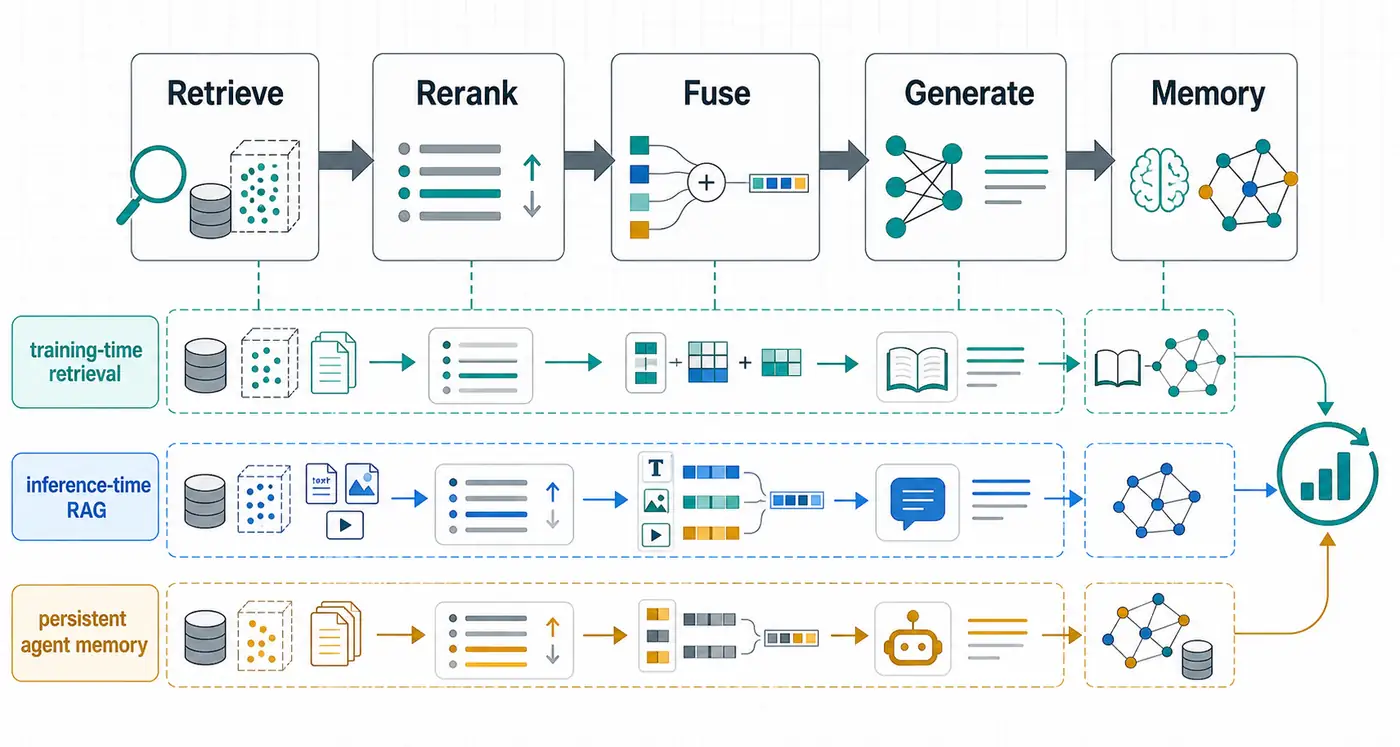
In this direction, you can take notes according to five questions.
When did the retrieval take place. REALM puts retrieval into pre-training; RAG combines parametric memory and dense index in the generation task; RETRO uses a large-scale Token database in autoregressive language modeling; Atlas researches fEW-Shot Updateable indexes in knowledge-intensive tasks. Go to Self-RAG, adapt-rag, and agent RAG, and the retrieval becomes the inference control problem.
What is external memory. In the early work, Wikipedia or web page text is mostly used; subsequent systems are included in tables, images, layouts, multiple rounds of dialogue, graph structure and long-term user memory. Notes are to record Corpus Snapshot, Chunk Granularity, Embedding model, index update method, and Provenance.
How the retrieval result enters the model. Directly splicing top-k password, reranker, Fusion-in-Decoder, cross-attention, graph context, memory hierarchy are different assumptions. This difference is usually more important than "which vector library was used".
Evaluate whether the source of failure can be positioned. RAG errors may come from failing to retrieve, incorrectly sorted, too long for context, generating misreading, JUDGE bias, or data contamination. The common value of MIRAGE, MTRAG, XRAG, T^2-RAGBENCH and LaRA is to make failure more attribution.
Whether the memory has a life cycle. Memory-ugmented models are not just vectorized old chat records. MemGPT and MemOS drive memory management to system problems, so focus on writing, forgetting, conflict resolution, access control, and traceability.
A reading guide to the key papers
| Stage | Representative work | What to look for as you read |
|---|---|---|
| Retrieve augmentation pre-training | REALM, RAG | Whether retriever is trained, how nonparametric memory enters the objective function |
| Large-scale explicit memory | RETRO | Database size, chunked cross-attention, parameters and external data |
| FEW-SHOT Knowledge Intensive Learning | Atlas | Whether the index can be updated, the benefits come from the model, Retriever, or knowledge coverage |
| Adaptive RAG | Self-RAG, CRAG, Adaptive-RAG | When to retrieve, how to determine the quality of evidence, how to correct errors |
| Structured and Multimodal RAG | GRAG, T^2-RAGBench, ACL 2026 survey | How to merge graphs, tables, layouts and multimodal objects |
| RAG vs long context | LaRA | When is the full text better and when is it better to search |
| agentic memory | Generative Agents, MemGPT, MemOS, Agentic RAG SoK | Write, retrieve, reflect, plan and call closed loop |
A closer look at key papers
REALM and RAG. The key to REALM is to get Retriever to get a learning signal during the pre-training stage, and use Masked Language Modeling to drive Latent Knowledge Retriever. RAG combines the pre-trained Seq2seq model with the Wikipedia Dense Vector Index, and proposes sequence-level and token-level format. To read these two articles, write clearly the relationship between Retriever, Latent Documents, Generator and Provenance.
RETRO and Atlas. RETRO uses 2 Trillion Token Retrieval Database in autoregressive language modeling, via Frozen BERT Retriever, Encoder and chunked cross-attention Use neighbor text for prediction. Atlas studies the performance of the Retrieval-Augmented Model in the FEW-SHOT knowledge-intensive task. To read these two articles, it is necessary to distinguish between "architecture-level Retrieval" and "at inference time prompt RAG".
Self-RAG / CRAG / Adaptive-RAG. Self-RAG learns when to retrieve and evaluate evidence through Reflection Tokens; CRAG increases retrieval evaluator, triggering a remediation when the retrieval quality is insufficient; no-retrieval, single-step, or iterative retrieval. The common conclusion is that the more retrieval is not the better.
2025-2026 benchmarks. MTRAG tests questions that depend on earlier turns in a conversation. MIRAGE examines retrieval and generation separately. XRAG assesses the language of the answer and the reasoning in cross-language tasks. T^2-RAGBench focuses on text, tables, and numerical reasoning, while LaRA compares long-context LLMs with RAG. These benchmarks are useful for learning to identify where an error originated.
Memory-Augmented Models. Generative Agents show Memory Stream, Reflection, and Planning; MemGPT compares context management to operating system virtual memory; MemOS upgrades Memory to first-class resources. The question here is no longer just "retrieving what", but "what the system should remember, when to forget, who can read it, and how to be held accountable".
Methods and experiments compared
| method type | Advantage | Risk | Small experiment |
|---|---|---|---|
| Fixed Top-K RAG | simple and controllable | noise pollution generation | Change k, chunk, RERANKER, record Recall and Faithfulness |
| Fusion / cross-attention | Fine-grained fusion evidence | High cost, depend on implementation | Compare Prompt Stitching and Fusion Reader |
| Adaptive RAG | Support complex problem routing | The controller may be misjudged | Construct simple / multi-hop / unanswerable issues |
| Graph / multimodal RAG | Suitable for structural relationships and layouts | Data builds | Use a reference diagram or financial report form to make a hybrid retrieval |
| Memory-augmented agents | Support long-term interaction | Memory pollution and privacy risks | Design multiple rounds of conversations, test writes, recalls, conflicts and forgetting |
How to reproduce the results
It is not recommended to reproduce the full RETRO or large-scale Atlas at first. A better training path is to do a small, diagnostic RAG lab.
- Fixed Corpus: Select 200-1000 paper abstracts, course lectures or public documents, record versions, wash scripts and chunk policies.
- Establish three layers of indicators: Recall@K, MRR for the Recall layer; the Context layer to see valid evidence and noise; the GENERATION layer to check the facts, the accuracy of citations and the recognition of non-responsiveness.
- Do a minimum ablation: compare BM25, Dense Embedding, Hybrid Retrieval, reranker, Query Rewriting, Answer Citation, and attribution to failure cases.
- Add Memory variable: Change the one-time QA to multiple rounds of tasks, compare the window history, Summary Memory, Vector Recall Memory, and explicit Profile Memory.
- Control the baseline of the long context: At least add the baseline of "directly put the full text or long abstract" to avoid exaggerated retrieval benefits.
Common misconceptions
- Treat Retrieval Recall as the final answer quality. The retrieval hit is only a necessary condition, and the model may still ignore or misread the evidence.
- Just tune embedding, not chunk. Boundaries, titles, table transcribing, and metadata filtering are often more critical.
- There are no unanswerable questions. The lack of unanswerable sets encourages model strong answers.
- Write memory to as harmless optimization. Long-term memory introduces privacy, pollution, conflict and outdated issues.
- Use LLM JUDGE to directly replace evidence verification. Judge can assist screening, but cannot replace Retrieval log, original evidence and reproducible experimental scripts.
Research questions for graduate students
- RAG and long-context router. Choose a full-text, search, or mixed policy based on the problem, document length, search Confidence and budget.
- Multiple rounds of RAG query rewrite failure diagnostics. Study how the subsequent rounds inherit entities, constraints, and negative information.
- Text table mix RAG. Check if the system has found the correct table area and can complete numerical reasoning.
- Long-term memory conflict resolution. When the old and new preferences conflict, how the system updates, retains the version and interprets the source.
- RAG safety and memory pollution. Research Poisoning, Prompt Injection documentation, privacy leaks and access controls.
Summary
The main line of Retrieval-Augmented Learning is to expand knowledge from "only memorizes only on parameters" to "retrievable, renewable, manageable, verifiable external memory". Early papers teach us how to access pre-training and generation of retrieval; the latest papers push the problem to multiple rounds, cross-language, multimodal, structured data, agent control and long-term memory governance. To read this route, the key is not to memorize the system name, but to draw the flow of evidence: where the problem comes from, where does the knowledge come from, how to choose the retrieval, how the evidence is integrated, how the error is positioned, and how the memory is updated.
References
Search date: 2026-08-05.
- Kelvin Guu et al. “REALM: Retrieval-Augmented Language Model Pre-Training.” arXiv, 2020. https://arxiv.org/abs/2002.08909
- Patrick Lewis et al. “Retrieval-Augmented Generation for Knowledge-Intensive NLP Tasks.” NeurIPS 2020 / arXiv. https://arxiv.org/abs/2005.11401
- Sebastian Borgeaud et al. “Improving language models by retrieving from trillions of tokens.” arXiv, 2021, revised 2022. https://arxiv.org/abs/2112.04426
- Gautier Izacard et al. “Atlas: Few-shot Learning with Retrieval Augmented Language Models.” arXiv, 2022. https://arxiv.org/abs/2208.03299
- Joon Sung Park et al. “Generative Agents: Interactive Simulacra of Human Behavior.” arXiv, 2023. https://arxiv.org/abs/2304.03442
- Charles Packer et al. “MemGPT: Towards LLMs as Operating Systems.” arXiv, 2023, revised 2024. https://arxiv.org/abs/2310.08560
- Akari Asai et al. “Self-RAG: Learning to Retrieve, Generate, and Critique Through Self-Reflection.” ICLR 2024. https://mlanthology.org/iclr/2024/asai2024iclr-selfrag/
- Shi-Qi Yan et al. “Corrective Retrieval Augmented Generation.” arXiv, 2024, revised 2024. https://arxiv.org/abs/2401.15884
- Soyeong Jeong et al. “Adaptive-RAG: Learning to Adapt Retrieval-Augmented Large Language Models through Question Complexity.” NAACL 2024 / arXiv. https://arxiv.org/abs/2403.14403
- Yuntong Hu et al. “GRAG: Graph Retrieval-Augmented Generation.” arXiv, 2024, revised 2025. https://arxiv.org/abs/2405.16506
- Yannis Katsis et al. “MTRAG: A Multi-Turn Conversational Benchmark for Evaluating Retrieval-Augmented Generation Systems.” arXiv, 2025. https://arxiv.org/abs/2501.03468
- Kuan Li et al. “LaRA: Benchmarking Retrieval-Augmented Generation and Long-Context LLMs.” arXiv, 2025. https://arxiv.org/abs/2502.09977
- Chanhee Park et al. “MIRAGE: A Metric-Intensive Benchmark for Retrieval-Augmented Generation Evaluation.” NAACL Findings 2025 / arXiv. https://arxiv.org/abs/2504.17137
- Yaxiong Wu et al. “From Human Memory to AI Memory: A Survey on Memory Mechanisms in the Era of LLMs.” arXiv, 2025. https://arxiv.org/abs/2504.15965
- Wei Liu et al. “XRAG: Cross-lingual Retrieval-Augmented Generation.” arXiv, 2025. https://arxiv.org/abs/2505.10089
- Zhiyu Li et al. “MemOS: An Operating System for Memory-Augmented Generation (MAG) in Large Language Models.” arXiv, 2025. https://arxiv.org/abs/2505.22101
- Jan Strich et al. “T^2-RAGBench: Text-and-Table Benchmark for Evaluating Retrieval-Augmented Generation.” EACL 2026 / arXiv. https://arxiv.org/abs/2506.12071
- Saroj Mishra et al. “SoK: Agentic Retrieval-Augmented Generation (RAG): Taxonomy, Architectures, Evaluation, and Research Directions.” arXiv, 2026. https://arxiv.org/abs/2603.07379
- Sensen Gao et al. “Scaling Beyond Context: A Survey of Multimodal Retrieval-Augmented Generation for Document Understanding.” ACL 2026. https://aclanthology.org/2026.acl-long.204/
- Balamurugan Palanisamy et al. “Security and Privacy in Retrieval-Augmented Generation.” arXiv, 2026. https://arxiv.org/abs/2606.25533