Date:2026-07-14
Who this is for: Graduate students in machine learning, NLP, program language, and knowledge representation; engineering readers focusing on reliable reasoning and interpretable models
search date:2026-07-14
Abstract
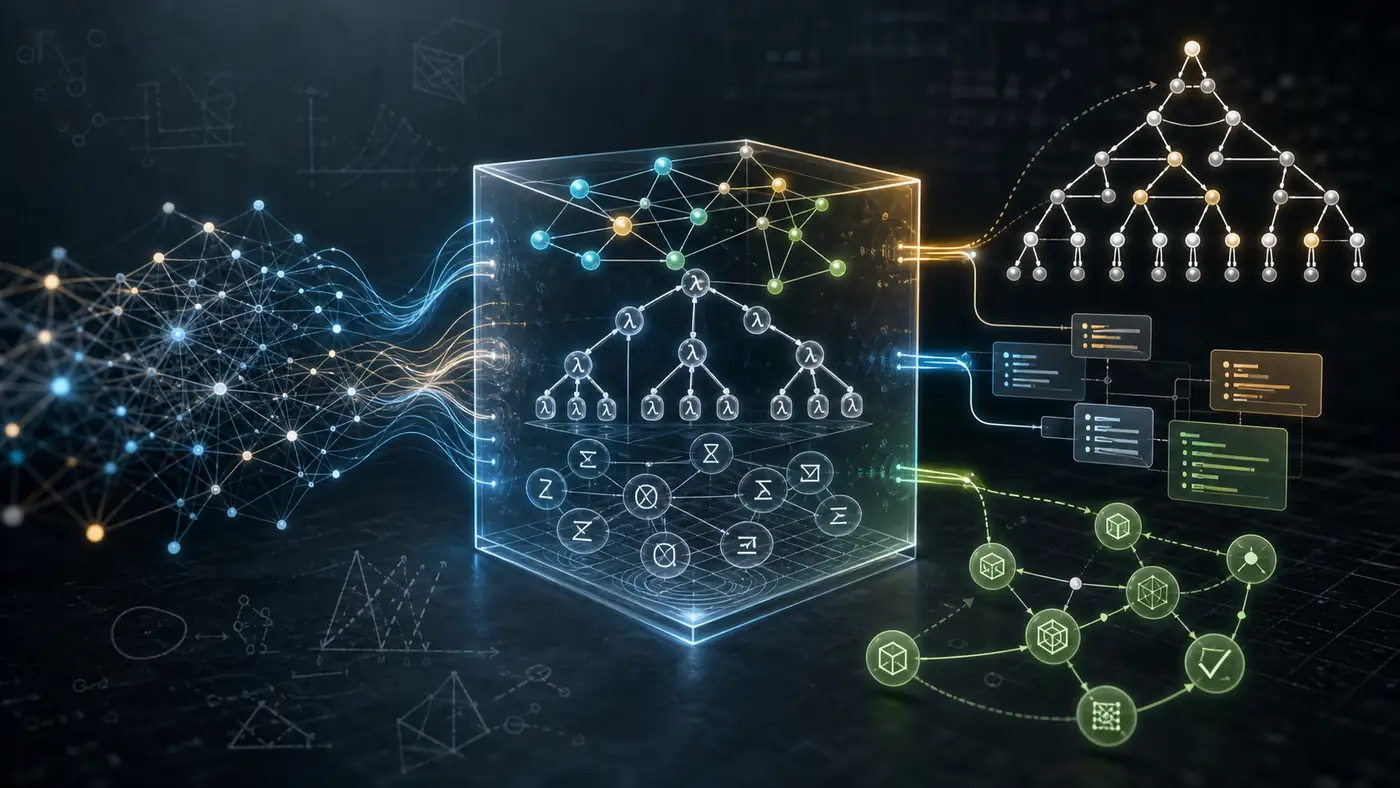
Neuro-Symbolic AI (Neural Symbol AI, hereinafter referred to as NeSy) in 2025-2026 Years have become important again, not because of the slogan of "symbolism revival", but because of the large model reasoning that exposes several very specific problems: natural language chain reasoning is difficult to guarantee intermediate steps Correct; long-chain search is expensive; the model can give a smooth explanation, but it may not be verifiable; the concepts, relationships, and constraints in vision, robot and scientific tasks are difficult to rely solely on Token Statistics is stable and generalized.
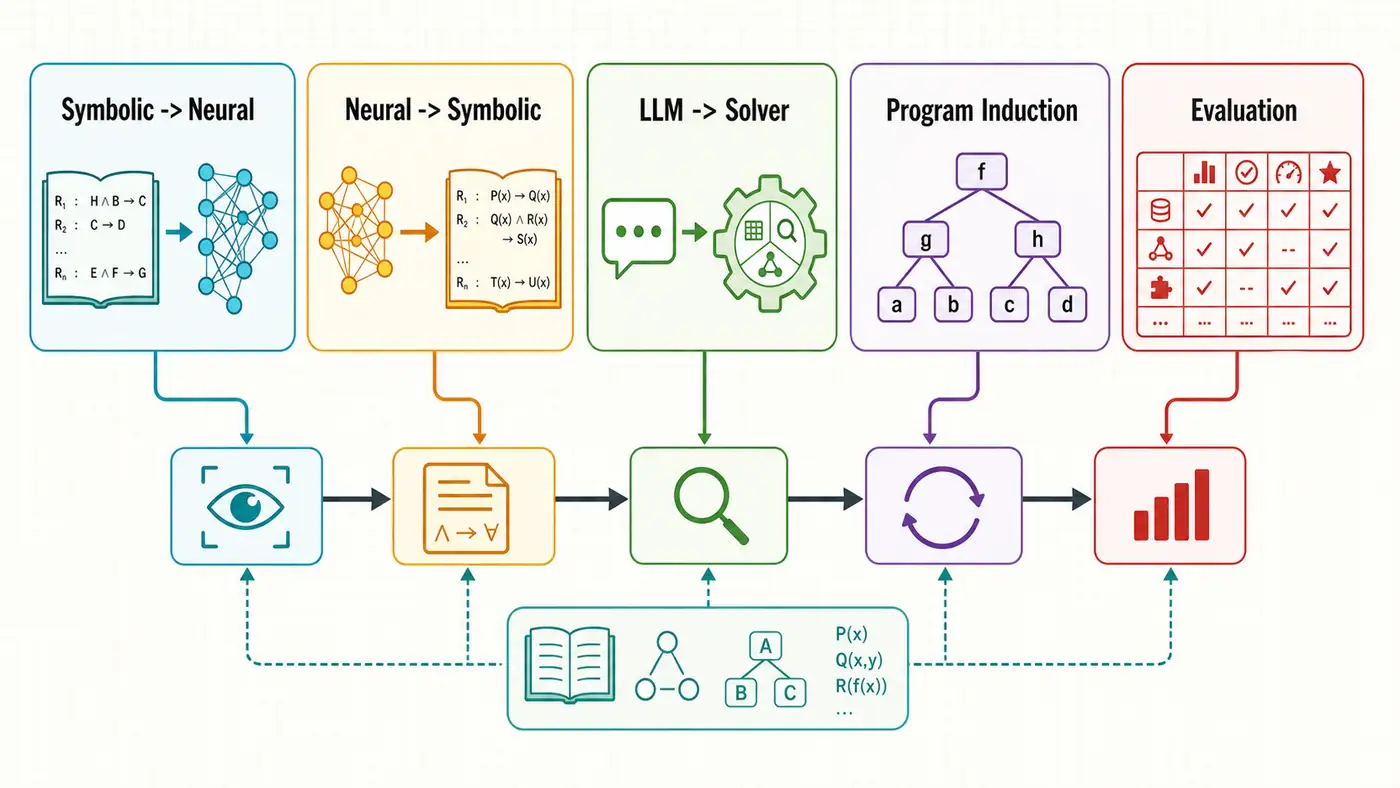
This article splits the NeSy research in recent years into five routes: the symbol system generates data or constrains the neural model; the neural model translates the perceptual input into a symbolic structure; LLM calls SAT/SMT/first-order logic certifiers/planners; program induction and library learning to turn "show questions" into "learn reusable concepts"; and to The evaluation paradigm represented by Benchmark, such as ARC-AGI, FOLIO, ProofWriter, CLEVR, and ConceptARC. The conclusion is first: the most valuable part of NeSy is not to replace LLM, but to split "guessing, formalization, search, verification, feedback" into auditable modules.
Contents
- Research background: Why NeSy is back
- core science questions
- A reading guide to the past year’s papers
- Key papers by research question
- Comparing the methods
- How to interpret the experiments and benchmarks
- Reproducibility and data problems
- Limitations and open questions
- Research questions for graduate students
- Summary
- References
Research background: Why NeSy is back
Traditional symbol AI is good at logic, rule, constraint satisfaction and program search, but is fragile in perceived noise, open world semantics and large-scale data; deep learning is good at learning representations from data, but it is difficult to guarantee combination generalization, prove correctness and interpretable structure. NeSy attempts to put these two abilities into the same system: the neural network is responsible for learning concepts or heuristics from images, languages, and trajectories, and the symbol module is responsible for constraints, searches, proofs, execution and auditing.
The application context of NeSy has changed over the past few years. Early representative work such as DeepProbLog, Logic Tensor Networks, Neuro-Symbolic Concept Learner pay more attention to "micrologic + The unified learning of perception; the current hotspots often revolve around LLM: let LLM translate natural Language problems into first-order Logic, SMT-LIB, PDDL or Python; let the solver return the verifiable result; then feed the error information to the LLM correction formalization process. 2025 review "Neuro-Symbolic Artificial Intelligence: Towards Improving the Reasoning Abilities of Large Language Models" NeSy in the LLM era is summarized into three categories: Symbolic→LLM, LLM→Symbolic, LLM+Symbolic, this division is very suitable for reading papers in recent years.
core science questions
NeSy is not a single model family, but a set of research questions.
First, how is the symbol grounded? If a system recognizes "red squares on the left side of the blue circle" in the image, are these symbols manually labeled, predicted by the neural network, or induced from task supervision? The NS-CL class emphasizes learning objects, attributes and programs from image-question-answers, but the concept boundary in the real open scenario is more vague, and errors will spread along subsequent inferences.
Second, is formalization reliable? The LLM→Solver method usually translates the natural language into logical expressions, and then submits it to Prover9, Z3, SAT/SMT, planner or interpreter. The bottleneck is not in the Solver, but in the autoFormalization: variable binding, quantifier range, negation, exception conditions, units and implicit premise.
Third, can the symbol structure be learned? The program induction line is not only about finding a program, but whether it can compress the abstraction of reusable libraries, concept levels and people can understand. DreamCoder uses the Wake-Sleep loop to learn the domain language; LILO combines LLM-booted program synthesis, STITCH-style symbol compression and automatic documents to try to make the learned library available and readable.
Fourth, how does the evaluation establish that a system can reason? Neuro-symbolic AI papers often report results on FOLIO, ProofWriter, PrOntoQA, CLEVR, ARC, ConceptARC, or program synthesis tasks. Look beyond a single accuracy score. Can the symbolic expression be executed? Can a failure be traced to a specific step? Does the system handle combinations outside its training distribution? How much does performance depend on training data leakage or hand-engineered rules?
A reading guide to the past year’s papers
1. NeSy for LLM reasoning. After 2025, a lot of work regards LLM as a semantic parser, policy generator or heuristic search, and gives strict reasoning to external modules. Logic-LM and LINC are early representatives: the former converts natural language logic questions into symbolic forms and calls the solver, and the latter rewrites logical reasoning into first-order logical proof tasks. The 2025 NeSy review further extends this line to data generation, solver calls, program execution, search enhancement, and symbolic feedback.
2. Program induction and library learning. DreamCoder is still the basic paper to understand the direction: it gradually forms abstraction through Program search, library compression and neural guided search. The new meaning of LILO is to introduce LLM to name and write documents for library functions, so that the abstraction of symbol compression is easier to use by subsequent synths. Active Learning for Neurosymbolic Program Synthesis 2025 Then focus on interactive annotation: neural components will be misjudged, so ask users which examples have the most information, and it is necessary to explicitly consider neural errors.
3. Abstract reasoning benchmark. The ARC-AGI-2 and ARC Prize 2025 technical report pushes "each question search, program optimization, feedback loop" to the foreground. ARC-AGI-2 still maintains fewer sample input and output grid tasks, but emphasizes higher-order abstractions. The ARC Prize 2025 technical report released in 2026 shows that the core trend of the 2025 competition is Refinement Loop: Iteratively generates, validates, corrects the program or candidate solution for each task, and does not just rely on one forward reasoning.
4. NeSy Agent of the concept center. In 2025, "Neuro-Symbolic Concepts" proposed the "concept vocabulary" perspective: object, relationship, and action Concepts have both neural representation and symbolic program structure, which can be used in images, videos, and 3D. Combined reuse in scenes and robot tasks. The important line is that it extends NeSy from logical questions to continuous learning and action systems.
Key papers by research question
A. Micrologic and Probability Logic: From DeepProbLog to Scallop
DeepProbLog connects the neural predicate to the probability logic program: the output probability of the perception module such as image recognition, and the logic program is responsible for the combination and query. It is suitable to illustrate the classic advantages of NeSy: the neural network handles uncertain perception, the logic program handles the combination rules, and the training can be carried out based on the final task supervision.
Scallop is more like a declarative language for NeSy. It supports recursion, aggregation, and negation based on the relational data model and Datalog, and uses Provenance semiring for micro-inference. For engineering readers, the significance of scalop is to upgrade "write a bunch of Python Glue code connection models and rules" to "represent a trainable logical structure in language". The difficulty of such systems is compilation and inference efficiency, and how ordinary ML researchers are willing to learn logical languages.
B. LLM + Symbolic Solver: Turn natural language inference into an executable problem
The basic process of Logic-LM is: LLM reads natural language logic questions, generates formal expressions that can be processed by symbol solvers, and then infers by the solver. The paper also adds self-refinement, so that the solver error information can be reversed to help correct formalization. LINC is similar, but emphasizes the first-order logic proofer, treats LLM as a semantic parser, and hands the deductive reasoning to the proofer.
The advantage of this route is clear: the answer is not "the model feels like this", but "available under a certain form system". But it is also easily misread. The solver can only guarantee the reasoning after formalization, and does not guarantee the translation of natural language to logic. A good paper should report a resolution failure rate, semantic equivalent error, solver error type, and manual verification example, not just report final accuracy.
C. Program induction, library learning and abstract compression
Program induction represents the task solution as a program. The program has three advantages over direct predicted answers: executable, combinable, and checkable. DreamCoder's Wake-Sleep mechanism compresses the decommissioned tasks into new library functions, and then uses these library functions to guide future searches; LILO brings LLM into this loop, and uses language to help discover, name and reuse abstractions.
This line is different from "LLM write code". It is concerned with domain language, search space, reusable abstraction and sample efficiency. A NeSy program induction system can learn the composition structure of small DSL in string editing, graphics generation, scene reasoning, and ARC grid task; LLM provides candidate generation, natural language prior and documenting capabilities.
D. ARC and concept generalization: not brushing the list, but looking at the mechanism
The value of the ARC series lies in the small tasks, new rules, and few training examples, forcing the system to do abstract, search and combine. NSA: Neuro-symbolic ARC Challenge uses Transformer to propose search directions, and then use the combination of DSL to find solutions; the 2025 ARC Prize technical report emphasizes The universality of the refinement loop. The "nerve" here is not a universal solver, but pulls the search back from the exponential explosion; the "symbol" is not an artificial rule set, but an executable candidate space.
ConceptARC complements a shortcoming of ARC: it is difficult for the original ARC to judge which concept the model has mastered. ConceptARC organizes tasks according to concept groups to test whether the system really learns the concept of space and semantics, rather than just happening to succeed on some Puzzle.
E. Concept Center and Interpretable Structure
"Neuro-Symbolic Concepts" regards objects, relationships, and actions as Neuro-Symbolic Concepts: they can be grounded by neural networks or combined with symbolic programs. This perspective is critical for robots and embodied agents, as agents need to connect perception, language, action, and long-term concept libraries. It also reminds us that explanability is not just an afterthought of attention HeatMap, but a structure that can be named, combinable, and testable for the model to maintain internal or external maintenance of the model.
Comparing the methods
| Route | what do nerve modules do | What does the symbol module do | Representative work | Main risk |
|---|---|---|---|---|
| Micrologic/Probability Logic | Perception, predicate probability, representation learning | Logic composition, probability reasoning, rule constraints | DeepProbLog, Logic Tensor Networks, Scallop | High inference complexity, regular engineering |
| LLM→Solver | Natural language understanding, formal generation, error correction | SAT/SMT/first-order certificate/planning/execution | Logic-LM, LINC, LLM+P | AutoFormalization error is hidden |
| Symbolic→LLM | Generate proof trajectory, search trajectory, synthetic data | Guaranteed data logic consistency | AlphaGeometry, LoGiPT, DualFormer | Only learn solver Imitation, migration is limited |
| Program induction | Candidate Generation, Heuristic Search, Natural Language Prior | DSL search, library compression, program execution | DreamCoder, LILO, NSA | Insufficient DSL coverage, high search costs |
| Concept Center Agent | Grounding Image/Video/Action Concept | Combination concepts, relationships and action procedures | NS-CL, Neuro-Symbolic Concepts | Open world concept boundary is difficult to define |
How to interpret the experiments and benchmarks
When reading a NeSy paper, it is recommended to ask at least six questions.
First, does the task really need a symbolic structure? NeSy may just add complexity if the BenchMark only measures templated text classification. Tasks for NeSy are usually well-defined rules, can perform intermediate representations, or verifiable constraints.
Second, how to count the formal error? Systems such as Logic-LM and LINC must distinguish semantic parsing errors, syntax errors, solver failures and final answer errors. Just looking at the final Accuracy will mask the real bottleneck.
Third, is the symbol module replaceable? A reliable system should describe the reason for using Z3, Prover9, Fast Downward, Python Interpreter, or custom DSL, and report the external tool version. Otherwise, it is difficult to locate the difference when reproducing the experiment.
Fourth, could data leakage or overfitting explain performance on the benchmark? The ARC Prize 2025 technical report explicitly flags benchmark contamination and constraints on knowledge coverage. When assessing neuro-symbolic AI in the LLM era, check whether the test set is public, whether it appears in the training corpus, and whether repeated attempts are allowed. Each can change the conclusion.
Fifth, do you evaluate the out-of-distribution combination? CLEVR, ConceptARC, ARC, and program synthesis tasks are more suitable for observing combinatorial generalization than ordinary QA, but it also depends on whether the training/test concept is really separated.
Sixth, is the interpretation executable? The interpretable structure is preferably performed, validated or tested against fact. Only natural language interpretation without procedures, proofs, rules or constraints can still be "interpretable illusion".
Reproducibility and data problems
The reproduction difficulty of the NeSy system is usually not in the model weight, but in the entire pipeline. A LLM→Solver system requires prompt, parsing template, Solver version, timeout setting, error retry policy; a program induction system requires DSL definition, search budget, candidate sorting, task generator; a micro-logical system needs Grounding mode, rule library, reasoning approximation and training stability settings.
Therefore, the most trusted papers usually open source three categories: data and task generation scripts; symbol intermediate representation and failure examples; complete evaluation of Harness. Only give natural language prompt or only to the final table, the reproduction value is limited. For the new papers in 2025-2026, if the code repository has not been disclosed or is still changing rapidly, the reference materials in this article are uniformly marked as "subject to the paper/homepage", and the repository status is not written as a stable fact.
Limitations and open questions
The first type of dispute for NeSy is scalability. Symbolic search and logical reasoning often have combined explosions; nerve heuristics can be pruned, but cannot eliminate the worst-case complexity.
The second type of dispute is interface vulnerability. Natural language to logic, image to object, track to action symbols, these boundary modules make mistakes. Modularity makes mistakes easier to locate, and also makes error propagation more obvious.
The third type of dispute is "where do the symbols come from". Artificial DSLs and rules library are interpretable but costly; learning symbolic structures from data is more elegant, but often requires strong inductive bias and complex search.
The fourth category of disputes is the evaluation incentive. ARC, ProofWriter, FOLIO and other tasks have promoted the methodology, but if the research only adjusts the Prompt or DSL around the fixed Benchmark, it will go back to "smart the problem". The truly valuable NeSy should be able to migrate to new concepts, new tools, new constraints, and new environments.
Research questions for graduate students
Error Diagnostic Dataset for Autoformalization: Collect translation errors from natural language to FOL/SMT/PDDL, and convert them into categories according to quantifiers, negatives, references, implied conditions, and units, instead of just giving the final answer.
Solver call with uncertain perception: Pass the Confidence of the visual or sensor output to the constraint solver, and study the formalized interface of the Probabilistic Constraint Solving and LLM.
ARC-style interpretable library learning: Compare the contribution of LLM generation, symbol search, library compression and refinement loop on ConceptARC or self-built small DSL.
Executable Interpretation Evaluation: Ask the model to output an explanation, program or proof, and use the actuator to check whether the interpretation really rolls out the answer.
Symbolic data enhancement in low-resource areas: Use rules, knowledge graphs or simulators to generate small-scale but logically consistent data, and then study whether LLM has learned transferable inferences.
Failed Recovery Strategy for NeSy Pipeline: Compare the cost of Solver Error Feedback, Self-Refinement, Counter-Example Generation, Active Learning, and Human-Machine Interactive Labeling in Real Tasks.
Summary
The new progress of the Neuro-Symbolic AI can be summed up in one sentence: the neural model is responsible for proposing possibilities, the symbol system is responsible for constraints, and the program and certificates are responsible for making the possibilities executable, checkable, and reusable. What is worth noting in 2025-2026 is not "whether NeSy will replace the large model", but whether it can change the large-model reasoning from a smooth text to a verifiable calculation.
For graduate students, the opportunity for this direction is precisely at the interface: how to connect natural language, perceived input, program, logic, search and feedback into a reproducible system. The clearer the interface, the better the failure can be analyzed; the more the failure can be analyzed, the more the research can accumulate.
References
The following links are all searched on 2026-07-14.
- Xiao-Wen Yang et al., Neuro-Symbolic Artificial Intelligence: Towards Improving the Reasoning Abilities of Large Language Models, arXiv, 2025. https://arxiv.org/abs/2508.13678
- LAMDA-NeSy, Awesome-LLM-Reasoning-with-NeSy, GitHub project page. https://github.com/LAMDASZ-ML/Awesome-LLM-Reasoning-with-NeSy
- Robin Manhaeve et al., DeepProbLog: Neural Probabilistic Logic Programming, arXiv, 2018. https://arxiv.org/abs/1805.10872
- Ziyang Li, Jiani Huang, Mayur Naik, Scallop: A Language for Neurosymbolic Programming, arXiv, 2023. https://arxiv.org/abs/2304.04812
- Jiayuan Mao et al., The Neuro-Symbolic Concept Learner: Interpreting Scenes, Words, and Sentences From Natural Supervision, arXiv, 2019. https://arxiv.org/abs/1904.12584
- Jiayuan Mao, Joshua B. Tenenbaum, Jiajun Wu, Neuro-Symbolic Concepts, arXiv, 2025. https://arxiv.org/abs/2505.06191
- Liangming Pan et al., Logic-LM: Empowering Large Language Models with Symbolic Solvers for Faithful Logical Reasoning, arXiv, 2023. https://arxiv.org/abs/2305.12295
- Theo X. Olausson et al., LINC: A Neurosymbolic Approach for Logical Reasoning by Combining Language Models with First-Order Logic Provers, arXiv, 2023. https://arxiv.org/abs/2310.15164
- Kevin Ellis et al., DreamCoder: Growing generalizable, interpretable knowledge with wake-sleep Bayesian program learning, arXiv, 2020. https://arxiv.org/abs/2006.08381
- Gabriel Grand et al., LILO: Learning Interpretable Libraries by Compressing and Documenting Code, arXiv, 2023. https://arxiv.org/abs/2310.19791
- Celeste Barnaby et al., Active Learning for Neurosymbolic Program Synthesis, arXiv, 2025. https://arxiv.org/abs/2508.15750
- Paweł Batorski, Jannik Brinkmann, Paul Swoboda, NSA: Neuro-symbolic ARC Challenge, arXiv, 2025. https://arxiv.org/abs/2501.04424
- François Chollet et al., ARC-AGI-2: A New Challenge for Frontier AI Reasoning Systems, arXiv, 2025. https://arxiv.org/abs/2505.11831
- François Chollet et al., ARC Prize 2025: Technical Report, arXiv, 2026. https://arxiv.org/abs/2601.10904
- Arseny Moskvichev, Victor Vikram Odouard, Melanie Mitchell, The ConceptARC Benchmark: Evaluating Understanding and Generalization in the ARC Domain, arXiv, 2023. https://arxiv.org/abs/2305.07141