Date:2026-07-10
Who this is for: Graduate students, AI4Science researcher, readers of scientific computing and experimental automation, technical readers with engineering background
search date:2026-07-10
Abstract
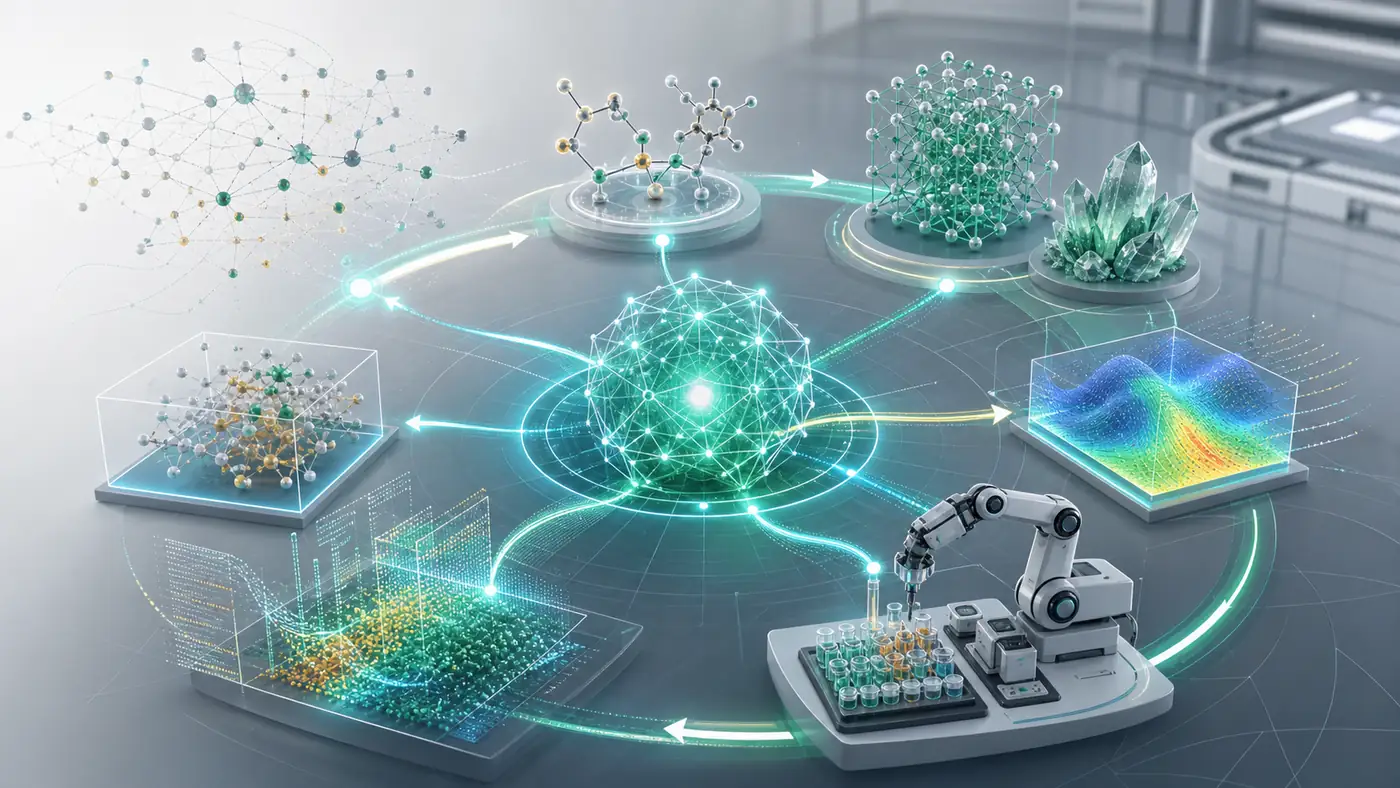
AI for Science is moving from "providing scientists with models and tools" to "participating in The scientific process itself". Basic models such as AlphaFold, GNoME, and AlphagenNome explain that deep learning can form a new prediction layer on high-value issues such as protein structure, material stability, and gene regulation; Coscientist, AI Co-Scientist, Robin, The AI Scientist-v2, AlphaEvolve, AutoLabs and several self-driving labs in 2026 The preprint will push The question to another level: Can AI put forward hypotheses, design experiments, call simulation or instruments, analyze The results, and then feed back The evidence to The next round of search?
The core judgment of this article is that the frontier of AI for Science is no longer just "model precision", but the closed-loop ability of scientific workflows. What is really difficult includes assuming whether it is novel and falsifying, whether the experiment is executable, whether the data and code can be reproduced, whether the automatic evaluation is reliable, whether the failed experiment is recorded, and how human experts can access the system within the safe boundary.
Contents
- Research background: From scientific prediction model to research closed loop
- Core Science Question: What Does AI Do in the Scientific Process
- A reading guide to the past year’s papers
- Key papers by research question
- Comparing the methods
- How to interpret the experiments and benchmarks
- Reproducibility and data problems
- Limitations and open questions
- Research questions for graduate students
- Summary
- References
Research background: From scientific prediction model to research closed loop
The most successful paradigm of AI for Science in the past decade has been "replacing or accelerating an expensive link in scientific processes with machine learning." In the protein structure prediction, the AlphaFold series pushes the prediction of amino acid sequences to three-dimensional structures to the level that is close to the experimental availability; in materials Science, GNoME uses graph neural networks and DFTs. Verify the expansion of candidate crystal spaces; in genomics, AlphaGenome maps long DNA sequences to a variety of regulatory attributes and mutant effects. These work are important, but they are still in a part of the scientific process: predictive structure, screening candidates, interpreting variants or optimizing algorithms.
Between 2024 and 2026, researchers began combining LLMs, tool calls, multiple agents, automated laboratories, and scientific foundation models into more complete workflows. Beyond predicting a molecule’s structure, these systems now attempt to propose the next hypothesis, choose an experiment and its success criteria, and revise the plan if the experiment fails. AI for Science thus becomes a systems problem spanning knowledge retrieval, causal explanation, experimental design, control of execution, data governance, and collaboration between people and machines.
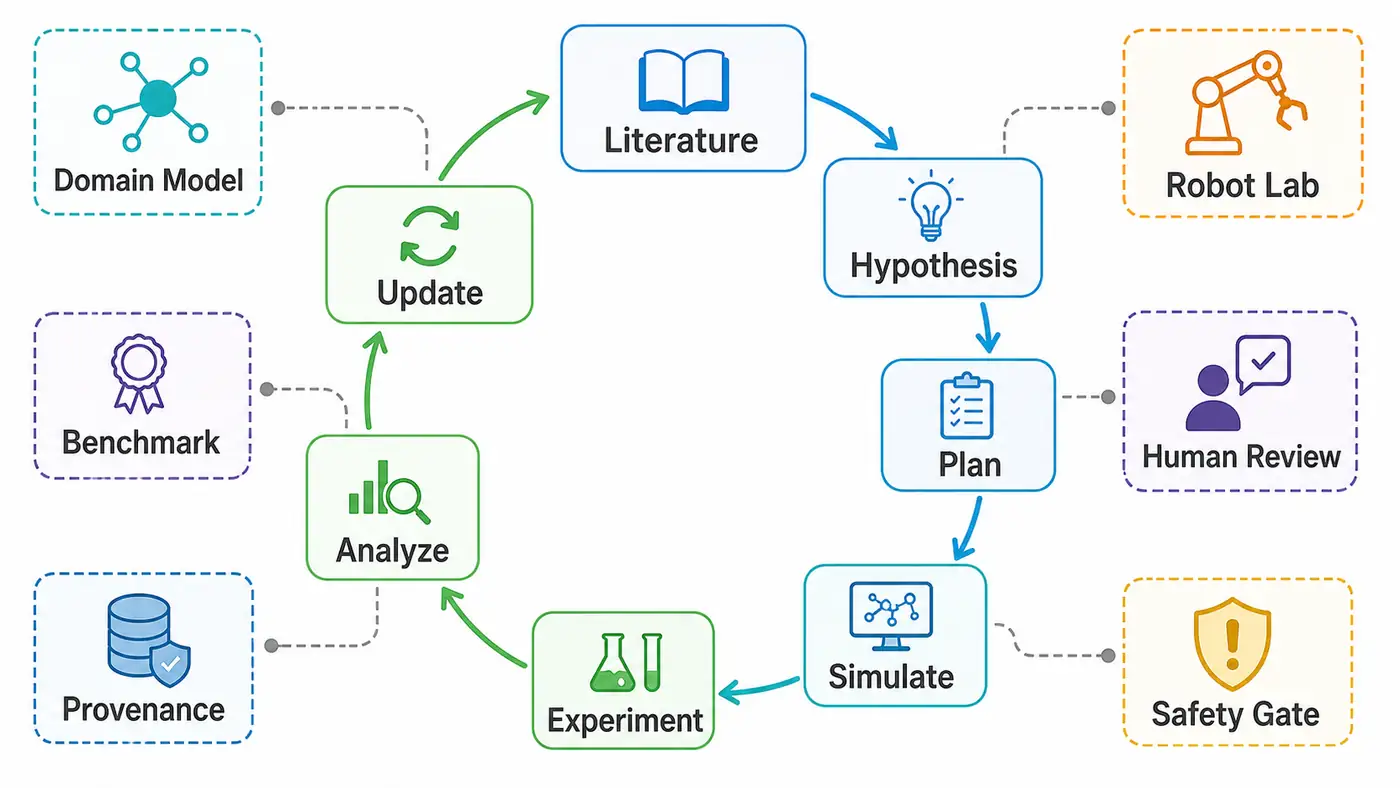
It is necessary to draw a clear boundary first: the "closed loop" discussed in this article does not mean that there is a completely unmanned scientist. Most systems still have strong artificial boundaries, such as human definition goals, reviewing hypotheses, providing wet experiment resources, approving dangerous operations, and interpreting abnormal results. More precisely, AI is undertaking more and more formal, executable and evaluable sub-processes.
Core Science Question: What Does AI Do in the Scientific Process
The research questions of AI for Science can be split into six layers.
The first floor is scientific representation: How are proteins, materials, genomes, cell images, physical fields, and experimental spectra coded? This corresponds to AlphaFold, GNoME, AlphaGenome, Neural Operator, Diffusion Generation Model, and multimodal scientific model.
The second floor is synthesis of knowledge: Can the system extract available facts from papers, databases, patents, experimental records and negative results? This is not a common RAG because scientific knowledge has units, conditions, dosages, instrument parameters, statistical significance and counterexamples.
The third layer is Hypothesis generation: What AI generates is not a "sounding sound" text, but a Research hypothesis that can be tested, falsified, mechanistically interpreted, and can be distinguished from existing evidence. Google Research's AI Co-Scientist, FutureHouse's Robin, and Sakana AI's The AI Scientist series are all exerted on this layer.
The fourth floor is Experimental design and execution: From natural language goals to experimental Protocol, simulation script, robot API, cloud lab instruction or high-throughput screening scheme. Coscientist, ChemCrow, AutoLabs, and Self-Driving Labs fall into this category.
The fifth floor is Result explanation and update: The experimental data cannot be summed up as "success/failure" only by the model. The closed-loop system needs to convert the spectrum, images, RNA-seq, performance curves and negative results into the next round of decisions.
The sixth floor is Evaluation and Governance: Scientific tasks often have no short-term standard answers. The system must state the source of evidence, experimental conditions, failure paths, potential pollution, human intervention points and safety boundaries.
A reading guide to the past year’s papers
One of The main lines of 2025 is "Scientific Research Agentization". Google Research releases AI co-scientist, put Gemini 2.0, multi-agent, generate-debate-evolution and test-time compute Combined, it is used for biomedical tasks such as drug reuse, liver fibrosis target and antimicrobial resistance mechanism. FutureHouse's Robin strings together The document Agent and The data analysis Agent, proposes a therapeutic strategy for dry age-related macular degeneration, and validates candidate drugs in The Lab-in-the-Loop framework. The AI Scientist-v2 of Sakana AI further turns The idea generation, experiment, writing and automatic review in ML Research into an end-to-end tree search system, and claims that there are AI generation papers through ICLR Workshop Review; this is marked, but quality, review standards and reproducibility should still be viewed with caution.
The second main line is "Validious Discovery". AlphaEvolve uses LLM to generate and modify code, and then filter candidate programs by the automatic evaluator, which is suitable for scientific issues that can be clearly scored such as mathematics, algorithms and computing infrastructure. It is closer to the closed loop of scientific research than ordinary scientific research chat assistants, because each candidate solution must run, score, enter the evolution database, and then affect the next round of search.
The third main line is "automatic laboratory". Coscientist has demonstrated GPT-4-driven chemical experiment planning and liquid processor control as early as 2023; AutoLabs, A-Lab GPS, SARA-H, AHOIS in 2025-2026 The work continues to combine LLM, multi-agent, self-correction, active learning and robot experiments. The new signal here is not that robots can do experiments, but the system begins to incorporate "abnormal observation, failure samples, expert feedback, Agent measurement and intermediate observation" into decision-making.
The fourth main line is "the evaluation system keeps up". PaperBench, MLE-bench, MLRC-Bench, FML-bench, ScienceAgentBench, AInsteinBench, etc. Benchmark Attempts to evaluate paper reproduction, machine learning engineering, research competition, basic ML research exploration, scientific data analysis and scientific code repository tasks. Together they illustrate the fact that without executable tasks, expert Rubric and fresh data, the ability of a scientific research Agent can easily be overestimated by LLM-as-a-judge or Pretty Report.
Key papers by research question
1. Scientific Basic Model: Turning Natural Objects into Computable Characteristics
AlphaFold 3 extends structural prediction of the interaction between protein, DNA, RNA, small molecule ligands, ions and modifications; Sequence, output a variety of molecular attributes and mutant effect predictions; GNoME uses graph networks and active learning to expand material candidate space, and hand over stable material candidates to open databases such as Materials Project.
The common value of these models is to provide a "callable predictor" to the scientific process. But they are not the same as closed-loop discovery. The prediction results also need to be experimentally verified, error analysis, application domain judgment and downstream objective function design. Taking the material discovery as an example, the thermodynamic stability is not equal to synthesis, processing, and scale, nor does it have all the properties required for the target application.
2. Research Agent: From a Literature Review to Hypothesis Competition
The key to AI CO-Scientist is not to "help to look up the paper", but to break the scientific method into several roles: generation, reflection, sorting, evolution, proximity check and meta-review. The system drives hypothesis iterations with Tournament and Elo automatic evaluations and allows scientists to provide SEED Idea or natural language feedback. Both the official blog and the arXiv paper emphasize that it is a collaborative tool rather than an alternative scientist.
Robin is characterized by a closer cycle of biomedical discovery: literature search, hypothesis generation, experimental recommendations, data analysis, and new hypothetical updates are integrated into a multi-agent process. Its strength is to incorporate the results of wet experiments into the next round of reasoning; the need to be cautious is that the success of a single disease case cannot be directly extrapolated to all biomedical problems.
The AI Scientist-v2 represents The radical route of "AI Research Automation". For machine learning research, it allows The system to automatically propose methods, code, run experiments, draw pictures, write papers, and respond to review feedback. Independent evaluations have pointed out that there are problems such as novel misjudgment, experimental failure, insufficient reference and hallucination figures in earlier versions. Therefore, what is worth studying this line is not "whether AI can write papers", but how to design a rigorous novelty check, experimental Oracle, review protocol and failure tracking.
3. The verifiable algorithm finds that when a scientific problem has a clear evaluator
AlphaEvolve, FunSearch, AlphaDev, and AlphaTensor belong to the easier and closed-loop scientific discovery routes: the candidate solution can be written as a program, the program can be run, and the results can be automatically evaluated. The official data of AlphaEvolve shows that it combines the Gemini model, program database, prompt sampling and evolution selection, and uses the automatic evaluator to verify the candidate algorithm.
The important inspiration of this type of system is that the first reliable breakthrough scenarios of scientific research agents are often not the most open hypothesis spaces, but there are clear Objectives, executable validators and a lot of cheap trial and error. Mathematical structure, algorithm optimization, compiler optimization, scientific calculation of Kernel, simulator parameter search, may mature earlier than "generalized to all scientific assumptions".
4. Automatic Lab: Connect AI decisions to instruments and samples
Coscientist shows how LLMs call network search, document retrieval, code execution and experiment automation APIs to complete the design of synthesis planning, liquid processor control and cross-conjugation reactions. ChemCrow connects chemical tools to LLM, emphasizing the combination of molecular properties, reaction planning and external tools.
Self-driving laboratories have traditionally used active learning or Bayesian optimization to select the next batch of experiments expected to yield the most information. Work in 2025–2026 explores more complex multi-stage decisions and LLM reasoning. A-Lab GPSS studies air-sensitive lithium halide spinel conductors. SARA-H combines automatic phase identification with human feedback. AutoLabs evaluates multi-agent self-correction in generating experimental protocols, while AHOIS uses a physics critic that asks Socratic questions to revise hypotheses. Specific figures and conclusions from these preprints still need verification before publication. The direction is clear, however: these systems are beginning to explain anomalies, propose mechanisms, and adjust procedures as well as optimize black-box functions.
Comparing the methods
| Route | Representative work | core ability | suitable for tasks | Main risk |
|---|---|---|---|---|
| scientific base model | AlphaFold 3、AlphaGenome、GNoME | From scientific objects to predictive representations | Structure, material, gene regulation, physical prediction | Applicable domains, experimental verification, data deviation |
| Hypothesis generates Agent | AI co-scientist、Robin | Literature synthesis, hypothesis generation, sorting and updating | Biomedical targets, drug reuse, mechanism explanation | hallucinations, novelty misjudgment, weak evidence chain |
| Automatic research pipeline | The AI Scientist-v2 | Idea, experiment, writing, review closed loop | Prototype of Machine Learning Research | The quality, citation and results of the paper are reproducible |
| verifiable algorithm discovery | AlphaEvolve、FunSearch | Generate a program and filter with an evaluator | Mathematics, Algorithms, Scientific Computation Optimization | The objective function is too narrow, overfitting evaluator |
| Self-driving laboratory | Coscientist、AutoLabs、A-Lab GPSS、SARA-H | Protocol generation, robot execution, active learning | Chemistry, Materials, High-Throughput Experiments | Instrument safety, sample pollution, data quality |
| scientific research evaluation | PaperBench、MLE-bench、MLRC-Bench、ScienceAgentBench | Measuring Capabilities with Executable Tasks and Rubric | Paper reproduction, ML engineering, scientific data analysis | Evaluation of pollution, high cost and incomplete coverage |
How to interpret the experiments and benchmarks
When reading an AI for Science paper, don't just look at the headline. At least six questions to ask.
first, Does the task have real scientific value?? Success on Kaggle, synthetic benchmark, or toy lab does not mean that new scientific discoveries can be published. On the contrary, real scientific research tasks are usually vague, expensive in experiments, many negative results, and slow evaluation.
second, Whether the evaluator is independent and reliable? The reason why systems such as AlphaEvolve are convincing is that the candidate programs can be run and verified automatically. Open hypotheses are more difficult to generate, because LLM self-assessment, Elo ranking or AI Reviewer may reward fluency and common sense consistency, rather than scientific novelty.
third, Is there a human expert baseline?? The value of PaperBench and MLRC-Bench is to dismantle the task into a evaluable molecular goal, and try to introduce human experts or competition results as a reference. "AI Discovery" without baseline is easily overrated.
fourth, Is the failure sample public?? The most valuable data in closed-loop scientific research are often failed experiments, false assumptions and negated routes. If the paper only shows a successful case, it is difficult to judge whether the system can really reason scientifically.
Fifth, Is the data possible to leak? Literature, code, benchmark, competition list and experimental protocol are all possible to enter the model training set . The closer you get to the public paper reproduction and known competitions, the more fresh tasks and decontamination designs are needed.
Sixth, Whether the experimental resources can be reproduced? Wet experiments depend on instruments, reagent batches, environmental controls and operating details; computational experiments rely on random seeds, GPUs, dependencies and hidden Prompts. Without a complete Provenance, closed loops are difficult to independently verify.
Reproducibility and data problems
AI for Science is more afraid of "looks reasonable" than ordinary LLM applications. If the scientific output cannot be reproduced, the cost is not a decline in user experience, but a waste of experimental resources, and even misleads follow-up research. A reliable system holds at least four types of records: input knowledge sources, models and Prompt versions, experimental or simulation execution logs, and all success and failure results.
The GNoME/A-Lab dispute in materials science reminds us that the bottleneck of the automation system is often not generating candidates, but whether the candidates are really new structures, whether they are correctly characterized, and whether there is sufficient evidence to support "successful synthesis". The reuse of drugs in biomedicine is also similar: positive cell experiments are only early signals, which does not mean that mechanism confirmation, animal experiments are effective or clinically feasible.
Therefore, the data infrastructure of AI for Science will be as important as the model in the future. Negative result databases, experimental protocol standards, machine-readable papers, sample metadata, instrument logs, executable notebooks, code containers, and open benchmark will determine whether a closed-loop system can really learn.
Limitations and open questions
First, automatic hypothesis is easy to generate "reasonable but mediocre" ideas. Many systems are good at combining public literature, but truly novel scientific problems often come from abnormal phenomena, implicit experimental experience and long-term domain intuition.
Second, the automatic evaluation may reward the wrong target. A suppose a high score in the LLM review does not mean that it is verifiable; a program performs well on Benchmark, or it may just be overfitting the evaluator.
Third, experimental automation brings security boundaries. Chemical, biological, and material experiments involve hazardous reagents, pollution, dual-purpose knowledge and expensive equipment. Agents cannot directly have unlimited instrument permissions, they must have safety gate, permission layering, and manual approval.
Fourth, interdisciplinary cooperation is still a bottleneck. AI researchers often underestimate experimental errors, sample preparation and data labeling costs; domain scientists may also underestimate model application domains and assessment of pollution. Really available systems require common definitions of Objective and Failure Mode on both sides.
Fifth, the new preprints change rapidly in 2026. The AutoScientists, AHOIS, A-Lab GPSS, etc. included in this article should be considered trend signals, and figures involving Benchmark scores, experimental scale and system capabilities require manual review before official release.
Research questions for graduate students
- Novelty Check of Scientific Assumptions: Combined with literature maps, knowledge graphs, time segmentation databases and expert annotations, evaluate whether a hypothesis is just a recap of old knowledge.
- Negative Results-Driven Research Agents: Let the failed experiment enter memory and planning, instead of just keeping the success trajectory.
- Scientific Protocol to executable code: For a certain type of instrument or simulation software, build a verifiable natural language to the Protocol compiler.
- Provenance standard for experimental closed loops: Design machine-readable audit logs for hypotheses, experiments, data, and charts generated by the Agent.
- Cross-modal scientific data evaluation: Put spectra, micrographs, tables, code and text in the same task to avoid only evaluating pure text Q&A.
- LLM and Bayesian Optimization Fusion: Let LLM be responsible for mechanism interpretation, constraint generation and abnormal diagnosis, and make BO responsible for efficient data search.
- Calibration of AI Reviewer: to study when the automatic review system is consistent with human experts, and when to prefer a fluent narrative rather than a real contribution.
Summary
The third stage of AI for Science is taking shape: the first stage is a scientific prediction model, the second stage is a scientific research assistant and tool enhancement, and the third stage is a closed-loop system that can cycle through "read literature, make assumptions, do experiments, look at results, and update" within a controlled range. In the short term, the most reliable breakthroughs will appear in areas with clear evaluators, automation of experiments, and failure to record failures, such as algorithm discovery, scientific computing optimization, high-throughput material screening and specific biomedical hypothesis verification.
In the long run, the value of scientific research agents is not to write more papers, but to make scientific exploration more auditable, more efficient, and more able to accumulate failure experience. What is really worth looking forward to is not the myth of unmanned scientists, but that human scientists and AI systems together maintain a verifiable, reproducible and sustainable discovery cycle.
References
Search date: 2026-07-10.
- Hengjie Yu, Yaochu Jin, “AI for Science: Current progress and pathways forward.” arXiv, 2025. https://arxiv.org/abs/2503.05822
- Jiaqi Wei et al., “From AI for Science to Agentic Science: A Survey on Autonomous Scientific Discovery.” arXiv, 2025. https://arxiv.org/abs/2508.14111
- Fan Liu et al., “Foundation Models for Scientific Discovery: From Paradigm Enhancement to Paradigm Transition.” arXiv, 2025. https://arxiv.org/abs/2510.15280
- Josh Abramson et al., “Accurate structure prediction of biomolecular interactions with AlphaFold 3.” Nature, 2024. https://www.nature.com/articles/s41586-024-07487-w
- Google DeepMind, “AlphaGenome: AI for better understanding the genome.” 2025-06-25, updated 2026-01. https://deepmind.google/blog/alphagenome-ai-for-better-understanding-the-genome/
- Amil Merchant et al., “Scaling deep learning for materials discovery.” Nature, 2023. https://www.nature.com/articles/s41586-023-06735-9
- Google DeepMind, “Millions of new materials discovered with deep learning.” 2023-11-29. https://deepmind.google/blog/millions-of-new-materials-discovered-with-deep-learning/
- Daniil A. Boiko et al., “Autonomous chemical research with large language models.” Nature, 2023. https://www.nature.com/articles/s41586-023-06792-0
- Andres M. Bran et al., “ChemCrow: Augmenting large-language models with chemistry tools.” arXiv, 2023. https://arxiv.org/abs/2304.05376
- Juraj Gottweis et al., “Towards an AI co-scientist.” arXiv, 2025. https://arxiv.org/abs/2502.18864
- Google Research, “Accelerating scientific breakthroughs with an AI co-scientist.” 2025-02-19. https://research.google/blog/accelerating-scientific-breakthroughs-with-an-ai-co-scientist/
- Ali Essam Ghareeb et al., “Robin: A multi-agent system for automating scientific discovery.” arXiv, 2025. https://arxiv.org/abs/2505.13400
- Chris Lu et al., “The AI Scientist: Towards Fully Automated Open-Ended Scientific Discovery.” arXiv, 2024. https://arxiv.org/abs/2408.06292
- Yutaro Yamada et al., “The AI Scientist-v2: Workshop-Level Automated Scientific Discovery via Agentic Tree Search.” arXiv, 2025. https://arxiv.org/abs/2504.08066
- Sakana AI, “The AI Scientist: Towards Fully Automated Open-Ended Scientific Discovery.” 2024-08-13. https://sakana.ai/ai-scientist/
- Joeran Beel, Min-Yen Kan, Moritz Baumgart, “Evaluating Sakana's AI Scientist for Autonomous Research.” arXiv, 2025. https://arxiv.org/abs/2502.14297
- Alexander Novikov et al., “AlphaEvolve: A coding agent for scientific and algorithmic discovery.” arXiv, 2025. https://arxiv.org/abs/2506.13131
- Google DeepMind, “AlphaEvolve: A Gemini-powered coding agent for designing advanced algorithms.” 2025-05-14. https://deepmind.google/blog/alphaevolve-a-gemini-powered-coding-agent-for-designing-advanced-algorithms/
- Nathan J. Szymanski et al., “An autonomous laboratory for the accelerated synthesis of inorganic materials.” Nature, 2023. https://www.nature.com/articles/s41586-023-06734-w
- Adedire D. Adesiji et al., “Benchmarking Self-Driving Labs.” arXiv, 2025. https://arxiv.org/abs/2508.06642
- Luca Torresi, Pascal Friederich, “Multi-stage Bayesian optimisation for dynamic decision-making in self-driving labs.” arXiv, 2025. https://arxiv.org/abs/2512.15483
- Gihan Panapitiya et al., “AutoLabs: Cognitive Multi-Agent Systems with Self-Correction for Autonomous Chemical Experimentation.” arXiv, 2025. https://arxiv.org/abs/2509.25651
- Yuxing Fei et al., “Agentic LLM Reasoning in a Self-Driving Laboratory for Air-Sensitive Lithium Halide Spinel Conductors.” arXiv, 2026. https://arxiv.org/abs/2604.11957
- Xianrui Zeng et al., “Socratic agents for autonomous scientific discovery in high-dimensional physical systems.” arXiv, 2026. https://arxiv.org/abs/2606.26722
- Giulio Starace et al., “PaperBench: Evaluating AI's Ability to Replicate AI Research.” arXiv, 2025. https://arxiv.org/abs/2504.01848
- Jun Shern Chan et al., “MLE-bench: Evaluating Machine Learning Agents on Machine Learning Engineering.” arXiv, 2024. https://arxiv.org/abs/2410.07095
- Yunxiang Zhang et al., “MLRC-Bench: Can Language Agents Solve Machine Learning Research Challenges?” arXiv, 2025. https://arxiv.org/abs/2504.09702
- Qiran Zou et al., “FML-bench: A Benchmark for Automatic ML Research Agents.” arXiv, 2025. https://arxiv.org/abs/2510.10472
- Titouan Duston et al., “AInsteinBench: Benchmarking Coding Agents on Scientific Repositories.” arXiv, 2025. https://arxiv.org/abs/2512.21373
- Ziru Chen et al., “ScienceAgentBench: Toward Rigorous Assessment of Language Agents for Data-Driven Scientific Discovery.” arXiv, 2024. https://arxiv.org/abs/2410.05080
- Shanghua Gao, Ada Fang, Marinka Zitnik, “AutoScientists: Self-Organizing Agent Teams for Long-Running Scientific Experimentation.” arXiv, 2026. https://arxiv.org/abs/2605.28655