
- Date: 2026-06-27
- Suitable for readers: graduate students, NLP/LLM researchers, engineering team responsible for model evaluation and application quality assurance
- Search date: 2026-06-27
Abstract
LLM-as-a-judge has evolved from the "GPT-4 help score" engineering skills to the core infrastructure in open task evaluation, data production, product regression testing and safety acceptance. Its appeal is straightforward: it is cheaper than manual review, better understands semantics than surface indicators such as BLEU/ROUGE, and can output reasons, error types and structured verdict. But the 2025-2026 research also pushes a question to the front: whether a Judge itself is reliable depends not only on the average correlation between it and human preferences. Position bias, length offset, Rubric option sequence, cross-language degradation, calibration drift, field mismatching, and model self-preference will all make the ranking and product acceptance at the risk of "it seems to have Confidence, the actual direction is wrong".
This paper is based on the basic paradigm of LLM-as-a-judge, the reliability research of the past year, the grouping of representative papers, the comparison of method and the inspiration of engineering implementation. The core conclusion is that the future Judge system will become more and more like an auditable measuring instrument, rather than a single prompt. Reliability comes from a combination of mission contract, Rubric design, sequential replacement, calibration set, statistical inference, Judge Ensemble, human sampling and continuous drift monitoring.
Contents
- Research Background: Why LLM Referees Needed
- Roadmap of the past year: from "correlation" to "reliable measurement"
- Key papers by research question
- Comparing the methods
- Technical trends
- Implications for deployment
- Limitations and open questions
- Questions to watch
- Summary
- References
Research Background: Why LLM Referees Needed
Traditional NLG evaluation has long relied on indicators such as BLEU, ROUGE, METEOR, BERTScore, etc. They are suitable for tasks with reference answers and stable forms, but often cannot express "whether this answer really satisfies the user's intentions" when facing open question and answer, multi-round dialogue, instruction compliance, RAG response quality, safety compliance, code explanation or agent trajectory. Manual review can cover these dimensions, but there are problems of high cost, long cycle, limited labeling consistency, and difficulty in sustaining regression.
G-Eval is an early representative: GPT-4 is used to score abstracts, dialogues and other outputs by task Rubric and natural language standards, emphasizing the correlation with human scores. Subsequently, Zheng et al.'s MT-Bench and Chatbot Arena paper system discussed the feasibility of using LLM to make pairwise judge, and also clearly pointed out that position Risks such as BIAS, Verbosity BIAS, and self-enhancement BIAS. AlpacaEval, Arena-Hard-Auto and other benchmarks further turn LLM Judge into a mainstream ranking component; Prometheus 2, JudgeLM and other work explore open source or specially trained Judge model.
The fundamental change of this route is that Judge is no longer just a "evaluation tool", it will in turn shape model development goals. The team will decide whether to go online model according to the Judge score, choose RAG Reranker, optimize the prompt, adjust the parameters, and even train the Reward Model. Therefore, Judge's error is not ordinary noise, but may become the optimization target itself, triggering the Goodhart effect.
Roadmap of the past year: from "correlation" to "reliable measurement"
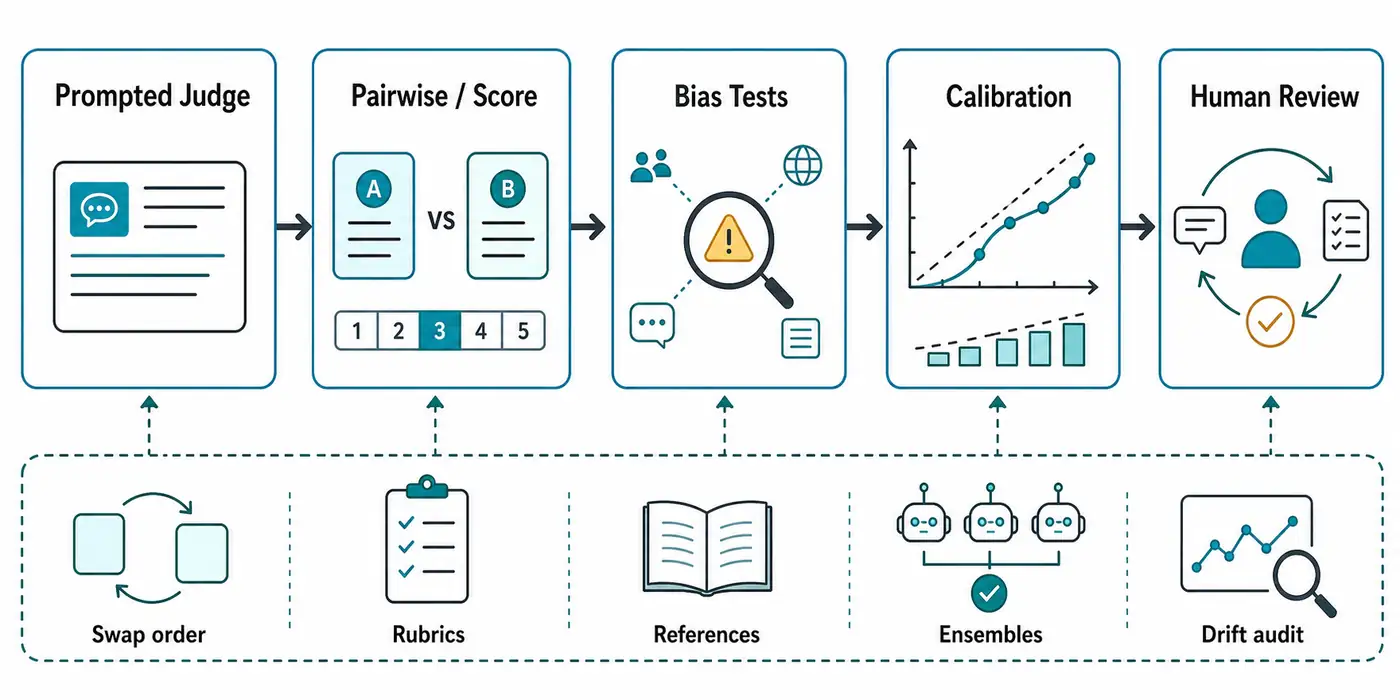
The paper from 2025 to 2026 is generally advanced along five routes:
First, from "human consistency" to "objectively discriminating samples". JudgeBench shifts Judge reviews from general human preferences to Challenging Response in knowledge, reasoning, mathematics and code Pairs, emphasizing that when human preferences themselves cannot be stable to represent the correctness of facts, they need to construct objective labels. Arena-Hard-Auto also turns CrowdSourced data into a harder and more model-based automatic evaluation set.
Second, move from Prompt skills to design selection audits. In 2025, Yamauchi et al. used BIGGENBench and EvalBiasBench to study the impact of evaluation criteria, decoding strategies and CoT on reliability. Judge multi-inference is more important; non-deterministic sampling can sometimes improve alignment with human preferences, but it also brings recurring costs.
Third, from single scoring to bias measurement. OffsetBas/EvalBiasBench summarizes multiple classes of Judge bias and constructs deviation data; BabelJudge in 2026 Further place offset, length offset, sequence inconsistent, and cross-language degradation in the same audit framework, and also extend to Agent Trajectory perturbation.
Fourth, from average points to statistical guarantees. Noisy but Valid studies how to do safety threshold authentication under the conditions of "imperfect judge", estimate the Judge's TPR/FPR through a small number of artificial calibration sets, and then correct the large-scale judge Statistical checks on labels. Bias and Uncertainty in LLM-as-a-judge Estimation discusses the original JUDGE output and shared calibration may cause system deviation in the model comparison, reminding the report Judge Quality and cross-model calibration stability.
Fifth, from general evaluation to domain contract. In 2026, we can see a number of Rubric-Driven Judges for vertical scenarios such as software testing coverage, human-machine collaborative programming, and sustainable travel recommendation. The common feature is to split the "good answer" into an executable evaluation contract: how to judge each dimension, how to verify the output schema, how to retry when it fails, and when the expert's review is required.
Key papers by research question
1. Basic paradigms: Prompt Judge, Pairwise Judge and dedicated Judge
G-Eval demonstrates that strong LLMs can be significantly superior to conventional surface metrics by natural language Criteria scores, but its assessment focus remains on correlation. MT-Bench/Chatbot Arena further makes Pairwise Preference mainstream: give two answers to the same question, let Judge choose the better one, and then summarize the win rate or Elo. The advantage of pairwise is that it is more stable than the absolute score, and the disadvantage is that the position, length, style and candidate distribution will affect the results.
Dedicated Judge models try to reduce costs and increase controllability. Prometheus 2 trains the open source Evaluator, which outputs scoring and feedback under the condition of a given rubric and reference; This type of model is easier to deploy and audit on-premises, but usually needs to continue to upgrade the ability of the evaluated model, otherwise there will be a bottleneck of "weak judges to evaluate strong models".
2. Meta-evaluation: first evaluate Judge, then use Judge to evaluate the model
The importance of JudgeBench is that it treats JUDGE itself as the object to be measured. In the past, the common practice was to ask "Is Judge related to human preferences", but for mathematics, code, and factual reasoning, human preferences may be misled by smooth expression. JudgeBench checks whether Judge can identify truly more correct outputs by constructing an objective and correct answer pair. The paper reports that many strong models are still difficult on this benchmark, which shows that the "strong chat model" does not automatically equal the "strong referee".
The review of LLMs-as-Judges and a survivey on LLM-as-a-judge systemizes the problem: the functional level includes scoring, sorting, feedback, and misclassification; the method level includes prompt, fine-tuning, reference-guided, ensemble; application level covers NLG, information retrieval, education, code, medical, multimodal ; At the level of meta-evaluation, consistency, robustness, fairness and interpretability are concerned.
3. Bias and robustness: position, length, rubric and language are all measured
Early MT-Bench has prompted position bias and verbosity BIAS. Subsequent studies have found that the problem is More detailed: Rubric-based judge looks like a Pointwise, but it may actually be affected by the order of score options like a multiple-choice question. 2026 AM I More Pointwise or Pairwise? shows that the Balanced Permutation is done and aggregated on the Rubric score option, which can reveal and alleviate this hidden position bias.
OffsetBias/EvalBiasBench organizes types of bias into a benchmark for evaluating judges and explores fine-tuning evaluators on debiased preference data. BabelJudge examines reliability across languages. A judge that appears stable can falter on low-resource languages, when the order is swapped, or when an agent’s trajectory is perturbed. Reliability findings cannot simply be carried over between Chinese, English, and low-resource languages. For agent trajectories, the evaluation must also examine more than the final answer.
4. Calibration and Statistics: Use JUDGE as a Noise Meter
"Average accuracy" is not sufficient when JUDGE scores are used for on-line thresholds or safety certifications. The idea of Noisy but Valid is to admit that Judge has errors, use a small amount of artificial labeling to estimate the error rate, and then incorporate this error into the hypothesis test. It's closer to statistical quality control than model rankings.
Bias and uncleanty in LLM-as-a-judge ESTIMMATION further pointed out that the original JUDGE The output is a biased Estimation; that is, using calibration correction, if the same calibration parameter is shared to different model being evaluated, the cross-model calibration is instable, which may reverse the comparison direction. For the product team, this is more critical than simply "Judge agreement = 0.8": the online decision is about who is better, not the average performance of Judge on the historical collection.
5. Vertical Scene: Rubric-Driven Evaluation Contract
In 2026, many scene papers have been engineering Judge systems. The software test covers the evaluation paper with Gherkin Acceptance Tests as an object, focusing on Accuracy, First-Attempt completion, retry cost and JSON structured output. Human-machine collaborative programming paper introduces Schema-Constrained Judge, Validation/Repair, group segmentation prevention leak, Brier Score, ECE, Cohen/Fleiss Agreement and other indicators. Sustainable travel recommendation papers use human experts to calibrate multidimensional Judge, and find that the overall ranking is consistent and does not mean that the interpretation of each dimension is consistent.
These work instructions: Reliable Judge is not a universal Prompt, but a set of evaluation contracts bound to the task. The clearer the contract, the more it will be able to do calibration, random inspection, drift monitoring and responsibility tracking in the future.
Comparing the methods
| way of doing it | Representative work | Advantage | Main risk | Engineering proposal |
|---|---|---|---|---|
| Prompted pointwise scoring | G-Eval, Domain Rubric Judge | Fast, flexible, and can output reasons | Fractional scale drift, Rubric sequential offset, Prompt sensitive | Fixed schema, record the Prompt version, and perform permutation tests on Rubric |
| Pairwise preference | MT-Bench、Chatbot Arena、AlpacaEval | Stable than absolute scores, suitable for open answers | Position offset, length offset, candidate distribution dependence | A/B sequential exchange, reporting the length-controlled indicator |
| Dedicated Judge model | Prometheus 2、JudgeLM | Low cost, can be localized, easy to reproduce | Ability lag, training data deviation | Regularly calibrate with new task manual, not blindly replace Frontier Judge |
| Judge meta-benchmark | JudgeBench、EvalBiasBench、BabelJudge | Directly test JUDGE capabilities and biases | BENCHMARK may still be optimized or invalidated | Incorporate the meta-review into the CI, not just run it once |
| statistical calibration | Noisy but Valid、Bias and Uncertainty | Can give online threshold and Confidence interval | Needs an artificial calibration set, assuming it will be distorted if it is not satisfied | Keep a small and new artificial gold standard set for each mission-critical mission |
| Ensemble / jury | Multiple Judge Voting, Frontier+Compact Jury | Reduce single model bias and accidental errors | Costs rise, and related errors between Judges still exist | Mix different model families, report dissent rate |
Technical trends
First, Judge Prompt will be replaced by the "assessment contract". A mature review contains not only Criteria, but also input fields, Rubric definitions, usage of reference answers, output JSON Schema, invalid output repair strategy, Tie/abstain rules, aggregation formulas, and version numbers.
Second, the reliability indicators are expanded from a single agreement to a set of dashboards. At least it should include human consistency, sequential exchange consistency, length sensitivity, Rubric permutation stability, cross-language/cross field performance, calibration error, inter-judge agreement, invalid output rate, cost and delay.
Third, Judge will emphasize the "rejection of the sentence". Forcing A/B winners to create false certainty when the problem exceeds Judge ability, lack of reference, ineligible candidates, or conflict of evidence. Abstain, Needs Human Review, Insufficient Evidence should become first-class citizens.
Fourth, the boundary between Judge and training closed loop will be more concerned. If the same JUDGE is used for both Leaderboard, data filtering, Reward Model training and online acceptance, the system is easy to overfitting judge. A more secure approach is to differentiate between developing Judges, verifying Judges and Auditing Judges, and keeping blind test sets.
Fifth, the multimodal and Agent trajectories will complicate the problem. Images, videos, tool calls, browsing paths, and code modification tracks are no longer single-segment texts, and Judge needs to judge intermediate steps, evidence chains, and tool side effects. The extension of BabelJudge to the Agent Trajectory Perturbation is an early signal in this direction.
Implications for deployment
Define the failure modes before choosing a judge. A single “overall quality” rating from 1 to 5 tells you little about which requirements were met. For RAG, assess factual support, citation coverage, irrelevant information, and whether a refusal was justified. For a coding assistant, check compilation, tests, edge cases, and the quality of explanations. For customer support, assess policy compliance, tone, and resolution rate.
Every key judge requires a gold label calibration set . The scale does not have to be very large, but it must be fresh, cover the boundary case, and distribute the same as the online traffic. When there is no gold standard set, Judge can only be used as an exploration signal, and it is not suitable for strengthening the online threshold.
Sequential exchange and length control by default. Pairwise Judge runs at least A/B and B/A twice; PointWise Rubric sample at least sample for fractional option replacement; text length should be recorded as a covariate.
Structure the judge output. Requires Verdict, Score, Criterion-Level Reasons, Evidence Spans, Confidence, Abstain Reason, and checkma checks. Inefficient output rate is itself a reliability indicator.
Don't be superstitious about CoT. The past year experience shows that if Criteria is clear, CoT does not necessarily bring significant gains; if Criteria is vague, CoT just writes fuzzy judgments longer. More importantly, the Rubric executable, examples cover boundaries, and the output is verifiable.
Handle high-risk scenarios with Ensemble, but report differences. The unanimity of multiple Judges does not represent the truth, but multiple Judges are valuable. Samples with dissent rate high should go to manual review or error library.
Record the Judge version. Model name, API version, Temperature, Prompt, Rubric, Reference, Schema, parsing code, retry policies and aggregate scripts are all traceable. After the closed source judge update, the representative calibation set should be rerun.
Limitations and open questions
First, the "interpretation" of LLM Judge is not equal to interpretability. It may give a fluent reason, but whether the reason really drives Verdict still needs a counterfactual test. Second, many studies still rely on a small number of tasks, a small number of models or English data, and treat manual verification across fields. Third, open source Judge reduces costs and enhances reproduction, but may not be able to evaluate a model that is stronger than yourself. Fourth, after the automatic Judge is widely used in the leaderboard, the candidate model may be optimized for the Judge style, resulting in an increase in scores and limited real user returns. Fifth, the vertical field, especially medical, legal, financial and security assessments, cannot still use LLM Judge as an expert substitute, but can only be used as a screening, diversion and auxiliary audit tool.
Questions to watch
The first type of problem worthy of attention is the uncertainty expression of Judge: how to make Judge give a calibrated probability, rather than a seemingly definite natural language judgment. The second category is Judge data governance: which samples should enter the Calibration Set, how to prevent leaks, and how to update them regularly. The third category is Agent evaluation: how the final answer, tool call, the chain of evidence and the intermediate state jointly determine the quality. The fourth category is cross-language fairness: whether Judge is still consistent with the judgment of the target user in Chinese, low-resource language and professional term scenarios. The fifth category is regulation and auditing: when JUDGE is involved in high-risk decisions, whether the contract, calibration records and manual review process can be reviewed externally.
Summary
The value of LLM-as-a-judge did not decline due to biased studies; on the contrary, these studies have moved it from a "convenient automatic scoringr" to a "measurement system that requires engineering governance". Available Judges are not equal to reliable Judges, and reliable Judges do not mean that they can completely replace humans. For the researchers, the key to the next stage is not to re-prove that the GPT-4 model can be related to humans, but to explain Judge's conclusion that Judge's conclusion can be trusted under the conditions of what task, what sample, and what calibration. The safest practice for the engineering team is to treat Judge as a quality sensor in the CI: continuous calibration, continuous auditing, allowing denials, and handing high-risk samples back to human experts.
References
Search date: 2026-06-27.
- Yang Liu et al. G-Eval: NLG Evaluation using GPT-4 with Better Human Alignment. arXiv, 2023. https://arxiv.org/abs/2303.16634
- Lianmin Zheng et al. Judging LLM-as-a-Judge with MT-Bench and Chatbot Arena. arXiv, 2023. https://arxiv.org/abs/2306.05685
- Yann Dubois et al. Length-Controlled AlpacaEval: A Simple Way to Debias Automatic Evaluators. arXiv, 2024. https://arxiv.org/abs/2404.04475
- Tianle Li et al. From Crowdsourced Data to High-Quality Benchmarks: Arena-Hard and BenchBuilder Pipeline. arXiv, 2024. https://arxiv.org/abs/2406.11939
- Junsoo Park et al. OffsetBias: Leveraging Debiased Data for Tuning Evaluators. arXiv, 2024. https://arxiv.org/abs/2407.06551
- Sijun Tan et al. JudgeBench: A Benchmark for Evaluating LLM-based Judges. arXiv, 2024. https://arxiv.org/abs/2410.12784
- Jiawei Gu et al. A Survey on LLM-as-a-Judge. arXiv, 2024. https://arxiv.org/abs/2411.15594
- Haitao Li et al. LLMs-as-Judges: A Comprehensive Survey on LLM-based Evaluation Methods. arXiv, 2024. https://arxiv.org/abs/2412.05579
- Yusuke Yamauchi et al. An Empirical Study of LLM-as-a-Judge: How Design Choices Impact Evaluation Reliability. arXiv, 2025. https://arxiv.org/abs/2506.13639
- Chen Feng et al. Noisy but Valid: Robust Statistical Evaluation of LLMs with Imperfect Judges. arXiv, 2026. https://arxiv.org/abs/2601.20913
- Yuzheng Xu et al. Am I More Pointwise or Pairwise? Revealing Position Bias in Rubric-Based LLM-as-a-Judge. arXiv, 2026. https://arxiv.org/abs/2602.02219
- Ashmi Banerjee et al. Multi-Dimensional Evaluation of Sustainable City Trips with LLM-as-a-Judge and Human-in-the-Loop. arXiv, 2026. https://arxiv.org/abs/2604.24158
- Md Faizul Ibne Amin et al. LLM-as-a-Judge for Human-AI Co-Creation: A Reliability-Aware Evaluation Framework for Coding. arXiv, 2026. https://arxiv.org/abs/2604.27727
- James Fiedler. Bias and Uncertainty in LLM-as-a-Judge Estimation. arXiv, 2026. https://arxiv.org/abs/2605.06939
- Shreyas KC. BabelJudge: Measuring LLM-as-a-Judge Reliability Across Languages and Agent Trajectories. arXiv, 2026. https://arxiv.org/abs/2606.22329
- Donghao Huang et al. LLM-as-a-Judge for Scalable Test Coverage Evaluation: Accuracy, Operational Reliability, and Cost. arXiv, 2025. https://arxiv.org/abs/2512.01232
- Seungone Kim et al. Prometheus 2: An Open Source Language Model Specialized in Evaluating Other Language Models. arXiv, 2024. https://arxiv.org/abs/2405.01535
- Prometheus Eval project repository. https://github.com/prometheus-eval/prometheus-eval
- JudgeBench project repository. https://github.com/ScalerLab/JudgeBench
- Awesome LLMs-as-Judges resource list. https://github.com/CSHaitao/Awesome-LLMs-as-Judges
- Shreyas KC. BabelJudge project repository. https://github.com/Shreyaskc/BabelJudge