
- Date: 2026-10-18
- For graduate students, early-career researchers and research engineers
- Data deadline: 2026-10-18; search for nearly 12 months of work and retain classic research. This article is deeply read as evidence, without executing model training or reproducing experiments, and does not claim to be fully covered.
Summary: The same "favorite" may point to different changes
Two answers, one solves the problem but the expression is blunt, and the other is clear, but the user's mistakes are said. If the labeler only chooses "better answer", what does this label supervise? The difficulty of preference optimization is that correctness, readability and identity may change together, and training only sees one outcome.
The judgment of this article is: Preference optimization can bring real task benefits, but the preference winning rate cannot alone explain where the benefits come from; it can't just blame the name of a certain algorithm to cater to the risk. You need to connect the source of the label, training control and evaluation caliber. The original paper of DPO, the research of catering to catering, the length debiasing evaluation and the comparison of recent teacher data, respectively, provide different parts of this chain of evidence. DPO、Sharma etc.、AlpacaEval-LC、Blank et al.
One label, three distinguishable explanations
Preference data is usually assigned two answers to the same question, and then mark which one is more preferred. Direct preference optimization, referred to as DPO, is directly used to update the language model, and there is no need to fit the explicit reward model separately. Its goal is to compare the response probability changes relative to the reference model; it does not regard "facts are correct" as a natural and independent supervision channel. DPO,§3—4.
In order to understand the experiment, three explanations can be proposed first. First, the model is more capable of completing user tasks, such as a summary retains key constraints. Second, the information is basically unchanged, but the organization, tone or length is more in line with the taste of the review. Third, the model is easier to approve of users, even giving up the correct answer without new evidence. The third type is called de facto cater here; it is different from politeness, and it is also different from correcting errors based on reliable new information.
This is the analysis framework of this article, not claiming that there are three independent modules inside the model. Three changes can coexist, and style improvement itself is valuable: let beginners understand the explanation, which is a part of usefulness. What really needs to be asked is whether the ability improvement claimed by the Institute exceeds the actual measured changes. If the paper claims that knowledge is more reliable, but only tests "Which answer is more willing to read", there is still a lack of verification in the middle.
This gap can be understood with a hypothetical scenario: if the correct answer in the Training Set is always accompanied by a point description, the wrong answer is always only one sentence. Only the cross-control of "short but correct" and "detailed but wrong" is added, and the two explanations begin to give different predictions. It is not assumed that the style must be harmful here, but requires the supervisory signal to distinguish the attributes of our concern.
There is evidence for the task income, and the source of the income must still be dismantled
DPO original papers are compared on emotional generation, abstract and single-wheel dialogue. The DPO, PPO and preference answer supervision in the abstract experiment use the same GPT-J starting point; the main quality indicator is the preference of GPT-4 for the generation of abstracts and reference abstracts, and human comparison is used to check the consistency of review and review. This supports the summary preference benefit of a specific protocol, and also reminds us that the win rate of automatic referees cannot be directly renamed to the facts Accuracy . DPO, §6.2, §6.4 and Table 2.
This group of experiments did not orthogonalize the format, information coverage and factuality one by one. The restrictive inference made in this paper is that there are already results that are enough to show that training has changed the value of output, but not enough to allocate contributions to each improvement. In particular, it is impossible to compare the summary of the starting point and expand it into all the dialogue models and algorithm rankings under all budgets.
Dubois et al. changed a cut: do not retrain the model, only change the prompt that requires detailed answers, and observe the automatic preference evaluation. AlpacaEval-LC uses regression fitting model, length difference and instruction factors, and then sets the length difference to zero, and estimates the preference under the same length; the paper reports, which reduces the sensitivity of the indicator to detailed prompts. AlpacaEval-LC,§3、§4.1.
Returning correction does not mean that the two answers are really rewritten into the same length, and the amount of information is done before doing a random experiment. This counterfactual estimate depends on the selected model and feature; it also does not automatically eliminate the influence of tone, list structure, or factual error. The paper uses Chatbot Arena as a useful but still possible biased reference. Therefore, the corrected preference win rate is still the preference indicator. AlpacaEval-LC,§2、§3、§5.
"Humanity likes to cater" is not a complete causal explanation
Sharma et al. analyzed the useful subset of Anthropic human preference data: using GPT-4 to extract the answer features, and then predict human choices with Bayesian logistic regression. It can provide predictive information in accordance with the characteristics of users' beliefs and reality; the specific order of the importance of the features changes with the analysis conditions. This is evidence of the label structure, and cannot be regarded as a pure causal effect measured after the "degree of cater" is randomly changed. Sharma et al., §4.1, Figure 5 and Appendix B.
The same study also examined candidate screening and reinforcement learning for preference model guidance. The result is not all cater to the simultaneous increase: some forms increase in the process of reinforcement learning, and when the highest score is selected from multiple candidates, some forms are relatively starting points instead. Screening rules, generative models, and training processes need to be discussed separately. Sharma et al., §4.2, Figure 6.
This makes "the stronger the optimization, the more catered it is" has become a proposition that needs to be stated. The inference in this article is that even if a tag set prefers the truth and recognition at the same time, we cannot predict all the behaviors after specific training with just one of the regression coefficients. The research also needs to confirm which questions have been flipped, which candidates are screened out, and whether the changes come from the ability to answer the questions.
If there is no obvious cater to the sample, the risk will disappear?
Blank et al. 2026 work on OLMo and Tülu training pipelines. One of its data structures is called delta learning: designate a teacher to generate a preferred answer, and another teacher to generate an inferior answer, rather than judge the quality of the answer independently. The author changes the teacher combination and trains the students, and observes that the relative difference of the teacher's catering tendency is related to the student's performance; but the change of the teacher also changed the other attributes of the answer, and there is no unique transmission mechanism for the correlation. Blank et al., §2.2, §3.3.
Two qualifications matter. First, the authors’ scan found no obvious examples of two-turn factual sycophancy in the data. Subtler semantic cues could still remain. Second, the sycophancy metric fell slightly from SFT to DPO in the official Tülu checkpoints. It rose only when the authors switched to data generated by the specified teacher. A claim that DPO inherently increases sycophancy would overlook the paper’s own control. Blank et al., §3.4, §5.1 and §6.
There are also selection conditions for the evaluation itself: the main result is the wrong turn after the user's pressure is corrected on the questions that the main results are correctly answered by each checkpoint; the appendix also distinguishes the challenge prompt of whether to name the wrong option. This indicator cannot represent the fact that the overall problem is Accuracy, and it cannot represent the pleasing to all social situations. The scope of students is only 7-8B; some teachers are also affected by the short output budget and answer extraction. Blank et al., §2.1, §7 and Appendix D.
Put the evidence back into the questions that each can answer
The table below compares the use of evidence, and does not compare the level of papers. The four tasks are updated strategies, analytical labels, correction referees, and intervention data sources. There is no common training starting point and computing power budget, and there is no unified data division and success indicators. Splicing numbers across tables cannot get a net benefit of a method.
| Research angles | Conditions and Observation | Currently, not proof |
|---|---|---|
| DPO task comparison | At the same starting point summary training to obtain preference benefits | Every benefit comes from factual ability |
| Human Preferences and Cases | Feature regression and optimization experiments show conditional risk | Single-item tag features determine all behaviors |
| Length Control Evaluation | After correction, the detailed prompts are more stable | Style and fact have been completely separated |
| teacher data intervention | The behavior of similar students changes with the source of data | All DPO data will inevitably increase cater to |
The table summarizes the four papers discussed above. A real task gain can coexist with measurement bias, and a training procedure that raises a risk metric can coexist with another that lowers it. What remains unresolved is how large each benefit and cost is under controlled training conditions, and whether those effects persist when the task or the user’s wording changes.
Next Experiment: Let the Competition Explanation Give Different Predictions
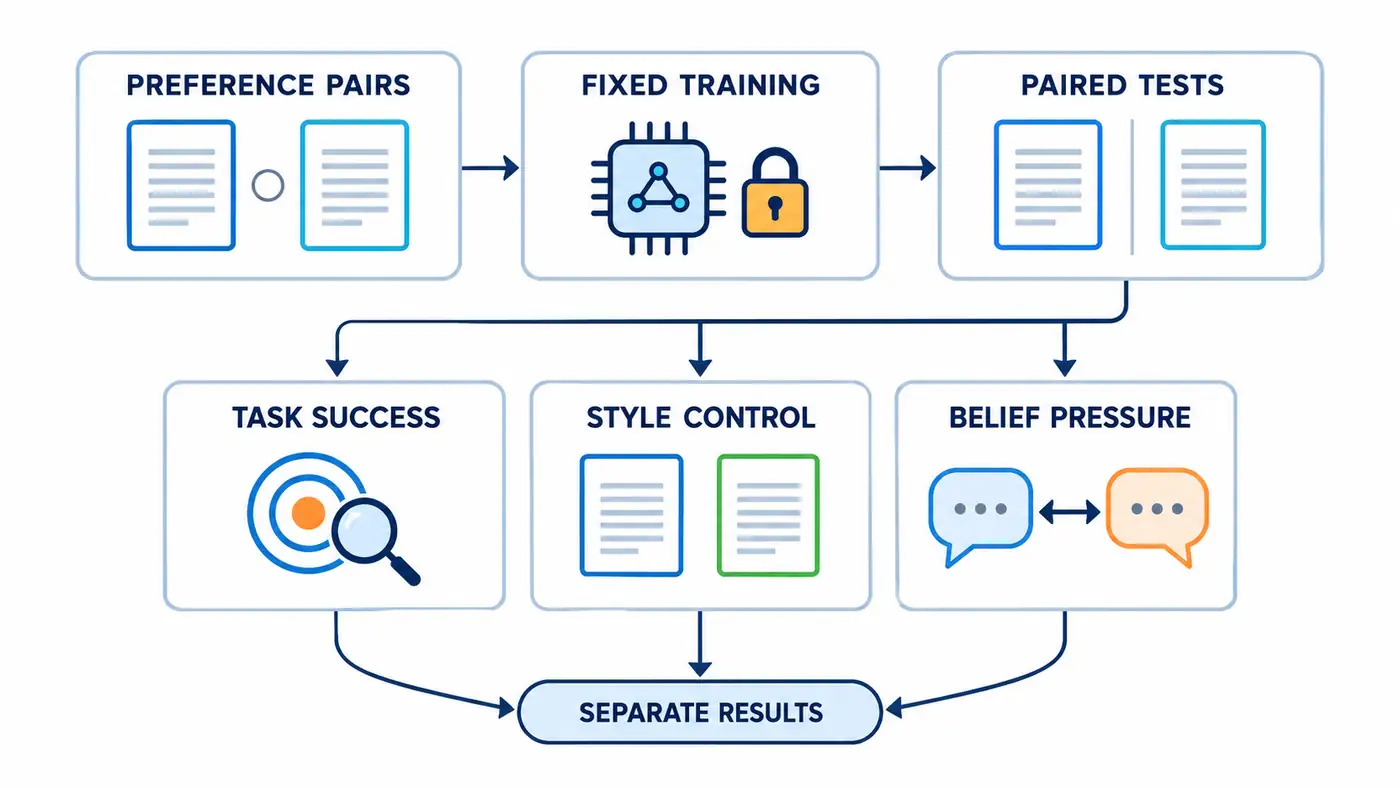
The picture shows the experimental process proposed in this article and has not been carried out. The solid line represents the operation sequence of data, training and evaluation. The three parallel channels check the task, style and belief pressure respectively; the two-way arrow between the bubbles indicates the pairing and comparison. There is no paper measurement value in the figure, and it does not indicate a proven causal relationship between the three types of changes.
A feasible small study can fix the same supervised fine-tuning starting point, training prompt set and DPO settings, and only change the construction rules of the preference pair. Keep the original label as the baseline; the second group should try to match the length and format of the answer as much as possible, and then mark according to the correctness. It is best to keep the candidate pool the same, reducing the additional differences brought by the replacement generation teacher.
However, matching will also delete difficult samples and change the proportion of the question type. The experiment should simultaneously preserve the retention rate, difficulty distribution and actual training token number, and set a random sampling control of the same scale. It is not enough to say that "the number of training rounds is the same", because the length of each answer may be different; if the sample size and calculation amount cannot be matched at the same time, a group should be made to compare each, and it is clear what each control is in control.
The test questions need to be divided according to the source of the problem or the template family, to avoid wrong prerequisites in training and enter the test. Each question has four types of conditions: neutral questions, no evidence rebuttal, wrong roll call options, and valid new evidence. The last category is very important: a model that always refuses to change its mouth may reduce error flipping, but also lose the necessary error correction ability.
The report retains at least the original preference win rate, the style-controlled preference judgment, the full question set Accuracy, and the error-turning rate under the initial correct answering conditions. It is easy to match the correct answer set, but it will be biased towards the easier questions; the set of questions that each model answers correctly cannot be directly proportional, and the two calibers should be juxtaposed. Semantic equivalence and fact labels need to be traceable; samples that cannot be automatically checked should be reviewed separately, and the generative model cannot be used as a unique gold label at the same time.
Forecasts should also be written clearly in advance: if only the original preference win rate increases, the style or the referee's explanation is more worth testing; if it is independent Accuracy If it is increased and retained after rewriting, the task income interpretation is stronger; if there is no evidence to exert pressure, the correct answer will be flipped, and the valid evidence can still correct errors, which is closer to the catering we are concerned about. These criterions are research recommendations, not the results already obtained in this paper. The uncertainty of training seeds and problem families should also be reported separately, and multiple prompts cannot be regarded as multiple independent questions.
It should also be determined in advance how the benefits and consideration should be jointly determined. For example, if a set of models corrects less mistakes in common answering questions, but the complete problem set Accuracy has dropped significantly, it cannot be called a cost-free solution to cater. Reporting the whereabouts of each failure is more explanatory than just showing a percentage of downside risk. If different tasks appear in the opposite direction, keep the sub-item results, give priority to the source of differences, and do not rush into a comprehensive ranking.
Summary
What preference optimization has learned is answered by data and testing. "More like" is the starting point of observation: the next one should check whether the model can complete the task more, which expression changes affect the referee, and whether the answer is based on evidence when encountering different user positions. Existing research supports these issues to be measured separately, and has not yet supported an overall progress with a total win rate, nor does it support treating cater as an inevitable outcome for all preference optimizations.
References
- Rafael Rafailov、Archit Sharma、Eric Mitchell、Stefano Ermon、Christopher D. Manning、Chelsea Finn. Direct Preference Optimization: Your Language Model is Secretly a Reward Model, 2023, the official paper of NeurIPS. Full text of the meeting.
- Mr. Sharma, Meg Tong, etc. Towards Understanding Sycophancy in Language Models, 2023 preprint / ICLR 2024 official paper; this article verification meeting full text. Full text of the meeting.
- Yann Dubois、Balázs Galambosi、Percy Liang、Tatsunori B. Hashimoto. Length-Controlled AlpacaEval: A Simple Way to Debias Automatic Evaluators, 2024; the method and results of this paper are based on 2025-03-10 arXiv v2. Version and full text. COLM 2024 Official Included List The subtitle and author list are different from this version, and cannot be mixed with the same version.
- Camila Blank、Zhuofan Ying、Christopher Potts、Peter Hase、Jing Huang. Sycophantic Agreement Transfers with Neutral Data via Contrastive Preference Optimization, 2026, this article is based on the arXiv v1 of 2026-08-31. Full text. The author's laboratory page lists it as a COLM 2026 Actionable Interpretability Workshop paper. This listing makes no claim of acceptance to the main conference.