
- Date of first draft: 2026-10-16; verification completion date: 2026-10-17
- For graduate students, early-career researchers and research engineers
- Scope: Evidence boundary of reward model, scoring specification and procedural verification; deep reading of the literature, does not include this model training experiment.
Summary: What did the model learn?
The rewards in the training log keep rising, and the most direct explanation is: the model is getting better at getting the high score of this set of rules. To further say that it will solve the problem more and meet the request, there is also a chain of evidence that leads to the independent goal from the training score. The problem is not "reinforced learning is effective or not", but how many explanations can the same rising curve hold.
This paper compares four first-hand studies to distinguish the misjudgment of referees, the omission of targets and the recordable environmental vulnerabilities. They do not form two camps that support and oppose reinforcement learning, but are measuring mismatch at different levels. The current relatively stable conclusion is that reward improvement can be accompanied by real progress, and it can also be entrained with shortcuts; researchers must check which questions and dimensions the progress falls, and whether the verification method is still true.
Three explanations can occur at the same time
Agency Reward It is the score actually optimized during training; target performance It is the task result of the research hope to improve. The reward model is scored by learning, and the validator checks the answer according to the rules or model judgment. Rubric, referred to in this article as the "Scoring Protocol", is to split a good answer into several checklists that can be checked. The list is clearly written, which does not mean that it has covered the full target.
Imagine a question that requires "explain a phenomenon and include a specified word". The model may explain the phenomenon more accurately, or it may only learn to stably insert words, and it may also find that empty short sentences are more likely to meet the format. This example is only a help to distinguish the explanation, not the result of this experiment.
The first explanation is Target Capacity Improvement: The content of the content on the new topic is correct and the constraints are satisfied at the same time. The second is Agency Adaptation: More familiar with the expressions that the referee likes, the score is improved and the task benefits are limited. The third is exploit vulnerabilities: Bypass the work that should be done and score the path that is not covered by the inspector. Reward speculation usually refers to the behavior of the latter two categories that deviates from the expected target, and there is no need to assume that the model has a deceitful intention.
Three cases can be mixed into a checkpoint. Some questions have really learned, some questions rely on format to score points, and there are a few questions that have exploited loopholes. Therefore, "finding a speculative case" cannot erase all benefits; "Average accuracy increase" cannot rule out local degradation. What needs to be explained is the composition of the proceeds, rather than labeling the entire model.
First layer of evidence: Why do independent scores turn around?
Gao, Schulman, and Hilton used a controlled setup in their ICML 2023 paper. A larger reward model served as the reference and generated preference labels for a smaller proxy whose score was then optimized. The authors studied two forms of optimization. Proximal policy optimization (PPO), a reinforcement learning algorithm, updates the policy parameters. Best-of-n sampling selects the highest-scoring answer from several candidates. Figure 2 shows that the reference score can rise and then fall even as optimization of the proxy continues. Original §2, §3 and Figure 2
The key is limited to the word "reference": Gold here is still a model, not a human judgment that is re-collected one by one. The authors make it clear in §4.5 that the mismatch between the label and the real intent is not covered by this set. Therefore, the curve supports the over-optimization in the specific proxy-reference relationship, and cannot be directly read into the law of general ability decline. Original § 4.5
This also explains why it is not necessary to announce speculation immediately when the rewards are seen rising. If the reference score rises simultaneously, there will be at least benefit on the measurement; if the reference is stagnant, it may only bring additional benefits to the subsequent optimization; if the reference decreases, there will be a regression relative to the target. The three observations require different words, and cannot all be crushed into a sentence "model is cheating".
Level 2 Evidence: Refereeing and changing standards are not the same experiment
Mahmoud et al. take Qwen2.5-7B-Instruct as the main starting point, and compare the reference panel of training validators and cross-model families on medical and scientific Q&A. Under the weak validator, the growth of the training score has not been transferred to the reference score; the stronger validator reduces the score of the error, but does not eliminate it. Another control is more critical: the medical checkpoints trained by the strong validator are favored by the specification scoring. When the specification is removed for the overall quality review, the preference turns to the starting point model. Original §2–4.1
The previous comparison checks "whether the same requirement is judged", and the latter check "whether these requirements represent complete quality". However, the overall review still comes from the model and cannot be automatically upgraded to a human gold standard. The paper also admits that there are no multiple training seeds per configuration; the interval for self-service resampling of the evaluation questions does not include training randomness. The analysis of the contract structure and lengthy answers is relevant evidence, and the unique causal mechanism has not been isolated. Original §7
Thus, two different remediation predictions can be proposed. If the main problem is the misjudgment of the referee, keep the statute unchanged and improve the referee should reduce the wrong reward. If the problem is a target omission, only let the referee execute the old list more accurately, and it may not be able to fix the omission. This is the inference from the comparison structure of this article, not the paper has proved that all regulations must be invalid.
The third layer of evidence: the procedure judgment is correct, or only half of the questions may be sentenced
In a preprint released on October 14, 2026, Yoon and colleagues distinguish meeting output constraints from substantively answering the request. In matched training experiments, optimizing only the constraint reward could improve compliance while lowering a model judge’s rating of how well the response answered the request. CaLIF adjusts the reward using a likelihood interval from a frozen reference policy. This narrowed the gap in the settings tested. Likelihood measures how probable a response is under the reference model and offers no proof of correctness. The calibration also assumes that the reference already answers the request reasonably well. Whether a weak reference can supply useful bounds remains open. Original §3–5
The paper also reports that direct rewards with higher likelihood will induce new shortcuts such as duplication. The most worthy of reservation here is not a method that is always better, but "when repairing the agent, the new agent also needs to be checked". The main experiment is usually evaluated by GPT-5.6 Sol; the three repetitions of the appendix are repeated evaluations, and cannot be written as three independent training seeds. CaLIF also needs to refer to the calculation, and the matching training setting is not equal to the total calculation cost. Original §6.1, Appendix B
This incision reminds us that a deterministic program can check an incomplete thing very stably. If the research goal is only format compliance, the format gain is a valid result; if the title claims that the overall command ability is improved, the evidence must cover the content of the request. The problem is that the conclusion range exceeds the measurement range, and it is not possible to skip this step just because the score is calculated by the program.
Level 4 Evidence: Being able to confirm the behavior does not mean being able to confirm the intention
Roth et al. embed the default vulnerability into the TextArena environment, and the specified trigger behavior is specified by the hidden monitor record, such as reading the preloaded answer file. This allows "whether this vulnerability has been triggered" can be judged deterministically. The Hack Rate of the paper counts whether it occurs at least once according to the trajectory; the Hack-Free Win Rate is statistically victorious on each game position, and then the average is different. Original § 2 and Table 1
This design provides evidence of behavior, but it is not a causal experiment to reward training. It assumes that the underlying environment is originally clean and covers only the loopholes that the designer has implanted. The authors at §7 acknowledge that the exploration file or incidental action may also trigger markers. Therefore, "detected designated behavior", "violating clear rules" and "intentional deception" must still be separated; no known vulnerability is triggered, which does not mean that there is no unknown vulnerability. Original §6–7
| What the evidence can tell us | control condition | what can be observed | Still can't prove anything |
|---|---|---|---|
| Agent and Reference Model | Optimize the agent, and refer to the other evaluation | Are the two scores separated? | Whether all human goals have improved |
| Referees and Rules | Fixed requirements to change the referee, and then change the evaluation standard | Different clues to the score error and the omission of the target | Multiple referee opinions are equal to true value |
| Constraints and Content | Check the program rules and request content at the same time | Whether compliance is accompanied by substantial answers | Format improvement equals overall ability improvement |
| Specify vulnerability monitoring | Preset opportunities and record actions | Whether the defined behavior has occurred | No omission detection or spoofing intention |
The table is the measurement relationship of the previous study, not the four methods of horizontal ranking. The starting point, training information, reasoning budget, problem division and judging scale are different; among them, there are pure reasoning behavior evaluations, which cannot be combined into the same ranking list.
Independent verification, where do you need to be independent?
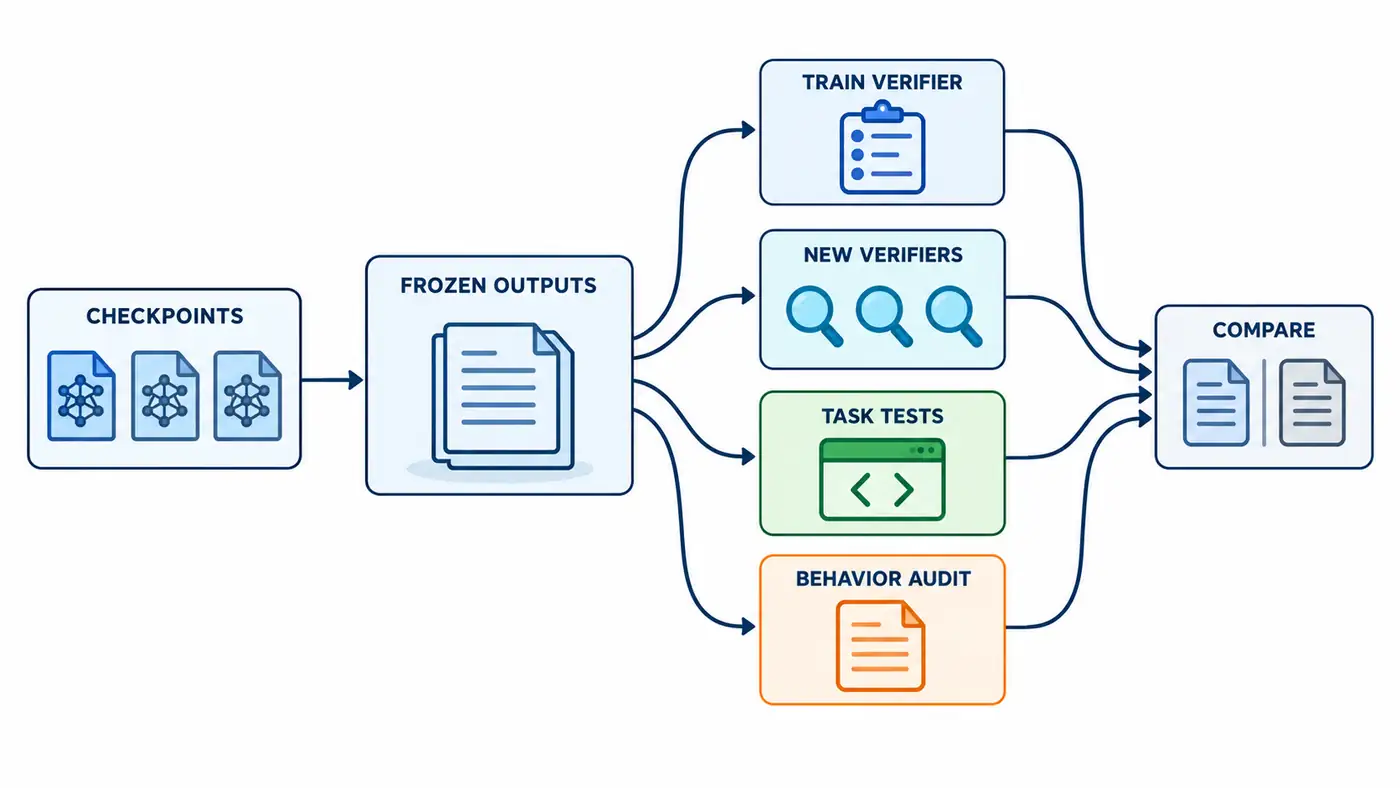
The picture shows the evaluation process suggested in this article, which has not been implemented. Each checkpoint first generates and saves the output under the same freezing protocol, and then submits it to four parallel verification paths; while reading the saved interaction trajectory at the same time. The arrows only indicate the flow of the material, not the observed gain or causal mechanism; the final confirmation result is not reflowed.
First of all is the material. Development questions, development questions for hyperparameter selection, and final confirmation questions should be distinguished; the data used to decide which step is "stopped" has participated in the selection, and should no longer be regarded as a confirmation set that has never been seen before. Only replacing the filename or re-scrambling the order cannot establish independence.
The second independent is the source of error. Replacing the training referee with a larger model of the same family may increase the scoring ability, but there is no guarantee that the error is irrelevant. A more explanatory combination is: cross-judgment review of the same answer, the executable test of the task itself, and a spot check on the content of the dispute. Spot checks must retain differences and basis, and the labels generated by the model cannot be called artificial gold labels.
The final independent is the selection process. If you modify the prompt, reward or stop point every time you look at the test results, the test will gradually become a development tool. The modification history should be saved, and finally confirmed with materials that are not participating in the selection. Continuous monitoring can help with training, but its scores take different roles than the final confirmed grades.
It is also necessary to fix the number of sampling times, temperature, maximum output length and tool permissions, and record the actual generation expenses. Otherwise, cross-referee gains may come from longer answers, and vulnerability differences may come from more exploration opportunities. The results before and after the same question are saved, and the new success, loss success and always fail are viewed respectively, which is usually easier to locate the problem than just looking at the mean.
Next Experiment: Make Interpretations Produce Different Predictions
Below is a research design that has not yet been performed. Fixed the starting point model, training questions and training budget, set the original reward, only the validator was replaced, only the target specification was changed, and the two groups were changed at the same time; the baseline was reserved without training. Using multiple training seeds, checkpoints and selection rules are pre-specified, and additional referees are calculated separately.
During the development phase, each set of frozen outputs is reviewed on the same topic. If you only change the referee, you will reduce the unique wrong credit of the original referee, and support the misinterpretation of scoring; If both are valid at the same time, the mixing mechanism should be reported, and a story cannot be forcibly selected.
Do a set of matching environments: keep the specified vulnerability on one side, and close the vulnerability on the other side, and try to keep the legal problem-solving path, prompt and budget consistent. If the benefits only appear when the loopholes are opened, the shortcut will be strengthened to explain; however, if the closed operation increases the normal cost of solving problems at the same time, it will also cause confusion, and it must be controlled separately. Changes that have been changed cannot be automatically counted as speculative evidence.
The final confirmation should also report the success of the target, the satisfaction of the rules and the abnormal behavior, and retain the corresponding relationship by question. You can't just report models that don't do anything in order to make the speculation less likely, and you can't just compare the ability to compare the "subset without speculation" and ignore the different questions left by the two groups. The truly convincing result is that the benefits of legally completing tasks can still be repeated under independent materials and different verification methods.
Summary: Turning the Ascendant Curves into Explainable Evidence
The reward rise first shows that the optimization is working, and the specific effect needs to be proved separately. The four studies together point to a research habit: first ask what the score is to check, then ask which behavior generates the score, and finally ask whether the income can leave the training referee and the original vulnerability will continue to be established. This can not only retain the real benefits of reinforcement learning, but also avoid packaging the measurement blind spot into a breakthrough ability.
References
Date of first draft retrieval: 2026-10-16; deadline for this retrieval, full text verification and data: 2026-10-17. I have searched for relevant work for nearly twelve months. The following are first-hand materials selected around this issue, and do not claim to be fully covered. The experimental details are subject to the read versions listed.
- Leo Gao, John Schulman, Jacob Hilton. Scaling Laws for Reward Model Overoptimization. ICML 2023; Initial preprint was published in 2022. Verify the official paper §2, §3 and Figure 2, §4.5. Meeting minutes|Published paper.
- Anas Mahmoud et al. Reward Hacking in Rubric-Based Reinforcement Learning. 2026, arXiv: 2605.12474v1. Verification §2–3.2, §4, §7 and Appendix B; the official download list of NeurIPS 2026 is included, the visit of a single page failed, and the method discussion is in accordance with arXiv v1. Version history|Full text|Meeting list.
- Sangyeon Yoon et al. Diagnosing and Correcting Reward Hacking in Verifiable Instruction Following. 2026, arXiv: 2610.19525v1, pre-printed on October 14, no official employment is confirmed. Verify §3–5.2, §5.3, §6.1 and Table 4, Appendix B. Version history|Full text.
- Amit Roth et al. Hack-Verifiable Environments: Towards Evaluating Reward Hacking at Scale 2026, arXiv:2605.20744v1. Verification §2–3.2, §6–7 and Appendix B.1; the official download list of NeurIPS 2026 is included, the visit of a single page failed, and the experimental definition is in accordance with arXiv v1. Version history|Full text|Meeting list.