
- Date: 2026-10-13
- For graduate students, early-career researchers and research engineers
- Data deadline: 2026-10-13; search for nearly 12 months of research, and retain the early papers necessary to explain the dispute. This article is deeply read as evidence, and the model is not run to train or reproduce the experiment, and does not claim to be fully covered.
Abstract: With more data, why is it possible to learn more and narrower?
The model can continuously generate new questions and new answers, which seems to solve the problem of insufficient training data. However, 10,000 words may only cover one type of question; after screening out the wrong answer, the rest may be a question that the model has already done. Data volume, single quality and task coverage are three different quantities.
This paper compares four evidence lines for recursive training, data accumulation, partial editing and instruction screening. Current evidence support: synthetic data can be useful, retaining original information and altering generation, and screening can also alleviate some degradation. The paper does not form two direct battling camps, "synthetic data is inevitable" and "unlimited generation must be effective". To judge whether the income can continue, it is necessary to first explain what is reserved, what is replaced, and what is measured. Shumailov et al., 2024; Gerstgrasser et al., 2024
Distinguish between quality, coverage and "collapse"
Synthetic data refers to the training material generated or rewritten by the model. Here Quality Whether the single material is correct, clear and suitable for learning; coverage It is the field, difficulty, structure and rare situation required by the target task. "Long tail" is the low frequency but still important part. A good quality set of samples may not necessarily cover a wide range; rare samples may not be correct.
Model Collapse usually describes the phenomenon that the model gradually deviates from the target distribution when the model is repeatedly learned to generate materials. However, the definitions of operations used in each paper are different: some look at the end of the distribution and disappear, and some see whether the test error increases without bounds with algebra, and some look at the performance of the question or change in skill. When reading, the nouns must be exchanged back to the indicators, and "no boundless growth" cannot be read as "no loss". Shumailov et al., definition 2.1; Gerstgrasser et al., §2, §3 footnote 3
This article divides possible interpretations into three categories. first, information reserved: The old samples are still there, and the rare mode does not have to be resampled every time to stay. second, Improve learning efficiency: The same information is re-expressed, cleaned or arranged, and it is easier to be used by the student model. third, Measurement range narrowed: Progress of common problems covers up rare problems, and the average score still looks good. The three may happen at the same time, and different controls are required to distinguish them.
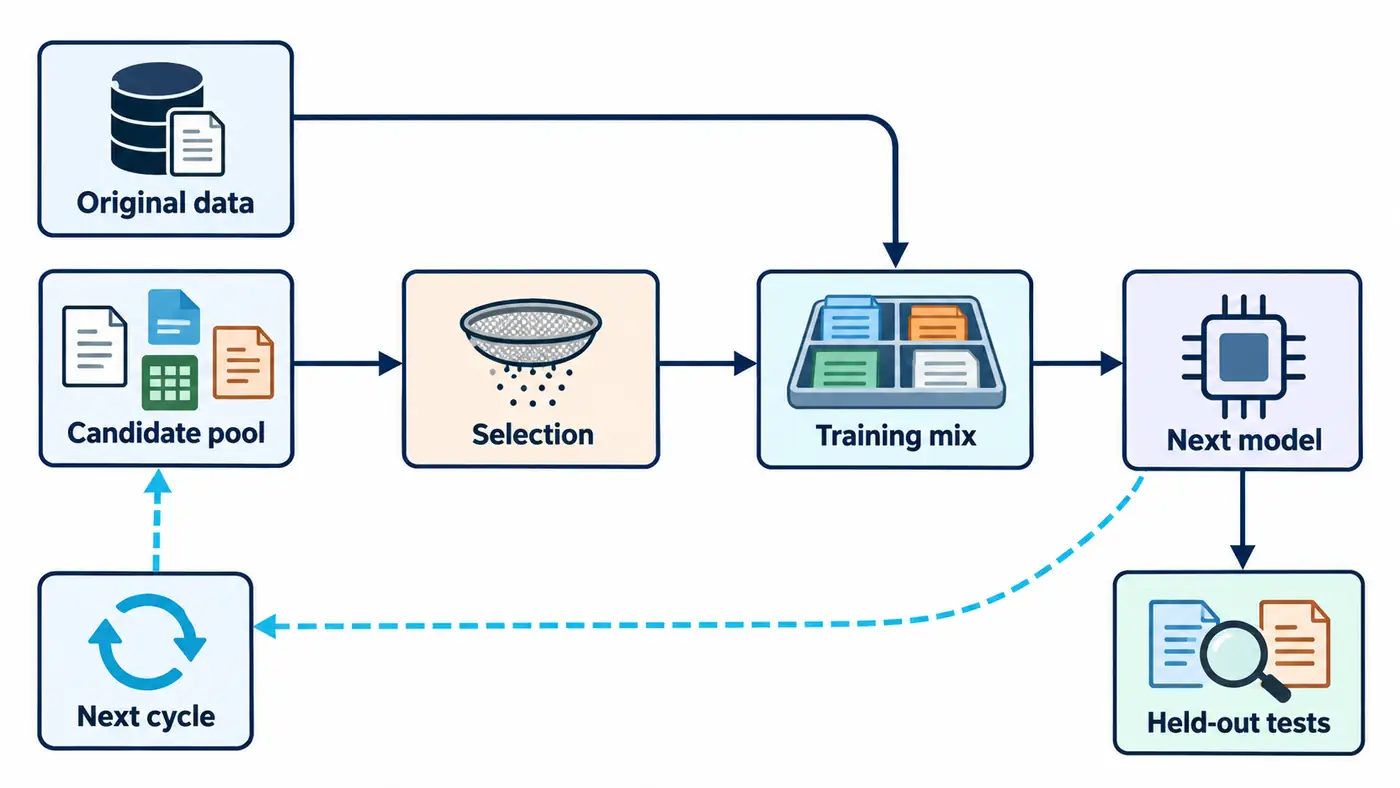
Figure: The comparative framework of this article is not the original process of any single paper. The solid line represents the step of data entering the training and independent evaluation; the dotted line indicates the path that the next round of candidates may continue to be generated, does not indicate sustained gains that have been proven. How much the original data is retained, what is the screening basis, and whether external answers are introduced should be used as experimental variables. There is no reflux arrow for the test; there is no measurement data in the figure.
What changed from "recursive replacement" to "cumulative reserve"?
Recursive training is indeed risky, but experiments are not the entire Internet
The Nature paper of Shumailov et al. is explained with a simple distribution model: the finite sampling and fitting error can accumulate in intergenerational transmission. The language experiment is the recursive fine-tuning of OPT-125m on WikiText-2, which uses beam search during generation. The paper reports degradation, and also reports that degradation is light when some of the original data is retained. Official version, "Theoretical Intuition" and "Model Collapse in Language Models", pp.756–759
There are two boundaries here. First of all, the infinite generation conclusion of the simple model cannot be directly transformed into the prediction of which generation fails the real model. Secondly, the two groups of language settings of the paper change the original data retention and training rounds at the same time, so this set of controls cannot independently estimate the causal effect of "changing the mixing ratio only". It proves that there is a risk in a specific feedback process, and it is bound to be harmful to not launch synthetic texts of any source and any screening method.
The counterexample of accumulated data does not mean that all details are preserved intact
Gerstgrasser et al. compare each generation with new generated data to replace the old set, keep the old set and append new data. The language experiment is trained from the newly initialized small GPT-2 and Llama2 architectures, and the test cross-entropy of the cumulative conditions is relatively stable. The paper also made a control of the expansion of the pure synthesis replacement set, and the condition is still degraded, indicating that the observation is not just "the number of data has increased". §2.1. Control description of Table 2 in Appendix C
A key detail is that the initial corpus TinyStories of its language experiments are generated by GPT-3.5/4. The more direct test here is to retain the role of reference corpus and intergenerational accumulation, and it cannot be written as "proving that the original human text is irreplaceable". In addition, the image experiments of §2.3 still report a decrease in detail diversity; the boundary error conclusion of §3 is established in a linear model. Maintaining the overall error and keeping each rare pattern is still a different proposition. §2.1、§2.3、§3
Therefore, the two tasks first explain the importance of data update rules, rather than reaching the opposite conclusions under the conditions. FINE-TUNING is different from re-training, WikiText-2 and TinyStories, fixed data volume and generation of data from generation to generation. If the accumulated data is fully trained in each generation, the calculation overhead will also be changed; there is no matching budget, and it cannot claim that there is a free long-term improvement.
Is it more "clean" to generate more "clean"?
Zhu et al. moved the problem to a single round of pre-training: Dolma and Cosmopedia with different proportions were used to keep the total training text in the mixed experiment, and it was observed that the increase in the synthesis ratio was accompanied by the degradation of the overall evaluation. Cosmopedia comes from a specific teacher and generation process, and Dolma is not a counterfactual version that is paired with it one by one. Therefore, this is a comparison of two sets of specific corpus and its formula, and all differences cannot be attributed to "people or machine writing". ICML 2025; read arXiv v3, §3.1, Table 1
The study also examined distributional differences using a reference model’s perplexity and features of short word sequences. Perplexity captures how surprising the text is to that model. Its value depends on the reference and cannot directly measure factual accuracy or map the coverage of knowledge. This motivated ToEdit. It retains the original passage and preferentially resamples tokens, the basic units a model processes, at high-confidence positions instead of freely generating a whole new passage. §3.2、§4.1
The partial editor of the paper reports improved the average performance during the tested training stage, but not every task in the table has risen; the theoretical boundary results use a linear model, which cannot guarantee that arbitrary editors will not be damaged for a long time. §4.2–4.3, Table 2–4 The judgment based on this article is that screening can only rerank or delete existing candidates, and cannot make up for the completely missing question types in the candidate pool. It is more accurate to select high-score samples, and to let key difficult cases enter the candidate pool, which must be verified separately.
Recent positive results: screening is helpful, external feedback is also present
The KITE preprint in July 2026 first generates weakness-oriented instructions based on the failed records, and then screens candidates based on semantic uncertainty between multiple answers. Each generation retains the accumulated data and re-tuning from the same initial checkpoint; it is not continuous training with the previous generation weight. The authors report on the advantages of the main experiment after five rounds, and the gain gradually slowing down when the single backbone model is extended to the ninth generation. Luo et al., §3, §4.1–4.4
The comparison shows how to construct instructions when an answer source is available. Every method relies on a strong external model for verification and on canonical answers, which limits what the study can say about indefinite self-teaching. Equal annotation budgets can hide differences in the compute spent generating candidates, answering repeatedly, and filtering. The authors also acknowledge that their diagnosis of weaknesses relies on skill labels that experts have yet to validate. These are imprecise measures of ability, and the authors have yet to reassess each skill after KITE. §6, Appendix 8.2–8.5
This article further infers that sharing a verification device does not rule out that it generates different interaction benefits with different candidate questions. To prove that the gain does not depend on this external channel, the control of the verification unit still needs to be replaced or removed. It is not possible to improve only by the average score, asserting that all the previously identified weaknesses have been fixed.
| line of evidence | critical condition | claims of observation or support | can not be proved |
|---|---|---|---|
| recursive degradation | Small model fine-tuning and specific generation methods | Feedback loop may lose distribution information | All synthetic training must fail |
| cumulative retention | Keep reference sets and historical generation sets | The measured language loss is more stable | All tail details are not damaged |
| Part of the editor | Original reserved, limited tokens replacement | Average performance improvement in some recipes | Unlimited continuous growth |
| KITE filtering | Accumulate SFT, external answer verification | Improve instruction training within the limited round | Self-transcendence without external information |
Each line corresponds to the original text above, and does not rank horizontal numerical values. In particular, it is not possible to compare the pre-training confusion with the command task Accuracy to increase the range; some KITE benchmarks also use limited disciplines or sampling subsets, not all test sets are used. See Appendix 8.2.2
How to do a follow-up experiment that can distinguish interpretation?
The following is an experimental design proposed in this article that has not yet been carried out. Select a model that can withstand multiple rounds of training and have an independent test set task, first fix the initial checkpoint, the original training set, decoding and answer judging rules, and then comparing three data streams: only leave this round to generate sets, keep the original set, and append the historical generation set, and keep the original and historical samples in layers under fixed capacity. The third group is used to distinguish "reserved information" from "increasing and more calculations".
Each group then compares random selection and quality screening, keeps the final training tokens consistent, and generates and verifies costs in a single column. If you can use the task of accurate verification of the program, then cross-set the program verification and model verification. The test set is always sealed and is not used to find weaknesses; the diagnostic sets generated are guided separately. Near repetition of the same topic should be excluded between training, diagnosis and testing.
Evaluation at least look at the overall accuracy, predefined rare question type performance, cross-round pairing records from pairs of changes to errors and pairs of errors, and coverage proxy indicators. Agent indicators should clarify what to measure: the cover of the question type is closer to the task structure than the vocabulary change, but is still limited by the labeling system. If you can't see that the sentence is not repeated, you will have more abilities.
If the cumulative group only has the advantage when the budget increases, the computing resources are competitive interpretation; if the quality screening is improved, the total score is damaged, and the quality and coverage have a choice. The positive results of any finite round can only support this observation interval. The number of rounds and stop rules should be written in advance, and all rounds should be saved to avoid only showing the best generation.
Summary: Continuous income needs to continuously check where the information comes from
The most questionable question about synthetic data research is not "whether the model generated can be used", but what information the new material retains, what structures are added, what external judgments have been borrowed, and what are missing. Existing evidence supports the study of these conditions, and is not enough to give all tasks a safe mix ratio or permanently growing formula.
For newcomers to scientific research, a more verifiable question is: under the same budget, can a certain generation and screening mechanism improve the performance of independent tasks, and at the same time maintain the pre-specified rare ability? **Record quality, coverage and budget separately, the positive results have a clear application boundary, and only the failed results have an interpretable value.
References
- Ilia Shumailov、Zakhar Shumaylov、Yiren Zhao、Nicolas Papernot、Ross Anderson、Yarin Gal. AI models collapse when trained on recursively generated data. Nature, 2024. formal page; The author institution of this reading archive PDF. Additional verification 2025 author corrected, which involves the error term symbol of the theoretical paragraph; this formula is not repeated in this paper.
- Matthias Gerstgrasser et al. Is Model Collapse Inevitable? Breaking the Curse of Recursion by Accumulating Real and Synthetic Data. 2024. arXiv version record; This deep reading V2 full text. The conference page is limited by access verification. The experimental judgment of this paper is limited to the already read version, and the conference information in the search is not used as a full-text version verification.
- Xuekai Zhu et al. How to Synthesize Text Data without Model Collapse? ICML, 2025. PMLR official record; This deep reading arXiv v3. The official PDF failed to read this time, and it was not assumed that it was verbatim with V3.
- Xiaonan Luo、Yue Huang、Kehan Guo、Ping He、Chuan Zou、Ting Hua、Xiangliang Zhang. Learning from Synthetic Data without Model Collapse in Iterative Instruction Tuning. 2026. arXiv V1 full text; Version and author record. This time, only the preprint is confirmed, and the official employment has not been confirmed.