
Date: 2026-06-18
Suitable for readers: Construction enterprise knowledge base, document Q&A, customer service assistant, code assistant, research assistant or engineer, product leader and technical leader.
Abstract
The first three articles discuss why Prompt Engineering is not enough, what Context Engineering is, and how to compress and sort Context. This article is the most easily underestimated, but most determined upper limit, the problem of entering the RAG system: How to evaluate the quality of search?
When teams deploy RAG, they often start with two questions about the final answer: is it correct, and did the model hallucinate? Those questions can miss the cause of a failure. The retriever may have missed the right document, or ranked it 12th, outside the context window. The model may have received the evidence but ignored it. Even a correct-looking answer may cite a source that does not support its conclusion.
Therefore, the RAG evaluation has to be split into three layers: Search whether the correct evidence has been found, whether the correct evidence is placed in the front, and whether the evidence is faithfully used. This article gives a set of engineering evaluation methods: how to design the gold set, how to calculate Recall@k/MRR/nDCG/Citation Support, how to record permissions and timeliness, how to use a runable script for offline evaluation, and which signals should be monitored online.
Contents
- 1. Why not just look at the final answer
- 2. Split the RAG link into three layers
- 3. Core indicators of retrieval quality
- 4. How to design the evaluation set
- 5. A minimum Retrieval Eval data format
- 6. Offline evaluation script: first position the problem clearly
- 7. Diagnostics matrix: where to change when the indicator is different
- 8. Answer layer evaluation: Don't let the model "any correct with wrong references"
- 9. Online monitoring: Offline scores are not equal to online reliability
- 10. Common Mistakes
- 11. Landing road map
- 12. Pre-release self-check list
- 13. Summary
- References
1. Why not just look at the final answer
RAG's goal is not to "make the model look referenced", but to allow the answer to be supported by external evidence.
If you only look at the final answer, you will mix different errors:
| Phenomenon | appearance | Really possible problems |
|---|---|---|
| wrong answer | Model says wrong policy, number or steps | The correct document was not recalled; the document expired; the model did not use evidence |
| The answer is too general | Only give common sense, no business details | Recall results are weakly correlated; the context is missing must-have facts |
| Reference exists but does not support conclusions | It seems to have a source, click it and it is not relevant | citation is just decoration, not supporting verification |
| Unstable answers to the same question multiple times | Sometimes right, sometimes wrong | Top-k sort fluctuation; chunk overlapping noise; reranker is unstable |
| Users see information | The answer refers to a document that should not be accessed | Metadata filter or permission layer is invalid |
| Old policies cover new policies | The answer continues with the old version | freshness/filter/version priority |
These problems cannot be solved by "write one more prompt". The RAG system must retrieve, sort, context, and generate a split evaluation.
An engineering judgment is:
RAG's primary evaluation object is not the answer, but "whether the chain of evidence holds".
If the chain of evidence is not established, the smoother the more fluent the more dangerous it is.
2. Split the RAG link into three layers
A typical RAG request can be split into three segments:
- search layer: Find candidate documents or chunks from the knowledge base.
- context layer: Filter, deduplicate, rerank, compress and budget candidate results.
- production layer: The model answers based on the context and gives references or evidence.
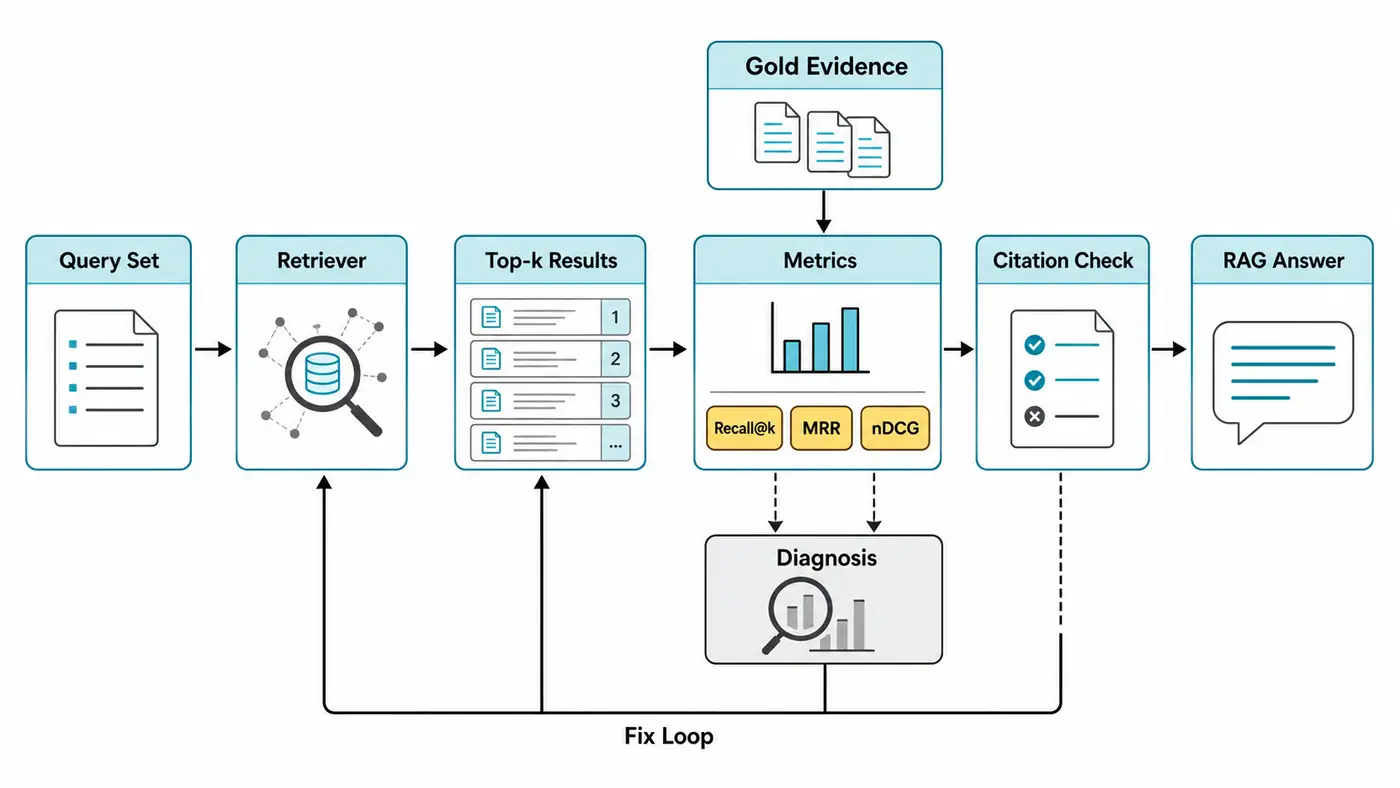
The corresponding evaluation questions are also different:
| level | Questions to ask | typical indicators |
|---|---|---|
| search layer | Has the correct evidence been found? | Recall@k、Hit Rate@k、Coverage |
| Sorting layer | Is the correct evidence ranked in the top position? | MRR、nDCG@k、Context Precision |
| context layer | Is the evidence of the model window clean, outdated, and not overpowering? | Duplicate Rate、Freshness、Permission Violation |
| production layer | Is the answer faithful, complete and traceable? | Faithfulness、Answer Correctness、Citation Support |
The OpenAI Retrieval document mentions that Retrieval can do semantic search, query rewriting, attribute filtering, ranking options, and can also be restricted max_num_results. These are not "adjusting items", but variables for evaluating experiments. You should be able to answer: Is Recall@10 improved after opening Query Rewrite? Hold score_threshold Does Precision increase after improvement but does Recall drop? Is there any reduction of overpower and expired evidence after filtering by department and date?
3. Core indicators of retrieval quality
Define a sample first:
{
  "query_id": "refund_001",
  "query": "跨境订单退款多久到账?什么情况需要人工审核?",
  "gold_doc_ids": ["refund_policy_2026_03"],
  "gold_chunk_ids": ["refund_policy_2026_03#chunk_07", "refund_policy_2026_03#chunk_09"],
  "required_facts": ["到账时间", "跨境支付需人工审核"],
  "user_scope": ["customer_service"],
  "as_of": "2026-06-18"
}
The retrieval system returns:
[
  {"chunk_id": "refund_faq_2025_10#chunk_03", "doc_id": "refund_faq_2025_10", "score": 0.83},
  {"chunk_id": "refund_policy_2026_03#chunk_07", "doc_id": "refund_policy_2026_03", "score": 0.79},
  {"chunk_id": "payment_policy_2026_01#chunk_12", "doc_id": "payment_policy_2026_01", "score": 0.74}
]
The following indicators answer different questions.
3.1 Hit Rate@k
Is there at least one gold evidence in Top-k?
Suitable for answering: "Did you get some correct material for this question?"
The disadvantage is also obvious: as long as one hit one, it is considered a success, and it does not care whether it is hit or not, and it does not care about the ranking.
3.2 Recall@k
The amount of GOLD evidence hit in the Top-k, in the proportion of the total number of GOLD evidence.
Recall@k makes more sense than Hit Rate if a problem must find both "Account Time" and "Human Review Conditions". Many RAG systems are incomplete, not the model will not sum it up, but only one of these facts is found in the search.
3.3 Precision@k
The proportions in the Top-k are correct evidence.
This indicator is important when the context budget is tight. Recall is high but Precision is low, which means you do find the right evidence, but also bring in a lot of noise. The model is reasoned in the noise, and the stability will decrease.
3.4 MRR
MRR (Mean Reciprocal Rank) cares about the first correct result.
If the first correct chunk is always ranked 1st or 2nd, the MRR is high; if the correct chunk is often ranked 8th or 12th, the MRR is low. MRR is critical for systems that only take TOP-3 or TOP-5 into the context.
3.5 nDCG@k
nDCG is suitable for scenarios where Gold evidence has grades. For example, a chunk is "the policy clause of directly answering the question", and the other is just a "background explanation", they should not have the same right.
If you are manually labeled Relevance Grade, for example:
- 3: Directly support the answer;
- 2: Partial support;
- 1: background related;
- 0: Not related.
Then nDCG@k can better reflect the sorting quality than simple Recall .
3.6 Coverage
Coverage is not a standard IR metric, but is practical for business RAG. It answers:
Are the key fact types that the question needs all covered by evidence?
For example, the refund question requires:
- time;
- channel;
- abnormal conditions;
- review conditions;
- policy version.
Only hit "time" is not enough. Coverage can be pressed required_facts calculation.
3.7 Freshness
RAG's errors are often not "not found", but "the old version was found".
Freshness can be defined by business rules:
- Whether to hit the latest version of the document;
- Is it qualified
as_oftime; - whether to avoid the abolition policy;
- Whether to choose the source with the highest priority in multi-version conflicts.
3.8 Permission Violation
Enterprise RAGs must use permissions as retrieval metrics, rather than generating layer ethical reminders.
If the user does not have access to certain documents, the documents appearing in the search results are already a system error, even if the model does not eventually refer to it. The evaluation set should contain different user_scope, department, region, customer level and data isolation scenarios.
3.9 Duplicate Rate
Chunk OverLap raises recall, but also brings repetition. Too many repetitions will squeeze out other evidence.
Duplicate Rate can be pressed doc_id, adjacent chunks, text similarity, or canonical fact calculations. It is not necessarily the lower the better, but to a certain extent, the context budget is wasted.
3.10 Citation Support
Citation Support is an indicator between the generation layer and the evidence layer. it asks:
Can each key assertion in the answer be directly supported by the reference source?
This is much stricter than "with or without reference". The most dangerous state of the RAG system is: the answer looks professional and referenced, but the reference point does not support conclusions.
4. How to design the evaluation set
Don't just draw 100 questions from the random user log to start counting. That will make the evaluation set bias towards high-frequency, simple, and clear problems, and cover up the boundaries that will actually cause accidents.
A reliable RAG eval set should override these types:
| Types of | Example | Purpose |
|---|---|---|
| Direct fact | "How many administrators are supported in Enterprise Edition?" | Basic recall |
| Multi-condition combination | "How long does it take for the refund of cross-border orders to arrive in the account, and what situations need to be manually reviewed?" | Coverage of multiple evidence |
| version sensitive | "What is the refund policy after March 2026?" | Time measurement |
| Permission sensitive | "How much is a client's contract discount?" | Metadata filter |
| synonym | "When will the money be returned?" | Query rewrite and semantic recall |
| counterfactual/non-existent | "Can I guarantee a refund within 24 hours?" | Abstention and uncertainty |
| evidence of conflict | "Which one is calculated when the old and new policies exist at the same time?" | Test version priority |
| long tail terms | "How to apply for SLA credit?" | Testing Domain Glossary and Hybrid Search |
| References | "Please give the source and quote the original basis." | Measurement Support |
Each sample must have at least these fields:
| Field | Effect |
|---|---|
query_id |
Stable tracking and regression testing |
query |
Original user question |
intent_type |
Facts, processes, comparisons, summaries, troubleshooting, etc. |
gold_doc_ids |
Proper Source Documentation |
gold_chunk_ids |
Minimum Correct Evidence Unit |
required_facts |
The fact that the answer must cover |
negative_doc_ids |
Similar interference documents that cannot be used as basis |
user_scope |
Permission context |
as_of |
time context |
expected_answer_notes |
Generation layer evaluation prompts, no unique answer is required |
The most laborious thing here is gold_chunk_ids. But without this field, it is difficult to judge whether the search is correct. Only the answer to the answer is not the evidence, and the question will be pushed back to the coarse granularity evaluation of "whether the final answer is correct".
5. A minimum Retrieval Eval data format
You can start with JSONL, don't make complex platforms at once.
{"query_id":"refund_001","query":"跨境订单退款多久到账?什么情况需要人工审核?","intent_type":"policy_qa","gold_doc_ids":["refund_policy_2026_03"],"gold_chunk_ids":["refund_policy_2026_03#chunk_07","refund_policy_2026_03#chunk_09"],"required_facts":["到账时间","跨境支付需人工审核"],"negative_doc_ids":["refund_faq_2025_10"],"user_scope":["customer_service"],"as_of":"2026-06-18","expected_answer_notes":"必须说明原支付渠道 1-5 个工作日;跨境支付订单进入人工审核;引用 2026-03 版政策。"}
{"query_id":"contract_014","query":"这个客户最新合同里的自动续约条款是什么?","intent_type":"contract_qa","gold_doc_ids":["contract_acme_2026_signed"],"gold_chunk_ids":["contract_acme_2026_signed#chunk_22"],"required_facts":["自动续约期限","提前通知窗口"],"negative_doc_ids":["contract_acme_2025_draft"],"user_scope":["legal","account_acme"],"as_of":"2026-06-18","expected_answer_notes":"只能使用已签署最新版合同,不能引用 2025 草案。"}
{"query_id":"support_033","query":"用户说登录后一直跳回首页,可能是什么原因?","intent_type":"troubleshooting","gold_doc_ids":["sso_runbook_2026_02","cookie_policy_2026_01"],"gold_chunk_ids":["sso_runbook_2026_02#chunk_11","cookie_policy_2026_01#chunk_04"],"required_facts":["SSO callback mismatch","SameSite cookie 配置"],"negative_doc_ids":[],"user_scope":["support_l2"],"as_of":"2026-06-18","expected_answer_notes":"需要给排查顺序,不能只给泛泛登录建议。"}
The search output is also recommended to be recorded as JSONL:
{"query_id":"refund_001","results":[{"rank":1,"doc_id":"refund_faq_2025_10","chunk_id":"refund_faq_2025_10#chunk_03","score":0.83},{"rank":2,"doc_id":"refund_policy_2026_03","chunk_id":"refund_policy_2026_03#chunk_07","score":0.79},{"rank":3,"doc_id":"refund_policy_2026_03","chunk_id":"refund_policy_2026_03#chunk_09","score":0.76}]}
There is a practical point in the OpenAI File Search document: the model output will be annotation by default, but if you want to analyze the retrieval result itself, you need to include the request explicitly in the request file_search_call.results. When doing eval, don't just save the final answer, but save the search query, top-k results, score, metadata, filters and final reference to the model.
6. Offline evaluation script: first position the problem clearly
Below is a Python example without third-party dependencies. It is not responsible for calling the retrieval service, only reading the Gold Set and Retrieval results, and then computes the underlying metrics. In a real project, it can be connected to a CI, offline experimental platform or Nightly job.
import json
import math
from collections import Counter
from pathlib import Path


def read_jsonl(path):
    with Path(path).open("r", encoding="utf-8") as f:
        for line in f:
            line = line.strip()
            if line:
                yield json.loads(line)


def dcg(relevances):
    return sum((2 ** rel - 1) / math.log2(i + 2) for i, rel in enumerate(relevances))


def evaluate(gold_path, result_path, k=5):
    gold = {row["query_id"]: row for row in read_jsonl(gold_path)}
    results = {row["query_id"]: row["results"] for row in read_jsonl(result_path)}

    totals = Counter()
    sums = Counter()
    failures = []

    for query_id, item in gold.items():
        rows = results.get(query_id, [])[:k]
        returned_chunks = [r["chunk_id"] for r in rows]
        returned_docs = [r["doc_id"] for r in rows]
        gold_chunks = set(item.get("gold_chunk_ids", []))
        gold_docs = set(item.get("gold_doc_ids", []))
        negative_docs = set(item.get("negative_doc_ids", []))

        chunk_hits = [chunk for chunk in returned_chunks if chunk in gold_chunks]
        doc_hits = [doc for doc in returned_docs if doc in gold_docs]

        hit_at_k = 1.0 if chunk_hits or doc_hits else 0.0
        recall_at_k = len(set(chunk_hits)) / max(1, len(gold_chunks))
        precision_at_k = len(chunk_hits) / max(1, len(rows))

        reciprocal_rank = 0.0
        for idx, row in enumerate(rows, start=1):
            if row["chunk_id"] in gold_chunks or row["doc_id"] in gold_docs:
                reciprocal_rank = 1.0 / idx
                break

        # 最小版 nDCG:gold chunk 记 3 分,gold doc 记 1 分,其他 0 分。
        rels = []
        for row in rows:
            if row["chunk_id"] in gold_chunks:
                rels.append(3)
            elif row["doc_id"] in gold_docs:
                rels.append(1)
            else:
                rels.append(0)
        ideal = sorted(rels, reverse=True)
        ndcg = dcg(rels) / dcg(ideal) if any(ideal) else 0.0

        permission_violation = any(doc in negative_docs for doc in returned_docs)
        duplicate_rate = 1.0 - (len(set(returned_chunks)) / max(1, len(returned_chunks)))

        totals["queries"] += 1
        sums["hit_at_k"] += hit_at_k
        sums["recall_at_k"] += recall_at_k
        sums["precision_at_k"] += precision_at_k
        sums["mrr"] += reciprocal_rank
        sums["ndcg_at_k"] += ndcg
        sums["permission_violation_rate"] += 1.0 if permission_violation else 0.0
        sums["duplicate_rate"] += duplicate_rate

        if recall_at_k < 1.0 or permission_violation:
            failures.append({
                "query_id": query_id,
                "query": item["query"],
                "recall_at_k": round(recall_at_k, 3),
                "returned_chunks": returned_chunks,
                "gold_chunks": sorted(gold_chunks),
                "permission_violation": permission_violation,
            })

    n = max(1, totals["queries"])
    summary = {name: round(value / n, 4) for name, value in sums.items()}
    return {"k": k, "summary": summary, "failures": failures[:20]}


if __name__ == "__main__":
    report = evaluate("retrieval_eval.jsonl", "retrieval_results.jsonl", k=5)
    print(json.dumps(report, ensure_ascii=False, indent=2))
This script is deliberately simple, because the goal of the first version of eval is not "indicators grace", but helps you layer the errors:
- Recall Low: The search layer is not found;
- MRR low: found but sorted back;
- Precision low: too much noise;
- Duplicate Rate High: The context budget is occupied by a repeated chunk;
- Permission Violation High: Permission filtering cannot be online;
- nDCG Low: Sorting did not put strong evidence before.
7. Diagnostics matrix: where to change when the indicator is different
The evaluation is not to get a score, but to decide where to change the next step.
| evaluation phenomenon | common reason | priority |
|---|---|---|
| Hit Rate@10 low | There is a big difference between query and document expression; index missing documents; embedding is not suitable for domains | query rewrite, synonym, index coverage, hybrid search |
| Recall@10 high but Recall@3 low | The correct result is behind | reranker、ranking options、domain boost |
| Precision@5 low | TOP-K mixed with a large number of weakly related fragments | score threshold、metadata filter、query decomposition |
| MRR low | The first correct result is too late | reranked model, title/level metadata, document structured |
| nDCG low | Strong evidence is not ranked before weak evidence | Artificial Relevance Grade, Business Priority, Source Authority |
| Duplicate Rate high | chunk overlap is too large; adjacent chunks are all in context | Result deduplication, by doc limit, MMR, diversity constraints |
| Freshness | The old document is not abolished; the date filter is missing | as_of Filter, version priority, index lifecycle |
| Permission Violation > 0 | There is no permission filtering before retrieval; only the reminder model at the generation layer | Force Metadata Filter, Tenant Isolation, Audit Log |
| The answer is wrong but the search is correct | There is no faithful use of evidence in the model; poor context sorting | Reference constraints, evidence number, answer verification |
| The answer is correct but the reference is wrong | Citation is not validated; references are just text decorations | claim-to-citation check, reference fragment playback |
Here's an easy-to-negle order: First repair the authority and timeliness, then repair the recall, then repair the sorting, and finally repair the generation.
The reason is very simple: if the search results already have more power or expired content, the stronger the generation layer, the more likely it is to organize the wrong evidence into a trusted answer.
8. Answer layer evaluation: Don't let the model "any correct with wrong references"
RAGAS breaks evaluation into dimensions such as answer relevancy, faithfulness, context precision, and context recall. Frameworks such as ARES also emphasize automated assessment of both retrieval and generation quality. These approaches keep evidence quality visible instead of folding it into a single opaque score for answer correctness.
In the project, the answer layer evaluation can be divided into four checks:
8.1 Answer Correctness
Is the answer covered required_facts, there is no obvious factual error.
This indicator can be done manually, rules, LLM judge, or mixed. High-risk tasks should not rely entirely on a single LLM Judge, at least sample manual review.
8.2 Faithfulness
Whether the key assertions in the answer are all from contextual evidence.
Example:
答案断言:跨境订单退款通常需要 1-5 个工作日,并需要人工审核。
证据 A:退款通常在 1-5 个工作日内退回原支付渠道。
证据 B:跨境支付订单需进入人工审核。
This is supported. If the evidence only says that "some abnormal orders need to be reviewed", and the answer is written, "All cross-border orders need to be reviewed", which is not faithful.
8.3 Citation Support
Whether each reference supports the sentence next to it.
Don't just check "there is no source list at the end of the answer". A better practice is to have the Citation ID for each key sentence of the answer, and then check it one by one:
{
  "claim": "跨境支付订单需进入人工审核。",
  "citation": "refund_policy_2026_03#chunk_09",
  "supported": true
}
8.4 Refusal / Insufficient Evidence
When there is not enough evidence to retrieve, the system will explicitly say "not enough to answer", rather than make up a seemingly reasonable answer.
Such samples must enter the eval set. Otherwise, the system will score well on the issue of evidence, but create hallucinations on the issue of unevidence.
9. Online monitoring: Offline scores are not equal to online reliability
Offline EVAL is the online threshold, not a death-free gold medal after the launch. At least monitor these signals online:
| Signal | Explanation |
|---|---|
| Retrieve the empty result rate | The empty result suddenly rises, it may be an index, permission or query rewriting exception |
| Average TOP-1/TOP-5 Score | Fractional distribution drift, possibly indicating that the data or query have changed |
| low score response rate | The answer is still generated when the Confidence is low retrieval, which needs to be paid attention to |
| Reference CTR/Feedback | Whether the user clicks on the source, does it think the source is irrelevant |
| artificial transfer rate | Customer service, legal and financial scenarios are very important |
| version hit rate | After the new policy is released, whether the old version is still hit |
| Permission denied rate | Is the permission filtering abnormally wide or extremely strict? |
| P95 Delay | The expansion of reranker, Query Decomposition and Top-K can affect the experience |
| Input token distribution | Excessive evidence will increase costs and may squeeze out the rules |
| Answer post-check verification failure rate | Failure trends of Citation Support or Faithfulness Checker |
Further, you can reflow the online failure samples to the eval set:
- The user clicks on or transfers to labor;
- Record query, retrieval results, answer, citations, filters;
- Manually label GOLD Evidence and the cause of the failure;
- Join regression eval;
- The next time you change the retrieval, chunking, renker or prompt, you must run by.
This is the closed loop of the continuous improvement of RAG quality.
10. Common Mistakes
10.1 Only use public benchmarks to judge services RAG
Benchmarks such as BEIR and KILT are helpful in understanding information retrieval and knowledge-intensive tasks, but they cannot replace your business Eval Set. The hardest questions in the Enterprise Knowledge Base are usually permissions, versions, internal terms, process exceptions, and document quality.
Publicly Benchmark can be used to compare the underlying Retriever, but the online decision must look at the business Gold Set.
10.2 Turn TOP-K as a versatile solution
TOP-K enlargement usually improves Recall, but also increases noise, token, delay and reference confusion. The correct approach is to observe both Recall, Precision, MRR, nDCG, answer Faithfulness and cost at the same time.
10.3 GOLD DOC only, not GOLD CHUNK
Only the granularity of the documented document will make the indicator inflated. There is a correct answer in an 80-page PDF, which does not mean that any chunk retrieved by this PDF is considered a success.
10.4 Unpredictable unanswered questions
The RAG system must say "don't know". No answer questions, insufficient permissions, and evidence conflicts should all go into eval.
10.5 LLM JUDGE as absolute true value
LLM Judge is great for scaling up the reviews, but it also requires calibration itself. The recommended practice is:
- Key indicators retain manual labeling samples;
- LLM JUDGE output justifications and references;
- Sample review of Judge misjudgment;
- Every time I change the Judge Prompt, I also run back.
10.6 Ignore the quality of data ingestion
If the PDF parsing error, table loss column, heading level disappears, scanned OCR error, the search evaluation will continue to score low. Don't just tune embedding and reranker, but also check the Ingest Pipeline.
11. Landing road map
If starting from scratch, I recommend pushing around.
Week 1: Build the Minimum Eval Set
- Choose 50-100 real business problems;
- Covering high frequency, long tail, no answers, permissions, versions and conflict scenarios;
- label
gold_doc_ids、gold_chunk_ids、required_facts; - Fixed first version of JSONL format.
Week 2: Run the baseline of the retrieval layer
- Record the TOP-10 search results;
- Calculate Hit Rate@K, Recall@K, MRR, nDCG;
- Output failure sample list;
- Categorized by cause: lack of documentation, poor chunk, poor query, poor sorting, permission/version errors.
Week 3: Do Sort and Context Experiments
- Compare different chunk sizes and overlap;
- Compare semantic, keyword, hybrid search;
- Compare the Query Rewrite switch;
- Add Reranker or business boost;
- Add deduplication, source cap, metadata filter;
- Only one type of variable is changed at a time to avoid inability to attribution.
Week 4: The answer layer and online monitoring
- Add answer correctness / Faithfulness / citation support to check;
- Recording
file_search_call.resultsor self-built Retriever trace; - Reflow the low Confidence, user negative reviews, and manual transfer samples;
- Set the regression threshold in the release process.
The first version of the threshold can be conservative, for example:
| Metric | Suggestions before going online |
|---|---|
| Permission Violation | must be 0 |
| Hit Rate@10 | >= 0.90 |
| Recall@5 | >= 0.75 |
| MRR | Continue to improve, no lower than the old version |
| Citation Support | >= 0.85, and manual sampling inspection of high-risk scenarios |
| No answers abstention Accuracy | >= 0.85 |
These numbers are not a general standard, just help the team start discussing Trade-Off. The real threshold is determined according to business risks.
12. Pre-release self-check list
At least ask these questions before going online:
- Is there an eval set that covers real business, not just a demo problem?
- Is Gold Chunk labeled, not just Gold Answer?
- Does it contain samples without answers, permissions, expiration, conflicts, and long tails?
- Is it possible to output the top-k result, score, metadata, filter and final reference of each query ?
- Have you looked at Recall, MRR, nDCG, Permission Violation, Duplicate Rate respectively?
- Is there a Faithfulness and Citation Support check for the answer layer?
- Is there a failed sample reflow mechanism?
- Is it possible to run back after the model, embedding, chunking, RERANKER, and prompt changes?
- Is it clear that downgrade strategies for low Confidence: abstention, follow-up, transfer manual or expand search?
- Is the knowledge base snapshot and evaluation report of the online version documented?
If these questions cannot be answered, the RAG system is still stuck in "can demonstrate", and has not entered "operational".
13. Summary
RAG retrieval quality evaluation is not a single score, but a set of toolboxes for positioning problems.
The most important thing is not to choose Recall@K or nDCG, but to establish this link:
业务问题 -> gold evidence -> top-k 检索结果 -> 排序指标 -> 上下文质量 -> 答案归因 -> 失败回流
When you can split a wrong answer into one of "No recall, Queen Mother, expired evidence, invalid permission, reference is not supported, and the model is not faithfully used evidence", the RAG system can really be improved.
The next article recommends continuing to write: How to do the citation and attribution of RAG: let every key conclusion in the answer have traceable evidence.
References
- OpenAI Developers: Retrieval
- OpenAI Developers: File search
- OpenAI Developers: Working with evals
- Es et al., RAGAS: Automated Evaluation of Retrieval Augmented Generation
- Thakur et al., BEIR: A Heterogeneous Benchmark for Zero-shot Evaluation of Information Retrieval Models
- Petroni et al., KILT: a Benchmark for Knowledge Intensive Language Tasks
- Saad-Falcon et al., ARES: An Automated Evaluation Framework for Retrieval-Augmented Generation Systems