AI Frontier Observation: Characters, Breakthroughs and Evidence | Interpretation Date: November 12, 2026 | Information as of 20:34:54 Beijing time
The robot’s fingers have touched the zipper pull. Should they tighten their grip or start pulling along the opening of the bag? In a Robbyant experiment on a physical robot, the same policy scored 39 points without tactile input. Feeding it raw sensor readings dropped the score to 15. Encoding the readings with LingBot-Touch first raised it to 59. All three conditions used the same demonstrations. To understand the gain, we need to ask what extra information the fingertips supplied and which actions actually earned points. Pre-printed first edition Submitted on November 9 at 18:12 UTC, that is, the early morning of November 10th, Beijing time; this is the submission date, and the paper does not give the specific date of this group of trials.
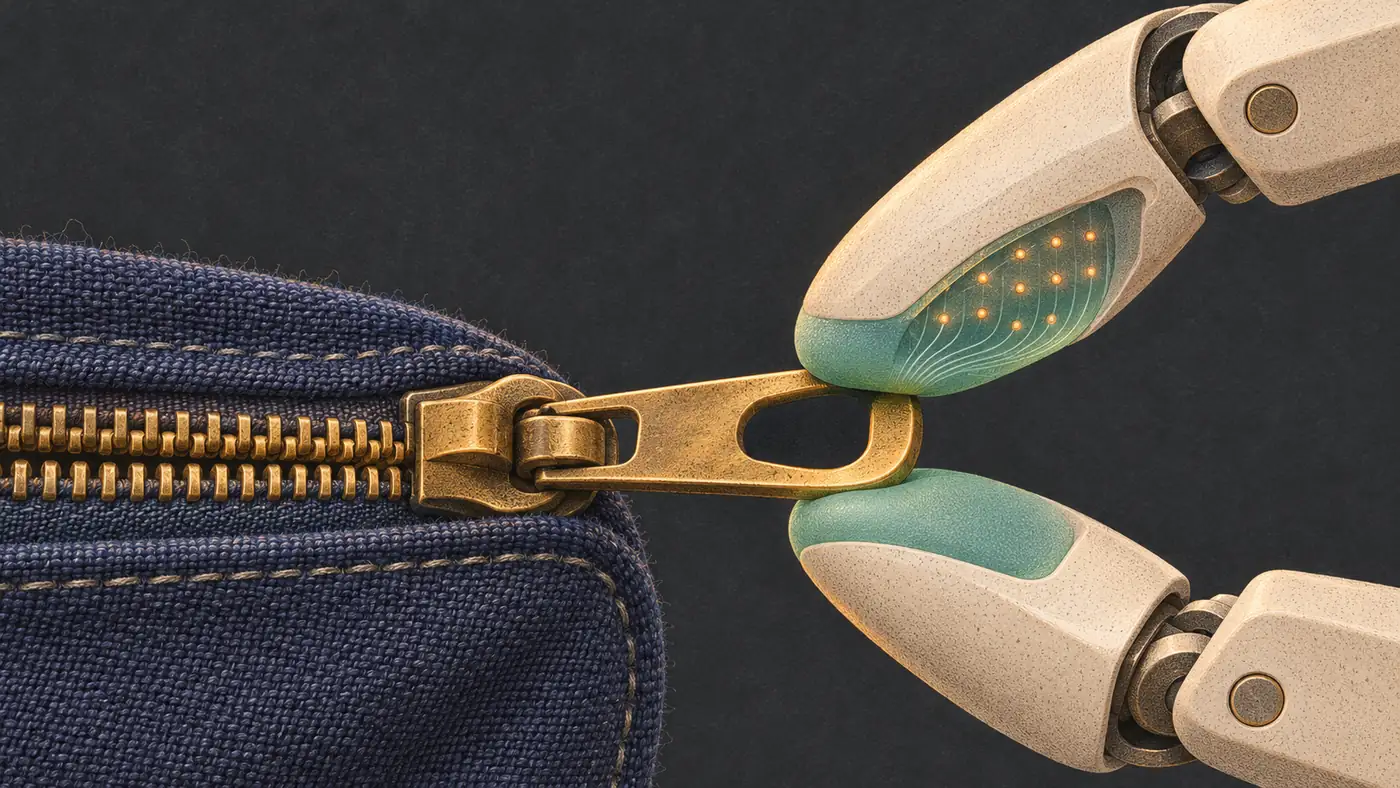
The original schematic diagram shows the position of the fingertips in contact with the pull tab, which does not represent the paper equipment or the experimental site.
Five steps are given points, and pulling is only one step
Look first Paper Table 2 and Appendix Table 7. On the Sharpa Wave manipulator, the researchers split the zipper task into five steps: lift and hold the bag, approach the zipper, grab the zipper, pull the zipper, and put the bag in the container. One minute at each step, and the zipper should be kept closed at the end. Try 20 times in a row for each configuration, and the full score is exactly 100 points. Although the head of the watch is written with the success rate, combined with the score rules, 59% of the π₀.₅ line should be read as 59% of the scores that can be scored, and cannot be converted into how many times there are 20 times from start to finish.
This difference determines what we can say to the manipulator. Suppose a hand can hold the bag, get close and grab the zipper every time, but always let go when pulling, it can already hold 60 points, and the number of complete completions is still zero. This is just an example of the scoring method. The real fifty-nine points may correspond to a very different action process; even if it is 20 points more than the baseline, it cannot be concluded that the newly added points come from successful pulls. To locate which step the touch is to help, it takes the number of passes of each step. It is especially worthy of comparison that those attempts that have already grabbed the zipper head have finally closed the pockets.
Why does adding a signal will lose points?
Different fingertips are recorded at the same time, and the numbers handed to the model may not be similar. The piezoresistive sensor uses the resistance change after being under pressure, the magnetic sensor senses the magnetic field change, and the visual haptic sensor uses imaging to observe the contact deformation. Even if both measuring points give a strong response, whether the measurement point is in the thumb or the index finger, is the response to the spike for a moment or it lasts for a period of time, which has an impact on the next step. One strategy gets more readings, and at the same time an extra job: learn how to read them from a limited action demonstration.
Team's Reasoning Repository Another division of labor is explained. The researchers first put the tactile measuring point into the unified fingertip coordinates, sorted the readings with the input module adapting to different sensing principles, and then let a shared model see the contact changes over a period of time. Cover some information during training, and let the model predict the internal representation of the missing part according to the surrounding clues. After learning, the encoder is fixed, and the action strategy is to learn how to use its output. The information you get has the information of fingers, location and time, but it is not an answer table that is marked by point and "it is slipping here". The experimental control supports the coding method to affect the score; just looking at the score that this time, it is impossible to diagnose whether it is noise, the number of demonstrations or other factors that make the original input lose.
Change the action, the original reading will also win
Move the line of sight from the zipper to the task of returning the memory card on the same table, and the order of the three groups will change. The same is π₀.₅, if you don't read the touch, you think it is 47 points, the direct reading signal is 69 points, and the encoder is 64 points. Both usages are better than the baseline, and the group that retains the original reading is higher. This reminds us that a certain expression is good at reusing between different tasks, and there is no guarantee that it retains the details that each action needs most. As for which piece of information played when the card is returned, it is also necessary to separate the press to unlock and the record of taking out the card.
The author commented on the combination of 26 hands and tasks on the two manipulators, with four strategies, and obtained 104 comparison units. The denominator here is the number of combinations of strategies and tasks, not one hundred and four independent real machine tests. The task is originally selected for the investigation and contact, and various strategies will also encounter the same object. Therefore, this statistic is more suitable for answering "whether a group of deliberately selected fine motors generally benefit", and is not suitable for estimating the probability that the robot can use it in family chores. Real machine agreement and itemized results
Change a hand, what work has to be redone
For the labs ready to access their own equipment, Data interface description It is more valuable than demonstration. The corresponding relationship between the coordinate axis, unit, measuring point and finger of the new sensor must be confirmed by the user. If the left and right hands are reversed, the shape of the input array can still be completely correct, but the model will put the contact in the wrong position. The repository gives the inference tool and weight entry of the freezing encoder; the action strategy in the real machine comparison is still trained with task demonstration. It is two different things to be able to use the encoder, and the new manipulator will be zippered.
In the next experiment I’d like to see two counts out of twenty attempts: how many times did the robot finish zipping the bag, and how often did the tab slip after the robot grasped it? If the encoded-input group still slips less often after grasping, across different tabs and different tensions at the opening, that would strengthen the case for better contact control. If it mainly reaches the bag opening sooner, the explanation lies earlier in the sequence. The available material comes from one team. I found no independent replication on a physical robot in this search, and I did not run the model. Fifty-nine points is reason to take tactile representations seriously. To see which hurdle they helped the robot clear, we still need to look at those five steps.
References
- LingBot-Touch Preprint: Author, Abstract and Version Time
- Public copy of the full text of the paper: True Machine Agreement, Table 2 and Appendix Table 7
- Robbyant: LingBot-Touch inference repository
- Robbyant: Sensor Data Interface and Calibration Instructions
Apps by the author
I also build small tools for everyday life. Here are two of my apps:
- Daily Expense Journal: Track your income and spending, plan a budget and set savings goals. View on the App Store.
- One Small Action: Pick a small action that fits the time and energy you have today, then record how it felt and what you noticed. View on the App Store.
Find more articles and projects on my website: zffjzz.top. I’d love to hear how the apps work for you and what I could improve.