
- Date: 2026-10-04
- For graduate students, early-career researchers and research engineers
- Scope: True SmolLM2-135M-Instruct, 32 film reviews and 32 news training pools; 64 emotions, 32 news development samples; single seed CPU short budget experiment.
Abstract
After fine-tuning, the model learned to produce JSON but missed more ordinary sentiment questions. Could mixing in another task help? Holding the supervised token count fixed, we compared news replay fractions of zero, one quarter, and one half, with a control trained on half the target-task data. One-quarter replay did not improve either primary metric, and one-half replay lowered both. More importantly, the news baseline was already only 8/32 and predicted A almost exclusively. Holding steady that close to the floor offers little evidence of retained ability. The completed experiment exposed a floor effect in the planned forgetting measure and calls for a narrower research question.
Contents
- Reproducing value and paper boundaries
- Core Idea: Mix according to the supervisory volume
- A guide to the official implementation
- A minimal experiment and evaluation protocol
- Results and failure analysis
- Code and instructions for reproducing the results
- Testable and summary
Reproducing value and paper boundaries
090 It has been found that the output convention of the same emotional task is weighed, but the ordinary answer and the JSON answer are still the same task, and cannot directly represent the broad old abilities. 091 Retain the model, emotional data, template, optimizer and development division, and add independent news classification tasks; controlled variables are the proportion of news supervision volume, and the new product is the double-task output and micro-batch budget ledger.
Playback refers to re-adding a sample of tasks that you want to keep during training. This news training data is not the original pre-training memory of the model, so it can only be called a task playback. The model itself has been trained in instruction; "new task" refers to the newly imposed supervisory target of this project, which does not mean that it has never seen emotional data. [1]
**From the paper:** In their ICLR 2024 paper, Kotha, Springer, and Raghunathan propose that fine-tuning can alter which task a model infers from a prompt. A decline in observed performance need not mean the underlying ability has vanished from the parameters. [2] We use this distinction to separate behavior, format, and mechanism. We did not replicate their conjugate-prompting experiment, and their conclusion cannot establish the cause of the decline seen here.
The actual verification of this time: Run four groups of real full parameter updates on the frozen version of the small model, and keep all the scheduled groups and failure records. The author's inference:Tag preference, formatting, and cross-task gradient interference may explain the phenomenon; there is no direct mechanism evidence to support one of them.
Core Idea: Mix according to the supervisory volume
SFT is supervising fine-tuning, that is, let the model increase the probability of correct answers under a given context. token is a tokenization unit. Let the target task and playback task contribute the effective target number respectively , define:
is the playback supervision ratio; Indicates a parameter update, is one of the micro batches, is a valid answer token number, is its average cross entropy loss. every update . Prompt and fill position do not count the loss, and the true end mark EOS is included in the supervision.
Emotional JSON has eight targets per line, and the news letter answer plus two EOS lines. One emotional update uses two lines; a news update requires eight rows, which are divided into four two lines of micro-batch to accumulate gradients. Each micro batch loses the first multiplication , after accumulation, cut and update; if each micro batch is directly done one step, the newsgroup will secretly get four times the opportunity to update.
The same ratio does not mean the same trajectory. This article alternates step by step, and uses gradient cropping; the actual update cannot be said to always optimize a completely equivalent static weighting target. It is even more impossible to regard the supervision budget as the total calculation volume: the news context is longer, the number of lines is more, and the input token and time will increase.
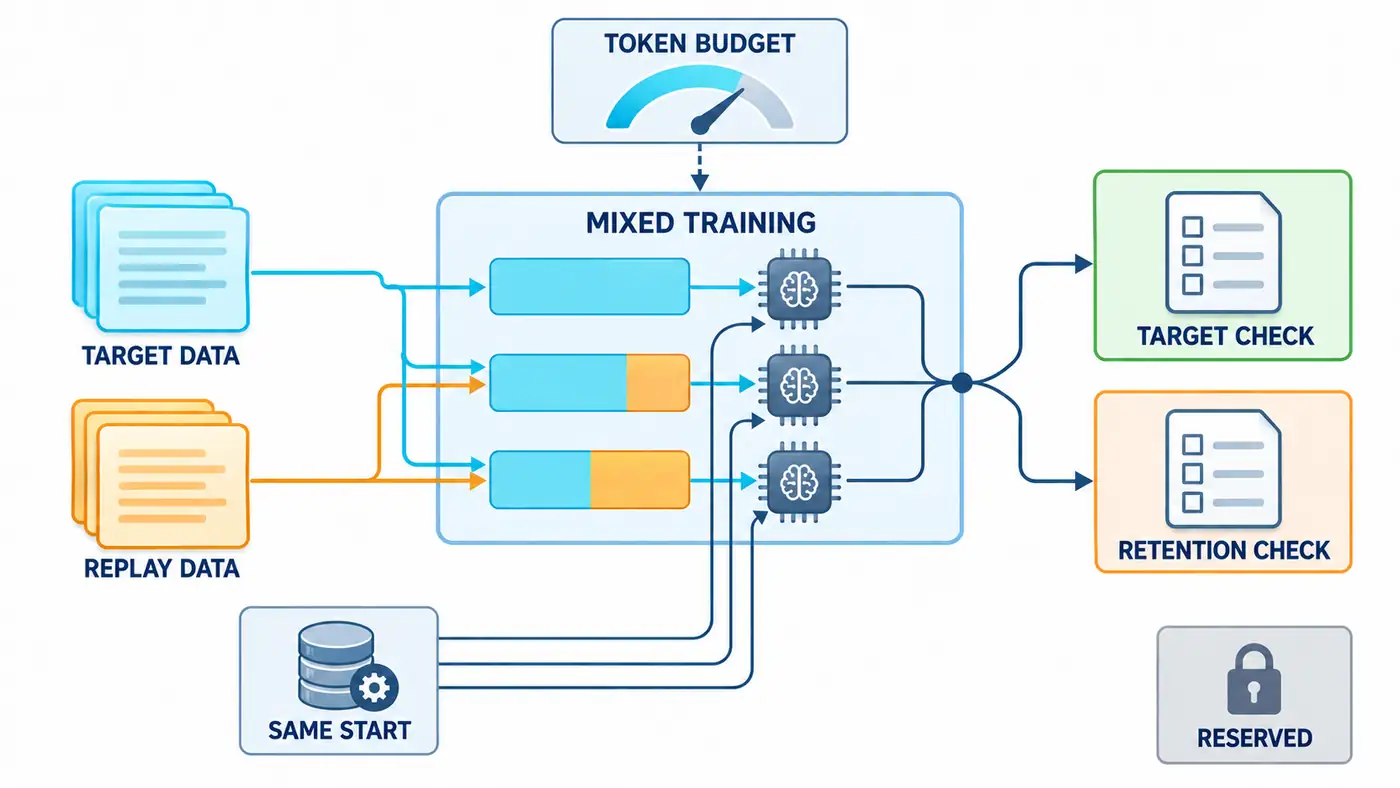
The cyan data enters three groups, and the orange playback only enters two mixed groups; the three models are independently initialized from the same weight. The two tasks on the right side are measured at the same time, and the confirmation set is isolated from the training. The figure is not drawn half aid group, and its budget is shown in the table.
A guide to the official implementation
Read the fixed model first tokenizer_config.json and Transformers apply_chat_template, confirm that the generated prefix is consistent with the full training sequence by ID. common.py/build Emotional templates, mixture.py/news_build Added letter answers. Real EOS and PAD are exactly the same as ID 2, and the end supervision can be retained according to the length mask, and all ID 2 cannot be deleted.
Read after LlamaForCausalLM.forward、ForCausalLMLoss: The label is not shifted in advance, and the next token is aligned inside the model. [3] The micro batch input shape is [2,L], logits is [2,L,49152], the last dimension is the vocabulary. The difference between independent shift cross entropy and official loss is saved batch by batch; the weight of the four micro batches of news is one.
Last look at PyTorch SGD.step Greedy with the generator to select the branch. True reasoning, losses and updates are called official implementations; sample selection, scheduling, masking and evaluation are self-written teaching codes. The source map fixes the commits, functions and line numbers of Transformers 4.49.0 and PyTorch 2.6.0.
A minimal experiment and evaluation protocol
The model and tokenizer revision are 12fd25f77366fa6b3b4b768ec3050bf629380bac; SST-2 is 8d51e7e4887a4caaa95b3fbebbf53c0490b58bbb; ag News is eb185aade064a813bc0b7f42de02595523103ca4. Twenty resource files have actual SHA-256. Cache identity includes model, tokenizer, data, hints, template, decoding, configuring and executing source code hashing.
The emotional training pool uses 32 lines of 090, which alternates negatively; the development set is still the original sixty-four lines, and one hundred and twenty-eight confirmed samples have not been reasoned. [4] The news label corresponds to the world, sports, business, and technology, and outputs A/B/C/D respectively. [5] Fix the Parquet row position number first, and then press within each category SHA256('91:'+idx) Sort: Train takes eight lines each; test takes the first eight lines for development, and then reserves sixteen lines. Therefore, news measurement is a development subset of 32 categories balanced, and it cannot be called a complete test score. There are 192 articles for confirmation data.
The internal and corresponding development and confirmation sets of the training pool are completely repeated through normalization; this does not rule out the pollution of near duplication, article association or pre-training. The news comes from a fixed image of the public data provider, and the original task author and the package provider are signed separately. The reserved sample only checks the index and coincides, and does not send it to the model.
| Condition | Emotional/News Updates | Two types of supervisory tokens | total input token |
|---|---|---|---|
| target only | 64 / 0 | 1024 / 0 | 10,556 |
| 25% playback | 48 / 16 | 768 / 256 | 25,477 |
| 50% playback | 32 / 32 | 512 / 512 | 40,398 |
| Half-volume target assist group | 32 / 0 | 512 / 0 | 5,278 |
The first three groups are fixed with 64 steps and 1024 supervisory targets; the last group only matches the target exposure of 50% of the playback, which is used to check the explanation of the "less training target". The playback is performed according to the cycle of the target news and target news, and each task is cycled in the freezing row sequence; the two task training pools each have 32 lines, and there is no development set playback.
All four groups were loaded from the original weight, 134,515,008 parameters participated in SGD, the learning rate was 0.001, no momentum and attenuation, clipping threshold one; SEED 91, CPU float32, four threads, eager attention. eval The mode turns off the random module, but the training reserves the automatic derivation. Fixed final step evaluation, no early stop, no selection is the best check point. Greed produces up to 32 new tokens.
The main indicators are the combined accuracy of the emotional JSON and news letters, that is, the format is correct with the label at the same time. In addition, the content agent of ordinary emotional answer, format rate, and unique explicit label is reported; the latter is not an artificial semantic gold label. The selection rules are prescribed in advance: the correct number of news is at least reduced to the baseline, and then the JSON joint is maximized; the lower playback ratio is selected in parallel. Execute this rule only in the development set.
Actual Result: Mix does not protect visible behavior
| Status | Normal emotion is correct | JSON format passes | JSON joint is correct | news union |
|---|---|---|---|---|
| Before training | 57/64 | 0/64 | 0/64 | 8/32 |
| target only | 33/64 | 64/64 | 58/64 | 8/32 |
| 25% playback | 34/64 | 64/64 | 58/64 | 8/32 |
| 50% playback | 34/64 | 59/64 | 51/64 | 5/32 |
| half target | 55/64 | 61/64 | 51/64 | 8/32 |
Only the goal and 25% replay are the same, although the total score of the JSON is the same, there are still one win, one loss, and 62 draws in one case; the same score cannot be written as a completely consistent behavior. The two correct samples of the news are the same as the baseline. The pre-determined rule selection is only the goal, and the meaning is that this group is simpler under the current constraints, not to prove that zero playback is generally optimal.
50% of the playback relative to baseline news is 2 wins, 25 draws and five losses. The format has been upgraded from 30 articles to 32 articles: the improvement of the format has not brought about improvement in content. The baseline 30 outputs A, and the other two are not legal single letters; 50% of the playback becomes twenty A, nine C, three D, no B. Equilibrium training labels do not guarantee the generation of distributed equilibrium.
The original label of the news index 2853 is the world, and the output changes from A to C; the original tag of 6105 is business, and the output changes from A to C. The same output change can cause losses and gains separately on different samples. Comparing one by one is more binding after the story of "diversity increases, so it's better". There is no manual re-labeling of news semantics.
The half-volume target group and 50% of the JSONs played back are 51/64, and there are one win and one loss in one case; Joining the news not only reduces the target training, but also changes the optimization path and additional supervision; this experiment cannot isolate whether it is task interference, sequence or alphabetic convention.
Troubleshooting and limits of the evidence
The most important failure is to measure the floor. Eight articles in each category of thirty-two news, always answer A, and get eight points; the current baseline has not established reliable news capabilities. The same eight points cannot prove that the old ability is well preserved, and the decrease of three points cannot be directly called catastrophic forgetting. After seeing the low score, change the task, prompt or label order, until you find a beautiful curve, you will package the development exploration into a pre-inspection. Therefore, the task is reserved according to the agreement this time, and the diagnosis failure is clearly reported.
There are also real failures in the project: the initial preprocessing was found on the news line 112808, and the model has not been loaded. After keeping the failure log, only the upper limit of news training is changed to 512, and the sample is not truncated or replaced; the upper limit of emotion remains unchanged. This is a resource revision before reasoning and has been appended to the protocol. Successfully tested 14 steps, 40 generations, and then estimated official resources, and did not change the budget according to the score.
The formal experiment was generated with 224 steps and 800 times, and the total time after importing was 223.41 seconds, and the peak RSS was 5.63 GB. The four groups of training are about 20.90, 38.80, 60.89, and 10.47 seconds; the GPU memory is not measured. The full parameter checkpoint is left locally, and the file hash and nonzero weight changes are logged. Independent audit rebuild masks, task schedule, budget, original answers and labels; no grammar is used to replace real training. Single-seed, tiny subsets and category quotas do not support overall significance or cross-platform consensus conclusions.
Code and instructions for reproducing the results
The source code of this article has been published publicly: Source tree at the pinned commit、README and run instructions、SOURCE_MAP official source code correspondence. The fixed version is 7bd49bd7d6c1; Please use the commit to reproduce, avoiding the master branch change.
Install fixed dependencies in README, execute python prepare.py --cache ./cache After, the minimum entry is python run.py --cache ./cache --out smoke-new --private ./private-new --smoke. Products include task indexing, step-by-step budget, out-by-case output, indicators, resource records and checkpoints; run again python audit.py --cache ./cache --out smoke-new. Remove the test run parameters to reproduce all four groups, and the cache will check the hash again.
This article retains the full original output; both data card licenses are unknown, and the distribution package does not include original movie reviews, news, input tokens, weights or environments. Individual models answer the news, the public verification record only keeps the hash and derived scores of these answers, and the original version is privately archived; the actual running of the script will generate a complete new record. The rest of the answers can be audited one by one, and the records that have been deleted cannot be pretended to be public original texts. Both the decompression and public dungeons are additionally operated to the minimum and real.
Testable research questions
The first explanation is that the news letter mapping is not suitable for the model. The next article can fix semantic matching of semantic matching on independent development materials, alphabet mapping and template variants, and measure the format and content respectively, and Complete the manual label maintenance check first; if the text category is significantly improved and the letters are still biased, the explanation of "the model does not understand news at all" is weakened. Those who have not yet completed the trial cannot be called the gold standard in advance.
The second explanation is sequential and task gradient conflicts. After the exposure of the two tasks is fixed, the alternation, division and different orders are compared in advance, and then multiple seeds are made; if the degradation only occurs in a certain order, the simple ratio explanation is insufficient. All development attempts need to be registered, and the existing confirmation set will continue to be sealed, and the final inspection cannot be modified after reading the failure.
Summary
This article does not get the positive result of "playback protection old ability". It delivers re-running mixed experiments, and also recognizes a more basic requirement: retention tasks must first demonstrate the measurable ability. Controlled budgets, negative results, failure logs, and competitive interpretations can promote continuous research than packing the same points into forgetting and being solved.
References
Retrieve with actual access date: 2026-10-04.
- HuggingFaceTB, SmolLM2-135M-Instruct Fixed Model Card. Model identity, template and license.
- Suhas Kotha、Jacob Mitchell Springer、Aditi Raghunathan,ICLR 2024, Understanding Catastrophic Forgetting in Language Models via Implicit Inference,v2. Only references its task inference hypothesis.
- Hugging Face, fixed causal loss;PyTorch, Fixed SGD.
- Richard Socher et al., EMNLP 2013, Recursive Deep Models for Semantic Compositionality Over a Sentiment Treebank; SST-2 Fixed Data Card.
- Xiang Zhang、Junbo Zhao、Yann LeCun,2015, Character-level Convolutional Networks for Text Classification; Authors’ repository; This AG News fixed data card. Check the task source, label and current data package.