AI Frontier Observation · Interpretation Date November 9, 2026 · Information as of November 9th, Beijing 20:30:17
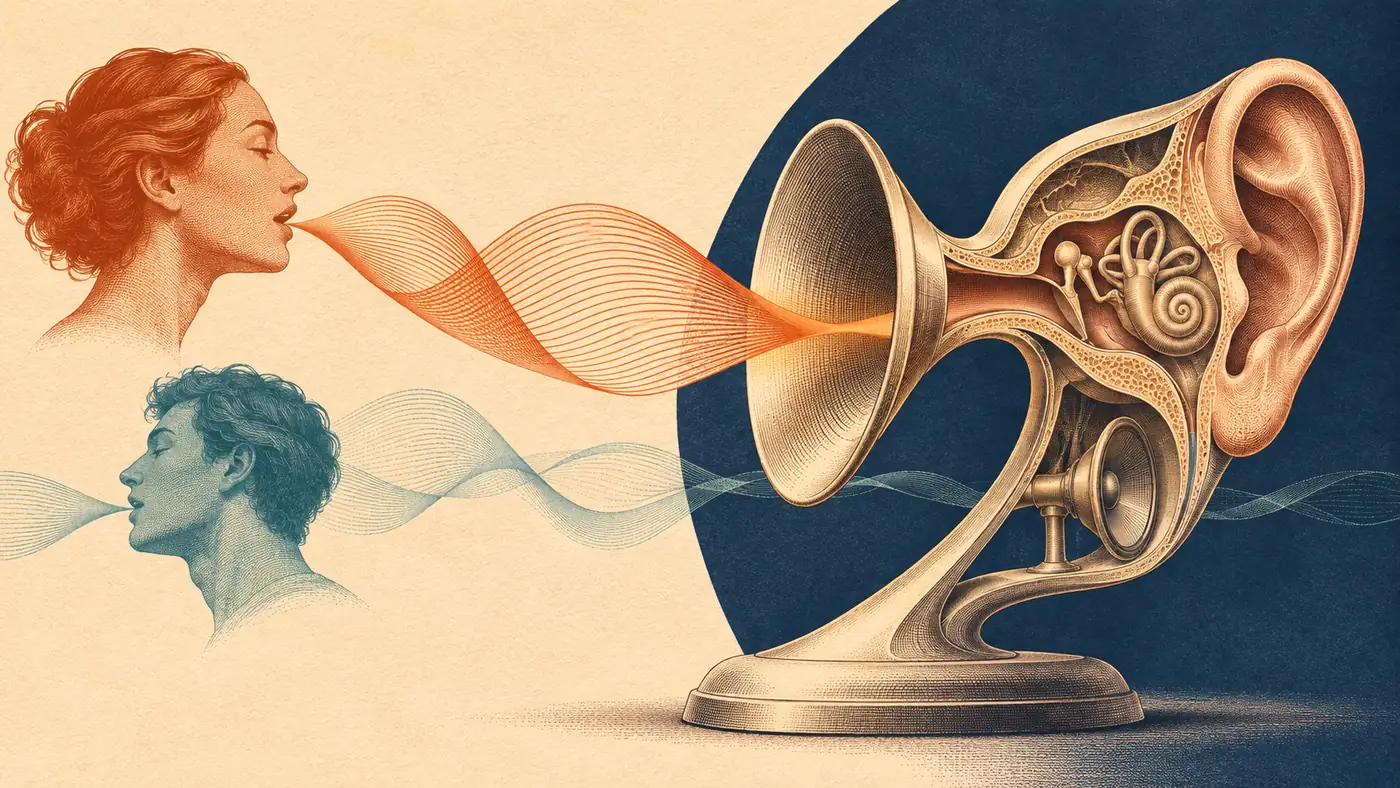
Original concept illustration. The voiceprint in the picture is used to distinguish the speaker.
Your voice assistant is halfway through a sentence when you turn to a friend and ask whether to bring an umbrella. If the assistant gives you the weather, it has mistaken whom you were talking to. If it falls silent and never finishes, you still have to ask it to start again. On November 7, OpenMOSS unveiled its real-time interaction system, MOSS-Live. In the team’s simulated side conversations, it responded to the aside only 2% of the time and continued what it had been saying 68% of the time. The gap between those figures deserves a closer look than a smooth conversation demo. Team Announcement|Full evaluation table
Two things to do at the same time
Full duplex means that the system can still listen to the input when the opening is opened. People often use the sentence "um" to let the speaker continue, and also use the sentence "wait a minute" to ask the other party to stop. Both sounds overlap with the assistant's voice, but the meaning depends on who is talking, who is, and where the previous sentence is said. Even if each word is written correctly in speech recognition, these problems are left to the interactive system.
According to the instructions of OpenMOSS, the foreground model is responsible for listening, speaking and handover rounds, and the background model is responsible for querying, calling tools and long inference. Both share context, memory, and task status. The team used the example of Zhoushan travel to explain this division of labor: when checking the hotel in the background, users can still ask for ferries and parking at the front desk, and may temporarily change the hike to the beach. Finding the hotel is only one step in the middle. When the assistant is ready to speak out the result, whether the destination and the conditions of concern for the user are still valid, and then decide whether the result is useful. This is the team's description of the demonstration scene, and the actual experiment date has not been disclosed. System Design and Demonstration Instructions
Where did the other 30% go?
Full-Duplex-Bench (FDB) v1.5 specifically constructs scenes with overlapping sounds. Among them, in the category of "users talk to others", the benchmark author synthesized 100 words for others to listen to others in semantics, and then lowered the volume, weakened some high frequencies and added reflection sounds, and simulated people turning their heads and leaving the microphone. The original plan first transcribes the system's answer, and then uses the automatic referee to judge what it has done. In addition to answering the interjection and continuing to speak the original words, it is also allowed to be classified as "indicating uncertainty" or "unabled"; the latter includes silence and answering unquestioned questions. Benchmark Section 2
Now you can read the numbers at the beginning. The denominator is the evaluation sample in the sub-task on the same side. According to the team table, the two ratios of MOSS-Live are 70%, and the remaining about 30% do not fall into these two items. The summary table does not give the remaining answers one by one, so these three Chengdu cannot be counted as silence. Switch to the user who really wants to interrupt the assistant's sub-task, and the expected behavior will be turned over. The proportion of MOSS-Live responses is 84.50%, and the Qwen Audio 3.0 Plus of the same table is 97.50%. Only the low response rate in the side talk will miss the moment that users really need to grab the call round. Project repository FDB v1.5 sub-item table
For those who listen, the costs of these categories are also different. The assistant briefly confirmed whether he was calling it, and the user still had a chance to correct it; the assistant stopped silently, and the user had to first notice that the conversation had been broken. The original benchmark lists the former hesitation list, and also allows short confirmation when the speaker is unclear. If you want to judge how many of the 30% need to be re-initiated by the user, at least you have to hear which sentence it stops at, and what the user does next. Behavioral Definition of Benchmarks
The acoustics limit what we can infer. In the side-conversation examples, both the meaning of the remark and the apparent distance of the voice changed. A system that recognizes “that was addressed to someone else” and one that simply keeps talking whenever the voice sounds farther away could earn the same score. The aggregate rates cannot distinguish those explanations. Have the same person address the assistant and a companion at the same volume while facing the same way, then compare response rates. That would come closer to testing whether the system can tell whom someone is addressing. Side-talk sample construction method
How far is it after choosing the right tool?
In addition to the front desk interaction, the team also gives the results of the task side. In the six participating systems of FDB v3, the success rate of MOSS-Live and Doubao SeedDuplex is 51%. MOSS-Live's tool selects F1 as 95.68%, and the parameter Accuracy is 72.17%. F1 Comprehensively measure how many tools you have selected, and how many are selected is correct. It is different from the scoring unit of the task success rate, subtracting the two percentages, and it is impossible to get how many calls are dragged down by the wrong parameters. That needs to be linked to the selection, parameter transmission and execution results of each task. Project repository FDB v3 sub-item table
This also leaves a specific research question. If a hotel inquiry uses the correct location and date, the user has changed his mind during the waiting period, the call itself may be completely correct. The assistant reads out the old results, and the entire interaction will still make people disappoint. The public table evaluates the success rate of the tool call and the speech wheel behavior respectively, and the success rate of the combination of "User Correction Conditions at Not End" can not be read from these two groups of summaries. The official provides experience entrance and interface guide; this article is interpreted according to the announcement and evaluation table, and no independent retest for this group of numbers was found in this search. Official Experience and Information Entrance
A failed recording worth keeping
The next most worth seeing material is to align the failed recording and background task records by time. Let the user say the same location twice in the same query, the first time to the companion, and the second time explicitly changed the command to the assistant. Record by round, when the assistant will give up the call round, whether the background adopts a new location, and which result will be broadcast in the end. Even if you answer wrong twice, you can distinguish whether the listener identification, task update, or the check when the old results are returned to the foreground.
The numbers given by OpenMOSS have made a general impression testable: in the controlled side talk, there is a measurable distance between taking the wrong words and the smooth continuation. If the independent evaluation can retain this advantage in the natural multi-person recording and track the final result after the user's temporary change requirements, we have more reasons to bring the progress of the experimental table to the conference room.
References
- OpenMOSS Release Notes and System Design
- MOSS-Live Project Repository and Complete Evaluation Sheet
- Full-Duplex-Bench v1.5 Benchmark Author Papers
Apps by the author
I also build small tools for everyday life. Here are two of my apps:
- Daily Expense Journal: Track your income and spending, plan a budget and set savings goals. View on the App Store.
- One Small Action: Pick a small action that fits the time and energy you have today, then record how it felt and what you noticed. View on the App Store.
Find more articles and projects on my website: zffjzz.top. I’d love to hear how the apps work for you and what I could improve.