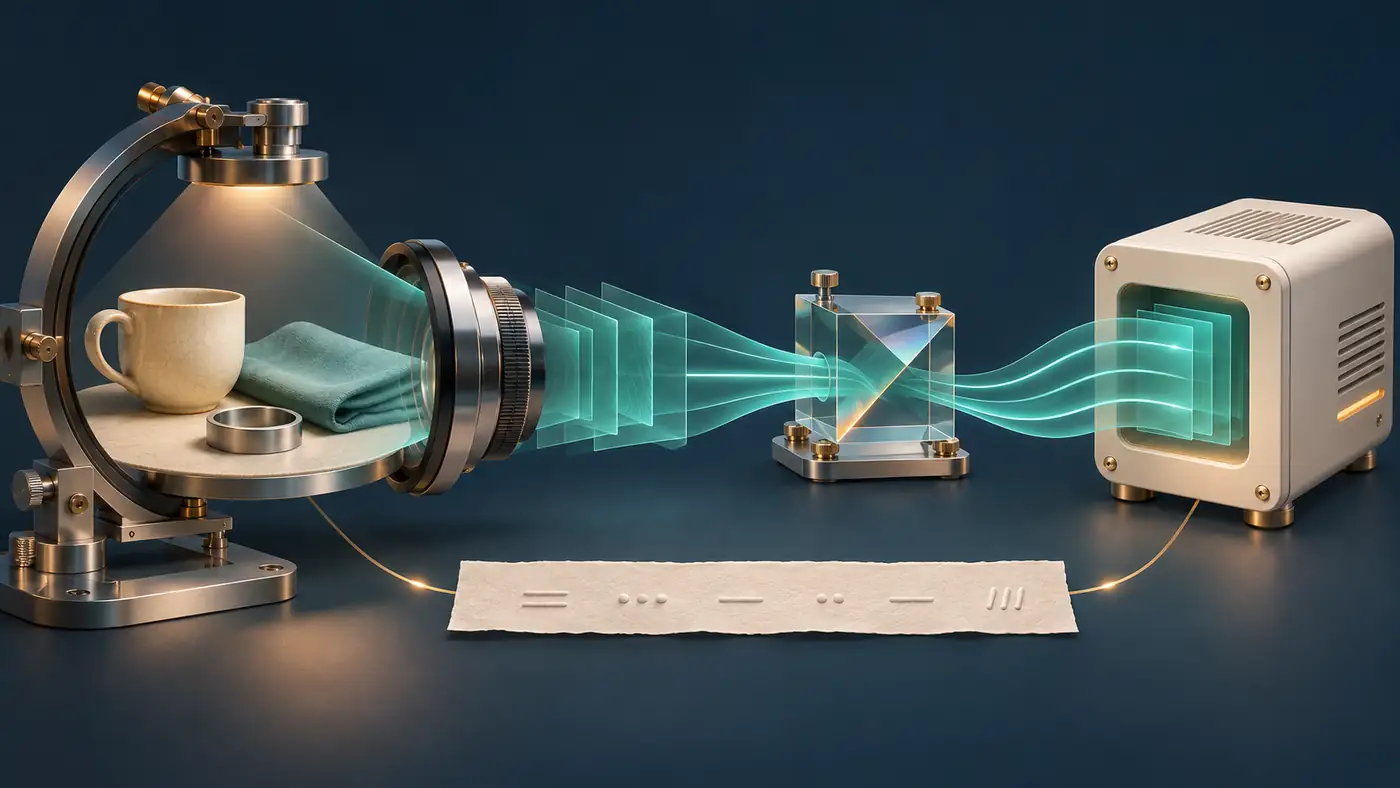
The concept of the cover is a concept generated by AI, and the optical device is just a metaphor, not a paper architecture, experimental equipment or performance results.
Interpretation date: 2026-11-02
Data deadline: 2026-11-02 20:33:09 (Beijing time, Asia/Shanghai)
At 21:53 Beijing time on October 30, Mo Shahdloo and colleagues submitted Latent-Lens to arXiv. It explores whether a vision-language model can pass hidden representations directly to a small language model. The work became public within the past three days, before today’s article. Its question is simple: must what one model sees first be put into words before another model can use it? Paper and revision history
From describing a graph to passing an internal representation
Imagine the cooperation of two research assistants: one is looking at the picture, and the other answers the question. If the former only says "the cup is on the table", it is difficult for the latter to judge the orientation of the cup handle, the occlusion relationship or the position of the object next to it. This is an information interface problem: no matter how strong the recipient's reasoning ability is, it cannot restore the evidence that the sender did not send out of thin air.
A hidden representation is a set of numerical features formed when the model processes input. The Latent-Lens maps the representation of the visual model to the input that the receiving model can use with a trainable interface, and adds a small-scale LoRA adaptation; the weight of the basic model remains frozen. Methods Chapter
This idea is worth studying, because it breaks the "how strong the model itself" and "how the two models cooperate". A different interface may improve the use of information, but it does not mean that the receiver has grown an independent visual system out of thin air. A more accurate understanding is that the entire combinatorial system has obtained another channel to deliver evidence.
There is also no way to think of numerical features as lossless telepathy. Compression, mapping, and training may all lose information. The advantage of words is that people can read, check and revise. Therefore, the scientific research problem is not which language is more advanced in advance, but after clarifying the task and resource constraints, it compares which information is retained and which errors are magnified.
How much to improve depends on who you compare with
The authors reported on CLEVR that the Accuracy of Latent-Lens is 81.0%, the frozen text communication is 11.2%, and the text communication with LoRA is 58.3%. On GQA, Latent-Lens and text plus LoRA are 65.4% and 61.8% respectively. These are the results reported by the authors. Comparison in the summary
The same result can correspond to very different statements. Compared with the weakest baseline, the reader sees a huge jump; compared with the task-trained baseline, the problem becomes how much additional benefits can be contributed to the interface. Both comparisons are useful, but cannot be interchanged. The freezing system may be subject to the communication method and the receiver is not suitable for the input, and cannot give all the gaps to the text.
Check what the parameter budget counts. Table 1 of the full paper lists 300,000 trainable parameters for text plus LoRA and 1.6 million for Latent-Lens, including its mapping module. For the trained conditions, the authors report the mean and sample standard deviation across three runs. Experimental Settings and Table 1
Therefore, the "same LoRA budget" cannot be abbreviated as "the same total training budget". The amount of parameters is not equal to computing power: different input length, training steps and intermediate representation will affect actual resource consumption. A reasonable follow-up control should explain the adaptation capacity and the complete calculation cost at the same time, instead of just aligning one of the numbers.
Two benchmarks, answering different questions
The original project of CLEVR emphasizes the visual reasoning that can be diagnosed, and uses problems such as object attributes, counting and spatial relationships to locate the shortcomings of positioning ability; its CoGenT settings also specifically change the attribute combination to test whether the model can handle new collocations. CLEVR project page
GQA builds a combination problem around real images, and uses scene diagrams and answer distribution control to reduce the opportunity for the model to take advantage of language preferences to guess answers. GQA project description
The significance of these two types of tests cannot be simply averaged. The controlled scene is easy to split errors, and the real photos are closer to the daily visual complexity; but neither of them can automatically represent document reading, microscopic images or robot operations. For scientific readers, the benchmark name is only the entrance, and what really needs to be asked is what changes the test sample covers, and whether there have been similar combinations in the training.
The judgment in this paper is that the next step is more valuable work than continuing to stack the average score, and is to check the gain by question type: the improvement mainly comes from counting, attribute recognition, or multi-object relationship? If it is only effective on one type of question, it may still be a useful method, but the interpretation of the mechanism should be narrowed accordingly.
More difficult to read messages require more specific checks
Errors in text interfaces can often leave a readable record; potential representations are more difficult to be directly reviewed by humans. This does not mean that it must be unreliable, but requires different diagnostic methods.
For example, you can keep the problem unchanged, only replace a key object in the figure, and observe whether the answer changes with the evidence; you can also disrupt the sender's output to check whether the recipient has used this channel. These are the follow-up tests suggested in this paper, not the experiments claiming that the paper has been completed. A good communication mechanism should convey information related to the question, not just make the answer on the Training Set easier to predict.
Likewise, longer text descriptions, structured object tables, and interfaces that allow recipients to ask questions are worth the comparison. If only one short answer represents all text communication, the coverage of the research conclusion will exceed the experimental design.
Leave progress where evidence can support
This paper is listed in the official download catalog of NeurIPS 2026, and the arXiv page also marked the meeting information; this time, the specific meeting entry could not be opened, and the review comments could not be read, and the catalog could not be included as an independent reproduction. Official conference directory
This retrieval was not found to confirm that it belongs to the public realization or independent reproduction of the research, and there is no running experiment in this article. The full text, abstract and conference catalog of the paper play a different verification role, and it is not the three teams who have verified the results.
The more secure judgment at this stage is that Latent-Lens provides a worthy test interface scheme for the cross-model transmission of visual information. Next, we should pay attention to whether the fixed configuration and the code are public, the stronger text interface and the similar total budget are established, and whether the new model matching and task can maintain benefits. Only when these evidences are gradually replenished can it be suitable for elevating a group of experiments to more common communication principles.
References
- Latent-Lens: Abstracts, Authors and Submission Records
- Latent-Lens v1: Methods, Experiments and Appendixes
- CLEVR: Original project and CoGenT description
- GQA: Original dataset description
- NeurIPS 2026 official download directory
Apps by the author
The following is the author's own product promotion. In addition to writing a technical blog, I have also independently developed two daily gadgets, welcome to understand: Daily Expense Journal Used to record revenue and expenditure, arrange budgets and save goals, View on the App Store; One Small Action Help you choose small actions according to the current time and energy, and record your feelings after completion, View on the App Store. More technical articles and personal works, welcome to visit Author personal website. These works are not technically related or endorsed by the study of this article.