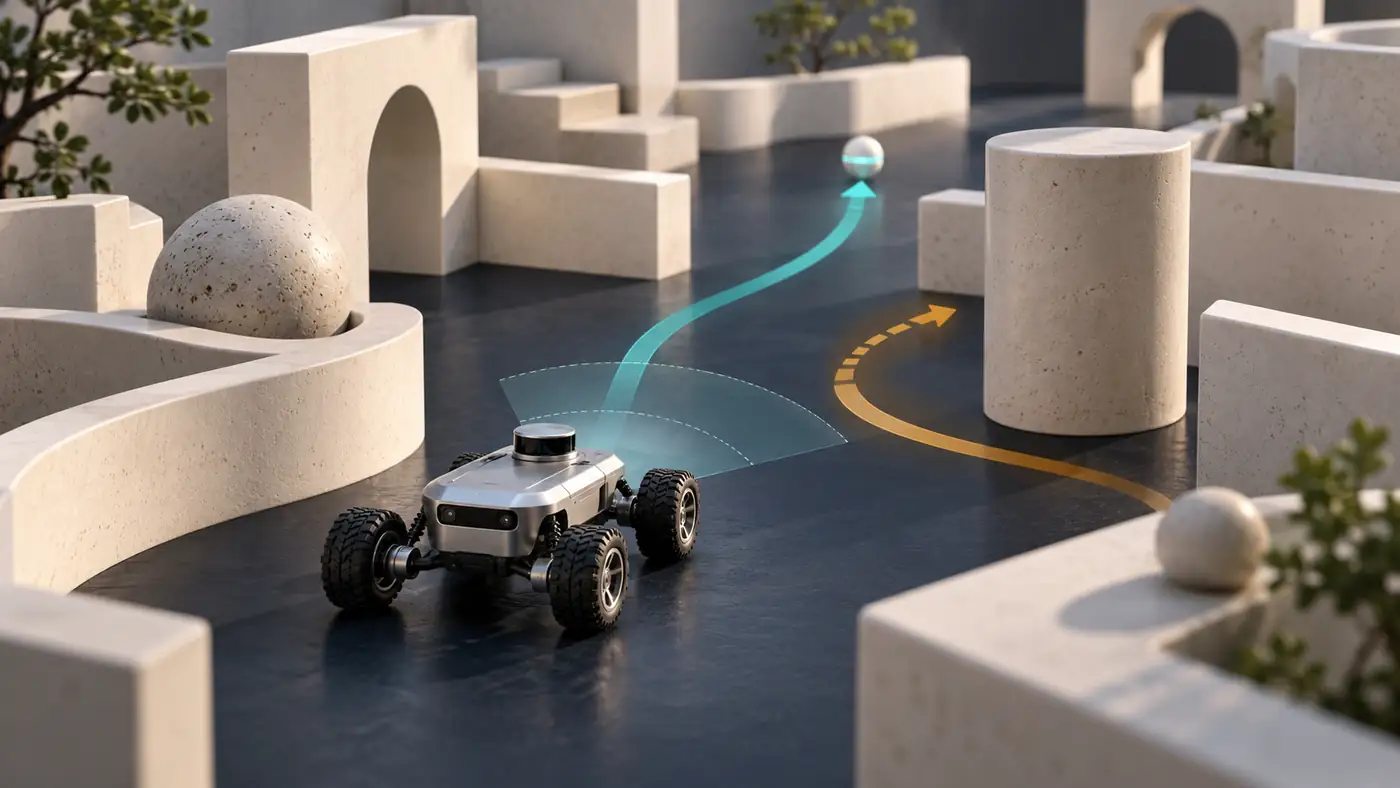
The concept of the cover is a concept generated by AI, not the original diagram of the paper, the real robot experiment or the actual control architecture.
- Interpretation date: 2026-10-28
- Data deadline: 2026-10-28 20:30:15 (Beijing time, Asia/Shanghai)
At 14:55 Beijing time on October 26, Bing Sun and colleagues submitted the LECO preprint. It explores how a mobile robot can learn to issue control commands directly while retaining predictive checks and a conventional controller as a fallback. The study appeared within the past three days. If some of the work normally done by an online solver moves into training, can the robot still track a trajectory steadily, and can the fallback take over when tracking gets difficult? Papers and Submission Time
What is learned is movement, but what is evaluated is the consequences of action
Imagine a robot turning in the hallway with a man. The shortest route is not necessarily the best: walking against the wall may lose its vision, and suddenly acceleration may bring violent bumps. What really needs to be coordinated is the target distance, visibility, obstacles and motion smoothness.
LECO predicts a sequence of control commands. A differentiable kinematic model then computes the resulting trajectory, and the task cost along that trajectory provides the signal for training the control policy. “Differentiable” means we can trace how a change in an action affects the outcome through the computation. Expert guidance helps early in training and gradually tapers off. Methods Chapter
This direction does not appear out of thin air. The previous YOPOv2-Tracker has explored the cost of trajectory directly for network training and verified on the quadrotor; it expresses tissue prediction through the intermediate representation of motion primitives. Preface Study Summary The two work together point to a research question: Should physical and geometric knowledge be left in the external solver, or should it enter the learning process?
The judgment of this paper is that the value is not "neural network replaces mathematics", but in the position of rearrangement of calculations. Making less iteration online does not mean that the system no longer depends on motion models, training data or carefully designed goals. To evaluate this method, it is necessary to put offline input and online behavior together.
For the same percentage increase, first ask who you are compared to
The original text has a caliber difference that is easily concealed by abstract reading. Abstract writing smoothness index improvement 14.1%—31.2%. The data of the body table I shows that this range corresponds to the complete method. LECO's own Ablation version, not relative to external methods. The external baseline improvement range in the additional column of the text is 33.2%—47.6%. Summary and Table I
In the densest setting, root-mean-square linear jerk was 27.63 for the full method, 32.18 for the ablated version, and 52.70 for the best external baseline, all in meters per second cubed. Relative to those two comparators, the reductions were about 14.1% and 47.6%, respectively. Jerk measures how quickly acceleration changes. A lower value indicates smoother motion, but it tells us little about the percentage improvement in overall performance.
The more appropriate treatment here is to preserve the specific comparison object, point out that the abstract wording is not clear enough, rather than picking a more eye-catching number. For scientific readers, the percentage is actually a compressed experimental description: who is the denominator, what the task is, and what the direction of the indicator is. If one lacks one, it may be read as another conclusion.
What kind of system does the success rate belong to?
Under the simulation conditions of 150 obstacles, the paper reports the complete system success rate of 86%; each density is 50 trials, and the success condition is that there is no loss of the target that lasts for more than 4 seconds. The complete system includes predicted security locks, and if necessary, transfers to the Hybrid A* and model prediction control branches. Experimental definition
Therefore, this result is "how to complete the task of the whole system". It cannot directly prove that the neural strategy is solely responsible for all difficult decisions. Average control ratio is very high, and it does not necessarily mean that the spare branch contributes very little: a few take over may happen just at the moment of determining success or failure.
This article also wants to see the evidence that the incident is opened according to the event: when to lose the goal, when to start taking over, how long to recover, and whether new collisions or emergency stops have been introduced before and after the takeover. Such records can distinguish two possibilities - the strategy itself is more reliable, or the system is better at recovering from policy errors. Both advances are worthy of recognition, but they correspond to different research directions.
The display of the two platforms is not a general migration
The paper trains strategies for different platforms and reports indoor and outdoor tests. The presentation cannot therefore be understood as the same set of weights migrate directly across the robot. The current material is a preprint; the paper indicates that the code will be disclosed, and the verifiable LECO author code repository is not found in this search, and this article has not run the experiment. Original Experiment and Availability Instructions
For reference, the author repository of the preorder YOPOv2-Tracker already lists simulator, strategy test and hardware data. I only read the repository instructions here, and did not verify its running results; it is not an implementation of LECO. Authors’ repository
If the subsequent public materials can be delivered in training configuration, complete failure trajectory and takeover log, the reader can turn the "look smoothly" in the demonstration into a verifiable problem. In particular, you need to know which parts must be retrained and which parameters need to be re-trained when changing the map, changing the sensing conditions, or changing the target motion mode.
What is the next step to see the evidence to move forward?
My conditional judgment is that LECO provides a control learning solution worth tracking, but the most convincing object is still a hybrid system with a clear task definition. It is not enough to support the conclusions that are universally safe or common to any platform.
The next step is to first see if the external team can reproduce the results under the same conditions, and then see whether the perception error, delay and the environment are still valid after adding the perception error. The time-consuming and training cost of the entire link should also be reported during comparison, and avoid misreading a strategy calculation as a complete robot response speed. If these evidences are gradually supplemented, we can judge which improvements come from the control laws learned and which comes from the protection and recovery capabilities provided by the system design.
References
- LECO paper abstract and submission record, 2026-10-26
- LECO V1 full text: method, table I, experimental definition and code description
- YOPOv2-Tracker Original Preprint Summary, 2025-05-11
- YOPOv2-Tracker author code repository and instructions
In the above entrance, the first two are different reading entrances of the same study; the last two are the preamble method and its supporting materials, which do not constitute an independent verification of LECO.
Apps by the author
The following is the author's own product promotion. In addition to writing tech blogs, I'm also independently developing some small tools that make everyday life more organized:
- Daily Expense Journal: Record the daily income and expenditure, arrange the budget and savings goals, and give every money to think of a good place to go. View on the App Store.
- One Small Action: Choose small actions according to the current time and energy, record the feeling after completion, and make the action and review easier to start. View on the App Store.
Find more articles and projects on my website: zffjzz.top. These are the introduction of independent daily tools, and there is no endorsement with the research and research team of this paper.