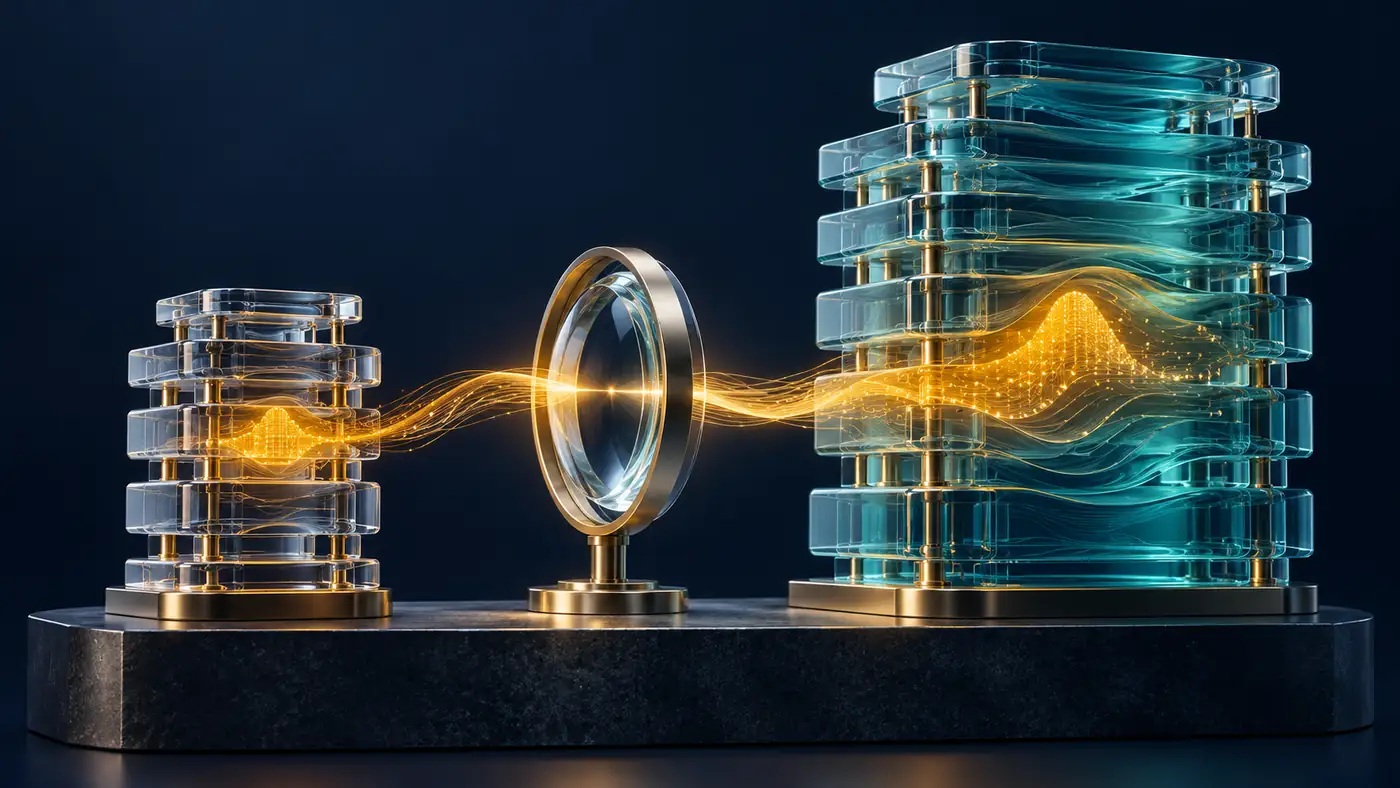
The cover is a concept of AI generation, and the optical device is only a metaphor, not a paper architecture, real device or experimental data.
- Interpretation date: 2026-10-26
- Data deadline: 2026-10-26 20:29:35 (Beijing time)
At 21:08 Beijing time on October 23, Filippo Rinaldi and colleagues from Italy’s University of Modena and Reggio Emilia and the University of Florence submitted the Ariadne preprint. The study, released within the past three days, explores how to reuse the effects of fine-tuning across Transformers of different sizes. When we switch models, can we transfer previously learned task behavior and save some of the work of training the new model? Paper and revision history
Is it a parameter, or a change?
First look at an existing concept: Task vector. Task Arithmetic study subtracts the parameters before fine-tuning with the model parameters after fine-tuning, and uses this difference to represent the update brought by the Task, and explores the change of behavior by adding and subtracting these updates. Summary of the original research
This idea is to save the revision record for the same book: which page and line are changed, there are corresponding positions. However, if you change to another book with different typesetting and chapter numbers, it is no longer natural to paste the revision records directly. When the number of layers of the model and the width of the internal representation change, it is also necessary to answer "the modification here, what does it correspond to there". This metaphor is used to illustrate the problem, and does not mean that the neural network really stores knowledge by chapter.
Earlier theses of the same team have studied cross-width migrations and handles updates with the aid of internal representations. Therefore, Ariadne cannot be described as the first thought of reuse the result of fine-tuning. Theseus Summary and Version Records
Ariadne's specific method is to observe the activation difference before and after the source model fine-tuning, first align the representation of the source and target model, and then use ridge regression to find the parameter update of the target model itself. Activation is the internal value of the model when processing input; ridge regression is to add constraints when fitting changes to avoid over-magnification of the solution. methods part
What do you still need to pay for "exemption"?
The author calls it a training-free method, but the process still needs to calibrate the input, extract the internal representation and solve the update. Its meaning should be understood as bypassing duplicate iteration fine-tuning, rather than not requiring data or calculations. Methods and Restrictions
This also allows it to form an interesting comparison with knowledge distillation. The classical work of Hinton et al. studies how to compress the knowledge integrated into a single model; both routes are concerned about the reuse of the learned results, but the way to obtain supervised signals and construct the target model is different. Distillation Original Paper Abstract
This article believes that the subsequent comparison should first list the available resources: whether the source model weight can be accessed, whether the internal state can be read, whether there is a sample of the original task, and how many targets are allowed to calculate. If one method has additional internal access, the other can only see the output, and it is difficult to explain the difference just by looking at the final score. Researchers need to compare choices under the same conditions, and also need to acknowledge that certain methods are applicable to different conditions.
Costs should also distinguish one-time construction overhead and long-term use overhead. A migration is slow but can be reused, and each answer has to be calculated with additional calculations, which is a different trade-off. Excluding calibration and fitting out of timing makes "how much" lose its full meaning. These costs are not measured in this paper, nor do they refer to an acceleration multiple that is out of the experimental caliber.
What is the result of a row of mathematical migration reminded?
In Table 3, the authors report that transferring the Qwen2.5-Math 1.5B update to a 0.5B target raised the mean of the GSM8K Strict and Flex scores from 33.22 to 34.15. The same table gives 32.20 for Theseus and 34.01 for BiCo. This result concerns one transfer setting. It cannot establish that the smaller model acquired the larger model’s mathematical ability in general. Experimental Table 3
The most important thing to keep in this line is the sense of scale. The average score has increased, and there is still a big distance between the ability of the complete inheritance source model. Scientific readers can continue to ask: which questions are added, whether the original answered questions have regressed, and whether the differences between different samplings and calibration sets are stable? These are the verification problems proposed in this paper, not claiming that the paper has completed the corresponding inspection.
It is also necessary to avoid misreading the mean of the ratings as a ratio of the new answering questions. The two answer extraction rules may make different judgments on the same output; if you want to discuss specific error types, you need to predict and score records by question. An average is suitable for generalization of trends, but cannot replace the interpretation of the source of change.
Local correspondence, not equal to the general ability interface
The paper clearly limits the scope of the experiment to the relevant visual and language backbone, and requires representative paired calibration input and model block correspondence, and does not prove that any architecture or modality can be migrated. Conclusion and Restrictions
In terms of research design, the Calibration Set is especially worthy of a separate inspection. Assuming that the internal changes of the two models can be aligned on common short sentences, it is still necessary to verify whether this correspondence is maintained in long text, rare expressions, or another language. This hypothesis example shows that well-fitting and reliable performance at the time of calibration are two properties that need to be measured separately.
I also prefer to see the evidence of "what's migrated". Only observing the increase in the target task may miss other ability declines; only observing the internal representation is more similar, and it is not enough to indicate that the output behavior is improved. Behavioral tests, question-by-question differences and retention capability checks should complement each other. In this way, we can judge whether the reusable task update is obtained, or it is just suitable for the adjustment of a certain group of samples.
Next, see if the borders of mobility can be drawn
There is no clear author code entry or independent reproduction of Ariadne in this search, and there is no running experiment in this article. The current material is introduced in preprints; the meeting reception status of Theseus cannot be transferred to this new work. The entry of multiple papers cannot be counted as multiple independent verifications.
It is worth waiting for the public implementation, fixed version and calibration data description, and repeated inspections across model families and cross tasks. If the advantages remain under these conditions, the Fine-Tuning results may become more reusable research assets. It is also valuable if the benefits are only found between the closest models, and it is also valuable to clearly identify this boundary: it can help researchers decide when it is worth moving and when to re-learn.
References and reading range
- Rinaldi et al.: From Parameter Rebasin to Functional Transfer Across Heterogeneous Transformers. V1 was submitted at 2026-10-23 13:08:33 UTC, that is, 21:08:33 Beijing time; read summary and version records. The date of occurrence of the experiment is unknown, and the peer review has not been verified.
- Ariadne V1 HTML text. Read introductions, method key paragraphs, table 2-4 and conclusion restrictions; check the numbers in Table 3, and review the appendix or review derivation item by item. It belongs to the same study as the previous entrance.
- Ilharco et al.: Editing Models with Task Arithmetic. 2022-12-08 First release, the read V3 is revised on 2023-03-31, and the page is marked with ICLR 2023; the read summary and version information are used for conceptual background.
- Rinaldi et al.: Transporting Task Vectors Across Different Architectures Without Training. 2026-02-13 The first release, the read V3 is revised on 07-30, and the page is marked with ICML 2026 received; the read summary and version information are not independently validated by Ariadne.
- Hinton、Vinyals、Dean:Distilling the Knowledge in a Neural Network. 2015-03-09 Submit, the page is marked NIPS 2014 Deep Learning Workshop; read summary and version information, only used for knowledge reuse background.
Apps by the author
The following is the author's own product promotion. In addition to writing a technical blog, I have also independently developed two apps to help organize daily life. Welcome to understand:
- Daily Expense Journal: Record daily income and expenditure, arrange budget and savings goals, and make each account and plan more clear. View on the App Store.
- One Small Action: Choose small actions according to the current time and energy, record the feelings after completion, and leave a clue to the daily review. View on the App Store.
Find more articles and projects on my website: zffjzz.top. Your feedback helps me improve these tools.