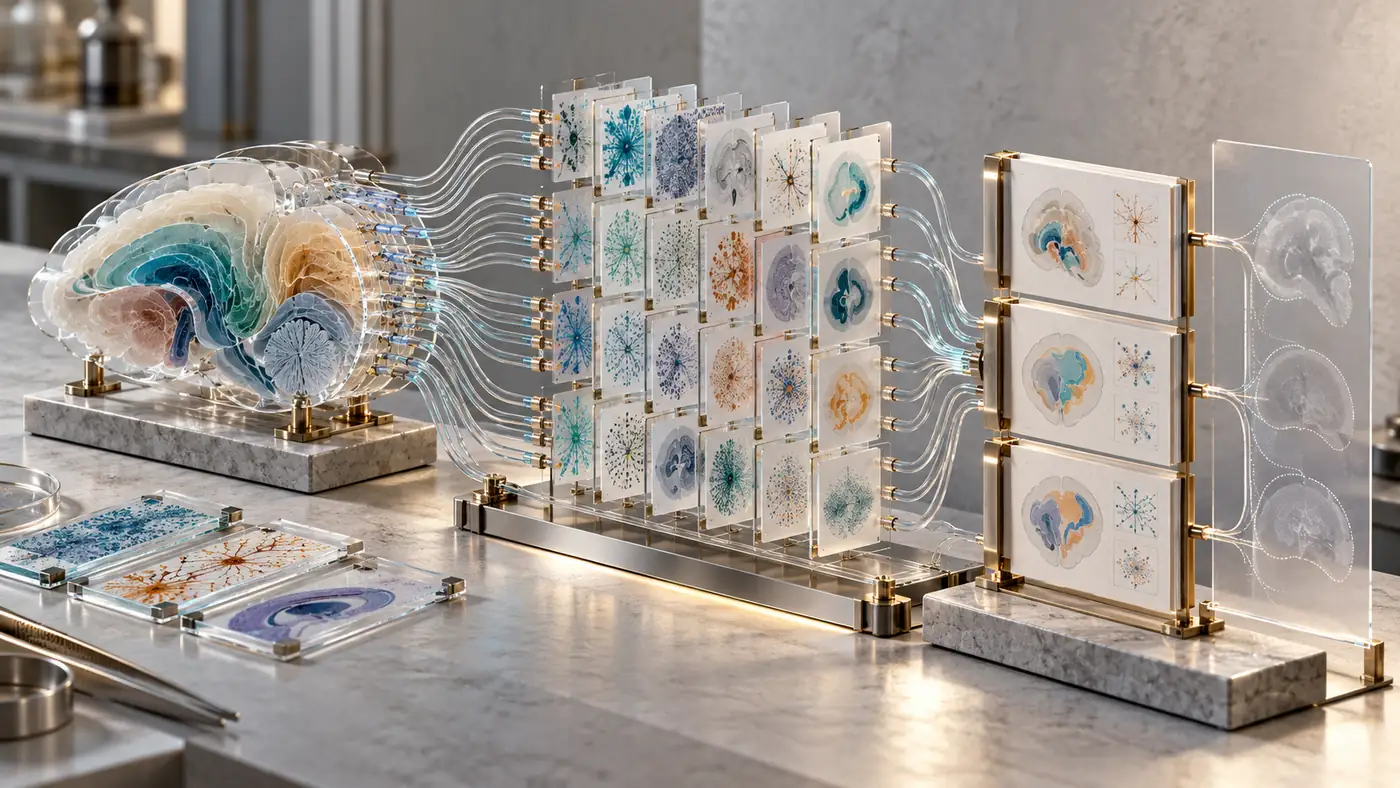
The cover is a conceptual representation of AI generation, not the original image of the paper, the real brain tissue image or experimental results.
- Interpretation date: 2026-10-22
- Data deadline: 2026-10-22 15:27 (Beijing time)
What should we be surprised if thousands of AI agents can comb a huge amount of brain science data in just 32 minutes? Is the model finally able to "independently do scientific research", or does a new organizational method begin to appear in a certain link in the scientific research process?
On October 21, OpenAI announced a collaboration with PerturbAI and Scripps Research. A multi-agent system based on GPT-Rosalind analyzed an existing mouse-brain gene perturbation dataset and organized potential leads for further research. The team’s reported 32 minutes covered the parallel analysis alone. Experimental design and mechanistic validation fall outside that time. Official research introduction
Corresponding preprints are actually October 16 publish. Therefore, this article is interpreting the recent announcement, not claiming that a new paper has just been born today. Preprinted Summary and Release Date
What was the acceleration this time?
Separate the "experiment" and "interpret the experiment" first.
The brain atlas came from earlier experiments. According to the data card, it contains records for about 7.7 million cells. Researchers used large-scale CRISPR perturbations and single-nucleus RNA sequencing to measure how gene expression changed across cells after a genetic alteration. In broad terms, they perturbed a biological system and measured its response. Those experiments took place before the AI’s half-hour analysis. original data card
The division of labor described in the abstract of the preprint is: let multiple agents study different parts of the experiment separately, and then summarize and explain. The authors report that some of these conclusions have been restored without obtaining the original research manuscript, and attempts to predict the perturbation effect of the left abundance. Research abstract
My understanding is that this is more like dismantling a huge data interpretation work to multiple analysts, rather than letting a model discover the law of life out of thin air. Each analysis unit needs to return to the data and literature, and the last thing left should be an explanation that can be traced, questioned and tested.
It is not worth paying attention to "many people", but how to dismantle the task
Multi-agents themselves do not guarantee high quality. Ask the same question a thousand times, and you may only get a thousand similar answers.
This case inspires scientific researchers to prioritize the search for task units with independent analysis significance. For this type of data, gene disturbance and cell type provide a natural division dimension. A reasonable question is: Can each explanation be made to correspond to a clear object of observation, instead of letting all agents discuss the entire project?
The author's public repository provides the agent framework, report corpus and materials for the analysis of the paper; among them, based on the saved results, the reconstructed analysis and the re-calling model to generate the results are two different operations. The public display service also does not contain all the original data required to recalculate statistics. These differences remind us: "Browsing output" "can recalculate existing results" and "can be re-run independently" are not the same level of openness.Author code repository
For the researchers, the more meaningful question than "how many agents have been used" is whether the intermediate evidence is complete enough to allow another person to locate a certain conclusion.
Three borders that are easily obscured by titles
First, the time on the wall clock does not equal the total scientific research cost. 32 minutes is striking, but parallel running will put many computational tasks within the same time period. When understanding such results, the concurrent scale, cumulative model call, data preparation and manual audit input should be checked separately. The team's estimation of labor time-consuming cannot be directly regarded as the result of the same-condition timing experiment. The method of reading the comparison results is proposed here, not asserting that these factors are not considered.
Second, experts prefer a report, which does not mean that the mechanism in the report has been confirmed. The abstract reports the preferences of blind review experts for multi-agent interpretation. It can support the judgment of "reporting research reference value", but it cannot replace subsequent experiments. The expression is complete, the reference is rich and the biological correctness needs to be tested separately. Summary of preprints
Third, multiple open entrances do not mean that multiple independent research teams have been reproduced. Official blogs, author repositories and preprints belong to different materials of the same research work, and cannot be accumulated into three external verifications. The laboratory is also currently listed in the bioRxiv preprint column; it should not be introduced as a conclusion that has completed the peer review. List of Jin Lab Papers
Where can scientific readers start?
You don't have to pursue thousands of agents on the first day. The more valuable starting point is to choose a small task that you are familiar with and can judge right and wrong.
For example, fix a subset of data, so that single agents and multi-agents with a clear division of labor use the same tools and total budget. Write clearly the evaluation criteria in advance: which conclusions can be directly supported by data, which need to be supplemented by literature, and which are just reasonable guesses. Don't wait until you've finished reading the results before picking the indicators that are beneficial to a certain plan.
You can also extract several seemingly convincing conclusions, and review data, analysis steps and original reference layer by layer. A small and solid verification is often more testable than the statistics of "how many pages are generated". This is the follow-up experimental idea proposed in this paper, and it is not a reproducing result that has been completed.
For this case, I look forward to seeing two follow-up signals: the performance of independent data, and the results of the pre-proposed clues after the new experiment is verified. The former is about whether it can be promoted, and the latter is about whether to really promote discovery.
What judgment can be drawn today?
The significance of this work is not to prove that scientific research can be completed automatically, but to show a path worthy of serious research: the interpretation of large-scale data into work units that can be processed in parallel and evidence can be retained.
"Fast to form a question worth verifying" and "Reliable answer has been given", there is still a way in the middle. Distinguishing this distance will neither underestimate progress nor write a promising research direction in advance.
References and reading range
- OpenAI:Using thousands of AI agents to uncover new leads in biological data, 2026-10-21. The text of the announcement has been read.
- Sun et al.: Distributed Agents Enable Comprehensive Discovery of Biological Insights at Scale, 2026-10-16, bioRxiv pre-printed; the abstract, date and author information returned by the original site has been checked, and the full-text page access is limited. This article does not claim that the method and supplementary materials have been reviewed accordingly.
- Author code and analysis repository: Distributed_Agent, read README; this article did not download the complete data or run the reproduction experiment.
- PerturbAI Brain-Wide in Vivo CRISPR Atlas data card, the data size, measurement method and field description have been checked.
- Jin Lab:Papers and Preprints, which is used for the attribution and preprint status of the cross-checking paper, and does not constitute independent experimental verification.
Apps by the author
I also build small tools for everyday life. Here are two of my apps:
- Daily Expense Journal: Track your income and spending, plan a budget and set savings goals. View on the App Store.
- One Small Action: Pick a small action that fits the time and energy you have today, then record how it felt and what you noticed. View on the App Store.
Find more articles and projects on my website: zffjzz.top. I’d love to hear how the apps work for you and what I could improve.